Whether you have any questions, or wish to get a quote for your project, or require further information about what we can offer you, please do not hesitate to contact us.
Contact us Need a reliable software development partner?
S3Corp. offers comprehensive software development outsourcing services ranging from software development to software verification and maintenance for a wide variety of industries and technologies


Software Development Center






Insights
Table Of Content
Key Takeaways
Introduction
Which Lending Model Should You Build: P2P, Marketplace or BNPL?
How Does Automated Underwriting Work in a Lending Platform?
How Do You Score Credit Risk When Every Decline Needs a Stated Reason?
Where Does AI Fit in a Lending Platform, and Where Should It Stay Out?
What Does BNPL Require That P2P and Marketplace Platforms Do Not?
Should You Build Custom, License a Platform, or Work With a Development Partner?
Which Modules Does a Lending Platform Need, and What Can Wait for Later Releases?
What Does Lending Compliance Require Your Software to Produce?
What Drives Lending Platform Development Cost and Timeline?
FAQ
Closing Recap and Next Step
Compare P2P, marketplace and BNPL lending models. Then learn how automated underwriting, explainable credit scoring and compliance evidence shape your lending platform build.
05 Nov 2026
If you plan a lending platform now, bring your loan product, target markets and funding model to a scoping call.
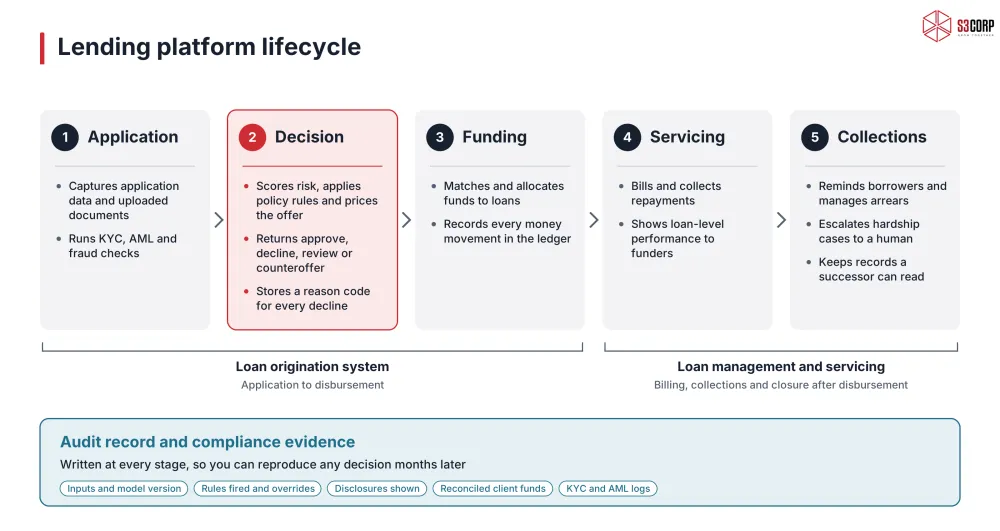
Lending platform development is the work of building software that runs a loan from application to repayment. The software handles identity checks, underwriting, funding, servicing and compliance reporting.
Your lending model decides who carries credit risk, how fast decisions must return and which rules your engine must meet. You choose between P2P, marketplace and BNPL models.
That choice carries more weight since 15 July 2026. On that date, the Financial Conduct Authority (FCA) began requiring UK lenders to run proportionate affordability checks on BNPL credit.
Each BNPL purchase now behaves like a regulated credit decision. Your software must prove that it made that decision correctly.
This guide helps you settle five questions before you sign a statement of work:
S3Corp has delivered software outsourcing work for 19+ years, across 400+ projects for 250+ clients in 25+ countries. This article applies that experience to the decisions you cannot afford to postpone when you start fintech software development for a lending product.
Choose by who funds the loan and how fast the decision must return. P2P platforms match individual investors to borrowers over hours or days. Marketplace platforms add institutional funders, and BNPL decides inside a checkout in seconds.
Each choice changes your funding ledger, your decision latency and your affordability rules. Settle it first, because every later design choice depends on it.
| Model | Who funds, who carries risk | What it changes in the build |
|---|---|---|
| P2P lending | Individual investors fund the loans and carry the credit risk. The platform earns fees. | Funding window, fractional-loan ledger, investor portal |
| Marketplace lending | Institutional funders, sometimes with retail investors, carry the risk unless the platform keeps a share. | Funder application programming interfaces (APIs), bulk allocation, concentration limits, loan-level reporting |
| BNPL | The provider or its funding partner carries the risk. | Checkout-speed decisions, per-purchase affordability checks, limit management |
Use three questions to narrow the choice:
Regulators use different labels for similar models. The World Bank places marketplace lending, P2P lending, loan-based crowdfunding, crowdlending and social lending on one spectrum of platform models. For your build, the funder mix matters more than the label.
Microfinance software usually serves small loans at high volume, so servicing and collections need early attention. Software as a service (SaaS) lending solutions suit teams that accept a vendor data model in exchange for speed.
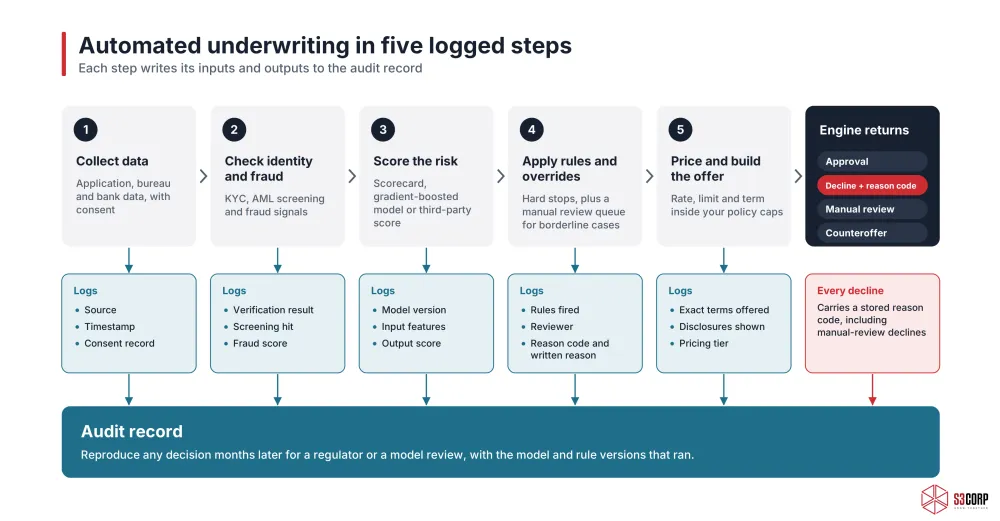
Automated underwriting turns an application into a decision through five steps:
Each step writes its inputs and outputs to an audit record. You can then reproduce any decision months later for a regulator or a model review.
An automated loan approval system runs these steps in order. It returns an approval, a decline, a manual review or a counteroffer. Build it as a service with versioned rules, because policy changes faster than the rest of your platform.
Start with the application fields and the documents the borrower uploads. Add a credit bureau pull and, with the borrower's consent, bank-transaction data through open banking connections.
Cash-flow data gives thin-file borrowers a fairer assessment and supports alternative data credit scoring. Log the source, timestamp and consent record for every data item.
Run know your customer (KYC) checks and anti-money laundering (AML) screening before you pay for a bureau pull. Add electronic KYC (eKYC) integration with artificial intelligence (AI) liveness detection.
This check confirms that a live person, not a photo or deepfake, stands behind the identity document. Obligations vary by entity type, licence and market, and biometric data needs a lawful basis and a retention policy.
Use KYC and AML solutions for identity and screening. Add AI fraud detection in finance for device, velocity and behavior signals that catch synthetic identities and bot applications. Log every verification result, screening hit and fraud score.
Keep the fraud model, its scores and its documentation separate from your credit-scoring model. If a fraud result declines an application, record it as a decline reason. Ask counsel whether it forms part of your creditworthiness assessment.
The model estimates the chance that the borrower repays. Choose a scorecard, a gradient-boosted model or a third-party score based on how well you can explain it.
Keep the model behind a versioned interface so you can swap it without a platform release. Promote each model and rule version through test environments with a development and operations (DevOps) pipeline, so every release stays auditable. Log the model version, input features and output score.
Rules handle hard stops such as sanctions hits, minimum age and maximum exposure. A manual review queue handles borderline cases.
A manual review ends in an approval or a decline, and every decline needs a reason. Give reviewers the same reason-code catalog that your model uses, so each decline carries a specific, stored reason.
Require a named reviewer and a written reason for every override. Log the rules that fired, the reviewer, the reason code and the written reason.
If you lend in the EU, add a human-intervention path. The revised Consumer Credit Directive (CCD2) lets a consumer ask for human intervention after an automated assessment. Build a request path that does five things:
Risk-based pricing sets the rate, limit and term inside your policy caps. Test pricing outputs for fairness before launch.
Store the exact terms and disclosures the borrower saw, along with the pricing tier.
Track three metrics: the straight-through processing rate, the override rate and reason-code coverage. The straight-through rate is the share of applications decided with no human touch. The override rate is the share of automated decisions that a human changes.
Reason-code coverage is the share of declines, automated and manual, that carry a stored specific reason. Aim for full coverage, and treat any gap as a defect.
A falling straight-through rate points to weak data or rules that are too strict. A rising override rate means your model no longer matches your policy.
If a regulator asks why you declined an applicant in March, your platform should answer in minutes, not weeks.
Use champion-challenger testing to compare a new model with the live one on a small share of traffic. Promote the challenger only when it wins on both accuracy and fairness.
Pick the scoring approach by how easily it can explain a decline, and design reason codes for every path to a decline. For covered credit decisions in the US, the Equal Credit Opportunity Act (ECOA) and Regulation B require an adverse action notice with specific principal reasons.
This duty covers every adverse action, whether a model or a human reviewer made the decision. Regulation B also lets a creditor tell the applicant about the right to request the reasons instead of stating them up front.
The statement-of-reasons rule sits in section 1002.9(b)(2) of Regulation B. Exceptions and notice content depend on the transaction type and the applicant, so confirm scope with counsel.
The Consumer Financial Protection Bureau (CFPB) once explained these duties in two circulars. Circular 2022-03 covered credit decisions based on complex algorithms, and Circular 2023-03 covered the proper use of its sample forms.
The CFPB withdrew both circulars on 12 May 2025, according to a Morgan Lewis guidance tracker. The tracker also lists the withdrawal of the 2024 BNPL interpretive rule. The underlying rule still applies, so design for it and confirm details with counsel.
| Approach | Explainability | Best fit |
|---|---|---|
| Logistic scorecard | High. Each variable maps to a clear reason. | First release, regulated lending, thin data |
| Gradient-boosted model with attribution layer | Medium. Attribution produces reason codes after validation. | Large data sets and mature risk teams |
| Rules-only policy engine | High. Each rule names its own decline reason. | Simple products, small loans, early pilots |
| Third-party or bureau score | Varies. The vendor must supply specific reasons. | Fast launch without your own data history |
| Manual underwriter review | Depends on the reviewer. Needs a shared reason-code catalog. | Edge cases, overrides and thin-file applicants |
Pick the release-one approach by your data and your governance maturity. Choose a logistic scorecard when data is thin or explainability comes first, and a rules-only engine for a simple pilot. Choose a gradient-boosted model only when your data, validation process and governance can support it.
Wrap any of them in a policy layer that holds your hard rules. This keeps your automated credit scoring easy to audit.
Use one reason-code catalog for models, rules and reviewers. A reviewer selects the code that matches the factors that drove the decision, and adds a note only to support it. Generate and store the code at decision time, beside the score.
Sample manual declines each month and compare the stored code with the file. Retrain reviewers when a code does not match the facts.
Adverse action can also cover some counteroffers and changes to existing credit, such as a limit cut. Confirm which events trigger a notice, and wire each one to the same catalog.
Explainable AI (XAI) methods attribute a score to each input feature. SHapley Additive exPlanations (SHAP) is a common method for gradient-boosted models.
Your team then maps the top attributions to plain-language reason codes. Attribution alone does not prove that a reason is accurate or legally adequate. Test that each reason code reflects the factors that drove the decision, keep the test evidence, and have legal review the mapping before launch.
Test outputs for disparate impact before launch and after every retrain. Document the test design, the results and any fixes.
Run model validation as a standing process, and monitor model drift so you catch decay before borrowers do. Store each test run with the model version it covered. A regulator can then trace any decision to a tested model.
AI belongs where a decision is repetitive, data-heavy and checkable. That covers reading documents, verifying identity, scoring risk, flagging fraud, setting limits and prices, prioritizing collections and answering borrower questions. Keep a human override and an explanation record on anything that approves, declines or prices a loan.
Mark each lifecycle step as AI-assisted, AI-decided or human-only. Then list the control each one needs. This is how fintech AI lending solutions stay inside the rules.
| AI use case | What it does | Control required |
|---|---|---|
| Document intake with optical character recognition (OCR) (AI-assisted) | Extracts fields from identity documents, payslips and bank statements | Confidence thresholds. Human review for low-confidence fields. |
| Identity and liveness (eKYC) (AI-assisted) | Matches the ID to the face and detects spoofed or synthetic media | Manual fallback. Biometric retention rules. |
| AI credit scoring software (AI-assisted, feeds policy rules) | Predicts repayment from bureau, cash-flow and consented data | Reason codes, validation, discrimination testing, drift monitoring |
| Fraud detection system (AI-assisted) | Flags device reuse, application velocity and bot-like behavior | Case queue, false-positive tracking, appeal path. Under the EU AI Act, fraud detection sits outside the creditworthiness high-risk category, so document it apart from scoring. |
| Limits and pricing (AI-decided inside policy caps) | Sets an offer for each applicant | Policy caps. Pricing-fairness testing. |
| Debt collection management (AI-assisted) | Segments overdue accounts and drafts reminders for message or voice | Contact-rule compliance, human escalation, hardship handling |
| Generative AI (GenAI) assistant (AI-assisted, no credit decisions) | Answers eligibility and repayment questions | Approved content only. No credit decisions. Conversation logging. |
Keep hardship cases, complaints and exceptions human-only, and record a reason code for every human decline.
Start with the controls you need on day one: auditable decision rules, access controls, reason codes and basic fraud monitoring.
Add advanced machine learning (ML) scoring models in a second release, once you have data to validate them. Wider GenAI use and automated collections can come later, with strict contact rules and human escalation.
Lead with bank-transaction, cash-flow and bill-payment data that the applicant consents to share. This data ties directly to repayment ability, so you can explain it in a reason code.
Treat social-media and app-behavior data as high risk because of fair-lending and privacy exposure. Do not present it as a selling point.
The EU AI Act treats AI that assesses the creditworthiness of individuals as high-risk, under Annex III. Regulation (EU) 2026/1744 moved the date for Annex III high-risk obligations to 2 December 2027, according to Bratby Law.
Annex III excludes AI systems used to detect financial fraud from that creditworthiness category. For EU borrowers, your fraud model and your scoring model can therefore carry different documentation and oversight duties.
The Commission published non-binding draft guidelines on 19 May 2026, and they read the exception narrowly, according to DLA Piper. Fraud detection must be the main purpose of the system, and the exception does not cover anti-money laundering checks.
A fraud score that feeds a credit decision may therefore fall back into the high-risk category.
Keep the two models separate in your architecture, your logs and your documentation. If you serve EU borrowers, build that documentation and your human-oversight controls now, and confirm scope and dates with counsel.
BNPL makes a credit decision at checkout, often for small, repeated purchases. Each transaction needs an affordability check that does not stall the sale. The UK requires proportionate affordability checks, the EU requires a creditworthiness assessment from 20 November 2026, and Singapore adds extra assessment above a set limit.
Plan for this early if you are scoping BNPL app development. Point-of-sale lending depends on checkout speed. Most shoppers reach the offer from a phone, so the decision flow must work inside a well-built mobile app and a mobile web checkout.
From 15 July 2026, the FCA regime for BNPL, which UK law calls deferred payment credit, applies to agreements within its scope. Lenders must run proportionate affordability checks, support customers in financial difficulty and give them access to the Financial Ombudsman Service.
The FCA also applies the Consumer Duty to in-scope BNPL from 15 July 2026. The Duty adds outcome monitoring and evidence of fair value and consumer understanding.
Your platform's data and reporting must support that evidence. Build reports on affordability results, arrears, support requests, complaints and the disclosures each customer saw, and keep them by product and customer group.
Eligible firms could register for a temporary permissions regime between 15 May and 1 July 2026. They then have six months to apply for full authorization. Merchants that provide their own credit remain exempt, so check whether your product falls in scope.
The FCA release reports that UK BNPL grew from £0.06 billion in 2017 to over £13 billion in 2024. That growth is the backdrop to the new rules.
In a February 2026 written reply to Parliament, the Monetary Authority of Singapore (MAS) said BNPL firms have committed to an industry code of conduct. The code is an industry standard, not a statute. A firm suspends a user's facility once a payment is overdue.
A firm also cannot grant a limit above S$2,000 (Singapore dollars) without extra credit assessment, including BNPL credit bureau checks. MAS added that BNPL stayed below 2% of card payment value in the first half of 2025.
CCD2, which is Directive (EU) 2023/2225, applies through national rules from 20 November 2026. The Directive text places BNPL schemes inside its scope. A narrow exemption covers a merchant's own interest-free deferral of up to 50 days, but only when no third party offers the credit.
CCD2 requires a creditworthiness assessment before each credit agreement. When the assessment uses automated processing, the consumer can request human intervention, which covers three rights:
Your decision engine needs both from that date: a per-agreement assessment record, and a path that routes each request to a human reviewer. Keep special-category data and social-network data out of the assessment, because the Directive's recitals say the information should not include them.
The CFPB withdrew its 2024 BNPL interpretive rule effective 12 May 2025. That withdrawal does not remove ECOA, Regulation B, other federal law or state law, which still apply by product structure.
New York is the concrete example to design against. Its Buy-Now-Pay-Later Act, signed on 9 May 2025, creates a state licensing regime for BNPL lenders, with fee limits and underwriting duties.
In multi-party programs, the rules can reach more than the entity that extends the credit, so check every participant, including partner banks and enabling platforms.
The New York State Department of Financial Services (NYDFS) published formal proposed rules on 15 July 2026. The regime takes effect 180 days after the rules are adopted.
The proposal gives you four design requirements:
Check the current rules in each state before launch, and confirm them with counsel.
| Market | Current rule | Engineering consequence |
|---|---|---|
| UK | FCA authorization or temporary permission for in-scope agreements. Proportionate affordability checks from 15 July 2026. Ombudsman access. | Per-transaction affordability check, stored evidence, complaint tracking, outcome-monitoring reports |
| Singapore | Industry code of conduct that firms follow. Extra credit assessment above S$2,000. Overdue lock. | Cross-provider bureau lookup, limit tiers, overdue lock |
| EU | Directive (EU) 2023/2225 (CCD2) applies from 20 November 2026 and brings most BNPL into scope. Creditworthiness assessment before each agreement. Human intervention on request after automated assessment. | Per-agreement assessment record, human-review request path, review queue, audit trail |
| US | CFPB withdrew its 2024 BNPL interpretive rule in May 2025. ECOA, other federal law and state rules still apply by product. New York proposes licensing, fee caps and income-and-debt underwriting. | Reason-code design, licence status and fee limits configured by state, income and debt assessment stored per loan |
The flow below is an illustrative design, not a client case study. Use it to set your own latency budget with your product team.
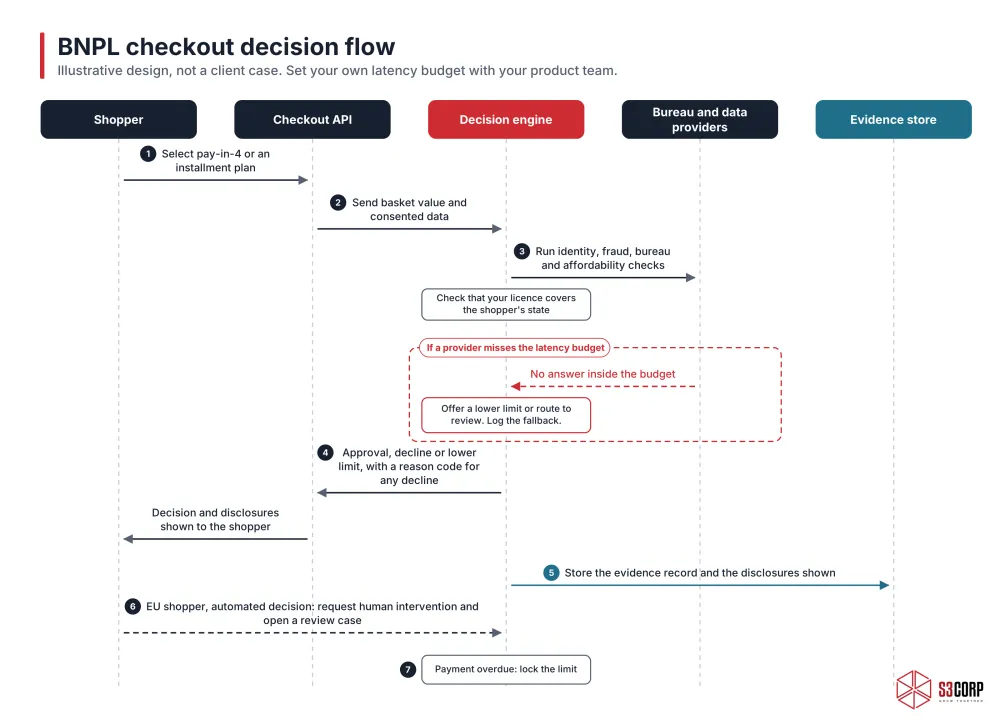
If a bureau does not answer inside your latency budget, offer a lower limit or route the case to review. Log the fallback so you can explain it later.
Also track repeat-purchase exposure. Small tickets add up fast when one shopper buys often, so limit management matters as much as the first decision.
Build the parts that define your lending model, such as the decision engine and ledger. Buy commodity parts like identity verification and payment rails. A partner team can build the core parts if your in-house capacity, credit-model intellectual property (IP) needs and launch date point that way.
A strategic approach to the build vs buy decision starts with four questions:
| Route | Fits when | Trade-off |
|---|---|---|
| In-house build | You hold engineering capacity and want full control | Slowest start and a heavy hiring load |
| Licensed platform | Products are standard and the launch date is close | Vendor lock-in, less control over decision logic and limited data export |
| Partner-led build | You need custom core logic without a large internal team | Needs clear IP terms and shared governance |
This illustrative scenario is not a client case. A US marketplace lender plans a launch with a bank partner and has three in-house engineers. The lender keeps product and risk policy in-house, assigns the decision engine and ledger to a dedicated team, and buys identity verification. The lender hires later, once the platform runs.
Outsourcing does not move your regulatory duty. The World Bank page cited earlier describes rules under which operators stay legally responsible for outsourced functions. Write IP ownership, data portability and audit rights into every contract.
Ask four questions before you shortlist a lending software development company:
S3Corp builds security and IP protection into its delivery process and backs it with ISO/IEC 27001 certification. That protects credit-model IP and borrower data.
The team works from Ho Chi Minh City, with 250+ engineers and clients in Australia, Singapore and the US. Vietnam offers a strong cost-to-quality ratio, a young developer talent pool and a time zone one hour behind Singapore. That mix explains why many lenders choose to outsource to Vietnam.
A lending build follows the governance of other software outsourcing services, and fintech development outsourcing adds extra care for IP and audit rights. Agree a daily overlap window and two-week sprints with a shared definition of done for each module.
Choose a model from the collaboration models that lets you scale a dedicated team up or down as scope changes.
If you already know your model and markets, we will map your decision engine, ledger and build route with you.
A first release usually needs the nine modules marked in Table 6, including a security and resilience layer. The exact list depends on your lending model, market and licence. Auto-invest and multi-currency can follow in a second release, and secondary trading and white-label can wait until later.
Loan origination system development covers the path from application to disbursement. A loan management system and loan servicing software cover billing, collections and closure after disbursement. Together they form the core of your digital lending platform software.
| Module | What it does | Release |
|---|---|---|
| Onboarding and KYC/AML | Verifies identity and screens sanctions | First release |
| Application and documents | Captures data and reads uploaded files | First release |
| Decision engine | Scores, applies rules and prices. Holds reason codes, assessment records and the human-review path. | First release |
| Funding and matching | Allocates funds to loans | First release |
| Ledger and segregated funds | Records every money movement | First release |
| Servicing and collections | Bills, reminds and manages arrears | First release |
| Funder view and reporting | Shows loan-level performance | First release |
| Admin and audit | Manages users, overrides, logs and consumer-outcome reports | First release |
| Security and resilience | Enforces access control, encryption, monitoring, backup and restore tests | First release |
| Auto-invest and multi-currency | Adds investor convenience and new markets | Second release |
| Secondary trading and white-label | Adds a resale market and partner branding | Later |
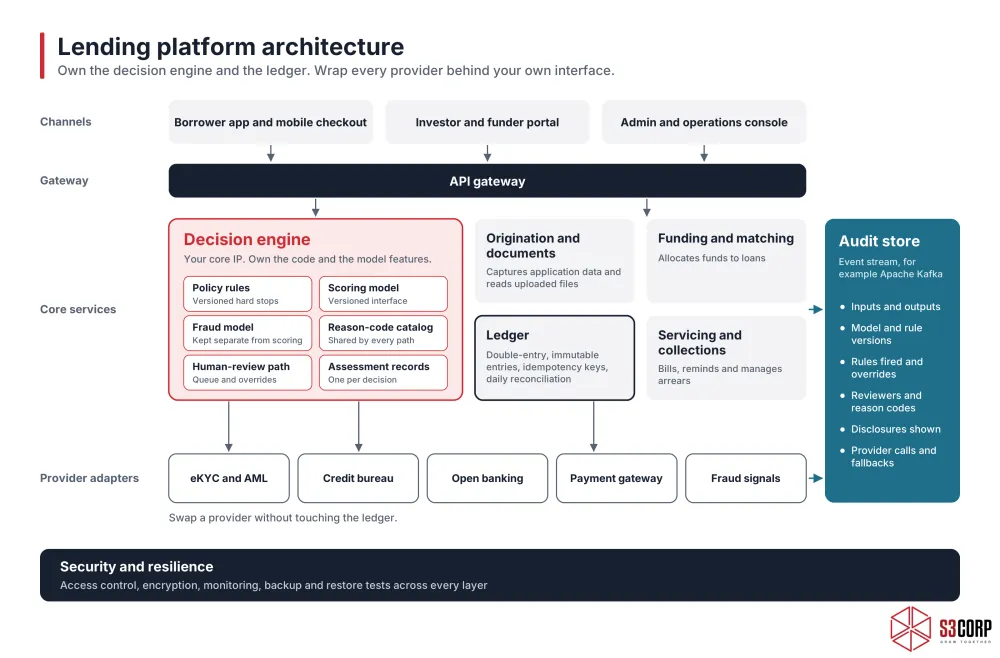 Scope release one as a minimum viable product (MVP). Cut features before you cut controls, because audit logs and reason codes belong in release one.
Pick components your team can hire for and maintain. The list below shows common choices, not a fixed recipe.
This scalable architecture lets you add a funder, a bureau or a market without rebuilding the ledger.
Do not assume any listed tool is the latest release. Before you lock the stack, verify supported versions, security patch policy and end-of-support dates for each component.
Then set these operating controls for release one:
If your platform includes a mobile app, test it against the Open Worldwide Application Security Project (OWASP) Mobile Application Security Verification Standard (MASVS). Its controls cover storage, cryptography, authentication, network, platform, code, resilience and privacy, and you scope tests by risk.
Use double-entry bookkeeping in the ledger and make entries immutable. Add idempotency keys to every payment call, so a retry never posts twice. Reconcile daily against bank statements.
Regulators also care where client money sits. According to the World Bank page cited earlier, regulators in India and Indonesia require escrow or virtual accounts for investor and borrower funds.
Your fund-holding model decides whether your market requires separate accounts, escrow or safeguarding. Confirm it early and design for segregated accounts as the safe default.
For payment gateway API integration, wrap each provider behind your own interface. You can then swap a provider without touching the ledger.
If you accept cards, the Payment Card Industry Data Security Standard (PCI DSS) scope follows your card data flow and your role in it. A payment provider can shrink that scope but does not remove every duty.
Keeping card data out of your systems reduces PCI DSS compliance work. Confirm the current PCI DSS version with the PCI Security Standards Council.
Errors in the ledger or decision engine cost real money, so build fintech testing and QA into every sprint.
Regulators ask for evidence, not intentions. Your platform must generate that evidence automatically. Expect to produce decline reasons, decision audit trails, versioned disclosures, reconciled client funds, KYC and AML records and a documented wind-down plan.
Copy this checklist into your requirements document:
The wind-down item matters more than it looks. The World Bank page cited earlier reports that the FCA requires arrangements so peer-to-peer loans keep being administered if a platform stops operating. It also describes a "P2P resolution manual" that helps wind down a failed platform.
Store loan and investor records so a successor can read them. Automate evidence capture with regulatory technology (RegTech) compliance automation, so your team does not rebuild evidence by hand.
Build a duty matrix by country, product, data type and legal role. Run a privacy impact assessment before you add new data uses such as biometrics or alternative data. Keep model governance records and bias-test files for each model version.
Four shifts matter over the next 12 to 18 months. The first has a fixed date, and the others are our expectations, not guarantees.
Six drivers explain most of the difference between quotes. They are the number of loan products, decisioning depth, funding and ledger model, integrations, jurisdictions served and investor features. Settle these before you request estimates, because each one changes build effort and the licensing work that runs alongside it.
| Driver | Why it moves scope | Decide first |
|---|---|---|
| Loan products | Each product adds rules, schedules and disclosures | Launch products and later products |
| Decisioning depth | Rules, scorecards and machine learning need different testing | Scoring approach for release one |
| Funding and ledger model | P2P, marketplace and BNPL need different ledgers | Funder mix and fund-holding structure |
| Integrations | Each bureau, eKYC and payment vendor adds work | Vendors per market |
| Jurisdictions | Each market adds disclosures, licensing and human-review duties | Launch markets and order, with US states by licence |
| Investor features | Dashboards and auto-invest add scope | What waits for a later release |
Vendor fees per verification and compliance updates add to the cost after launch. Optimizing cost and performance means choosing where to spend, so decide which parts you own and which you buy.
Turn these drivers into a scoping brief using a software development request for proposal (RFP) structure. Then compare estimates against the same scope. Once scope is fixed, a fintech app development cost estimate becomes easy to check line by line.
Lending platform development is the design and engineering of software that runs a loan from application to repayment. It covers onboarding, underwriting, funding, servicing and compliance reporting. Platforms follow P2P, marketplace or BNPL models, which differ in funder, decision speed and affordability rules.
The terms overlap. The World Bank describes marketplace lending, P2P lending, loan-based crowdfunding and crowdlending as one spectrum of platform models. For your build, the funder mix is the useful distinction, because it sets your ledger, reporting and investor-protection needs.
Yes, but US law still requires specific and accurate reasons for an adverse decision. ECOA and Regulation B apply even when a complex model decides, although the CFPB withdrew Circulars 2022-03 and 2023-03 on 12 May 2025. Choose models whose outputs convert to reason codes.
Yes, in the US every adverse action needs specific reasons or notice of the right to request them. This holds whether a model or a person decided. Use one reason-code catalog for models and reviewers, store the code with each decision, and sample manual declines to check it.
UK lenders with in-scope agreements need FCA authorization or temporary permission and proportionate affordability checks from 15 July 2026. EU national rules under CCD2 add creditworthiness assessments and human intervention from 20 November 2026. Singapore sets extra assessment above S$2,000, and New York will require a BNPL licence once its rules take effect.
Timelines depend on loan products, integrations and jurisdictions. Licensing and compliance review run in parallel and often set the real launch date. Ask each partner to state licensing assumptions and release scope in writing, and treat any quote that omits them as incomplete.
Cost depends on six drivers: loan products, decisioning depth, funding and ledger model, integrations, jurisdictions and investor features. Quotes differ because scope differs. Write one scoping brief, send it to every partner and compare all estimates against that same scope.
AI supports a lending platform at seven points: documents, identity and liveness, credit scoring, fraud, limits and pricing, collections and borrower questions. Each use needs controls. Add explainable decline reasons, tests for discriminatory outcomes and a human override path for decisions that affect a borrower.
Pick the model first. Then fix decision latency, reason-code design for model and manual declines, and funding structure around it.
Define the compliance evidence your platform must produce in each market before you scope modules. With those decisions on paper, estimates from any partner become comparable.
S3Corp brings 19+ years of delivery experience, overseas engineering talent in Ho Chi Minh City and customized solutions to fintech projects.
Recent work leans into AI-driven engineering. Innovative solutions in lending still start with sound basics: a clear model, an explainable decision and a ledger you can audit. S3Corp documents delivery work across industries in its case studies.
Request a lending platform scoping call.
Bring your target loan product, markets, funding model and decisioning inputs. Our team will walk through your build route with you.