Whether you have any questions, or wish to get a quote for your project, or require further information about what we can offer you, please do not hesitate to contact us.
Contact us Need a reliable software development partner?
S3Corp. offers comprehensive software development outsourcing services ranging from software development to software verification and maintenance for a wide variety of industries and technologies


Software Development Center






Insights
Table Of Content
Key Takeaways
Incumbent Bank vs. Fintech: How Your Starting Point Changes the Build?
What Core Features Does Every Mobile Banking App Need?
Which Features Should Be in the MVP and Which Can Wait?
What Architecture Should Sit Behind a Mobile Banking App?
How Should the App Handle Security, Authentication and Transaction Integrity?
How Do You Keep Banking Transactions Reliable When the Network Fails?
What Advanced and Differentiating Features Are Worth Considering?
What Does Core Banking Integration Actually Involve?
How Should You Choose Your Tech Stack?
Native vs. Cross-Platform: Which Mobile Technology Approach Fits Banking?
What Does the Compliance and Certification Roadmap Look Like?
What Is the Required Security Architecture for Mobile Banking Apps?
How Much Does Mobile Banking App Development Cost?
What Does the Mobile Banking Development Process Look Like From Discovery to Launch?
How Do You Test a Mobile Banking App Before Release?
What Should Banks and Fintechs Look for in a Mobile Banking Development Partner?
Mobile Banking App Development: Key Takeaways and Next Step
Frequently Asked Questions
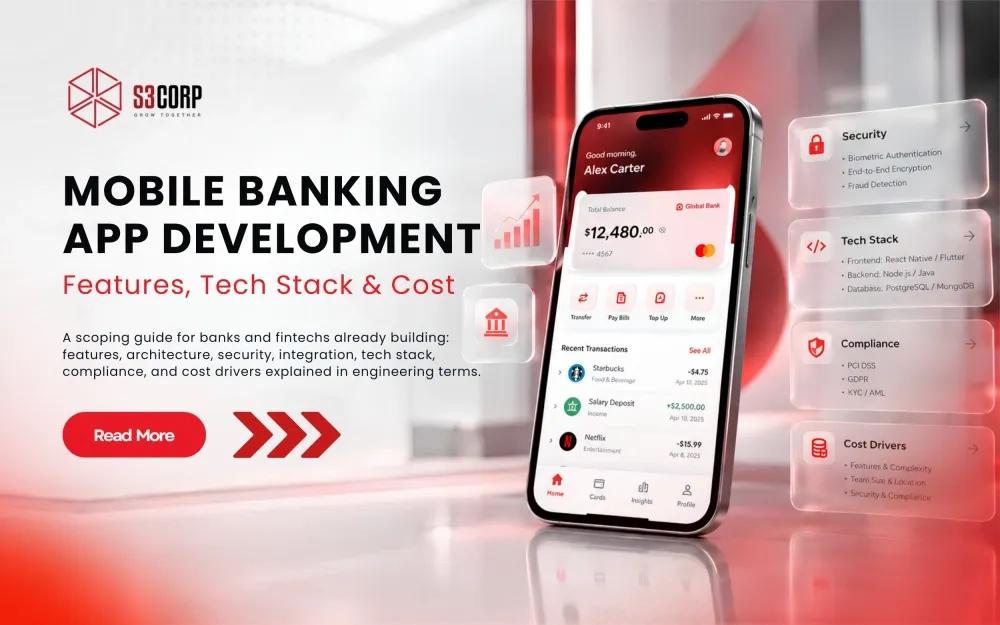
A scoping guide for banks and fintechs already building: features, architecture, security, integration, tech stack, compliance, and cost drivers explained in engineering terms.
09 Sep 2026
Building a mobile banking app in 2026 comes down to three linked decisions. You need to know which features are foundational versus which ones can wait.
You also need to decide how deep your core banking integration has to go, and which compliance certifications gate your launch date. The path, and the price, differ sharply depending on whether you are modernizing an incumbent bank channel or building fintech-native from scratch.
Mobile banking app development is the engineering of a secure mobile channel that connects customers to accounts, payments, identity, and cards, the same engineering fundamentals covered in the general mobile app development guide, applied under banking-grade constraints. For a production banking product, the hard part is never the mobile UI.
It is integrating the app with identity, core banking, payments, fraud, and compliance systems while keeping every transaction secure, reliable, and auditable. Mobile banking overtook every other account-access channel years ago.
Nearly half of banked US households, 48.3%, now use mobile banking as their primary way to access accounts, a share that has grown almost ninefold in a decade, according to the 2023 FDIC National Survey of Unbanked and Underbanked Households. Your mobile app is no longer a channel extension; for most customers, it is the bank.
This guide helps you decide five things: which features to build first, how to structure the architecture, what security and compliance actually require, which tech stack fits a banking risk profile, and what drives cost up or down.
A mobile banking app for an incumbent bank and one for a fintech share a feature list but almost nothing else underneath it. One extends a legacy core banking system that already carries audit, compliance, and channel-parity obligations.
The other can build mobile-first against a banking-as-a-service (BaaS) layer, with a lighter and faster path to launch.
Knowing which profile fits your organization changes where you should focus your reading in the rest of this guide. If you are modernizing an existing bank, weight the integration and architecture sections more heavily. If you are building fintech-native, weight the compliance and licensing section more heavily.
|
Decision Point |
Incumbent Bank |
Fintech / Neobank |
|
Core system to integrate against |
Legacy core banking platform (often decades old) plus existing middleware |
Modern core or banking-as-a-service layer, sometimes no legacy core at all |
|
Compliance/licensing path |
Existing bank charter; must maintain channel parity with branch and web |
Sponsor-bank partnership or direct licensing; path varies by product and jurisdiction |
|
Timeline pressure |
Slower: integration and change management dominate the schedule |
Faster but compressed timelines raise security and compliance risk |
|
Internal approval friction |
Heavy: multiple risk, compliance, and IT governance layers |
Lighter: smaller organization, fewer sign-off layers |
|
Typical team composition |
Mixed team: legacy integration specialists plus mobile engineers |
Mobile and backend engineers with strong API and BaaS integration skills |
If your organization sits between these two (a digital-first arm of an incumbent bank, for example), expect a blend: fintech-speed product decisions constrained by incumbent-grade compliance obligations. That combination is common, and it is exactly where scoping mistakes happen most often.
Every mobile banking app needs the same foundational layer, regardless of who builds it. The core product supports identity and onboarding, account and card management, payments, transaction history, alerts, customer service, and baseline security controls. The exact feature set inside each of those categories shifts depending on whether you serve retail customers, businesses, or a digital-first fintech base.
For a first production release, prioritize the flows customers use to access and move money safely. That means onboarding and authentication, account visibility, transaction history, transfers or payments, notifications, support, and the controls that protect those actions. Advanced analytics, rewards, conversational AI, and broader financial products can follow once the core journey holds up under real usage.
A useful way to sequence scope:
Security, auditability, transaction reliability, and observability belong in the MVP even though customers never see them directly. A feature set with fewer screens is not automatically an MVP if it skips these controls. Cutting them to hit a launch date usually means rebuilding them under pressure later, which costs more than building them correctly the first time.
A feature-priority matrix makes the MVP-versus-later split concrete before you brief a delivery team:
|
Capability |
MVP or Later Phase |
Why It Matters |
|
Onboarding, KYC, authentication |
MVP |
Blocks account creation; also a compliance gate |
|
Account balance and transaction history |
MVP |
Core value proposition; customers check this daily |
|
Transfers and payments |
MVP |
Primary reason customers open the app |
|
Push notifications for security events |
MVP |
Fraud and account-takeover protection depend on it |
|
Personal finance/budgeting tools |
Later phase |
Improves retention but is not required to launch safely |
|
Robo-advisory or wealth tools |
Later phase |
High value for incumbent banks with investment arms, but adds real scope |
|
Gamification and rewards |
Later phase |
Engagement driver, not a core banking function |
Treat a banking app as a client inside a larger financial system, not as the banking system itself. The mobile layer communicates through secured APIs and services that connect identity, customer data, account information, payments, cards, fraud controls, notifications, and the core banking environment.
A request generally moves through the following path:
This is not one universal blueprint. The exact architecture depends on the existing core, the middleware already in place, the identity model, the payment rails, and the regulatory environment your organization operates under. A neobank building against a real-time payments architecture and a modern core will draw this diagram very differently than a 20-year incumbent extending a mainframe-based ledger.
Where the design touches open banking or third-party data sharing, align the API layer with the Financial-grade API (FAPI) security profile published by the OpenID Foundation, not a generic "best practice" description. FAPI defines the exact consent flow, token binding, and mutual-TLS requirements for financial-grade authorization, which is the specification engineering teams need to implement, not a vague reference to industry patterns.
Reinventing consent and token models instead of building to the FAPI specification is where avoidable security gaps show up, especially on the authorization flows that connect to open banking partners.
Mobile banking security has to protect the account and the transaction as two separate problems. Authentication establishes who the user is, while device and session controls reduce account-takeover risk.
Transaction authorization protects high-risk actions specifically. Encryption protects data at rest and in transit.
Audit trails make sensitive activity traceable after the fact. This same discipline extends past banking. See how S3Corp approaches security-sensitive builds more broadly on the data security domain page.
Group the engineering requirements by domain rather than treating "security" as one flat checklist:
Identity
Device
Data
Transaction
Backend and Operations
Use the OWASP Mobile Application Security Verification Standard as the baseline reference for mobile-specific controls rather than a generic web security checklist: mobile apps have failure modes (local storage, reverse engineering, insecure inter-process communication) that web-focused standards do not cover well. A dedicated penetration testing and QA process should validate these controls before every major release, not just at launch.
A banking app cannot treat poor connectivity the way a normal consumer app does. A retry must never accidentally create a second payment.
A stale screen must never suggest that a transaction succeeded when it did not. The customer needs a clear state for pending, completed, failed, or reversed activity at every moment, not just after a successful round trip.
The failure modes below are specific to money movement, and each one needs an explicit engineering answer:
|
Failure Scenario |
What Should Happen |
Engineering Control |
|
Request times out after submission |
App shows a pending state, not a failure or success |
Client polls or receives a push update on true backend state |
|
Network fails on app launch |
Last-known balance displays instead of a blank or broken screen |
Securely cached balance shown with a clear "offline as of [time]" timestamp |
|
App closes during transfer |
Reopening shows accurate status, not a blank retry option |
Backend remains the single source of truth for transaction state |
|
Network reconnects and retries |
Retry does not create a duplicate transaction |
Idempotency key attached to the original request |
|
Backend responds slowly |
Customer sees a clear waiting state, not an error |
Timeout thresholds tuned separately from UI loading states |
|
Payment accepted but confirmation delayed |
Customer is told the payment is processing, not failed |
Asynchronous status updates via notification or refresh |
|
Transaction is reversed |
Customer sees the reversal and reason clearly |
Reconciliation process ties client state back to ledger truth |
The engineering pattern behind all six rows is the same: attach an idempotency key to every transaction-initiating request, treat the backend ledger as the only authoritative source of transaction state, and build reconciliation as a first-class process rather than a manual cleanup task.
The launch-failure row needs a different pattern: a read-only cache. Store the last confirmed balance locally, encrypted at rest, and label it with a timestamp the moment the network drops. That single design choice stops a network failure from turning into a blank screen the customer reads as "my bank lost my money." Do not prescribe one implementation pattern for every banking stack here: the right pattern depends on whether your core banking system supports synchronous confirmation or works asynchronously by design.
Beyond the baseline, a handful of features meaningfully move retention and engagement: AI-driven personalization, embedded finance, and fraud detection lead the list. Each adds real engineering scope, so the right subset depends on where you sit in the incumbent-versus-fintech split covered earlier.
Rank two or three of these against your own roadmap instead of treating the list as a backlog to build in full. Feature creep is the most common way a well-scoped MVP turns into a project that never ships.
The mobile client is only one part of the banking product. Integration complexity often determines the real development effort, because every external or internal system introduces authentication, data mapping, failure handling, monitoring, testing, and operational ownership that someone has to build and maintain.
In practice, integration follows one of two patterns.
Direct integration connects the app straight to a core banking system such as Temenos, FIS, Finastra, or Mambu. This path suits incumbent banks that already run one of these platforms and need channel parity with existing branch and web systems. Expect more integration work up front: data mapping, authentication against internal systems, and testing against a system that was not designed with mobile-first access in mind. You are likely here if your organization already operates a licensed core banking system with existing compliance and audit machinery in place.
A middleware or banking-as-a-service layer, such as Galileo, Marqeta, or Synctera, abstracts the core banking system away entirely. The BaaS provider handles ledger, card issuing, and much of the regulatory groundwork, letting the mobile team build against a modern API instead of a legacy interface.
This does not remove the bank charter from the picture; it moves it behind the API. A licensed sponsor bank still holds that charter, which means the fintech inherits an ongoing compliance-reporting relationship, not a one-time integration task.
Treat sponsor-bank oversight as a live operational dependency. The sponsor can tighten reporting requirements or audit the program well after launch, and either event can affect the roadmap the fintech has to work through.
This path suits fintechs and neobanks building mobile-first without an existing core to protect. You are likely here if you are launching a new financial product without a legacy system holding it back.
Which pattern applies changes your timeline by months, not weeks, so identify it before anyone estimates the project. Beyond the core system itself, map every integration surface separately:
The engineering bench at S3Corp extends past standard web and mobile work into this kind of integration-heavy delivery, spanning mobile, backend, and third-party financial infrastructure: the discipline this section of the build requires.
A banking tech stack should be selected as a system, not as a list of trending tools. The mobile framework, backend services, API layer, database, cloud infrastructure, observability tooling, security tooling, and integration strategy all need to work together under the reliability and compliance requirements a bank has to meet.
Platform choice comes down to one real trade-off for banking apps specifically. Native iOS/Android development gives full access to secure-enclave and biometric APIs with the least friction. Flutter or React Native cut build time meaningfully, at the cost of some of that native security-API depth.
|
Layer |
Best For |
Banking-Specific Note |
|
Native iOS/Android |
Apps where biometrics, secure enclave access, or platform-specific security APIs are central |
Fewest workarounds for secure hardware access; two codebases to maintain |
|
Cross-platform (Flutter/React Native) |
Faster time to market, smaller teams, feature-heavy apps with less native-security dependency |
Native bridge modules often still required for secure enclave and biometric depth |
|
Backend |
Domain services, business logic, integration orchestration |
Language choice (Java, .NET, Node.js) matters less than team depth and existing bank standards |
|
Cloud/Infra |
Elastic scaling, managed security tooling, compliance-ready regions |
Data residency and regional compliance requirements often narrow provider choice |
Layer-by-layer, the stack generally breaks down as: mobile client, API/edge layer, backend domain services, data layer, integration layer, cloud infrastructure, security tooling, QA/observability, and, increasingly, an AI/personalization layer. For a broader view of how platform choice plays out beyond banking, see the mobile app development platform comparison.
Do not claim any single stack is "most secure" without evidence. The security outcome depends far more on how the stack is implemented and tested than on which framework logo appears on the architecture diagram.
There is no universal winner between native and cross-platform development for banking. The decision should follow the security model, device capabilities needed, performance requirements, existing engineering skills, release strategy, and the complexity of native integrations, not a generic claim that one approach is always faster or cheaper.
|
Factor |
Native (Swift/Kotlin) |
Cross-Platform (Flutter/React Native) |
|
Performance-sensitive flows |
Best fit |
Usually adequate, occasional bridge overhead |
|
Native device/security APIs |
Direct access |
Requires native modules for full depth |
|
Code sharing |
None between platforms |
High - one codebase for both platforms |
|
Team skills required |
Separate iOS and Android expertise |
Single team can cover both platforms |
|
Release cadence |
Independent per platform |
Synchronized releases, faster iteration |
|
Long-term maintenance |
Two codebases to evolve |
One codebase, but framework-version risk |
Avoid defaulting to outdated recommendations here. Java is no longer the default choice for Android development, and framework maturity shifts year over year.
Verify current framework status and long-term support commitments when you make this decision, rather than relying on older guidance, including the guidance in this article. For a deeper comparison across all three approaches, see native vs. hybrid vs. cross-platform mobile app development.
A mobile banking app does not clear one compliance bar. It clears several, and they do not all block launch the same way. PCI DSS is typically non-negotiable before processing card data.
SOC 2 is often expected by enterprise partners rather than legally mandated. Regional banking-regulator requirements vary sharply between operating as a licensed bank versus operating as a technology partner to one.
|
Standard |
What It Covers |
Blocks Launch or Can Follow |
|
Protection of cardholder data across storage, processing, and transmission |
Blocks launch for any app handling card data |
|
|
SOC 2 |
Security, availability, and confidentiality controls at the vendor/organization level |
Often expected by partners; not always a legal launch blocker |
|
Regional banking regulator (varies by market) |
Licensing, consumer protection, and operational requirements specific to the jurisdiction |
Blocks launch - requirements vary sharply between incumbent banks and licensed fintechs |
|
Identity verification and anti-money-laundering monitoring |
Blocks launch - required before onboarding real customers |
Refer to the primary standards bodies directly rather than a secondary summary: the PCI Security Standards Council publishes PCI DSS itself, and the AICPA System and Organization Controls framework governs SOC 2 reporting.
Security certification at the vendor level belongs in this conversation too. With an ISO 27001-certified delivery process (one criterion inside the security-audit expectations most banking partners already apply to vendors), S3Corp treats certification as an ongoing practice rather than a one-time badge, verified through independent third-party audits rather than self-assessment.
Compliance sets the floor. Security architecture is what protects the app day to day. Biometric authentication, end-to-end encryption, device attestation, and real-time fraud detection form the four layers every launch-ready banking app needs, built in roughly that priority order.
Build these in this order because each layer depends on the one before it: authentication without device attestation is easier to spoof, and fraud detection without encrypted, trustworthy data inputs produces unreliable signals.
Cost is driven less by the number of screens than by the systems and controls behind those screens. Core banking integrations, identity and KYC, payment flows, security testing, fraud controls, transaction reliability, and compliance requirements all move engineering effort in ways a screen count never captures.
The banking-specific line items that sit on top of a general mobile app cost baseline include:
There is no reliable general figure for a banking-specific build, because integration and compliance scope vary too widely between projects to publish one honestly. For the general 2026 mobile app cost framework, including complexity tiers, regional cost bands, and AI-feature pricing, see the full mobile app development cost breakdown, then request a banking-specific scope estimate that accounts for the drivers above.
A strong banking app project starts with system and risk discovery before any UI work begins. The team needs to map users, banking workflows, integrations, regulatory constraints, security requirements, transaction states, and operational ownership before turning those findings into architecture and an implementation plan.
Testing runs throughout development, never only at the end. Skipping this is the single most common gap between banking projects that ship on schedule and ones that do not.
Full-lifecycle development, QA and testing, maintenance, and DevOps capability need to sit inside the same delivery team, rather than being handed off between disconnected vendors at each stage.
Banking QA needs to validate more than whether each screen works correctly. Test coverage should prove that sensitive transactions behave correctly across devices, network conditions, permissions, authentication states, backend failures, performance peaks, and active security attack scenarios.
Build a release-readiness checklist across these categories:
Ask a delivery partner for evidence at each of these stages, not a summary claim that "testing was done." Automated regression coverage plus scheduled independent penetration testing (see fintech testing and QA) should both exist before any production release involving real customer funds.
Evaluate a development partner on banking-relevant engineering evidence, not a polished portfolio alone. Ask how the team handles security, sensitive-data access, integration ownership, QA, incident response, code ownership, documentation, release management, and knowledge transfer.
Ask to review relevant case studies covering integration-heavy or regulated-industry delivery, not screenshots of finished screens. That evidence tells you more about how a team handles a banking build than a portfolio does.
A weighted vendor due-diligence scorecard:
|
Criterion |
What to Ask |
|
Relevant domain evidence |
Has the team shipped banking, payments, or regulated fintech work before? |
|
Security certification/process |
Is there an active, independently audited certification (ISO 27001, SOC 2)? |
|
Architecture capability |
Can they explain the system boundaries described earlier in this guide, specifically? |
|
Integration experience |
Have they connected to a core banking system or BaaS provider before? |
|
QA and automation |
Is testing continuous, or only a pre-launch gate? |
|
DevOps/release capability |
Can they support staged rollouts and rapid incident response? |
|
Code/IP ownership |
Who owns the code, documentation, and IP after the engagement ends? |
|
Documentation/knowledge transfer |
Is there a clear handover plan if the relationship changes? |
|
Team continuity |
Will the same engineers stay on the project through launch? |
|
Commercial transparency |
Are estimates broken down by the cost drivers covered above, or given as one flat number? |
With 19+ years of delivery experience and engineering teams working across multiple time zones with global clients, S3Corp brings the kind of integration-heavy, compliance-aware delivery experience this checklist is built to surface. See the fintech industry practice for the wider financial-services work this sits inside. Review the collaboration models available to see how engagement structure fits your internal governance requirements.
A successful mobile banking app is not simply a secure set of screens. It is a reliable financial channel connecting customers to identity, accounts, payments, risk controls, and core systems. The decisions that matter most are the ones that shape architecture, transaction integrity, security, integrations, MVP scope, and long-term maintainability, not the ones about button color.
Before you brief a delivery team, resolve three things:
Talk to the application development team at S3Corp about scoping your core banking integration, architecture, and security requirements before you finalize a build plan. Contact the team for a technical scoping conversation, or review full-lifecycle application development services to see how discovery, build, and post-launch support connect end to end.
Start with threat modeling and security requirements before writing implementation code. Combine strong authentication, device and session controls, encryption, secure API design, transaction authorization, fraud controls, audit logging, and continuous security testing across the mobile client, backend, integrations, and infrastructure.
Define the banking workflows and target users, map existing systems and integrations, set security and compliance requirements, design the architecture and UX, prioritize an MVP, build the mobile and backend components, test continuously, and launch through a controlled rollout. Monitoring and maintenance continue after launch as part of the same lifecycle.
There is no reliable single price, because banking projects vary significantly in integration and security scope. Core banking connectivity, payment and card integrations, KYC, fraud controls, security testing, supported markets, and platform choice all move the budget. Use a general mobile app cost guide as a starting point, then request a banking-specific scope estimate.
Useful tools span the full lifecycle: mobile IDEs and frameworks, API testing tools, automated QA, security testing tools, CI/CD pipelines, observability platforms, infrastructure management, and incident monitoring. Tool choice should follow your architecture and banking environment, not come before it.
Timeline depends almost entirely on integration pattern and compliance scope. A BaaS-based fintech MVP can realistically launch faster than a direct core-banking integration for an incumbent bank, where legacy system dependencies and internal approval cycles extend the schedule by months. Treat any fixed timeline quoted before scoping is complete with caution.