Whether you have any questions, or wish to get a quote for your project, or require further information about what we can offer you, please do not hesitate to contact us.
Contact us Need a reliable software development partner?
S3Corp. offers comprehensive software development outsourcing services ranging from software development to software verification and maintenance for a wide variety of industries and technologies





Software Development Center
_1746790956049.webp&w=384&q=75)
_1746790970871.webp&w=384&q=75)



Insights
Table Of Content
TL;DR — Outsourced Product Development in 2026
What Is Outsourced Product Development, and When Should You Use It?
Should You Outsource Product Development or Build In-House?
How Much Does Outsourced Product Development Cost in 2026?
Which Outsourcing Model Fits Your Product Strategy?
What Are the Risks of Outsourcing, and How Do You Mitigate Them?
How Do You Choose the Right Outsourced Product Development Company?
Which Countries Are Best for Outsourced Product Development?
What Does the Outsourced Product Development Process Look Like?
What Business Impact Does Outsourcing Deliver?
Why Do Companies Choose S3Corp for Outsourced Product Development?
Conclusion
FAQs About Outsourced Product Development
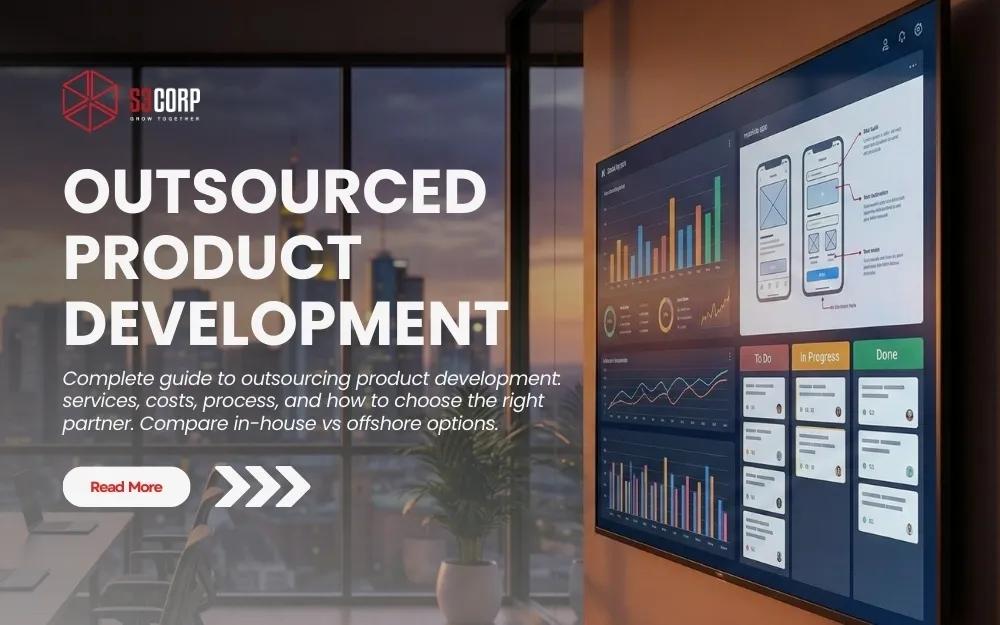
A complete 2026 guide to outsourced product development — covering real costs, engagement models, vendor selection criteria, and risk mitigation strategies for CTOs and product leaders.
25 Oct 2023
Outsourced product development means hiring an external team to design, build, and scale your software product. It is the right move when internal hiring takes longer than three months, your MVP timeline is tight, or your engineering budget cannot support local salaries.
Cost: Expect $40,000–$120,000 for an MVP, $150,000–$400,000 for a SaaS platform, and $400,000–$700,000+ for enterprise systems. Vietnam-based teams offer rates 40–70% lower than US equivalents at comparable quality.
Best model:
Top risks are communication gaps, inconsistent quality, and IP exposure — all manageable with structured contracts, async-first processes, and a partner who has done it before.
How to pick the right vendor: Look for technical depth you can verify in a live conversation, a team that pushes back on bad specs (product mindset), and a track record of stable, long-term client relationships. Run a paid pilot before committing to a full engagement.
Best regions in 2026: Vietnam for cost-quality balance, Eastern Europe for EU nearshore, India for high volume and speed.
Outsourcing done right reduces time-to-market by 30–40%, extends your financial runway, and frees your internal leadership to focus on what only they can do. The difference between a good outcome and a bad one is almost always vendor selection — not outsourcing itself.
If your team is taking more than three months to hire a senior engineer, or if your product roadmap keeps slipping because of capacity gaps, you already have the answer to the question most executives dance around: it is time to look outside.
Outsourced product development means engaging an external team to design, build, and scale a software product end to end. Companies use it when speed, cost control, or missing technical expertise block internal execution. According to Statista, the global IT outsourcing market was valued at approximately US$484.86 billion in 2023 and is projected to grow steadily through 2029 at US$812.75 billion — a clear signal that outsourcing is no longer a fallback plan; it is a core product strategy.
This guide gives you the decision frameworks, cost benchmarks, risk tables, and vendor evaluation criteria that help you make the right call — not just understand the concept.
Outsourced product development means contracting an external team — engineers, designers, QA specialists, and product leads — to handle some or all of your software product lifecycle. That scope can range from an MVP built in eight weeks to a multi-year SaaS platform scaled across global markets.
It is not simply staff augmentation, and it is not simple freelancing. True product engineering outsourcing involves a partner who takes ownership of outcomes, not just task completion. The distinction matters, because the wrong model will cost you more than keeping everything in-house.
You should consider outsourcing when:
S3Corp operates as a full-cycle partner for companies in exactly these situations, handling everything from initial product scoping through full-lifecycle app development and beyond.
Read More: A Comprehensive Guide to Software Development Services
You should outsource when the cost and time of hiring internally would delay your product roadmap by more than one quarter. For most growth-stage companies, that threshold arrives faster than expected — particularly in markets where senior engineers are both expensive and scarce.
Here is a direct comparison:
|
Factor |
In-House Team |
Outsourced Product Development |
|
Time to hire |
3–6 months per senior role |
2–4 weeks to start |
|
Fully loaded cost (US) |
$180K–$280K per engineer/year |
$40K–$120K per engineer/year (offshore) |
|
Flexibility |
Low — fixed headcount |
High — scale up or down per sprint |
|
IP and code ownership |
Full |
Full (with proper contracts) |
|
Domain expertise |
Limited to current team |
Broad and immediately accessible |
|
Communication overhead |
Low |
Moderate (manageable with process) |
The table above reflects general industry patterns. According to Deloitte's Global Outsourcing Survey, 42% of companies cite access to skills as a primary driver for outsourcing, while 35% cite cost reduction. Both factors have intensified since 2023 as AI tooling reshaped what product teams need to ship.
Three patterns consistently point toward outsourcing as the right call:
Outsourced product development costs range from approximately $40,000 for a basic MVP to over $700,000 for enterprise-grade systems, depending on scope, complexity, and the region where your partner operates.
That range is wide, which is exactly why cost comparisons must account for project type and geography simultaneously.
|
Project Type |
Scope |
Estimated Cost Range |
|
MVP (core features only) |
8–16 weeks, 3–5 engineers |
$40,000 – $120,000 |
|
SaaS Platform (mid-market) |
6–12 months, 5–10 engineers |
$150,000 – $400,000 |
|
Enterprise System |
12–24 months, 10–20 engineers |
$400,000 – $700,000+ |
|
Mobile Application |
12–20 weeks, 3–6 engineers |
$50,000 – $180,000 |
These figures assume offshore or nearshore development. Adding onshore engineers — particularly in the US or UK — can increase costs by 60–120%.
For Mobile App Development Services, the cost range above applies to native iOS/Android builds. Cross-platform apps built with React Native or Flutter typically fall 20–30% lower in the same timeframe.
|
Region |
Avg. Hourly Rate |
Quality Tier |
Time Zone Overlap (US ET) |
|
United States |
$120 – $200 |
Enterprise |
Same |
|
Western Europe |
$80 – $150 |
Enterprise |
5–6 hrs overlap |
|
Eastern Europe |
$45 – $90 |
High |
6–7 hrs overlap |
|
Vietnam |
$25 – $55 |
High |
11–12 hrs (async-friendly) |
|
India |
$20 – $50 |
Variable |
9–10 hrs |
|
Latin America |
$40 – $80 |
High |
1–2 hrs overlap |
Vietnam stands out specifically because the cost advantage does not come at the expense of technical caliber. S3Corp., for instance, maintains delivery standards consistent with enterprise clients in the U.S. and Singapore, while engineering costs remain 40–70% lower than Western equivalents. With 19+ years of experience, the delivery infrastructure — sprint rituals, async documentation, English-proficient leads — has been refined specifically for global product teams.
S3Corp can scope your MVP or SaaS platform and provide a detailed estimate.
The best outsourcing model depends on two variables: how clearly your scope is defined, and how much ongoing ownership you want over the team. Most clients discover their initial model choice is wrong within the first 60 days — so understanding the trade-offs before signing is critical.
A dedicated development team is the right model when:
This model gives you a stable team — engineers, a QA lead, a project manager — who work exclusively on your product. You direct the roadmap; the partner manages HR, infrastructure, and retention. Collaboration models can help you understand the specific contractual and operational structure this involves.
Fixed-scope, project-based outsourcing works well when:
The risk here is scope creep. Any ambiguity in your specification becomes a negotiation point mid-project. Be precise or be prepared for change orders.
Staff augmentation — embedding individual engineers into your existing team — suits situations where:
It is the lightest model and offers the most control, but it also requires the most internal management overhead. If your product team is already stretched, augmentation may add complexity rather than reduce it.
The primary risks of outsourcing are communication failure, inconsistent quality, and IP exposure — all of which experienced partners have solved through structured process, not luck.
|
Risk |
Impact |
Mitigation Strategy |
|
Communication gaps |
Delayed decisions, misaligned scope |
Weekly syncs, async documentation, English-proficient leads |
|
Code quality inconsistency |
Technical debt, rework costs |
Testing Services, code review gates, CI/CD pipelines |
|
IP and data security |
Legal and competitive exposure |
NDAs, GDPR-compliant infrastructure, IP assignment clauses |
|
Team instability |
Knowledge loss, onboarding costs |
Dedicated team model, low-attrition partners |
|
Over-dependence on vendor |
Lock-in risk |
Modular architecture, clean handoff documentation |
|
Cultural / time zone friction |
Slow iteration cycles |
Overlapping hours policy, async-first rituals |
The most common failure mode is not technical. It is contractual ambiguity combined with weak onboarding. Teams that invest two weeks in proper knowledge transfer — business context, architecture decisions, product vision — recover that time within the first sprint.
Choose a partner based on three non-negotiable criteria: technical depth, product mindset, and demonstrated team stability. A vendor who can execute tasks is not the same as a partner who can own product outcomes. The distinction is not semantic — it defines whether you will be managing your outsourcing partner or collaborating with them. And managing a remote team while also trying to run your business is a full-time job you did not budget for.
Start your vendor evaluation earlier than you think you need to. The best outsourcing companies have lead times — their best teams are not sitting idle waiting for your inquiry. If you identify a target launch date, begin vendor conversations at least six to eight weeks before you want development to start.
Before shortlisting any vendor, verify these capabilities directly — not through sales collateral, but through technical conversations with the engineers who would actually work on your product:
Ask for a technical walkthrough of a past project. Not a case study PDF — an actual call where their engineers describe decisions made, trade-offs considered, and problems solved. That conversation tells you more than any portfolio page ever will. Listen for specificity: engineers who have actually built something can describe why they chose PostgreSQL over MongoDB for a particular use case. Engineers who have not will give you a generic answer about both.
Read More: How to Choose a Software Development Company (Step-by-Step Guide)
There is a meaningful difference between a team that builds what you specify and a team that tells you when your specification is wrong. You want the second type. Always.
A product-minded partner reads your ticket, asks what you are trying to accomplish, and occasionally tells you that your proposed solution will not achieve it. That second type of engagement is uncomfortable sometimes — and invaluable always.
Look for signals in your first conversations: Do their engineers ask questions about the business problem, or just the technical ticket? Do they propose architecture patterns proactively, or wait to be told? Do they flag scope risks before sprints begin or after they miss deadlines? Do their project leads bring up edge cases you had not considered?
Product mindset is a cultural trait, and you can assess it in a one-hour discovery call if you ask the right questions. The simplest one is: "Tell me about a time you pushed back on a client's technical requirement." Every good partner has a story. Vendors who only execute tasks do not.
For any engagement, your standard protections should include:
Partners operating in Vietnam benefit from the country's alignment with international IP frameworks, and enterprise clients from the US, UK, and Singapore routinely structure agreements under their home jurisdiction's governing law. This is standard practice, not an accommodation — any credible partner will sign it without friction.
S3Corp offers a no-commitment technical scoping call — bring your architecture questions.
Vietnam, India, and Eastern Europe each offer strong outsourcing capability with meaningfully different trade-offs — and the right choice depends on your timeline, budget, and collaboration style.
|
Country |
Avg. Rate (USD/hr) |
English Proficiency |
Time Zone (vs. US ET) |
Strength |
|
Vietnam |
$25 – $55 |
High (rising fast) |
UTC+7 (11–12 hrs) |
Cost + quality balance |
|
India |
$20 – $50 |
High |
UTC+5:30 (9.5 hrs) |
Volume and speed |
|
Poland |
$50 – $90 |
Very High |
UTC+1 (6 hrs) |
Nearshore for EU |
|
Ukraine |
$35 – $70 |
High |
UTC+2 (7 hrs) |
Deep technical talent |
|
Romania |
$40 – $80 |
High |
UTC+2 (7 hrs) |
Enterprise clients |
Vietnam has moved from a low-cost alternative to a genuine engineering hub. According to the 2024 AT Kearney Global Services Location Index, Vietnam ranks among the top outsourcing destinations in Asia for digital services, driven by a young engineering workforce (approximately 57,000 IT graduates per year, according to Vietnam's Ministry of Information and Communications), competitive compensation, and improving infrastructure.
For product teams in NA and the UK, the 11–12 hour time difference is often cited as a concern. In practice, well-structured async workflows convert that gap into a productivity advantage — your team defines priorities at end of day, the Vietnam team executes overnight, and you review results at the start of your next morning.
S3Corp has operated this collaboration model with clients across the US, UK, Singapore, and Australia for 19+ years. The async-first approach is not a workaround for time zones; it is a delivery methodology refined across hundreds of project cycles. Software Outsourcing Services provides a detailed breakdown of how global engagement is structured.
Industries served include Fintech, Healthcare, E-Commerce and Retail, and Advertising and Entertainment — sectors where both speed and compliance rigor are non-negotiable.
The process includes five phases: discovery, design, development, testing, and scaling — and the quality of phase one determines the success of all that follow.
Most outsourcing engagements that fail do not fail in development. They fail in discovery, when scope is under-defined and assumptions go unchallenged. A reliable partner invests real time in understanding your business before writing a line of code. That time investment — typically one to two weeks for a properly scoped discovery phase — pays back in reduced change requests, fewer sprint replans, and cleaner architecture decisions.
The other critical factor is documentation culture. Distributed product teams depend on written records of every significant decision. Not just code comments — product decisions, architecture choices, dependency selections, integration assumptions. If a key engineer leaves or a client stakeholder changes mid-project, the documentation becomes the institutional memory that keeps the product on track.
Step 1 — Define Scope: Document your product vision, core user journeys, technical constraints, and non-functional requirements (performance targets, security posture, scalability expectations). This is not optional. Ambiguity at this stage becomes contract disputes six weeks into development. Be specific about what the MVP includes and, more importantly, what it intentionally excludes. Every feature you defer at this stage is one fewer negotiation about scope creep later.
Step 2 — Choose Vendor: Use the evaluation criteria covered above. Prioritize partners who push back on your scope document, ask about your go-to-market timeline, and can demonstrate relevant architecture experience in your domain. Run a paid discovery sprint — typically one to two weeks — before committing to a full engagement. This is the most effective filter for distinguishing partners from vendors.
Step 3 — Run a Pilot Project: Begin with a bounded, lower-risk deliverable: a specific feature, an integration module, a performance audit, or a security review. This validates the team's process, communication quality, and code standards before you are 12 weeks into a larger commitment. Treat the pilot as a real product deliverable — not a test — and evaluate the team as if the engagement has already started. Because in every meaningful way, it has.
Step 4 — Scale the Engagement: Once the pilot confirms fit, expand the team and roadmap. Establish a sprint cadence, a documentation standard, and an escalation path. Agree on definition-of-done criteria before they are needed — specifically, what does "done" mean for a feature? Merged and deployed? Tested and signed off? In production with monitoring active? These definitions prevent the most common source of mid-engagement friction.
Step 5 — Maintain and Evolve: Product development does not end at launch. Plan for ongoing iterations, infrastructure scaling, and feature expansion from the start. The best outsourcing partnerships are multi-year relationships — teams that have accumulated deep product knowledge — not single-project transactions that leave you starting over with a new vendor every year. DevOps Services plays a critical role in this phase, as continuous deployment pipelines and infrastructure automation are what enable a distributed team to ship reliably at pace, without the release anxiety that plagues teams operating manual deployment processes.
For teams building across multiple platforms, Desktop App Development and embedded systems work benefit from the same phased approach, adapted for their specific architecture constraints. The process principles remain consistent regardless of platform — the variables are the technology stack, not the collaboration structure.
Outsourcing reduces time-to-market and extends financial runway — two of the metrics that most directly determine whether a product survives its first year.
The financial impact compounds across several dimensions:
For seed-stage and Series A companies in particular, outsourcing can stretch a funding round by 6–12 months — enough time to hit the milestones that justify the next raise without dilutive emergency fundraising. For enterprise clients, the impact is different but equally real: faster time-to-market in competitive product categories means revenue earlier, and a stronger position before incumbents respond.
Beyond cost, there is a strategic dimension that leaders often underestimate. When your external team handles product engineering, your internal leadership can focus on product direction, customer relationships, and market positioning — the work that only you can do. Innovative solutions, when delivered by a capable outsourcing partner, free your founders and product leaders to spend their time on the decisions that actually move the business, not the ones that keep the lights on.
It is also worth noting what outsourcing does not compromise, when done correctly. Code quality, security posture, scalability architecture — none of these are inherently weaker with an offshore team. They are weaker with the wrong offshore team. The selection criteria covered earlier in this guide exist precisely to separate partners who produce scalable architecture from vendors who produce the appearance of one.
Companies choose S3Corp because they need more than a development shop. They need a partner who understands product timelines, communicates without friction, and delivers code that does not become tomorrow's technical debt.
S3Corp has worked with global clients for 19+ years, with engineers who hold deep expertise across web, mobile, cloud, and enterprise systems. The team operates from Vietnam — giving clients the cost advantages of offshore development without the quality compromises that older outsourcing models carried. The difference between S3Corp and lower-cost alternatives is not in the rate card. It is in the infrastructure that surrounds the engineering work: the delivery processes, the client communication practices, the quality gates, and the product thinking that goes into every engagement.
What makes the approach different:
The typical client engagement begins with a scoping call — usually one hour — where S3Corp's technical leads review your product goals, existing architecture (if any), and timeline constraints. You will receive a scope estimate and team recommendation. Within two to four weeks of a signed agreement, your dedicated team is operational and sprinting.
That timeline is possible because the infrastructure already exists. The hiring pipelines, the onboarding playbooks, the tooling, the delivery frameworks — 19 years of iteration have made them reliable. You do not wait for the partner to figure out how to work with you; they arrive knowing how.
Contact us to discuss your product goals, get a scope estimate, or review an architecture you are already working with. The conversation is free; the clarity it provides is not.
Outsourced product development works when you choose the right partner and treat it as a strategic collaboration, not a cost-cutting shortcut. The companies that struggle almost always made the same mistake: they chose on price alone, skipped discovery, and managed reactively.
The path forward is straightforward. Define your scope, set an honest budget, run a technical conversation with shortlisted vendors, and start with a paid pilot before committing to a full engagement.
In 2026, the talent and delivery infrastructure for high-quality offshore development are genuinely mature. The risk is not whether outsourcing works — it is choosing a partner who is not ready for your product.
If you are ready to scope a team or pressure-test your architecture, S3Corp is a good place to start that conversation.
S3Corp builds MVPs and enterprise platforms with Vietnam-based engineers — teams ready in 2–4 weeks.
Costs range from $40,000 for a basic MVP to $700,000+ for enterprise systems. The primary variables are project complexity, team size, duration, and the region where your partner operates. Vietnam-based partners typically offer rates 40–70% lower than US equivalents at comparable quality levels.
With a vendor like S3Corp, a dedicated team can be operational in 2–4 weeks from the point of signed agreement. That timeline covers team selection, onboarding, discovery documentation, and sprint setup.
Ownership of code and intellectual property transfers fully to the client in any properly structured outsourcing agreement. Verify that your contract includes an explicit IP assignment clause — not just an NDA. For sensitive products, add source code escrow provisions.
Yes, with the right controls. Enterprise-grade outsourcing partnerships include NDAs, role-based access control, GDPR-compliant data handling, and audit logging. Partners with experience in fintech and healthcare have already implemented these frameworks as standard practice.
A fixed-scope project model works for MVPs with well-defined requirements. If your MVP scope is likely to evolve — as most are — a small dedicated team (3–5 engineers) on a sprint-based engagement gives you more flexibility without sacrificing speed.
Async-first processes, documented sprint rituals, and overlapping working hours (typically two to three hours per day) resolve most time zone challenges. The key is structured documentation: every decision, every scope change, every architecture choice should be written down and accessible to both teams.
Yes, and the dedicated team model is specifically designed to support this. Your partner manages hiring and onboarding on their side. You define capacity needs per sprint, and the team scales accordingly — typically with a two-to-four-week lead time for new engineers.
Include performance benchmarks and review periods in your contract — typically a 30-day or 60-day performance review clause at the start of the engagement. Define what "underperformance" means before it happens: sprint velocity targets, defect rates, communication SLAs. A reliable partner will agree to these terms without negotiation.