Whether you have any questions, or wish to get a quote for your project, or require further information about what we can offer you, please do not hesitate to contact us.
Contact us Need a reliable software development partner?
S3Corp. offers comprehensive software development outsourcing services ranging from software development to software verification and maintenance for a wide variety of industries and technologies





Software Development Center
_1746790956049.webp&w=384&q=75)
_1746790970871.webp&w=384&q=75)



Insights
Table Of Content
Overview
Core Team Structures
Structure Patterns for Different Project Types
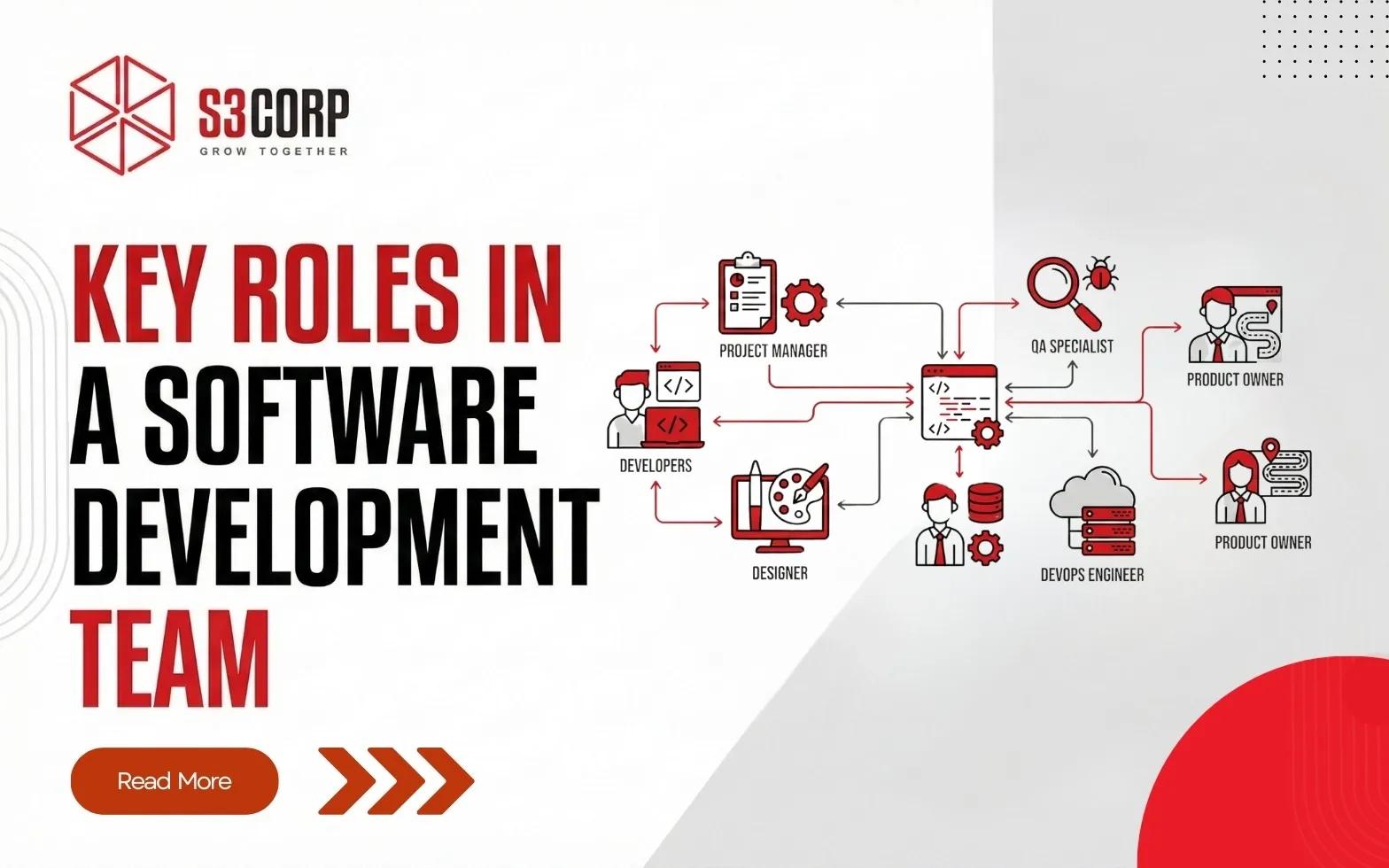
Key Roles in a Development Team
How to Choose the Right Team Structure
Best Practices for High-Performing Teams
Common Pitfalls and How to Avoid Them
When to Outsource Your Software Development Team
How S3Corp Builds Effective Teams
Conclusion
FAQs
Learn how to build high-performing software teams. Explore team structures, roles, and models that drive delivery speed, quality, and collaboration across web, mobile, cloud, and AI projects
25 Nov 2023
A software development team structure defines how people work together to build software. It maps out who does what, how information flows, and where accountability sits.
The structure you choose shapes everything. A good structure speeds up delivery, improves code quality, and keeps communication clean. A bad one creates bottlenecks, confusion, and missed deadlines.
Most teams fail not because developers lack skills, but because the team organization chart doesn't match the project needs. A five-person startup building an MVP needs a different team model than a 50-person enterprise migrating legacy systems to microservices.
Think of team structure as architecture for collaboration. You wouldn't build a skyscraper and a beach house the same way. Same principle applies here.
A typical software project team includes developers, testers, designers, and managers. How you arrange these roles—and how many of each you need—depends on your project type, timeline, budget, and technical complexity.
Every team needs clear ownership, defined communication paths, and the right balance between specialists and generalists. If you get this right, and everything else becomes easier.
Read More: Software Development Services: The 2026 Ultimate Guide
Generalist teams work best for small projects with straightforward requirements. Everyone on the team handles multiple responsibilities. A developer might write code, review pull requests, help with testing, and even contribute to design discussions.
This team model fits early-stage startups, MVPs, and projects where speed matters more than perfection. When you have three to five people building a product, rigid specialization slows you down. You need people who can shift roles based on what the project needs today.
Strengths: Fast decision-making, low overhead, flexible resource allocation, strong shared ownership, easy communication.
Limits: Skill depth varies across domains, harder to scale, quality control depends heavily on individual discipline, difficult to handle complex technical problems.
A typical three-person generalist team might include one full-stack developer who leads architecture, one mid-level developer who handles most features, and one junior developer who writes tests and assists with simpler tasks. Everyone reviews code. Everyone deploys. Everyone fixes bugs.
Scale this to five people and you add another developer plus a part-time product owner who also handles QA. It works because the project scope stays manageable.
Specialist teams organize around deep expertise in specific domains. You have frontend engineers who only touch UI code, backend developers who focus on APIs and data, QA engineers who only test, and DevOps engineers who manage infrastructure.
This engineering team hierarchy fits large, complex systems where cutting corners leads to technical debt that costs more than hiring specialists upfront. Financial platforms processing millions of transactions need database specialists. Healthcare systems managing patient data need security experts. Enterprise applications with millions of users need performance engineers.
Strengths: Deep technical quality, clear accountability, efficient parallel work streams, easier to maintain standards, better for complex problem-solving.
Limits: Higher communication overhead, potential silos, slower feature delivery if dependencies block progress, requires more management coordination.
A ten-person specialist team might look like this: one technical architect, two backend developers, two frontend developers, one mobile developer, two QA engineers, one DevOps engineer, and one UI/UX designer. Each person owns their domain. The architect ensures everything connects properly.
Scale to fifteen people and you double developers, add a database specialist, and include a security engineer. This structure supports multiple features in parallel without people stepping on each other.
Most companies use hybrid teams because pure generalist and pure specialist approaches both have gaps. Hybrid combines the speed of generalists with the depth of specialists.
A hybrid team composition includes a core group of cross-functional development team members who can handle most work, plus specialists who tackle complex problems in their domain. Your backend developer knows enough frontend to fix small UI bugs, but you still have a frontend specialist who owns the design system.
This team organization chart works for mid-size projects, which covers most software development in the real world. You're not building Google-scale infrastructure, but you're also not throwing together a landing page.
One project manager coordinates work and removes blockers. One business analyst translates requirements and validates features. One software architect makes technical decisions and reviews critical code. Two full-stack developers build most features. One frontend specialist owns UI components and performance. One QA engineer writes automated tests and runs manual test cycles. One DevOps engineer manages deployment pipelines and infrastructure.
Everyone has a primary role, but there's enough overlap that the team doesn't freeze when one person takes vacation.
Web applications need strong frontend and backend coverage with clear separation between UI logic and business logic. The team model typically includes full-stack developers who understand both layers, even if they specialize in one direction.
A small web app team (five people) includes one senior full-stack developer, one mid-level frontend developer, one mid-level backend developer, one QA engineer, and one part-time DevOps engineer. This covers all bases without redundancy.
Medium web apps (eight to twelve people) add a UI/UX designer, a dedicated project manager, separate frontend and backend tech leads, more developers, and full-time DevOps. This supports multiple features in parallel and maintains higher quality standards.
Large web apps (fifteen-plus people) split into squads. Each squad owns specific features or services, with its own mini cross-functional development team structure. Shared platform teams handle infrastructure, design systems, and common services.
Mobile development requires platform-specific knowledge. iOS and Android have different languages, tools, and design guidelines. Your software development team structure must account for this split.
A typical mobile team (six people) includes one iOS developer, one Android developer, one backend developer who builds APIs, one UI/UX designer who creates screens for both platforms, one QA engineer who tests on multiple devices, and one project manager who coordinates releases.
If the app is complex or user-heavy, add more developers per platform and consider a mobile architect who ensures consistency across iOS and Android. Large mobile projects might also include a release manager who handles app store submissions and version coordination.
Hybrid frameworks like React Native or Flutter reduce the need for separate platform developers, but you still need someone who understands native code for performance optimization and platform-specific features.
Microservices architecture changes how you organize teams. Instead of one large team building a monolith, you create smaller teams that each own specific services.
Each service team (four to six people) includes developers who build and maintain their service, a QA engineer who tests it, and shared access to DevOps support. One architect oversees the entire system to prevent integration chaos.
This distributed team organization chart requires strong communication protocols. Services must interact through well-defined APIs. Changes in one service shouldn't break others. Documentation becomes critical.
A cloud-native project also needs dedicated DevOps engineering team members who manage container orchestration, service mesh, monitoring, and deployment automation. These roles can't be part-time when you're running twenty microservices across multiple regions.
AI and machine learning projects need different dev team responsibilities than traditional software. The team composition includes data scientists, machine learning engineers, data engineers, and traditional software developers.
A small AI team (five people) includes one data scientist who builds models, one ML engineer who deploys models to production, one data engineer who manages data pipelines, one backend developer who integrates ML services into applications, and one DevOps engineer who handles infrastructure.
Medium AI projects (ten to fifteen people) add more data scientists for experimentation, frontend developers for user interfaces, and specialized ML engineers for model optimization. You might also need a data annotation team if you're training custom models.
AI projects have unique challenges: data quality issues, model drift, computational costs, and explainability requirements. The software engineering team organization must support rapid experimentation while maintaining production stability.
S3Corp builds software for regulated industries where team structure must support compliance, security, and audit requirements.
Fintech teams add security specialists, compliance officers who review features against regulations, and additional QA engineers who run security tests. Development team workflow includes mandatory code reviews, penetration testing, and regulatory documentation. A typical fintech project (twelve people) dedicates at least two people full-time to security and compliance.
The team will need HIPAA compliance experts, security engineers, and careful data handling procedures. Every feature that touches patient information requires privacy impact assessment. Team roles expand to include compliance reviewers who validate each release. Teams are usually ten to fifteen people with extra QA coverage.
Retail teams focus on performance and scalability. High-traffic seasons like holiday shopping require load testing, performance monitoring, and rapid scaling capabilities. The team model includes performance engineers, additional DevOps support, and frontend specialists who optimize page speed. Teams range from eight to twenty people depending on platform size.
These retail domain-specific requirements shape how S3Corp structures managed software teams for clients. We staff projects with people who understand industry constraints, not just technical requirements.
Owns the product vision and decides what gets built. Sets priorities, makes trade-off decisions, and ensures the team builds features users actually need. Translates business goals into development work. Available to answer questions and validate completed features.
Coordinates daily work, runs meetings, tracks progress, removes blockers, and communicates status to stakeholders. In Agile team structure, the Scrum Master facilitates sprint planning, daily standups, retrospectives, and ensures the team follows Agile principles. Shields the team from interruptions and helps improve processes.
Bridges the gap between business stakeholders and developers. Gathers requirements, documents user stories, creates acceptance criteria, and validates that completed features match expectations. Catches misunderstandings before they become expensive mistakes. Creates process flows and feature specifications.
Makes high-level technical decisions about system design, technology choices, integration patterns, and code structure. Reviews critical code, resolves technical disagreements, and ensures the codebase stays maintainable as it grows. Serves as technical escalation point for complex problems. Owns the technical vision.
Write code, review pull requests, fix bugs, write tests, and deploy features. Frontend developers build user interfaces. Backend developers create APIs and business logic. Full-stack developers work across both layers. Participate in planning, estimate work, and communicate progress. Own the quality of their code.
Design test plans, write automated tests, run manual testing cycles, document bugs, verify fixes, and ensure quality standards. Work closely with developers during feature development to catch issues early. Maintain test automation frameworks. Run regression tests before releases.
Build and maintain deployment pipelines, manage infrastructure, monitor system health, handle scaling, implement security controls, and support production incidents. Create automation for repetitive tasks. Ensure developers can deploy code safely and quickly. Own system reliability.
Create user flows, wireframes, mockups, and design systems. Research user needs, run usability tests, and iterate on designs based on feedback. Work with developers to ensure designs are implemented correctly. Maintain consistency across the product. Balance aesthetics with functionality.
Read More: Understanding the Software Development Process: From Planning to Deployment
Start with project size. Small projects (under six months, limited scope) work well with generalist teams of three to five people. Medium projects (six to twelve months, moderate complexity) need hybrid teams of six to twelve people. Large projects (over a year, high complexity) require specialist teams of fifteen-plus people organized into squads.
Complexity matters more than size sometimes. A small project with complex regulatory requirements needs specialists. A large project with straightforward requirements can use generalists effectively.
Budget constraints force trade-offs. Specialists cost more but deliver higher quality in their domain. Generalists cost less but take longer on specialized tasks. Factor in the total cost including rework, bugs, and technical debt, not just salaries.
Timeline pressure affects team organization chart decisions. Need something fast? Use generalists who can pivot quickly. Have time to do it right? Specialists produce better long-term results.
Compliance requirements change everything. Regulated industries need additional roles for security, privacy, and audit trails. Your software project team roles expand to include compliance reviewers, security specialists, and documentation experts.
Technology stack influences team composition. Modern JavaScript frameworks need frontend specialists. Complex data processing needs backend experts. Cloud-native architecture requires DevOps engineers. Legacy system integration needs architects who understand old and new technologies.
In-house versus outsourced changes the structure. In-house teams need less documentation because knowledge transfers through conversations. Offshore development teams need stronger documentation, clear processes, and defined communication schedules. Dedicated development teams from outsourcing partners like S3Corp come with pre-built team structures tested across multiple projects.
S3Corp typically recommends hybrid structures for most clients. A project building a fintech web application might include: one product owner from the client side, one project manager from S3Corp, one business analyst, one architect, three full-stack developers, one frontend specialist, two QA engineers, one DevOps engineer, and one UI/UX designer. This twelve-person team handles complex requirements while maintaining delivery speed.
For clients starting with team augmentation (adding S3Corp developers to existing teams), we match the client's existing structure and roles rather than imposing our preferred model.
Communication paths need clear definition. Who reports to whom? Who makes final decisions? Who needs to be consulted versus informed? Use RACI for development teams: Responsible (does the work), Accountable (owns the outcome), Consulted (provides input), Informed (receives updates). Every task should have exactly one person Accountable.
Ownership model determines accountability. Assign clear ownership for each service, feature, or system component. When something breaks, everyone should know who owns fixing it. Shared ownership sounds good but often means nobody feels responsible.
Developer to QA ratio impacts quality. Too few QA engineers create bottlenecks and release delays. Too many QA engineers sitting idle waste budget. A good starting ratio is 3:1 or 4:1 developers to QA engineers. Adjust based on project complexity and quality requirements.
Documentation patterns prevent knowledge silos. Code comments explain why, not what. Architecture decision records capture major technical choices. API documentation stays current through automation. Runbooks describe how to handle common issues. Don't document everything—document what people will need three months from now when they've forgotten the context.
DevOps integration happens from day one, not as an afterthought. Set up continuous integration pipelines before writing production code. Implement automated deployment before launch. Add monitoring and alerting before users report problems. DevOps engineers sit with the team, not in a separate infrastructure group.
Sprint rhythm and reporting create predictability. Two-week sprints work for most teams. One-week sprints work for urgent projects. Four-week sprints work for research-heavy work. Consistent sprint length makes velocity meaningful. Daily standups take fifteen minutes maximum. Sprint demos show working software, not PowerPoint. Retrospectives produce actionable improvements, not complaints.
Over-specialization creates bottlenecks when only one person can touch certain code. If your frontend specialist quits or takes vacation, can anyone else deploy UI changes? Build T-shaped skills: deep expertise in one area, enough knowledge in adjacent areas to stay productive.
Single point of failure happens when critical knowledge lives in one person's head. The database expert who's the only one who understands the schema. The DevOps engineer who's the only one with production access. Document critical procedures. Cross-train team members. Implement knowledge sharing sessions.
Slow QA cycles delay releases and frustrate developers. QA engineers get features the day before sprint ends, find bugs, but there's no time to fix them. The fix slips to next sprint. Features pile up. Solution: involve QA from sprint planning, write automated tests during development, test features as soon as code is ready, not at the end.
Role confusion wastes time and creates conflict. Is the architect supposed to write code or just review it? Does the project manager make technical decisions? Who prioritizes bugs versus new features? Write down responsibilities. When confusion happens, clarify and document the answer.
Missing architect oversight leads to technical chaos in medium to large projects. Developers make inconsistent technology choices. Services integrate poorly. Technical debt accumulates. Code becomes unmaintainable. Even small projects benefit from someone thinking about system design holistically, even if it's a senior developer wearing an architect hat part-time.
Several signs indicate you need external support. Your internal team lacks specific technical skills required for the project. Hiring full-time employees takes too long given your timeline. Project scope exceeds your current team capacity. You need to reduce fixed costs and increase flexibility. You want to accelerate delivery without compromising quality.
Outsourcing provides immediate access to proven expertise. You skip the months of recruiting, interviewing, and onboarding. Your team starts productive work within weeks instead of quarters.
Speed improves because outsourcing partners already have established processes and tools. They bring experience from similar projects and avoid common mistakes. You get to market faster with fewer setbacks.
Costs become more predictable. You pay for exactly what you need instead of carrying fixed overhead. You scale the team up or down based on project phases without layoffs or expensive hiring sprints.
An outsourced team structure typically mirrors in-house structures but with enhanced flexibility. The outsourcing partner provides developers, QA engineers, and technical leadership. You retain the product owner role and provide business direction. Communication happens through regular ceremonies and collaborative tools. The outsourced team integrates into your workflow as an extension of your organization.
S3Corp uses dedicated team models where a stable group works together on your project long-term. This builds project-specific knowledge and reduces onboarding overhead.
We favor hybrid cross-functional development team structures that adapt to project needs. Most clients get senior developers who can work across the stack, plus specialists for frontend, DevOps, and QA.
Senior-mid pairing accelerates delivery and builds team capability. Senior developers tackle complex problems and mentor mid-level team members. Mid-level developers handle most feature work and learn from code reviews. This ratio controls costs while maintaining quality.
QA and DevOps engineers join from day one, not after developers finish. Early QA involvement catches issues before they become expensive. DevOps from the start means deployment infrastructure grows with the product, not as a crisis response later.
Domain-specialist roles depend on industry. Fintech projects include security specialists and compliance reviewers. Healthcare projects include HIPAA compliance experts. Retail projects include performance engineers. We staff teams with people who understand your industry's specific requirements.
Our team structures for Fintech, Healthcare, and Retail come from dozens of completed projects in each sector. We know which roles you actually need versus which sound good but add little value. A fintech MVP needs security thinking but probably doesn't need a full-time security engineer. A healthcare enterprise application absolutely needs dedicated compliance review.
When clients need outsourced software teams, we propose structures based on their project type, timeline, and budget. When they need team augmentation, we provide developers who fit into existing structures. Both approaches use the same underlying principle: match team organization to project needs, not to a template.
Software development team structure determines whether your project succeeds or struggles. The right structure speeds delivery, improves quality, and keeps everyone aligned. The wrong structure creates confusion, delays, and wasted effort.
Small projects work with generalist teams. Large projects need specialists. Most projects fall in the middle and benefit from hybrid teams that combine broad skills with deep expertise in critical areas.
Choose your structure based on project size, technical complexity, timeline, budget, and industry requirements. Adjust as the project evolves. What works for MVP development might not work for scaling to millions of users.
Focus on clear roles, defined communication paths, and the right balance between developers and QA. Include DevOps from the start. Document critical knowledge. Avoid single points of failure.
Great teams don't happen by accident. They result from intentional decisions about team composition, roles, and organization. Get the structure right, staff it with capable people, and establish working agreements. Everything else follows.
Need help building a high-performing software team? S3Corp brings proven team structures, experienced developers, and domain expertise to your project. Whether you need a dedicated development team, team augmentation, or project-based delivery, we structure teams that deliver results.
Contact S3Corp to discuss your project needs and get a custom team structure recommendation.
The best structure depends on your project. Small projects with simple requirements work well with generalist teams of three to five people. Medium projects with moderate complexity need hybrid teams of six to twelve people. Large projects with high complexity require specialist teams of fifteen or more people. Agile team structure with cross-functional members works for most modern projects.
Ideal team size ranges from five to nine people. Smaller teams (three to five) work for simple projects but lack coverage. Larger teams (ten-plus) need more coordination and communication overhead. If your project needs more than twelve people, split into multiple squads with three to seven people each.
Core Agile roles include Product Owner (sets priorities), Scrum Master (facilitates process), Developers (write code), and QA Engineers (ensure quality). Most teams also need a UI/UX Designer and DevOps Engineer. Larger teams add Business Analyst, Software Architect, and specialized developers for frontend and backend.
Startup teams favor generalists who handle multiple responsibilities and move fast. Teams stay small (three to seven people) with minimal hierarchy. Enterprise teams use specialists organized into clear roles with defined responsibilities. Teams are larger (ten to fifty people) with more structured processes, documentation requirements, and quality gates.
Hire an outsourced development team when you lack in-house technical expertise, need to scale quickly, want to reduce hiring time and costs, or require domain-specific knowledge. Offshore development teams work well for defined projects with clear requirements. Dedicated development teams from partners like S3Corp provide stable, long-term capacity without the overhead of building an internal team.