Whether you have any questions, or wish to get a quote for your project, or require further information about what we can offer you, please do not hesitate to contact us.
Contact us Need a reliable software development partner?
S3Corp. offers comprehensive software development outsourcing services ranging from software development to software verification and maintenance for a wide variety of industries and technologies





Software Development Center
_1746790956049.webp&w=384&q=75)
_1746790970871.webp&w=384&q=75)


Insights
Table Of Content
TL;DR
What Are API Development Services and Why Do Businesses Need Them?
When Should You Choose Custom API Development vs. Off-the-Shelf Tools?
What Business Problems Do API Development Services Solve?
Which API Architecture Should You Choose for Your System?
How Does S3Corp Deliver API Development Services?
What ROI Can You Expect from API Development?
How Much Do API Development Services Cost?
How Do You Choose the Right API Development Company?
Conclusion
Frequently Asked Questions
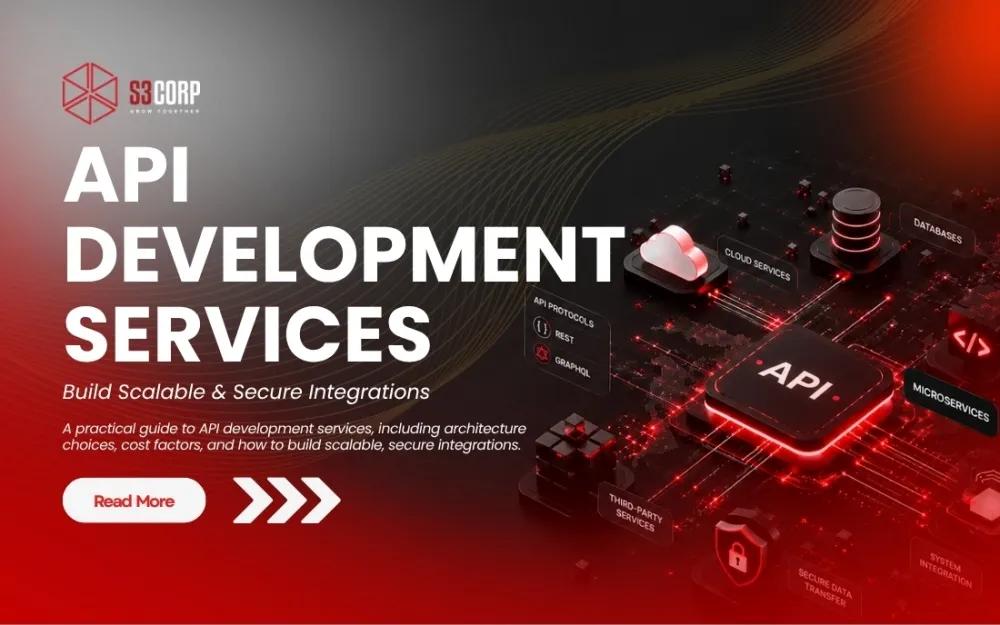
A practical guide to API development services, including architecture choices, cost factors, and how to build scalable, secure integrations. S3Corp designs and delivers custom API development services — from REST and GraphQL to microservices — helping enterprises connect systems, automate workflows, and scale with confidence.
06 May 2026
API development services cover designing, building, securing, and maintaining interfaces that let software systems exchange data. Here is what the full guide covers in 60 seconds:
Modern systems depend on APIs to connect platforms, move data, and scale products. API development services help businesses build secure, scalable, and high-performance integrations that support growth and automation. Without a clear API strategy, systems become fragmented, slow, and expensive to maintain.
This guide explains how to choose the right API approach, which architecture fits your use case, and how to avoid common integration failures. You will also learn how to evaluate cost, ROI, and vendor capability with a practical lens. Beyond, you will know when to go custom versus off-the-shelf, what the real cost drivers are, and how to evaluate an API development company worth trusting.
API development services include designing, building, securing, and maintaining interfaces that allow software systems to exchange data reliably and efficiently. Businesses use APIs to connect SaaS tools, automate workflows, power mobile and web applications, and scale digital products without rebuilding their entire stack each time requirements change.
In practice, this covers a wide range of work:
APIs act as the backbone of modern platforms. Indeed, no organization today operates on a single platform. You have a CRM, a data warehouse, a payment processor, an analytics tool, and a mobile app — and they all need to talk to each other. Without API, teams rely on manual processes or disconnected systems, which increases cost and slows innovation.
S3Corp builds APIs that connect enterprise systems across cloud and legacy platforms, supporting everything from real-time data sync to batch processing pipelines across industries including Fintech, Healthcare, and E-Commerce and Retail. This enables consistent data flow across departments and applications.
Read More: Software Development Services: The 2026 Ultimate Guide
Custom API development is required when your system needs high scalability, complex business logic, or strict data security that generic tools cannot provide. Off-the-shelf automation platforms like Zapier or Make work well for simple, low-volume workflows — but they hit their limits fast in enterprise environments.
|
Factor |
Custom API Development |
Off-the-Shelf |
|
Scalability |
Built for high-volume, enterprise load |
Limited by platform rate limits and pricing tiers |
|
Business Logic |
Fully configurable to your workflows |
Constrained by available triggers and actions |
|
Security Control |
Full ownership of auth, encryption, and data handling |
Data passes through third-party infrastructure |
|
Long-term Cost |
Higher upfront, lower marginal cost at scale |
Low upfront, costs rise with usage volume |
|
Integration Depth |
Deep, native integration with any system |
Surface-level integrations via pre-built connectors |
You need a custom API when existing tools cannot handle your data volume, latency requirements, or business logic without compromise. Specific indicators include:
Third-party integrations are sufficient when your workflows are simple, data volumes are low, and the business does not depend on the performance of those connections. If you are syncing a CRM to a project management tool a few hundred times a day, a pre-built connector works fine. S3Corp actively helps clients reduce cost by selecting pre-built integrations when custom APIs are genuinely unnecessary — because the right solution is not always the most complex one. This approach supports optimizing cost and performance without over-engineering.
API services directly address system fragmentation, slow data flow, manual operational overhead, and the inability to scale digital products without rebuilding core infrastructure. These are not abstract engineering concerns — they translate directly into revenue loss, customer frustration, and competitive disadvantage. This becomes critical in industries like Fintech Software Development where latency and data accuracy directly impact revenue.
|
Business Problem |
How API Development Solves It |
|
Data silos across departments |
APIs create a unified data layer accessible to all authorized systems |
|
Slow, manual reporting workflows |
Automated data pipelines eliminate human touchpoints and delays |
|
SaaS connectivity gaps |
Custom connectors bridge platforms that have no native integration |
|
System fragmentation post-acquisition |
APIs federate separate codebases without a full rewrite |
|
Scaling limitations on monolithic apps |
Microservices APIs allow independent scaling of individual components |
|
Partner and developer ecosystem needs |
Public APIs enable third parties to build on your platform |
|
AI and LLM integration readiness |
APIs designed to serve structured, low-latency data to AI agents, LLM pipelines, and vector databases enable enterprises to build AI features without rebuilding their data layer |
Consider the example of a mid-sized e-commerce operator expanding into Southeast Asia. Their order management system, warehouse software, and payment gateway were all separate platforms from different vendors. Without API integration services, their operations team manually reconciled data across all three systems each day. After building a unified API layer — connecting all three platforms with automated sync, webhook-driven order updates, and real-time inventory checks — that manual work disappeared entirely, and they could add new regional payment providers in days rather than months.
This is the real ROI of good API architecture. It is not just about technology. It is about giving your team the operational bandwidth to grow.
The right API architecture depends on your system's complexity, scalability requirements, and how your frontend or clients will consume the data. There is no universal answer — REST, GraphQL, WebSockets, Webhooks and microservices each have clear use cases, and choosing incorrectly creates technical debt that compounds over time.
REST API development works best for standard applications with predictable data flow because of its simplicity, stateless architecture, and universal toolchain support. Choose REST when:
REST's stateless architecture means each request is independent, which makes horizontal scaling straightforward. For the majority of SaaS products, marketplaces, and enterprise integrations, REST is the correct default.
REST remains the default choice for many platforms, especially when building web application development solutions.
GraphQL delivers measurably better performance in scenarios where clients need flexible, nested queries and where over-fetching is a real problem. The difference is significant: with REST, a mobile app might make five separate API calls to render a single screen. With GraphQL, it makes one. S3Corp uses GraphQL to reduce over-fetching in SaaS platforms — specifically in cases where frontend teams need to move fast without waiting for backend teams to build new endpoints. This will improve API performance optimization and user experience.
GraphQL is the right choice when:
WebSockets and Webhooks solve a fundamentally different problem than REST or GraphQL — they are the right choice when your system needs to react to events as they happen, rather than waiting for a client to ask.
REST and GraphQL are request-driven: the client asks, the server answers. That model breaks down the moment you need live updates — a trading dashboard refreshing prices, a logistics platform tracking driver location, a collaborative editor syncing changes across users. Polling the server every few seconds is wasteful and slow. This is where event-driven architecture earns its place.
WebSockets establish a persistent, bidirectional connection between client and server. Once the connection is open, either side can push data at any time without a new HTTP handshake. Use WebSockets when:
Webhooks take a different approach — they are HTTP callbacks that fire when a specific event occurs on the server side. Your payment gateway sends a webhook when a transaction completes. Your CI/CD pipeline sends one when a build fails. Webhooks are the right pattern when:
The practical distinction: WebSockets are for sustained real-time streams; Webhooks are for discrete event notifications. Many well-architected systems use both — WebSockets for the live user-facing layer and Webhooks for the backend service-to-service event triggers underneath it.
Microservices architecture decomposes a monolithic application into independent services, each with its own API and deployment lifecycle. Enterprises adopt this pattern because it enables independent scaling — your payment service can scale to handle Black Friday traffic without scaling your entire application.
Within microservices environments, two protocols dominate internal service-to-service communication: GraphQL and gRPC. They are not interchangeable.
|
Factor |
GraphQL |
gRPC |
|
Primary use case |
Flexible client-facing data queries |
High-performance internal service communication |
|
Protocol |
HTTP/1.1 or HTTP/2, JSON |
HTTP/2, Protocol Buffers (binary) |
|
Performance |
Good; overhead from JSON parsing |
Significantly faster; binary serialization |
|
Latency |
Suitable for most SaaS products |
Optimized for sub-millisecond internal calls |
|
Type safety |
Schema-defined, but runtime validated |
Strict compile-time contract enforcement |
|
Streaming support |
Via subscriptions |
Native bidirectional streaming |
|
Best for |
External APIs, multi-client frontends |
Internal microservice-to-microservice calls |
gRPC's advantage is raw performance. Because it serializes data using Protocol Buffers rather than JSON, payloads are smaller and faster to parse — typically three to ten times faster than equivalent REST or GraphQL calls in benchmarks. For a microservices system where a single user request triggers dozens of internal service calls, that latency difference compounds quickly into something the end user can feel.
A common enterprise pattern is to combine both: gRPC for the internal service mesh where speed and contract enforcement matter most, and GraphQL or REST for the external-facing API layer where developer experience and flexibility take priority. This hybrid approach gives you performance where the infrastructure demands it and usability where the developer ecosystem needs it.
The trade-off is operational complexity. Microservices APIs require an API gateway, service discovery, distributed tracing, and robust DevOps pipelines. For teams without that infrastructure, starting with a well-structured monolith and introducing microservices selectively is often the more pragmatic path. This is a conversation worth having early with your software outsourcing services partner.
S3Corp. follows a structured API lifecycle built around scalability, security, and performance — from initial discovery through production deployment and ongoing maintenance. The development process is designed to reduce risk at every stage while keeping delivery timelines predictable.
Before writing a single line of code, the team maps your existing systems, data flows, and integration requirements. This phase produces an architecture decision record (ADR) that documents why specific choices were made — REST vs. GraphQL, synchronous vs. event-driven, monolith vs. microservices. It is the foundation that prevents expensive pivots later.
API security is not an afterthought at S3Corp — it is built into the development process from day one. Standard practices include OAuth 2.0 for delegated authorization, JWT for stateless token-based authentication, rate limiting and throttling to protect against abuse, input validation and injection prevention, and TLS enforcement across all endpoints. For clients in regulated industries such as HealthCare or Fintech, compliance requirements (HIPAA, PCI-DSS, GDPR) are mapped directly into the security architecture.
An API that works under normal conditions but fails under load is a liability. The testing services process at S3Corp includes functional testing, contract testing (using tools like Pact), and load testing with realistic traffic simulations. Target benchmarks are defined during discovery — latency thresholds, throughput targets, and error rate tolerances — and validated before any production release.
APIs without documentation are black boxes that slow down every team that depends on them. S3Corp delivers Swagger/OpenAPI-compliant documentation as a standard deliverable, not an optional extra. This includes interactive API references, authentication guides, example request/response pairs, and versioning changelogs — everything a developer needs to integrate confidently.
Schedule a Technical API Architecture Call with S3Corp engineers.
API development delivers measurable returns through faster system performance, reduced manual operations, and the ability to scale digital products without proportional cost increases. The specific numbers vary by project, but the value drivers are consistent across industries.
Key performance improvements clients typically see after a well-executed API integration project:
API performance optimization is not a one-time event. The teams that see the best long-term returns treat their APIs as products — versioning them deliberately, monitoring them continuously, and deprecating older versions on a defined schedule.
API development costs vary significantly based on complexity, the number of integrations, security requirements, and the team model you choose. There is no single price because there is no single API — a simple webhook integration and a multi-system enterprise API gateway are fundamentally different projects.
The honest answer is that most serious API projects sit between $15,000 and $150,000+ depending on scope. What determines where yours lands:
|
Cost Factor |
Impact on Budget |
|
Number of integrations |
Each additional system adds design, development, and testing scope |
|
API type and complexity |
GraphQL schemas and microservices are more complex than basic REST endpoints |
|
Security requirements |
Regulated industries require additional compliance architecture |
|
Performance requirements |
Load testing, caching layers, and CDN configuration add cost |
|
Documentation scope |
Full OpenAPI documentation and developer portals require dedicated effort |
|
Ongoing maintenance |
Version management, monitoring, and updates are recurring costs |
|
Team model |
Offshore development teams in Vietnam typically offer 40–60% cost reduction vs. equivalent US or UK teams |
The enterprise API budget conversation is also about total cost of ownership, not just build cost. A poorly architected API that needs to be rebuilt 18 months later costs far more than doing it correctly the first time. This is where collaboration models with an experienced outsourcing partner often deliver better financial outcomes than attempting to build a full in-house team from scratch.
Choose an API development partner based on architecture depth, security expertise, proven integration experience, and a delivery process you can trust — not just hourly rate. The cheapest option rarely produces the right outcome at scale.
Here is a practical evaluation framework:
Why S3Corp? With 19+ years of experience delivering full-lifecycle app development across markets in North America, the UK, and Asia, S3Corp brings both the technical depth and the cross-cultural communication experience that enterprise API projects demand. The engineering hub in Vietnam combines world-class talent with a cost structure that makes serious API investments financially accessible for growth-stage and enterprise clients alike. Teams at S3Corp include specialists across DevSecOps, cloud architecture, and Web App Development — which means API work does not happen in isolation from the broader system context.
Read More: How to Choose a Software Development Company
Every system integration decision you make today either compounds into a competitive advantage or accumulates as technical debt. There is rarely a middle ground. APIs that are architected well from the start give your product teams the freedom to move fast, your operations team the bandwidth to focus on growth, and your engineering team a foundation they can extend — not fight against — for years.
The mistake most organizations make is treating API development as a tactical task rather than a strategic one. They bolt on integrations as needed, skip the architecture discussion to hit a deadline, and end up with a patchwork of brittle connections that no one fully understands. Fixing that later costs significantly more than doing it right the first time.
What "right" looks like is not the same for every business. A fintech platform in Singapore connecting to payment rails has different requirements than a healthcare operator in the UK integrating clinical data systems, or an e-commerce brand in North America wiring together their warehouse and storefront. The architecture, the security model, the testing approach — all of it shifts based on your specific context. This is why the best API development outcomes come from a partner who asks questions first and writes code second.
At S3Corp, that has been the approach for 19+ years across clients in North America, the UK, Asia, and beyond. Whether the work involves Web App Development that needs a new API backbone, a Mobile App Development Product that requires a high-performance data layer, or a full software outsourcing services engagement where the API is one component of a larger system — the starting point is always the same: understand the business problem before proposing a technical solution.
If you are evaluating API development services right now — Whether you are starting from scratch, integrating a complex set of enterprise systems, or refactoring an API that has outgrown its original design, the architecture decisions you make now will shape your product's performance for years — the most useful next step is a direct technical conversation
→ Get a Free API Architecture Consultation with S3CorpAPI development is the process of designing, building, securing, testing, and maintaining Application Programming Interfaces — software contracts that allow different systems to communicate and exchange data. It includes everything from defining endpoints and authentication methods to documentation and ongoing version management.
A simple REST API integration with one or two external systems typically takes two to six weeks. A full enterprise API layer — including an API gateway, multiple service integrations, security hardening, and documentation — generally takes three to six months. Timeline depends heavily on how well-defined the requirements are at the start of the project.
REST is a request-response architecture where each endpoint returns a fixed data structure. GraphQL is a query language that lets clients request exactly the data they need in a single request. REST is simpler and works well for most use cases. GraphQL delivers better performance for complex, nested data requirements and multi-client environments.
An API gateway is a management layer that sits between clients and your backend services. It handles routing, authentication, rate limiting, logging, and sometimes transformation. If you are running multiple services or exposing APIs to external developers, an API gateway is strongly recommended — it centralizes control and removes security logic from individual services.
Yes, provided you choose a partner with a documented security process, clear IP ownership agreements, and strong references. Reputable API development companies in Vietnam — including S3Corp — operate under NDAs, international IP frameworks, and established DevSecOps practices. The risk profile of outsourcing API work is similar to any technology partnership: it depends on the partner, not the geography.
API documentation describes how to use your API — its endpoints, parameters, authentication methods, and expected responses. Good documentation, typically delivered in Swagger/OpenAPI format, is the difference between an API that your team and partners can use confidently and one that creates constant support overhead. It is a deliverable, not a nice-to-have.