Insights
Table Of Content
Key Takeaways
What Are Software Development Standards?
Why Do Software Development Standards Matter for Modern Engineering Teams?
What Are the Core Categories of Software Development Standards?
Which Software Quality Metrics Matter Most in 2026?
How Do High-Performing Engineering Teams Enforce Development Standards?
What Software Development Standards Often Fail in Practice?
How Does AI-Assisted Development Change Software Development Standards?
How Does S3Corp Apply Software Development Standards Across Distributed Engineering Teams?
What Is a Practical Software Development Standards Checklist?
Frequently Asked Questions About Software Development Standards
Conclusion: Standards Are a Strategic Advantage, Not a Compliance Tax
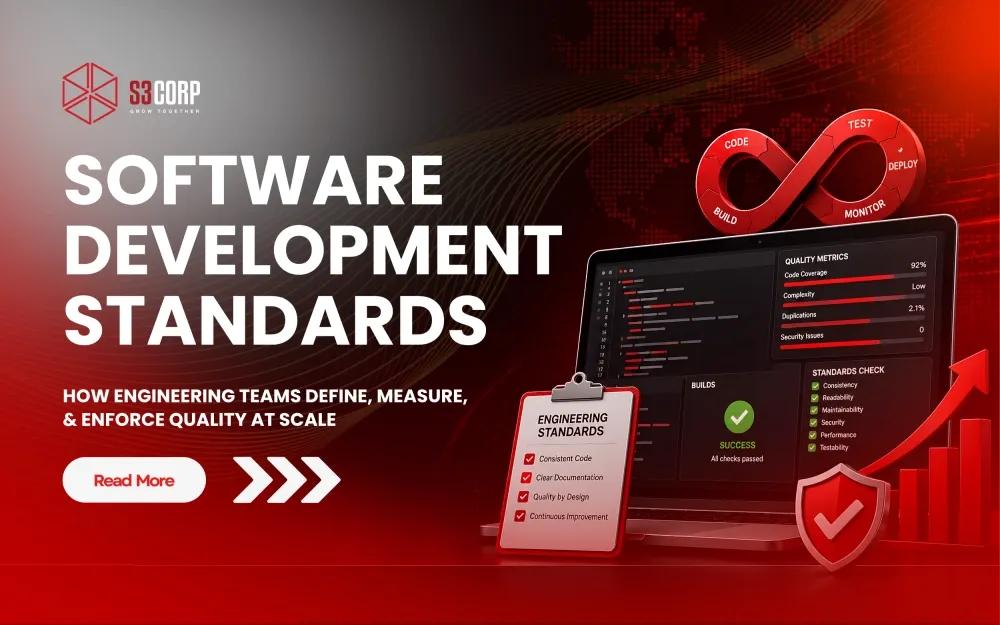
A practical executive guide covering coding standards, documentation requirements, quality benchmarks, and enforcement strategies for distributed engineering teams building software at scale.
27 Jul 2026
Every CTO has felt it: that creeping dread when a production incident traces back not to a bad architectural decision or a rogue bug, but to an undocumented assumption that lived in one engineer's head for eighteen months. Or the onboarding experience where a new hire finds three different naming conventions across three different services—all written by the same team, in the same quarter.
Software development standards are the antidote to that particular kind of organizational pain. They are not bureaucratic red tape. They are the operational backbone of engineering teams that ship software reliably, at speed, and at scale.
Software development standards are documented rules that govern how teams write code, maintain documentation, review changes, measure quality, and deploy software. Effective standards combine coding guidelines, documentation requirements, and measurable quality benchmarks—such as test coverage, maintainability, defect density, and deployment reliability—into a coherent, enforceable system.
Strong standards create a common language for engineering teams. They define how code should be written, how systems should be documented, how quality should be measured, and how releases should move safely into production. They reduce technical debt, improve maintainability, strengthen security, and make engineering outcomes more predictable.
This guide gives engineering leaders a clear, actionable framework for understanding, implementing, and enforcing software development standards across their organizations—whether they manage five engineers or five hundred.
Software development standards are formal or semi-formal agreements within an engineering organization that specify how software should be written, reviewed, tested, documented, and deployed. They sit at the intersection of engineering governance, software quality assurance, and team operations.
At the most practical level, standards answer three questions: How should code be written? How should software behavior be documented? And how do we know when quality is sufficient to ship?
These questions seem simple until you are coordinating forty engineers across five time zones, all with different training backgrounds and different interpretations of "good enough."
Software engineering standards typically cover five areas:
Without standards, teams often accumulate technical debt, duplicate effort, inconsistent architectures, and difficult-to-maintain systems.
One important distinction to draw early: software engineering standards are different from compliance certifications like ISO 27001, SOC 2, or HIPAA. Compliance certifications are external—they verify that your organization meets a third party's security or process requirements. Development standards are internal—they are the engineering team's own rules for how work gets done, day to day, at the code level.
The external frameworks that most directly inform modern development standards include:
These frameworks do not prescribe exactly how your team writes code. They define what dimensions of quality matter and how to measure them objectively.
Here is a number worth sitting with: according to CISQ, poor software quality cost U.S. organizations approximately $2.41 trillion in 2022, driven by operational failures, failed projects, and accumulated technical debt. That figure is not theoretical. It represents money spent fighting the compounding consequences of codebases that were built without consistent standards, quality controls, or governance.
The business case for software development standards delivers five concrete, measurable benefits:
Technical debt accumulates when teams prioritize speed over quality. Standards like the DRY principle (Don't Repeat Yourself), the KISS principle (Keep It Simple, Stupid), and YAGNI (You Aren't Gonna Need It) are lightweight guardrails that prevent unnecessary complexity from entering the codebase in the first place. They cost nothing to enforce once they are automated.
A new engineer who joins a team with clear coding conventions, a well-maintained README standard, and documented architecture decisions can contribute meaningfully within days rather than weeks. Without standards, onboarding depends entirely on tribal knowledge—information that lives only in someone's head and disappears when that person leaves.
According to Google's DevOps Research and Assessment (DORA) program, elite-performing engineering teams achieve change failure rates below 5% and restore services from production incidents in under one hour. Those outcomes are only achievable with consistent engineering standards, automated quality gates, and well-defined development workflow standards that eliminate guesswork.
Software developer productivity identifies standardized toolchains, consistent deployment pipelines, and clear coding guidelines as core drivers of engineering throughput. When engineers are not debating which approach to take, they spend more time solving actual problems.
Secure coding practices aligned with standards like the OWASP Top 10 reduce the number of vulnerabilities introduced during development. When standards are embedded in the pipeline rather than posted in a wiki, security and compliance reviews become verification exercises rather than firefighting missions.
Ready to close the gap between your standards and your team's daily practice? Contact Us to discuss how S3Corp builds quality-first engineering frameworks for global clients.
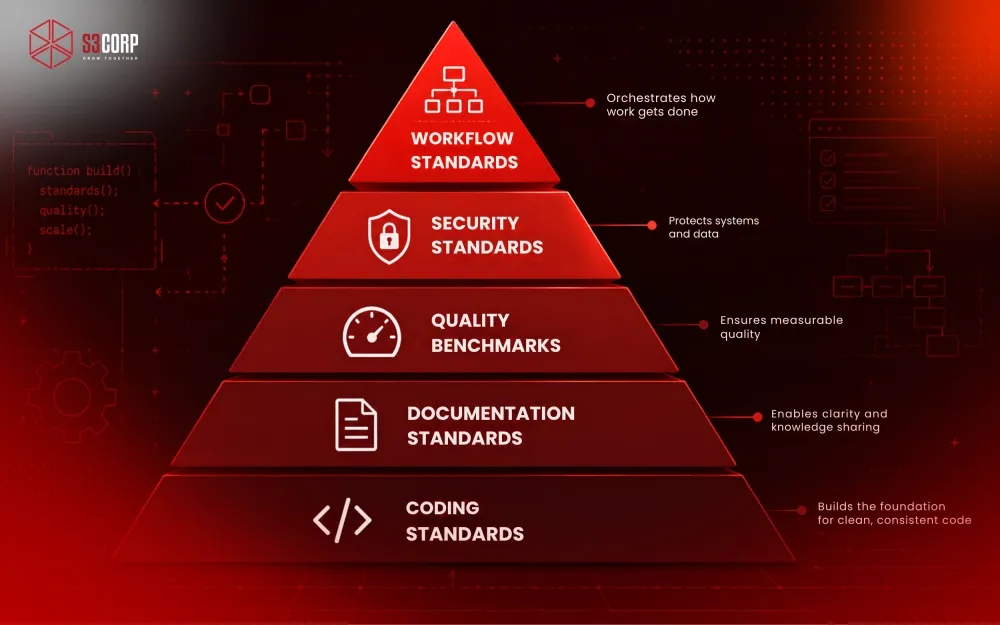
Most organizations with strong software governance organize their standards into five categories: coding standards, documentation standards, quality benchmarks, security standards, and workflow standards. Each category addresses a different layer of the software delivery lifecycle, and each reinforces the others.
 What Are Coding Standards and What Should They Include?
Coding standards define naming conventions, formatting rules, architecture practices, and code review expectations. They are the foundation upon which all other development standards rest.
The goal is consistency.
High-quality code should feel as though one engineer wrote it, even if hundreds contributed.
Think of a code style guide as the editorial style guide for your engineering team. It removes subjective debates—camelCase versus snake_case, tabs versus spaces—from code review conversations so that reviews can focus on what actually matters: correctness, security, and design quality.
The most widely adopted coding standards in production engineering environments include:
These are not just stylistic preferences. Consistent coding conventions reduce cognitive overhead, make code reviews faster, and produce codebases that any team member—including someone who just joined—can read and reason about quickly.
A complete set of coding standards typically covers these areas:
|
Standard Area |
What It Covers |
Example Rule |
|
Naming conventions |
Variables, functions, classes, files |
PascalCase for classes; camelCase for variables |
|
Formatting |
Indentation, line length, bracket placement |
Max 100 characters per line; consistent indentation |
|
Architecture |
Design patterns, module structure, dependencies |
Single responsibility per class; dependency injection preferred |
|
Code review |
Review scope, approval requirements, merge rules |
Two approvals required before merge; no self-merging allowed |
Clean code principles—readability, self-documentation, and modularity—should be the spirit behind every rule in the style guide, not just the letter of each convention. Naming a variable x might satisfy a linter. It will not satisfy the next engineer who reads it at 2 AM during an incident. As mentioned, clean code principles might include: DRY Principle (Don't Repeat Yourself), KISS Principle (Keep It Simple), YAGNI Principle (You Aren't Gonna Need It).
Documentation standards ensure software remains understandable, maintainable, and transferable across teams—even when the original authors are no longer available.
Documentation is the part of engineering that most teams intend to do and then skip under deadline pressure. The problem compounds quietly over time. A year later, nobody remembers why a particular architectural decision was made. A new engineer spends three days reverse-engineering logic that could have been explained in three paragraphs.
A practical documentation standard for modern software teams covers six areas:
Tools like Sphinx and MkDocs make it practical to maintain living documentation alongside code. When documentation lives in the repository and is rendered automatically on each commit, it stays current instead of rotting in a forgotten knowledge base that nobody trusts.
Quality benchmarks translate engineering standards into measurable, trackable outcomes—turning a subjective notion of "good code" into objective targets that teams can actually hit.
Without measurement, standards become opinions. With measurement, they become accountability mechanisms. The table below summarizes the most important benchmarks, what each one signals, and the target range that high-performing teams aim for:
|
Metric |
What It Signals |
Target Range |
|
Test coverage |
Percentage of code exercised by automated tests |
70–90% (context-dependent) |
|
Defect density |
Number of confirmed defects per thousand lines of code |
< 1 defect per KLOC |
|
Cyclomatic complexity |
Number of independent execution paths per function |
< 10 per function |
|
Lead time for changes |
Time from code commit to production deployment |
< 1 day (elite teams, per DORA) |
|
MTTR |
Mean Time to Restore after a production incident |
< 1 hour (elite teams, per DORA) |
|
Code churn |
Percentage of code rewritten within 3 weeks of commit |
< 25% |
|
Defect leakage |
Defects that escape testing and reach production users |
< 10% of all detected defects |
These targets are directional, not universal laws. A system processing financial transactions has a different risk tolerance than an internal admin tool. Standards should reflect both the criticality of the product and the maturity of the team.
The metrics landscape has expanded significantly as DevOps Services and platform engineering practices have matured. Here is a clear breakdown of what each metric actually measures—and why it matters to business outcomes, not just engineering dashboards.
What Is Test Coverage? Test coverage measures the percentage of source code executed during automated test runs. It is frequently misunderstood as a quality guarantee—it is not. High coverage with shallow assertions is nearly worthless. The value of test coverage is as a risk indicator: low coverage (below 50%) flags areas of the codebase where changes are likely to produce undetected regressions. Elite teams target 70–90%, but coverage should never be tracked in isolation from defect rates.
What Is Defect Density? Defect density measures the number of confirmed bugs per thousand lines of code (KLOC). It is most useful as a relative metric—comparing density across modules, releases, or teams within the same organization. A rising defect density in a specific module is an early warning signal that the module may need refactoring before it becomes a production liability.
What Is Cyclomatic Complexity? Cyclomatic complexity measures the number of independent execution paths through a piece of code. High complexity—above 10 per function—indicates code that is difficult to test, difficult to reason about, and statistically more likely to contain defects. The practical fix is simple to state and hard to maintain under deadline pressure: keep functions small, focused, and linear. This is the KISS principle applied concretely.
What Is Lead Time for Changes? Lead time for changes measures how long it takes from a code commit to that change being deployed in production. According to the DORA State of DevOps Report, elite-performing teams achieve lead times measured in hours, not days. This metric reflects the health of the entire development workflow—from how efficiently code review standards are applied to how fast the CI/CD pipeline runs.
What Is MTTR? Mean Time to Restore measures how quickly a team recovers from a production incident. Short MTTR is a function of good monitoring, clear runbooks, well-documented architecture, and practiced incident response processes. It is one of the four DORA metrics that most directly reflects real-world software reliability—and the one that executives care most about when a system goes down.
What Is Code Churn? Code churn measures the percentage of code that is rewritten, deleted, or significantly modified within two to three weeks of being committed. High churn signals poor requirements definition, architectural instability, or premature implementation before design is clear. It is also a leading indicator of engineer burnout—when developers spend more time undoing work than building on it, morale follows close behind.
What Is Defect Leakage? Defect leakage measures how many defects escape your testing process and reach production users. A leakage rate above 10% suggests structural gaps in QA and Testing Services—either in test design, test coverage, or release gate criteria. Tracking leakage by severity (critical versus minor) provides a far more actionable view than raw defect counts alone.
Successful teams automate enforcement through tooling, code reviews, and CI/CD pipelines—because anything that relies purely on human discipline eventually breaks under deadline pressure.
The best engineering governance is invisible to developers when it is working. Automated tools catch style violations before they reach a reviewer. Quality gates block deployments that fail metric thresholds. Review workflows enforce approval requirements without requiring managers to police every merge request. The enforcement mechanism runs consistently, regardless of time zone, seniority, or how late on a Friday the pull request was submitted.
Linters and static code analysis tools are the first line of defense in any quality enforcement strategy. They analyze source code without executing it, identifying style violations, potential bugs, security vulnerabilities, and maintainability issues—in seconds, on every commit.
The most widely deployed tools in production environments include:
The key operational principle: linting standards should be configured in the repository, version-controlled alongside the code, and enforced at the CI stage—not suggested in a wiki that nobody reads. If a developer can bypass a linting rule without breaking the build, that rule does not enforce anything.
CI/CD standards prevent what engineers call "standards drift"—the gradual erosion of quality that occurs as deadline pressure leads teams to accept one exception, then another, until the exception becomes the norm.
A well-designed CI/CD pipeline (built on Jenkins, GitHub Actions, GitLab CI, or equivalent) enforces quality at every stage of the development workflow:
|
Pipeline Stage |
Standard Enforced |
Example Tool |
|
Pre-commit |
Code style, formatting |
ESLint, Prettier, Black |
|
Pull request |
Static analysis, unit tests |
SonarQube, Codecov |
|
Build |
Dependency audits, compilation, SBOM generation |
npm audit, OWASP Dependency-Check, Syft |
|
Pre-deploy |
Integration tests, coverage gates |
Pytest, JUnit, Postman/Newman |
|
Production |
Feature flags, canary releases |
LaunchDarkly, Argo Rollouts |
With software supply chain attacks now a standing concern at the executive level, generating a Software Bill of Materials (SBOM) on every build has moved from an advanced practice to a baseline security standard for enterprise engineering teams. An SBOM is a structured inventory of every open-source library, package, and dependency compiled into a build—which makes it possible to answer "are we affected?" within minutes when a vulnerability like Log4Shell is disclosed, instead of days of manual auditing across every repository.
The pipeline is the enforcement mechanism that makes standards non-negotiable. When a pull request fails a quality gate, the pipeline blocks the merge—regardless of who submitted it or what deadline is approaching. This is engineering governance in its most effective form: systematic, consistent, and immune to social pressure.
Scorecards translate quality metrics into a summary view of service health and engineering maturity. They are particularly valuable in platform engineering contexts, where a central platform team needs to monitor the quality posture of dozens of services simultaneously without inspecting each one individually.
A production readiness scorecard might evaluate each service against criteria such as:
Service ownership becomes clearer when each team can see a simple dashboard showing their service's score against these criteria. Teams self-regulate more effectively when accountability is visible, criteria are unambiguous, and the enforcement mechanism is automated rather than dependent on periodic audits.
This approach is particularly valuable for software outsourcing services engagements, where governance frameworks must span organizational and geographic boundaries. Clear, automated scorecards make it practical to maintain standards across distributed teams without requiring constant manual oversight from a central quality function.
In practice, most platform teams no longer build these scorecards from scratch. Internal Developer Portals (IDPs) such as Backstage, Cortex, and Port have become the standard interface for visualizing service ownership, scorecards, and quality gates across an entire organization. Rather than chasing metrics across separate dashboards for SonarQube, CI/CD, and documentation coverage, an IDP consolidates them into a single service catalog, so engineering leaders and individual teams see the same source of truth. This is especially useful in platform engineering setups managing dozens or hundreds of microservices, where manually tracking scorecards per service simply does not scale.
Is your engineering pipeline enforcing standards or just hoping teams follow guidelines? Contact Us to see how S3Corp automates quality governance for distributed engineering teams.
Standards fail when they become documentation-only policies without automation or accountability. This happens more frequently than most engineering leaders want to acknowledge publicly.
Here are the most common failure patterns, and what they look like in practice:
A mandate for 100% test coverage sounds rigorous. In practice, it drives engineers to write tests that touch lines of code rather than tests that verify behavior, producing a false sense of quality. High-coverage test suites with shallow assertions routinely miss the defects that matter. A 75% threshold with meaningful, behavior-driven assertions outperforms 100% coverage with superficial tests every single time.
Some coding conventions require comments on every function, class, and variable. The result is a codebase where comments state the obvious ("// increment counter by 1") while genuinely complex logic goes unexplained because engineers assume the quantity of comments proves compliance. Good documentation standards target intent and architectural context, not surface-level narration of what code already says clearly.
Documentation that is not updated as part of the development workflow becomes actively dangerous over time. Engineers trust documentation that exists. When they follow an outdated runbook during a production incident, the consequences can be worse than having no runbook at all. Docs-as-code workflows, where documentation lives in version control and is updated in the same pull request as the code change, are the most effective countermeasure against documentation rot.
Teams that treat standards as checklists—boxes to tick before merging—miss the point entirely. Coding conventions exist to make code clearer, more maintainable, and more consistent. When engineers check boxes without understanding why a rule exists, they follow the letter of the standard while violating its purpose.
The most insidious failure mode is information that never makes it into formal standards because "everyone already knows that." Everyone except the three engineers who joined last quarter. The offshore team onboarded last month. The successor to the architect who is leaving next week. Tribal knowledge is technical debt in human form—invisible until the person who carries it walks out the door.
AI coding tools increase development speed substantially, but they also introduce new governance risks that existing software quality assurance processes were not designed to address.
According to the GitLab 2024 Global DevSecOps Report, the majority of developers were already using AI coding assistants at work—and adoption has grown significantly since. Tools like GitHub Copilot and Amazon CodeWhisperer can generate syntactically correct, functionally plausible code at a speed that manual writing cannot match. That speed creates three categories of risk that engineering governance must address:
Maintainability Risk: AI-generated code can introduce patterns that are locally correct but architecturally inconsistent with the rest of the codebase. Without explicit standards for how AI-generated code is reviewed, the accumulated inconsistency compounds into a maintainability problem within months.
Security Risk: Research from Stanford University has found that developers using AI coding assistants are significantly more likely to introduce security vulnerabilities in their code when they accept suggestions without applying critical review. AI tools are not trained to understand your application's specific threat model or data sensitivity requirements.
Licensing Risk: AI tools trained on open-source code may reproduce segments that carry licensing restrictions the organization is unaware of. Without a review step that includes license awareness, organizations can inadvertently introduce intellectual property obligations into commercial software.
The response from high-performing engineering teams is not to prohibit AI tools—that decision has already been made by the engineers themselves. The productive response is to update software governance practices to treat AI-generated code with the same rigor applied to any code contribution:
The software engineering standards that protect quality in 2026 are not fundamentally different from those that worked in 2016. They simply need to be more consistently automated and more actively enforced—because the volume of code being generated has increased dramatically.
Unlike previous technology shifts, 2026 marks a genuine break from prior practice: the category of risk itself has expanded, not just its volume. The traditional OWASP Top 10 was written for human-authored application code—injection flaws, broken access control, misconfiguration. It does not cover risks specific to systems built around large language models. For teams shipping LLM-powered features, the OWASP Top 10 for LLM Applications is now a separate, necessary reference, covering risks such as prompt injection, training data poisoning, insecure output handling, and excessive agency granted to model-driven workflows. Engineering governance in 2026 means running both checklists side by side—one for the code a human or AI wrote, and one for the model-driven behavior that code exposes.
With 19+ years of experience delivering Software Outsourcing Services to clients in North America, the UK, Singapore, and across Asia-Pacific, S3Corp has developed a structured, practical quality framework for distributed engineering. That framework travels well across time zones, codebases, technology stacks, and client requirements.
Here is how the approach used by S3Corp addresses the core challenges of distributed development:
Language-Specific Coding Conventions: Rather than applying a single universal style guide across all projects, S3Corp maintains separate, language-specific coding standards for its primary stacks—JavaScript/TypeScript, Python, Java, .NET, and mobile platforms. Each standard is documented in a shared internal repository, version-controlled, and updated quarterly through an internal RFC (Request for Comments) process. When a new standard is proposed, engineers across the organization can review and comment before adoption.
Automated Code Review Workflows: Every pull request goes through automated static analysis—SonarQube for backend services, ESLint and Prettier for frontend code—before human review begins. This keeps code review standards focused on architecture, logic, and business requirements, not formatting debates that tooling can resolve automatically.
Structured Documentation Requirements: Every service delivered to a client includes a README template, an OpenAPI/Swagger specification for all APIs, and documented ADRs for significant architectural decisions. This is not optional—it is embedded in the definition of done on every engagement. For clients who engage with full-lifecycle app development services, documentation standards are agreed upon and formalized during project onboarding, so expectations are clear before the first line of code is written.
CI/CD Quality Gates Across Every Pipeline: The CI/CD pipelines used across S3Corp projects enforce quality gates at every stage: linting, unit tests, integration tests, coverage thresholds, and security scanning. A deployment cannot proceed if the pipeline fails. This structure makes engineering governance practical rather than aspirational—the standard is enforced by the pipeline, not by a post-mortem conversation after something goes wrong.
Quality Scorecards and Client Reporting: For ongoing engagements, S3Corp provides clients with periodic quality scorecards covering key software quality metrics: test coverage trends, defect density by sprint, MTTR from the most recent period, and code churn rates. These reports give clients genuine visibility into engineering health without requiring deep technical expertise to interpret. This is part of the optimizing cost and performance philosophy that guides every long-term engagement.
Security-Integrated Standards by Default: OWASP Top 10 awareness is built into developer onboarding and code review checklists. OWASP Dependency-Check runs automatically in all CI pipelines, and critical vulnerability findings block deployment rather than generating a ticket for someone to ignore. This directly serves the Data Security Services requirements of clients in regulated industries such as fintech, healthcare, and enterprise software.
The result is a scalable architecture for quality that does not require a dedicated quality policing function—because standards are embedded in the tools, the pipeline, and the review workflow itself. For clients partnering with S3Corp through structured Collaboration Models, this framework provides consistent, predictable quality outcomes regardless of team size or project phase.
Organizations should implement standards incrementally, starting with coding guidelines, documentation templates, and automated quality checks before adding more sophisticated governance mechanisms.
Trying to implement everything at once typically results in implementing nothing well. Start with the high-priority items. Review the full list quarterly. Add medium and low-priority items as team maturity increases.
|
Category |
Standard to Implement |
Priority |
|
Coding |
Style guide adopted per language stack |
High |
|
Coding |
Linter configured and enforced in CI pipeline |
High |
|
Coding |
Code review requires ≥2 approvals; no self-merge |
High |
|
Documentation |
README template required in every repository |
High |
|
Documentation |
APIs documented via OpenAPI/Swagger |
High |
|
Documentation |
ADRs written for major architectural decisions |
Medium |
|
Quality |
Test coverage ≥70% enforced as pipeline gate |
High |
|
Quality |
Cyclomatic complexity limit configured in linter |
Medium |
|
Quality |
SonarQube (or equivalent) quality gate active |
High |
|
Security |
OWASP Dependency-Check running in CI pipeline |
High |
|
Security |
OWASP Top 10 checklist included in code review template |
Medium |
|
Workflow |
Branch strategy documented and enforced by platform |
High |
|
Workflow |
CI/CD pipeline with automated tests on every pull request |
High |
|
Metrics |
Defect density and MTTR reviewed monthly |
Medium |
|
Metrics |
Code churn tracked per sprint |
Low |
One practical note: the "High" items in this list require investment of effort once, upfront—configuring tools, writing templates, defining review rules. The ongoing cost of maintaining them is low. The "Medium" and "Low" items require more organizational maturity and cross-team alignment before they deliver consistent value.
Coding standards are a subset of software development standards. They specifically govern how code is written—naming conventions, formatting, design patterns, and code review criteria. Software development standards is the broader category, encompassing coding guidelines along with documentation requirements, testing standards, CI/CD workflow standards, security practices, and quality benchmarks. Every organization should have both; coding standards are simply where most teams start because they are the most immediately actionable.
Engineering leaders should prioritize the four DORA metrics—lead time for changes, deployment frequency, change failure rate, and MTTR—as the baseline for delivery and reliability. Alongside those, track product-specific metrics: test coverage, defect density, and defect leakage. Start with a small, consistently measured set rather than tracking fifteen metrics inconsistently. Metric overload produces noise rather than insight, and teams that are held accountable for too many numbers optimize for the numbers rather than the outcomes.
Quarterly reviews are the practical minimum. Significant events—a major technology migration, the adoption of a new language stack, a production incident that traces back to a standards gap—should trigger an ad hoc review outside the regular cycle. Standards that are never updated gradually stop reflecting how the team actually works, which is the first step toward irrelevance.
Yes—with proportionate formality. A five-person team does not need a forty-page standards document. What they do need is a consistent code style enforced by a linter, a simple repository structure with a README template, and a basic code review process. The right time to establish standards is before the team doubles in size—not after. Post-hypergrowth standardization is substantially more expensive than pre-growth standardization, and the technical debt accumulated during the gap is real.
Distributed teams maintain consistency through automation, not discipline. Configured linters, pre-commit hooks, and CI pipeline quality gates enforce standards regardless of time zone, seniority, or individual preference. Shared documentation repositories—kept in version control—provide a single source of truth that all team members can access. For teams operating under collaboration models that span multiple geographies, automating the enforcement layer is not optional; it is the difference between standards that work and standards that only work in the main office.
The core toolset for most teams includes ESLint or Pylint for linting standards, SonarQube or Codacy for static code analysis, GitHub or GitLab for code review workflows, Jenkins or GitHub Actions for CI/CD standards enforcement, and OpenAPI/Swagger for API documentation. For security-specific standards, OWASP Dependency-Check and Snyk are widely used. The exact tool choices depend on language stack, team size, and existing infrastructure—but the underlying principle is universal: automate every enforcement mechanism you can. Anything that depends on individual memory will eventually be forgotten.
Software development standards are no longer optional for organizations building products at scale. They provide the structure that allows engineering teams to move quickly without sacrificing quality.
The engineering teams that build great products at scale are not necessarily the ones with the most talented individuals. They are the ones where every individual contributes to a shared system of quality that makes the whole greater than the sum of its parts. Software development standards are that system.
The investment is not large to start. A well-configured linter, a clear documentation template, a defined code review process, and four DORA metrics tracked consistently will put most organizations ahead of the majority of their peers. The discipline to maintain and evolve those standards as teams grow and codebases expand is where the real work lies.
A strategic approach to development standards pays dividends in software reliability, maintainability, engineering velocity, and—critically—engineer satisfaction. Developers who work in well-structured codebases with clear conventions are measurably more productive and meaningfully less likely to leave.
As AI-generated code becomes more common, standards will become even more important. Engineering leaders who establish measurable quality benchmarks today will be better positioned to manage software reliability, maintainability, and delivery speed tomorrow.
At S3Corp, 19+ years of delivering software for global clients—from growth-stage companies in Singapore to enterprise organizations in North America and the UK—has produced a practical, scalable quality framework that adapts to team size, technology stack, and business context. The framework is built for distributed teams, engineered for consistency, and focused on optimizing cost and performance across every client engagement. The innovative solutions delivered through this framework are grounded in engineering discipline, not just technical ambition.
Whether you are standardizing a team of ten or governing an engineering organization of three hundred, starting with coding standards, documentation requirements, and automated quality gates is the fastest path to sustainable software quality—and the surest way to make your codebase an asset rather than a liability.
Ready to build a quality-first engineering culture that scales? Contact Us to discuss how S3Corp defines and implements development standards for distributed teams globally. Or explore QA and Testing Services to see how automated quality assurance integrates with your software delivery pipeline.

Whether you have any questions, or wish to get a quote for your project, or require further information about what we can offer you, please do not hesitate to contact us.
Contact us Need a reliable software development partner?
S3Corp. offers comprehensive software development outsourcing services ranging from software development to software verification and maintenance for a wide variety of industries and technologies





Software Development Center
_1746790956049.webp&w=384&q=75)
_1746790970871.webp&w=384&q=75)