Whether you have any questions, or wish to get a quote for your project, or require further information about what we can offer you, please do not hesitate to contact us.
Contact us Need a reliable software development partner?
S3Corp. offers comprehensive software development outsourcing services ranging from software development to software verification and maintenance for a wide variety of industries and technologies





Software Development Center
_1746790956049.webp&w=384&q=75)
_1746790970871.webp&w=384&q=75)




Insights
Table Of Content
What Are Software Outsourcing Models?
The 3 Core Categories of Software Outsourcing Models
Engagement Models Explained
Location-Based Outsourcing Models
Software Outsourcing Pricing Models
Comparison Table: Software Outsourcing Models
How to Choose the Right Software Outsourcing Model
Common Outsourcing Model Combinations
Conclusion
FAQs Software Outsourcing Models

A practical guide to software outsourcing models—from staff augmentation to fixed-price contracts—helping you choose the right engagement, location, and pricing structure for your project.
19 Oct 2023
Choosing how to work with an external development team matters more than most companies realize. The wrong software outsourcing model can drain your budget, slow your timeline, or create friction between your internal team and your vendor. The right one aligns with how you actually work and what you need to accomplish.
This guide breaks down the main software development outsourcing models, compares their strengths and weaknesses, and helps you figure out which approach fits your situation.
Software outsourcing models define how you structure your relationship with an external development partner. Think of them as the framework that determines who does what, how they communicate, where they work, and how you pay them.
Most people use the term loosely, but there are actually three distinct dimensions to consider. The engagement model describes how the team operates and integrates with your business. The location model specifies where your developers are based geographically. The pricing model determines your payment structure and financial risk.
Understanding these three categories helps you avoid confusion. When someone asks "which outsourcing model should I use," they might be asking about engagement structure, geography, payment terms, or all three at once.
Read More: Ultimate Guide to Software Outsourcing 2026: Strategy & Vendor Selection
Every IT outsourcing model falls into one or more of these buckets.
The engagement model defines your working relationship and how integrated the external team becomes with your organization.
Staff augmentation adds individual developers to your existing team. You manage them directly, they attend your meetings, and they work alongside your internal engineers. This model extends your capacity without changing your structure.
Dedicated development team gives you a full squad that operates semi-independently under your strategic direction. You get developers, QA engineers, and sometimes a project manager or team lead. They focus exclusively on your work but maintain more autonomy than augmented staff.
Project-based outsourcing hands a defined project to a vendor who manages everything from planning to delivery. You provide requirements and feedback, but the vendor handles execution, team composition, and day-to-day decisions.
Geography affects cost, time zones, and communication dynamics.
Onshore outsourcing means hiring teams in your own country. Communication is easy, cultural alignment is strong, but costs run higher.
Nearshore outsourcing puts your team in a neighboring country or region. You get modest cost savings with manageable time zone differences and often cultural similarities.
Offshore outsourcing model takes your development work to distant countries with significant cost advantages. Time zone gaps require careful coordination, but the financial benefits can be substantial.
Your payment structure affects budget predictability and flexibility.
Fixed price means agreeing on a set cost for defined deliverables. You know exactly what you will spend, but changes cost extra.
Time and materials bills you for actual hours worked and resources used. Costs fluctuate, but you can adjust scope and priorities easily.
Let's dig into the three main outsourcing engagement models since this decision shapes everything else about your outsourcing relationship.
Staff augmentation places external developers directly into your team structure. They use your tools, follow your processes, and report to your managers. From a workflow perspective, they function like remote employees hired through a vendor rather than your HR department.
You interview candidates, select who joins your team, and maintain full control over their daily work. The vendor handles payroll, benefits, healthcare, equipment, and administrative tasks, but the developers integrate into your organization operationally. They join your Slack channels, attend your sprint planning, and push code to your repositories.
This model works when you have clear internal processes and capable management but need more hands on deck. Companies use staff augmentation to fill skill gaps, handle temporary workload spikes, or test hiring needs before committing to permanent employees.
It makes sense when your team knows what needs building but lacks the capacity to do it. If your product manager can write clear tickets and your tech lead can review code effectively, adding augmented developers accelerates progress without restructuring how you work. The model assumes you have established development practices that new people can follow.
Organizations ramping up quickly before major launches often augment staff temporarily rather than hiring permanent employees they may not need long-term. Startups validating product-market fit use augmentation to build quickly without employment commitments.
You maintain complete control over priorities, methodology, and daily decisions. Developers become familiar with your codebase and business context, making them more effective over time. Unlike project-based models where knowledge leaves with the vendor, augmented developers build understanding that stays accessible as long as they remain on your team.
Scaling is straightforward. Need another frontend developer? Add one. Need two backend engineers? Add them. Project wrapping up? Reduce headcount. This flexibility helps manage budget and capacity dynamically without the complexity of hiring or layoffs.
Knowledge stays largely in-house because your team leads the work. Onboarding external developers to your systems forces you to document processes and codify practices, which strengthens your internal capabilities.
Integration depth means augmented developers can contribute to any part of your product. Unlike project-based teams that focus on defined deliverables, augmented staff can jump between features, fix bugs, respond to urgent issues, or help wherever needed.
You need strong management capacity. Someone on your team must assign work, answer questions, review output, and keep people productive. If your internal leadership is stretched thin, augmented developers may sit idle or work inefficiently. Every additional person requires management attention.
Cultural and communication differences require active management. Remote developers in different time zones need clear documentation, async communication practices, and intentional inclusion in team activities. Misunderstandings happen more easily across cultural boundaries, so clarity becomes even more important.
You also inherit hiring risk. If a developer does not perform well, replacing them takes time and creates disruption. Unlike dedicated teams where the vendor manages performance, you must identify issues, provide feedback through the vendor, and coordinate replacements if needed.
Onboarding overhead increases with each individual added. Unlike bringing on a complete team that already works together, augmented staff need individual integration into your culture, processes, and codebase.
A dedicated development team is a self-contained unit that works exclusively on your projects. Unlike staff augmentation where individuals join your team, here you get an entire squad with complementary skills that functions as a cohesive group.
The team typically includes frontend developers, backend engineers, QA specialists, and a team lead or project manager who coordinates internally. They operate semi-independently, executing work based on your strategic guidance rather than detailed daily direction. You tell them what outcomes you need and why they matter, and they figure out how to deliver.
The vendor manages team composition, internal processes, and delivery mechanics. They handle performance management, skill development, and replacement of team members if needed. You focus on what needs building and whether delivered work meets your standards.
This model shines for long-term products requiring sustained development. Companies building complex platforms, maintaining multiple applications, or running continuous product development benefit from the stability and focus a dedicated team provides.
It works well when you understand your product vision but lack bandwidth for day-to-day development management. The team lead bridges the gap between your strategic goals and implementation details, translating your priorities into sprint plans and task assignments.
Startups and growing companies use dedicated teams to build technical capacity quickly without the overhead of recruiting, training, and managing a large internal engineering organization. Instead of hiring fifteen employees, you contract a complete team already configured to work together.
Organizations expanding into new technical areas use dedicated teams to access expertise without building it internally. If you need blockchain development but your core team knows web applications, a dedicated blockchain team can deliver without requiring your existing engineers to learn new technologies.
Team cohesion improves productivity. Dedicated teams develop working relationships, understand each other's strengths, and coordinate naturally after spending time together. This chemistry makes them more efficient than collections of individuals who must coordinate through you.
Reduced management burden is significant. Instead of managing five individual developers, you manage one team through their lead. This scales your leadership capacity because you provide direction at a higher level rather than tracking individual tasks.
Continuity benefits product quality. The same people work on your product month after month, building deep understanding of architecture decisions, business requirements, and technical debt. They remember why things were built certain ways and can make better decisions going forward.
Vendor accountability is clearer. The team commits to delivering working software, not just providing hours. If productivity drops or quality suffers, the vendor must address it because their reputation depends on team performance.
Flexibility within structure gives you adaptability without chaos. You can shift priorities between sprints, add new features, or change direction based on market feedback. The team adjusts while maintaining their internal processes and coordination.
You give up some direct control. The team operates with more autonomy, which means you influence direction but do not micromanage execution. If you need constant visibility into who is doing what each hour, this model creates friction.
Building team cohesion takes time. Dedicated teams work best with stable membership, so frequent turnover or constant scope changes undermine effectiveness. You need patience during the first few months as the team learns your domain and establishes rhythms.
Costs run higher than basic staff augmentation because you pay for a complete team structure, including non-developer roles and management overhead. The team lead, QA specialists, and coordination time cost money but do not write code directly.
Communication requires deliberate structure. You need regular syncs, clear requirement documentation, and well-defined feedback loops to keep the team aligned with your vision. Assuming they will figure things out without guidance leads to wasted effort building the wrong things.
Minimum team size creates cost floors. Dedicated teams typically require at least four to six people to function effectively. If you only need two developers, the dedicated model imposes unnecessary overhead.
Project-based outsourcing hands complete responsibility for a defined initiative to a vendor. You specify what you want built, the vendor proposes how they will build it, you agree on scope and price, and they deliver the finished product.
The vendor assembles the team, chooses the technology stack, manages development processes, handles testing, and delivers the final output. Your involvement focuses on providing requirements upfront, reviewing progress at milestones, and accepting deliverables when complete.
This model treats software development like construction projects—you hire a contractor, provide blueprints, and they build what you specified. The vendor manages all execution details while you maintain oversight through scheduled checkpoints.
This model works for projects with clear, stable requirements and definable end states. Building a specific mobile app, migrating a legacy system, developing a standalone tool, or creating a marketing website fits this structure well. You know exactly what you want, can describe it in detail, and expect minimal changes during execution.
Companies use project-based outsourcing when internal teams lack capacity for additional work or when a project sits outside core competencies. If you run a financial services firm needing a customer portal, outsourcing the entire project lets your team stay focused on your primary business.
It also makes sense for proof-of-concept development or market testing. You can validate an idea without building internal capacity for something that may not continue. Test the concept with a project-based vendor, and if it succeeds, consider transitioning to staff augmentation or a dedicated team for ongoing development.
Organizations replacing legacy systems often use project-based models because requirements are well understood—the new system must replicate the old one with modern technology. Specifications are clear because current functionality defines them.
Fixed accountability gives you clear recourse if things go wrong. The vendor commits to delivering specific outcomes, not just providing hours of effort. If the project fails or misses requirements, it is their problem to fix without additional payment.
Minimal management overhead frees your team for other priorities. Beyond initial scoping sessions and periodic check-ins, the vendor handles execution details. You do not need to provide daily direction or answer constant questions.
Predictable budgets help financial planning, especially when combined with fixed-price contracts. You know the total cost upfront, making investment decisions straightforward. No surprise bills or scope creep inflating expenses.
Access to specialized expertise without long-term commitment lets you tackle projects outside your wheelhouse. Need machine learning for one initiative? Hire a vendor with ML expertise for that project rather than building an internal ML team.
Clear beginning and end points help manage organizational change. Teams know when the project starts, when it finishes, and when they can move on to other priorities. This clarity aids resource planning across your organization.
Scope changes become expensive and contentious. If requirements evolve during development—which happens frequently in software—you face change orders, timeline extensions, and relationship friction. Vendors resist changes because their profit depends on delivering the original scope efficiently.
Quality depends entirely on vendor capability. You have limited visibility into their development process, so choosing a reliable partner matters enormously. Bad vendors can deliver technically functional software that is poorly architected, difficult to maintain, or misaligned with your actual needs.
Integration complexity often gets underestimated. Even if the vendor delivers what you asked for, connecting their work to your existing systems can surface unexpected challenges. Authentication, data synchronization, API compatibility, and deployment processes require coordination that project scoping sometimes overlooks.
You build less internal knowledge. When the vendor leaves, your team may struggle to maintain or extend what was built. Documentation helps but does not replace hands-on experience developing the system.
Hidden assumptions create gaps between expectations and deliverables. Despite detailed requirements, interpretations differ. The vendor builds what they understood, which may not match what you intended. Ambiguous specifications amplify this risk.
Geography influences cost, communication, and how teams collaborate.
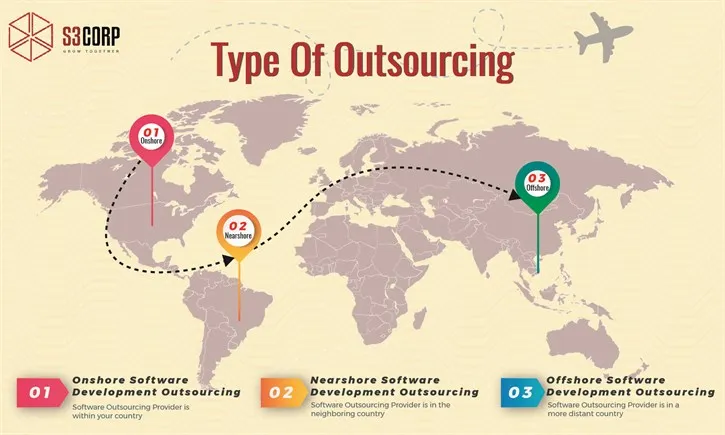
Working with teams in your own country eliminates time zone challenges and cultural differences. Real-time communication flows naturally, and travel for in-person collaboration is manageable.
Costs remain high because labor markets are the same for internal and external teams. You pay for convenience, shared business context, and easier legal compliance.
This model suits projects requiring frequent face-to-face interaction, companies with limited remote work experience, or situations where regulatory requirements favor domestic providers.
Nearshore teams work in adjacent countries or regions with modest time zone differences. A U.S. company might work with developers in Latin America, or a European firm might partner with teams in Eastern Europe.
You get partial cost savings—less than offshore but more than onshore—while maintaining reasonable overlap for synchronous communication. Cultural and business practice similarities reduce friction.
This option balances cost efficiency with communication ease. Teams can schedule daily standups during mutually convenient times without anyone working odd hours.
The offshore outsourcing model places development teams in distant countries with significant cost advantages. Asian markets like Vietnam, India, and the Philippines offer skilled developers at a fraction of Western rates.
Time zone differences require intentional collaboration design. Overlapping hours are limited, so teams rely heavily on async communication, clear documentation, and well-structured handoffs.
The cost benefits are substantial. Companies access the same skill levels at 40-60% lower rates, making offshore models attractive for budget-conscious organizations or projects where labor costs dominate expenses.
Cultural and language differences require active management. Clear writing, visual communication, and explicit context-setting help bridge gaps. Companies that invest in relationship building and process clarity see strong results with offshore teams.
How you pay shapes incentives, risk distribution, and flexibility.
Fixed price contracts establish a set cost for defined deliverables. The vendor quotes a total price, you agree, and they deliver what was specified regardless of actual effort required.
This works when requirements are stable and well-understood. Building a known feature set or replicating an existing system fits this structure. The vendor assumes execution risk—if development takes longer than expected, they absorb the cost.
Budget predictability is the main advantage. Finance teams appreciate knowing exactly what a project costs. Fixed price also motivates vendors to work efficiently since additional hours do not increase revenue.
The downside is rigidity. Changing requirements mid-project triggers expensive change orders. Discovery work during development often reveals better approaches than initial specifications, but pivoting costs time and money.
Vendors also pad estimates to cover uncertainty. If they are taking execution risk, they build buffer into quotes. You may pay more for perceived safety.
Time and materials bills you for actual hours worked plus material costs. Developers track time, you pay agreed hourly or daily rates, and expenses get passed through at cost.
This model embraces flexibility. Requirements can evolve, priorities can shift, and new discoveries can redirect work without contractual friction. You pay for what actually happens rather than what you predicted months ago.
It works well for exploratory projects, long-term product development, or any situation where requirements will emerge during execution. Agile development naturally aligns with time and materials since agile assumes changing priorities.
The tradeoff is budget uncertainty. Costs can exceed initial estimates if scope expands or work proves more complex than expected. Disciplined backlog management and regular budget reviews help control spending.
This model also requires trust. You are paying for effort, so you need confidence the vendor works efficiently and honestly. Transparent reporting, regular demos, and outcome-focused conversations build necessary accountability.
|
Model |
Control |
Flexibility |
Cost Range |
Best For |
Main Risk |
|
Staff Augmentation |
High – you manage daily work |
High – scale up/down easily |
Mid-High – competitive developer rates |
Filling specific skill gaps, temporary capacity needs |
Management burden, integration challenges |
|
Dedicated Team |
Medium – strategic direction, vendor handles execution |
Medium – stable team, adaptable scope |
Mid – balanced team structure cost |
Long-term product development, sustained capacity needs |
Coordination overhead, team ramp-up time |
|
Project-Based |
Low – vendor owns delivery |
Low – scope changes costly |
Varies – depends on pricing model used |
Well-defined projects, one-time initiatives |
Scope creep, misaligned expectations |
|
Onshore |
High – same business hours, easy communication |
High – frequent interaction possible |
High – domestic labor rates |
Regulatory compliance needs, frequent collaboration |
Cost inefficiency |
|
Nearshore |
Medium-High – some timezone overlap |
Medium-High – manageable communication |
Mid – moderate cost savings |
Balanced cost and communication needs |
Limited talent pool in some regions |
|
Offshore |
Medium – timezone coordination needed |
Medium – requires process discipline |
Low-Mid – significant cost advantage |
Budget-constrained projects, scalable development |
Communication gaps, coordination complexity |
|
Fixed Price |
Low-Medium – vendor plans execution |
Low – changes require negotiation |
Varies – includes risk premium |
Stable requirements, defined deliverables |
Scope rigidity, change order costs |
|
Time & Materials |
High – continuous priority control |
High – adapt as you learn |
Varies – reflects actual effort |
Evolving projects, exploratory work |
Budget overruns, requires active management |
Matching your outsourcing model to your actual situation requires honest assessment of several factors. Organizations that pick models based on what sounds good rather than what fits their reality waste money and time.
Project clarity determines whether fixed structures work
If you can write detailed specifications describing exactly what you need, project-based or fixed-price models make sense. If you are figuring things out as you go—which most software projects involve—time and materials with staff augmentation or a dedicated team gives necessary flexibility.
Ask yourself whether your requirements could change based on user feedback, market conditions, or technical discoveries. If yes, prioritize flexible models. Building something genuinely new always involves learning and adaptation. Requirements written six months before development starts are usually outdated by the time coding begins.
Consider whether you have built similar products before. Prior experience helps you predict requirements more accurately, making fixed structures more viable. First-time projects almost always involve surprises that require flexibility.
Budget sensitivity shapes location and pricing decisions
Companies with tight budgets benefit from offshore models and time-and-materials pricing that avoids vendor risk premiums. Organizations with more financial flexibility might prefer onshore teams or fixed-price contracts for predictability.
Consider whether cost certainty or cost minimization matters more. Fixed price gives certainty but often costs more due to risk padding. Time and materials risks overruns but avoids premiums and maximizes efficiency.
Calculate your cost tolerance. Can you absorb a 20% budget overrun if the project delivers great results? Then time and materials works. Need to stay within a strict budget because funds are limited? Fixed price or carefully managed time and materials with hard caps makes more sense.
Think about opportunity cost. Spending less on development might let you invest more in marketing or sales. Spending more on development might mean skipping other initiatives. Understanding these tradeoffs helps you choose models that optimize total business value rather than just minimizing development costs.
Internal management strength determines engagement model fit
Teams with experienced technical leadership can effectively manage augmented staff. Organizations lacking management bandwidth need dedicated teams or project-based models where the vendor handles daily coordination.
Evaluate honestly whether your team can provide clear direction, timely feedback, and effective oversight. Weak internal management combined with staff augmentation creates expensive confusion where developers wait for decisions, build the wrong things, or work inefficiently because nobody guides them.
Consider your management capacity relative to project demands. Managing two augmented developers is easy. Managing ten is hard. If you need substantial capacity but lack proportional management strength, dedicated teams scale better because you manage one team lead instead of ten individuals.
Think about management sustainability. Can your tech lead handle current responsibilities plus managing external developers for six months? If they are already stretched thin, adding management burden creates burnout risk and compromises both internal work and external team effectiveness.
Timeline influences both engagement and location choices
Urgent projects need fast ramp-up, favoring augmentation or onshore teams that can start quickly. Long-term initiatives support dedicated team models that take time to gel but deliver sustained value.
Consider whether you need someone coding tomorrow or can invest weeks building the right team structure. Augmentation can add developers within days if you have clear tasks ready. Dedicated teams require weeks to assemble, onboard, and establish working rhythms.
Think about project duration. Short projects under three months work better with augmentation or project-based models because dedicated teams do not have time to amortize setup costs and learning curves. Long projects over six months benefit from dedicated teams whose initial investment pays off through sustained productivity.
Account for ramp-up time when planning. Offshore teams typically need four to eight weeks to become fully productive as they learn your domain, processes, and codebase. Onshore teams may reach productivity in two to four weeks. Plan accordingly so deadlines account for reality.
Need for flexibility points toward specific model combinations
Products requiring frequent pivots need time-and-materials pricing with staff augmentation or dedicated teams. Well-defined projects with stable requirements fit fixed-price project-based models.
Think about how often your priorities shift. Weekly? Then you need maximum flexibility through time and materials with integrated teams. Monthly? Dedicated teams with time and materials work well. Rarely? Fixed-price project-based outsourcing can deliver efficiently.
Consider how much you know versus how much you need to discover. Proven concepts with clear requirements support fixed models. Novel products where you are validating assumptions require flexible models that embrace learning and adaptation.
Evaluate your tolerance for ambiguity. Some organizations operate comfortably with evolving plans and changing priorities. Others need structure and predictability to function. Choose models that match your organizational culture and operating style.
Smart companies combine models strategically rather than choosing one approach for everything. Different work types have different needs, and sophisticated outsourcing strategies match models to specific situations.
Many organizations use offshore dedicated teams for core product development combined with onshore staff augmentation for specialized integration work. The bulk of feature development happens cost-effectively offshore while niche expertise integrates tightly with internal teams. This approach balances cost efficiency with collaboration quality where it matters most.
Another pattern pairs time and materials pricing with staff augmentation during discovery phases, then shifts to fixed price project-based outsourcing once requirements stabilize. You maintain flexibility during early exploration when learning happens quickly, then lock in costs for execution once you know what you are building. This reduces waste from building the wrong things while capturing cost certainty when risk decreases.
Some companies run dedicated offshore teams for ongoing platform work while handling urgent fixes or specialized features through nearshore staff augmentation. This balances cost efficiency for sustained work with responsive capacity for situations requiring closer collaboration or faster iteration.
Organizations with multiple products might use dedicated teams for each major product line while employing project-based outsourcing for internal tools or secondary initiatives. Core products get sustained attention from teams that build deep knowledge, while smaller projects get handled efficiently without distracting primary teams.
Large enterprises sometimes maintain onshore staff augmentation for security-sensitive work that must meet regulatory requirements, nearshore dedicated teams for customer-facing applications that need good collaboration, and offshore dedicated teams for backend services and data processing where cost efficiency and deep technical work matter most.
The key is matching model characteristics to specific work requirements rather than forcing everything into one approach. Flexibility in your outsourcing strategy lets you optimize different objectives simultaneously.
Choosing software outsourcing models requires understanding three dimensions: how teams work together through engagement models, where they are located through geography, and how you pay through pricing structures. The right combination depends on your specific project requirements, management capacity, budget constraints, and flexibility needs. Companies that honestly assess these factors and match models to their actual situation build productive outsourcing relationships that deliver value efficiently. Those that choose based on assumptions, follow trends, or copy what competitors do often face frustration, waste money, and spend months correcting course. Take time upfront to understand your real needs and constraints, then select models that support your goals rather than fighting against how your organization actually operates.
No single model is universally best. Staff augmentation works when you have strong internal management and need flexible capacity. Dedicated teams suit long-term product development with less management bandwidth. Project-based models fit well-defined initiatives with stable requirements. Choose based on your project clarity, management capacity, budget, and flexibility needs.
Staff augmentation adds individual developers to your existing team under your direct management. You control daily work and need strong internal leadership. Dedicated teams give you a complete squad that operates semi-independently under strategic guidance. They need less day-to-day management but offer less direct control. Pick augmentation when you have capable managers and want maximum control. Choose dedicated teams when you want sustained capacity without management overhead.
Fixed price contracts set a total cost for defined deliverables, giving budget certainty but limiting flexibility. Scope changes trigger expensive renegotiation. Time and materials bills actual hours worked, allowing flexible priorities but creating budget uncertainty. Use fixed price when requirements are stable and you value cost predictability. Choose time and materials when requirements will evolve and you need adaptability.
An engagement model defines how you structure your working relationship with an outsourcing provider. It specifies whether external developers join your team directly, work as a separate dedicated unit, or operate independently to deliver a complete project. The engagement model determines communication patterns, management responsibility, integration depth, and operational control. Common engagement models include staff augmentation, dedicated development teams, and project-based outsourcing.