Insights
Table Of Content
TL;DR
Why Agent Type Is the First Decision That Matters?
What Are Agentic AI Agents?
Standard Classification of AI Agents
Advanced Agentic AI Types for Enterprise Environments
Key Differences Between Agent Types
How to Choose the Right Agent Type for Your Business
Real Business Use Cases by Agent Type
Common Mistakes in Agentic AI Deployment
How S3Corp Approaches Agentic AI Development
Conclusion: The Type Determines the Outcome
FAQ on Types of Agentic AI
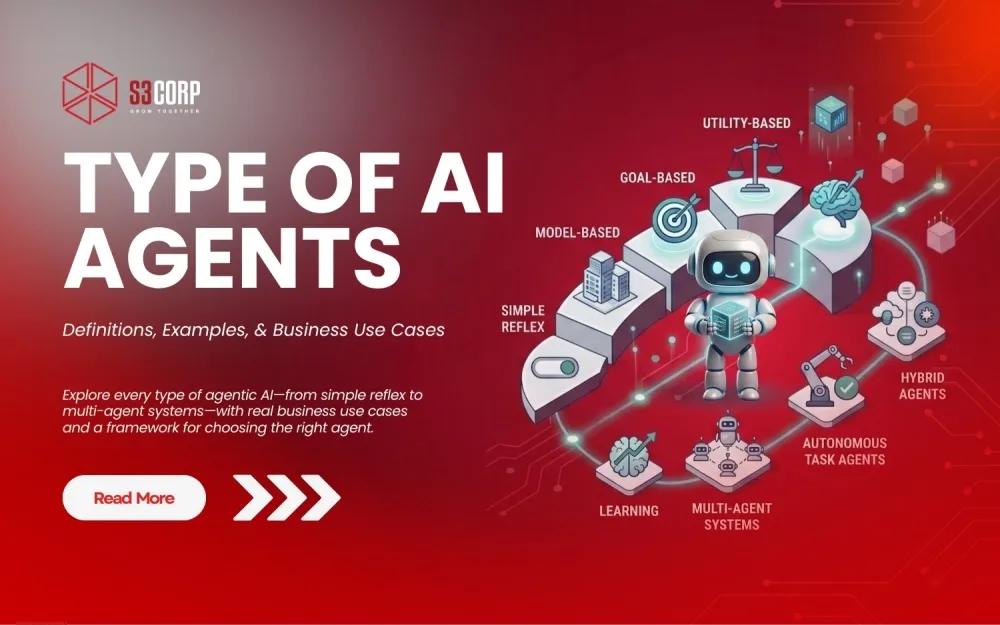
A practical guide to the classification of agents in AI—covering definitions, examples, and a decision framework to help business leaders match the right agent type to the right problem
24 Apr 2026
TL;DR
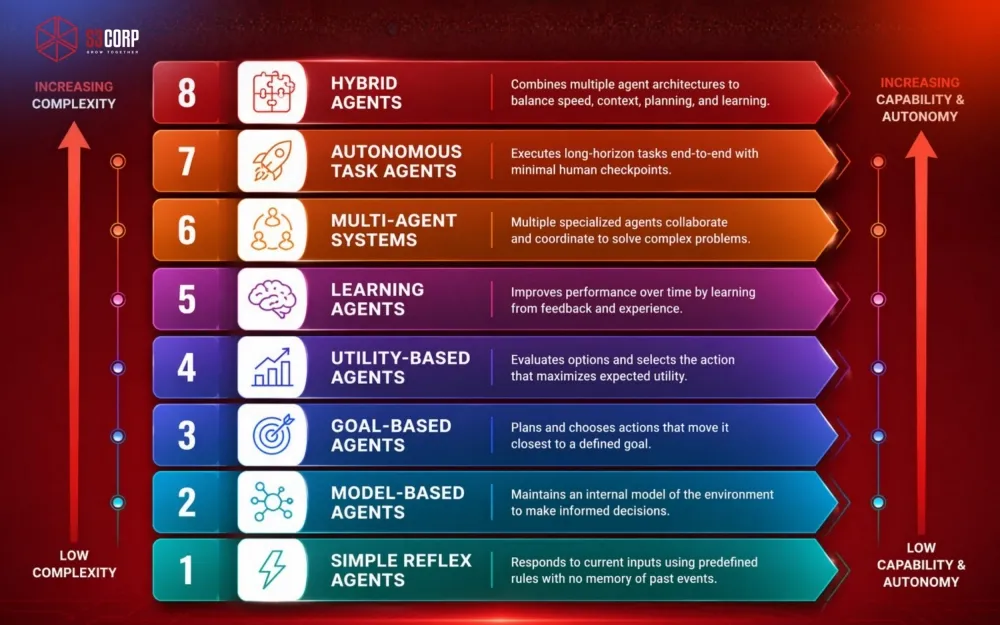
Agentic AI systems are classified into five foundational types — Simple Reflex, Model-Based, Goal-Based, Utility-Based, and Learning — each suited to a different level of decision complexity. Modern enterprise deployments extend these into three advanced architectures: Multi-Agent Systems (parallel coordination across specialized agents), Autonomous Task Agents (end-to-end execution of long-horizon goals), and Hybrid Agents (layered combinations of multiple types in a single system).
There is no universally best type. Choosing correctly depends on three factors:
- Problem structure — rule-governed tasks suit reflex agents; optimization problems suit utility-based; improvement over time suits learning agents
- Data readiness — learning and utility-based agents require clean, sufficient data; reflex and model-based agents are more forgiving of immature data environments
- Risk and cost tolerance — more autonomous architectures deliver higher capability but introduce higher latency, operating cost, and security exposure (including agentic loop risks and prompt injection vulnerabilities)
The matching exercise — problem type to agent type, done before a line of code is written — is what separates AI implementations that scale from ones that stall.
Bottom line: There is no universally best agent type. Match the architecture to the problem, the data, and the risk profile — in that order. Start with simpler types, prove value, then scale toward autonomy.
Get a quick architecture recommendation based on your use case, data, and risk level.
Agentic AI refers to artificial intelligence systems that can perceive their environment, make decisions, and take actions autonomously to achieve defined goals — without requiring a human to prompt every step. If you have been watching the rapid rise of AI across enterprise operations, you have probably noticed the term being used interchangeably with "autonomous agents" or "intelligent agents." Same family, different levels of capability.
This guide cuts through the noise. You will learn the standard classification of AI agent types, how each one works, and — critically — which type fits which business problem. Whether you are evaluating your first AI deployment or rearchitecting a full automation stack, understanding these distinctions is the starting point for any strategic approach.
For the broader strategic picture, start with our Agentic AI on what agentic AI means for enterprise.
Before breaking down types, it helps to be precise about what an "agent" actually is in the AI context.
An intelligent agent is a software entity that perceives inputs from its environment, processes those inputs according to some internal logic, and produces outputs — decisions or actions — that affect that same environment. The key word is autonomy. Unlike traditional automation, which follows a fixed script, an agent makes judgment calls.
Three characteristics define every agentic AI system:
The critical difference between traditional automation and agentic AI is this: traditional automation follows a fixed script. A rule fires, an output is produced. Agentic AI, by contrast, can handle ambiguity, adapt to new inputs, and—depending on the agent type—improve over time. A rule-based chatbot routes tickets. A learning agent builds a progressively better picture of customer intent and adjusts its behavior accordingly.
Traditional Automation vs Agentic AI
|
Feature |
Traditional Automation |
Agentic AI |
|
Logic |
Fixed rules |
Dynamic decisions |
|
Adaptability |
Low |
High |
|
Learning |
None |
Continuous |
That distinction matters enormously when you are scoping a project or evaluating vendors.
 Standard Classification of AI Agents
The academic and engineering literature converges on five foundational types. These are not competing products — they are conceptual blueprints that real-world systems are built from.
A simple reflex agent maps a perceived input directly to a predefined action. If condition X, do action Y. No memory of what happened before.
A model-based agent maintains an internal representation of the world — essentially a working memory of how the environment has evolved over time. This allows it to handle partially observable environments where the current input alone is insufficient to determine the right action.
Model-based agents are the minimum viable option for any environment where context shifts between interactions. For enterprises running complex infrastructure, this layer of memory is non-negotiable.
Goal-based agents introduce explicit objectives. Instead of matching conditions to responses, they evaluate multiple possible actions and choose whichever one moves them closest to a defined goal.
Goal-based agents are where agentic AI starts to feel genuinely autonomous. They can handle multi-step processes that would otherwise require a project manager to babysit. This architecture is central to many modern Web Application Development projects where business logic is complex and conditional.
Goal-based agents ask "will this action reach the goal?" Utility-based agents ask a harder question: "which of all goal-reaching actions produces the best outcome?" Rather than simply reaching a goal, it finds the best way to reach it by scoring outcomes against a utility function that quantifies tradeoffs.
Utility-based agents are powerful, but they require clearly defined optimization criteria. Ambiguous utility functions produce confusing and sometimes damaging outputs—a lesson many early AI pricing experiments learned the hard way.
For businesses in E-Commerce and Retail or fintech, utility-based logic often sits at the heart of the most commercially impactful AI deployments.
Learning agents are the most architecturally sophisticated of the five standard types. It improves its own performance through feedback. It has a performance element (the active decision-maker), a critic (which evaluates outcomes), a learning element (which updates behavior based on the critique), and a problem generator (which explores new strategies).
Learning agents are the backbone of most modern AI use cases in consumer tech—from Netflix recommendations to Google's search ranking, from fraud detection in FinTech Solutions to personalized education paths in EdTech platforms. The feedback loop is their engine; data quality is their fuel.
The five classical types represent a spectrum of capability. Modern enterprise systems, however, often require architectures that go beyond a single agent type.
A multi-agent system (MAS) is an environment where multiple independent agents operate simultaneously, either cooperatively or competitively, to solve problems that are too large or too complex for a single agent.
Think of it as the difference between one highly skilled analyst and a full team of specialists — each handling their domain, sharing information, and arriving at a collective result faster than any individual could.
Multi-agent systems are where scalable architecture for AI becomes critical. Poorly designed inter-agent communication creates bottlenecks and conflict states that are hard to debug. For organizations looking to build these systems, working with an experienced software outsourcing services partner can compress the learning curve significantly.
Platforms like AutoGPT, CrewAI, and enterprise variants built on LangGraph are making this category increasingly accessible. But implementation quality varies enormously, and the risk profile demands rigorous testing before production deployment.
Autonomous task agents are designed to complete long-horizon, multi-step tasks with minimal human checkpoints. They break a high-level objective into subtasks, execute each one, handle errors, and deliver a final output. These are the systems that most people imagine when they hear "AI agent" in 2025–2026.
For engineering teams and Software Outsourcing Services, autonomous task agents represent the most direct path to meaningful throughput gains on repeatable, well-defined workflows.
Most production AI systems are, in practice, hybrid agents — they combine reactive rules (for speed and safety), internal models (for context), goal-directed planning (for complex sequences), and learning loops (for improvement over time).
Pure architectures are useful for classification and learning — but real enterprise problems rarely fit neatly into a single box. Hybrid agents are what scalable architecture looks like in practice. They give organizations the control of rule-based systems and the adaptability of learning systems in a single deployable product.
|
Agent Type |
Memory |
Adaptability |
Decision Logic |
|
Simple Reflex |
None |
None |
Condition → Action rules |
|
Model-Based |
Short-term state |
Low |
Rules + environment model |
|
Goal-Based |
Goal + state |
Medium |
Planning toward an objective |
|
Utility-Based |
Goal + state + preferences |
Medium-High |
Maximize expected utility |
|
Learning |
Persistent, evolving |
High |
Feedback-driven model updates |
|
Multi-Agent |
Distributed across agents |
Very High |
Cooperative or competitive coordination |
|
Autonomous Task |
Task memory + tool outputs |
High |
Hierarchical subtask decomposition |
The type of agent that creates value for your organization depends on three practical factors — not on which technology sounds most impressive.
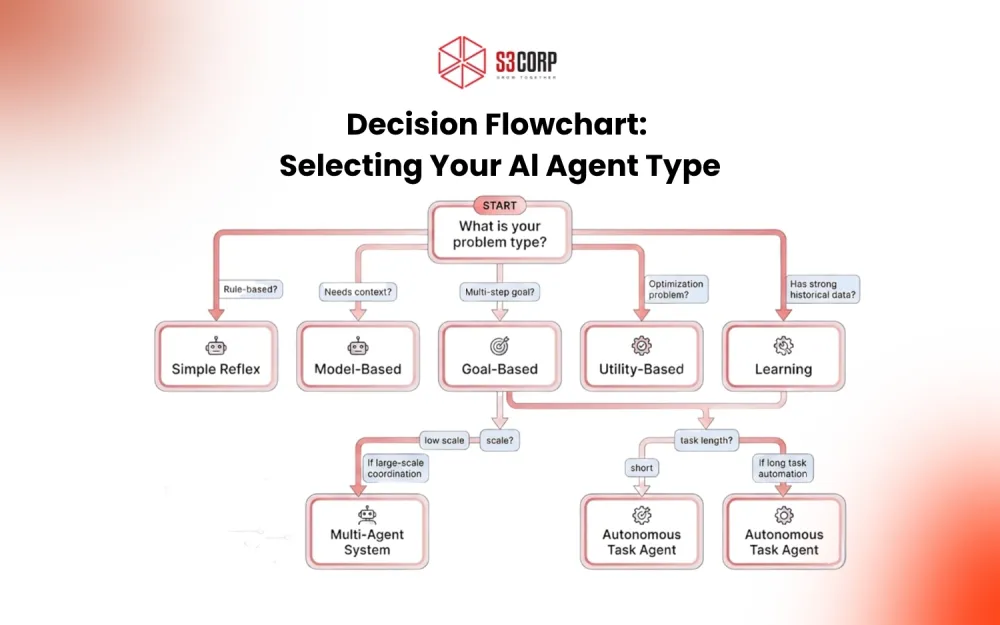
|
Problem Type |
Best Agent Match |
Real-World Agent Examples |
|
Fixed rules, low variability |
Simple Reflex |
Zendesk rule-based routing, IVR phone trees, basic spam filters |
|
Context-dependent decisions |
Model-Based |
Datadog anomaly detection, AWS CloudWatch alarms, network intrusion monitors |
|
Multi-step workflows with a clear end state |
Goal-Based |
Zapier multi-step automations, ServiceNow workflow engines, robotic process automation (RPA) bots |
|
Trade-off optimization across multiple variables |
Utility-Based |
Airbnb/Uber surge pricing engines, programmatic ad bidding systems, inventory reorder optimizers |
|
Improving accuracy from user or outcome data |
Learning |
Spotify Discover Weekly, Netflix recommendations, Salesforce Einstein lead scoring |
|
Distributed, large-scale coordination |
Multi-Agent |
AutoGen multi-agent pipelines, CrewAI orchestration frameworks, enterprise supply chain platforms |
Agent architecture does not just determine capability — it determines operating cost and response speed. These two dimensions often break tie-breakers when multiple agent types could technically solve the same problem.
|
Agent Type |
Typical Latency |
Relative Cost per Decision |
Notes |
|
Simple Reflex |
< 10ms |
Very Low |
Runs on deterministic rules; no model inference required |
|
Model-Based |
50–200ms |
Low–Medium |
State maintenance adds overhead; scales with model complexity |
|
Goal-Based |
200ms–2s |
Medium |
Planning algorithms are computationally heavier; depends on action space size |
|
Utility-Based |
100ms–1s |
Medium–High |
Scoring many options in parallel; cost rises with variable count |
|
Learning |
Variable |
High (training) / Medium (inference) |
Training cost is upfront and significant; inference at scale is manageable |
|
Multi-Agent |
500ms–5s+ |
High |
Coordination overhead multiplies with agent count; parallel execution helps but adds infra cost |
|
Autonomous Task |
Seconds–minutes |
Highest |
Multiple LLM calls, tool invocations, and replanning loops per task |
The practical implication: if your use case demands sub-100ms responses — real-time fraud screening, live content moderation, instant chatbot replies — reflex and model-based agents are the only architectures that reliably deliver at that speed. Learning and autonomous task agents are better suited for asynchronous workflows where a slightly longer processing window is acceptable in exchange for higher decision quality.
Learning agents require clean, labeled, historical data to train on — and continuous feedback loops to improve. If your data is sparse, inconsistent, or siloed, starting with a learning agent will produce disappointing results and erode stakeholder confidence in AI adoption.
Goal-based and utility-based agents need well-defined problem spaces and clear success metrics. Reflex and model-based agents are more forgiving of limited data environments, making them reasonable starting points for organizations early in their AI journey.
Autonomous task agents and multi-agent systems operate with significant independence. In regulated industries—healthcare, fintech, financial services—this independence requires well-designed override mechanisms and audit trails. The more autonomous a system, the more critical it is to implement observability, rollback mechanisms, and human-in-the-loop checkpoints for high-stakes decisions.
For organizations in Fintech or Healthcare verticals, agent governance is not optional. It is a compliance requirement.
Beyond general caution, there are specific technical and security risks that every team deploying agentic AI needs to account for explicitly:
A practical framework: deploy reflex or model-based agents in production first. Measure performance, build trust, then graduate to more autonomous architectures as your team's confidence and your infrastructure's maturity both grow. Good software testing services coverage at each stage — including adversarial testing for prompt injection and loop conditions — is non-negotiable.
We help you design, test, and deploy the right agent architecture — from simple automation to multi-agent systems.
Understanding classifications is only useful when you can map them to outcomes. Here is how these agent types perform across common enterprise functions.
Customer Support (Simple Reflex → Hybrid): A global e-commerce brand starts with reflex agents for FAQ deflection—reducing first-contact load by routing inquiries automatically. As the data matures, they layer a learning agent to detect sentiment shifts and escalation signals, creating a hybrid that handles 70–80% of contacts without human intervention.
Sales and Revenue (Learning Agents): Predictive lead scoring, churn prediction, and next-best-action recommendations all depend on learning agents ingesting CRM history, engagement signals, and closed-won data. Organizations that deploy this architecture consistently report pipeline quality improvements within two to three quarters.
Supply Chain & Logistics (Utility Agents + Multi-Agent Systems): Optimizing delivery routes, balancing inventory across warehouses, and coordinating supplier lead times are inherently multi-variable problems. Utility-based agents handle trade-off optimization; multi-agent systems coordinate across organizational boundaries.
Software Engineering (Autonomous Task Agents): Code generation, test writing, pull request summarization, and documentation are all being accelerated by autonomous task agents. Teams that integrate these into existing CI/CD pipelines through DevOps Services are seeing measurable reductions in cycle time — particularly for routine, well-defined engineering tasks.
Engineering & DevOps (Autonomous Task Agents): Development teams use autonomous agents integrated with their DevOps Services pipeline to run regression tests, flag regressions, and generate incident summaries—eliminating hours of manual investigation per incident. Organizations looking to implement this can explore Web Application Development Services and Full-Lifecycle App Development frameworks that integrate agentic tooling from the start.
Healthcare Operations (Model-Based & Goal-Based Agents): In HealthCare Solutions, model-based agents support clinical decision tools that track patient history across encounters. Goal-based agents power care coordination workflows where the objective is measurable — discharge readiness, medication adherence, follow-up completion.
Getting the classification right is only half the challenge. These are the mistakes that consistently undermine AI initiatives — even when the technology choice is correct.
With over 19 years of experience delivering software solutions for clients across North America, the UK, Singapore, and beyond, the team at S3Corp has watched the AI agent landscape shift from academic theory to enterprise standard.
The pattern is consistent: businesses that define the agent architecture before writing a line of code achieve faster time-to-value and fewer costly rearchitects downstream. That discipline — strategic approach first, implementation second — is the foundation of every AI engagement at S3Corp.
S3Corp works with product leaders and CTOs to design innovative solutions that start with the right agent classification, build on a solid data foundation, and apply optimizing cost and performance at every layer of the stack. Whether you are exploring a targeted automation for a single workflow or orchestrating a multi-agent system for enterprise operations, the work begins with a clear problem definition—not a technology choice.
Our teams span Mobile App Development, Web Application Development Services, Software Testing Services, and full-cycle delivery, which means we can support the full agent implementation journey—from architecture design through production deployment and ongoing iteration.
If you are mapping your AI strategy and want a second opinion on which agent architecture fits your use case, contact the S3Corp team for a working session with our technical leads.
Work with a team that has delivered production-grade systems across industries.
No single agent type is universally superior. A learning agent deployed in an environment with no reliable data will underperform a well-designed simple reflex system. A reflex agent applied to a dynamic, multi-variable problem will fail the moment reality moves outside its rule set.
The discipline is in the matching: problem type to agent type, data readiness to learning requirements, risk tolerance to autonomy level. That matching exercise—done rigorously before a line of code is written—is what separates AI implementations that scale from ones that stall.
The five standard types of intelligent agents in AI are: Simple Reflex Agents, Model-Based Agents, Goal-Based Agents, Utility-Based Agents, and Learning Agents. Each represents a different level of decision-making sophistication, from basic condition-action rules to feedback-driven self-improvement.
A goal-based agent asks: "Will this action achieve my goal?" It selects any action that reaches the objective. A utility-based agent asks: "Which action produces the best outcome?" It quantifies and compares all goal-reaching options using a utility function, optimizing for maximum value rather than simple success.
They overlap significantly, but "intelligent agents" is the broader academic classification. "Agentic AI" is the more recent industry term, typically applied to modern systems capable of long-horizon autonomous task execution — often combining multiple agent types in a single architecture. All agentic AI systems are intelligent agents, but not all intelligent agents qualify as fully agentic.
There is no universal answer. The best agent type depends on your problem structure, data maturity, and risk tolerance. Simple reflex agents work well for narrow, rule-governed tasks. Learning agents add value where historical data is rich and continuous improvement matters. Utility-based agents excel at optimization problems. For complex, distributed challenges, multi-agent systems often deliver the highest impact — at the cost of greater architectural complexity.
The five foundational types (Reflex, Model-Based, Goal-Based, Utility-Based, Learning) are standard across AI literature. In applied enterprise contexts, these expand to include Multi-Agent Systems, Autonomous Task Agents, and Hybrid Agents — which combine multiple foundational types into a single deployable system.

Whether you have any questions, or wish to get a quote for your project, or require further information about what we can offer you, please do not hesitate to contact us.
Contact us Need a reliable software development partner?
S3Corp. offers comprehensive software development outsourcing services ranging from software development to software verification and maintenance for a wide variety of industries and technologies





Software Development Center
_1746790956049.webp&w=384&q=75)
_1746790970871.webp&w=384&q=75)