Insights
Table Of Content
Key Takeaways
Why Do Most Mobile Apps Fail?
What Actually Causes Apps to Fail in the First 90 Days?
Retention Is the New Failure Line in 2026
The Overlooked Cause: Your Outsourcing Partner
How Do You Vet a Development Partner So These Failures Don't Happen?
US In-House vs. Offshore Development: Cost and Risk by Region
What Can Real App Failures Teach Us?
Don't Let Execution Be the Reason Your App Fails
Frequently Asked Questions
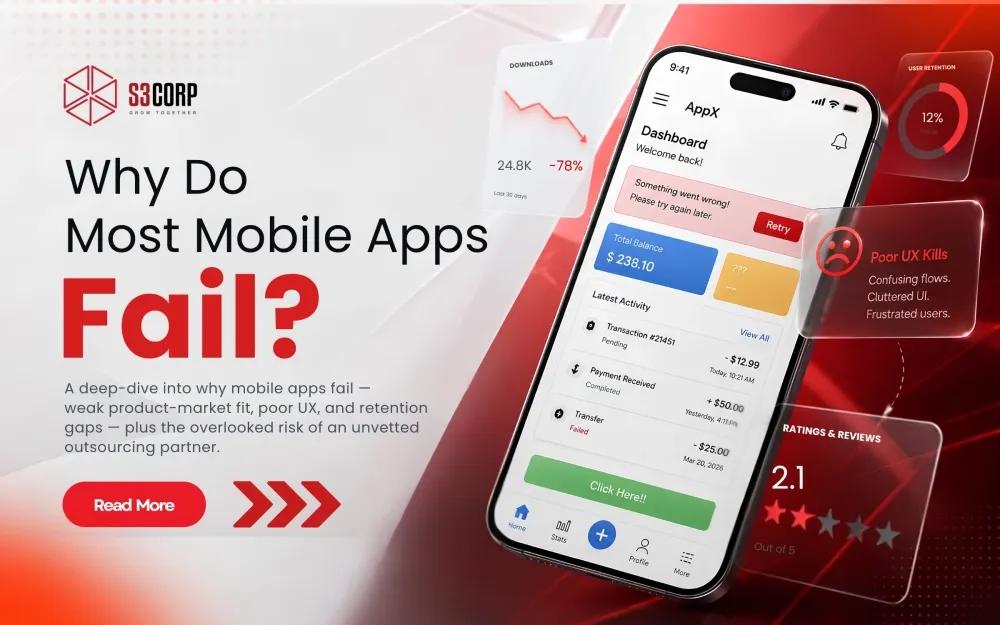
Why Do Most Mobile Apps Fail? The Real Reasons
A deep-dive into why mobile apps fail — weak product-market fit, poor UX, and retention gaps — plus the overlooked risk of an unvetted outsourcing partner.
18 Aug 2026
Key Takeaways
- Most apps fail from four essential causes: weak product-market fit, poor UX and performance, no real distribution plan, and weak retention design.
- B2B apps succeed at roughly 13%, while pure consumer apps succeed at a fraction of that — a gap driven by existing infrastructure and clearer intent.
- Day 30 retention now averages roughly 3.8% on Android and 5.3% on iOS, the sharpest line between apps that survive and apps that quietly die.
- For teams that outsource development, a fifth cause rarely makes the checklist: an execution partner without the technical depth or security discipline to catch these problems before launch.
- Vetting a partner against that risk means checking for a documented QA process, a named security certification such as ISO 27001, and a delivery model built for long-term ownership.
Most mobile apps fail because they solve a problem users do not feel urgently enough, deliver a slow or confusing experience in the first few sessions, launch with no real distribution plan, or lose users faster than the team can replace them. Estimates vary by source, but B2B apps succeed at roughly 13%, while pure consumer apps succeed at a fraction of that number.
Founders and product teams already know this list. What gets skipped is a fifth cause, specific to teams that outsource development instead of building in-house: choosing an execution partner without the technical depth or security discipline to catch these problems before launch. A vendor that ships fast but skips code review, under-tests before release, or leaves security gaps open is just as capable of killing an app as a bad product idea.
This guide covers both: the product mistakes everyone already talks about, and the execution risk almost nobody does.
|
Failure Category |
Root Cause |
Who Usually Owns the Fix |
Preventable Before Launch? |
|
Weak product-market fit |
App solves a problem users do not feel urgently |
Product / Founder |
Yes — with structured validation |
|
Poor UX & performance |
Slow load times, confusing onboarding, unresolved bugs |
Product + Engineering |
Yes — with proper QA cycles |
|
No distribution plan |
App launches with no marketing or ASO strategy |
Marketing |
Yes — with pre-launch planning |
|
Weak retention design |
No habit-forming loop, ignored analytics |
Product |
Yes — with onboarding and analytics design |
|
Unvetted execution partner |
Technical debt, thin QA, security gaps from the vendor |
Outsourcing partner selection |
Yes — with structured vendor due diligence |
Why Do Most Mobile Apps Fail?
Most mobile apps fail because they solve a problem users do not feel urgently enough, deliver a rough or slow experience in the first few sessions, launch with no real marketing plan, or lose users faster than the team can replace them. Estimates vary, but B2B apps succeed at roughly 13%, while pure consumer apps succeed at a small fraction of that.
That gap between B2B and consumer outcomes is not accidental. There is just 13% of B2B mobile apps hit a sustainable threshold of downloads, retention, and revenue after release, while consumer apps face a success rate closer to 0.1%. Business apps solve a problem an organization already has budget and a champion for. Consumer apps have to earn that urgency from a stranger, cold, inside the first thirty seconds.
Essential causes repeat across nearly every failure post-mortem written about this topic:
- Weak product-market fit. The app solves a problem nobody urgently needs solved, or solves it worse than an existing habit already does.
- Poor UX and performance. Slow load times, confusing navigation, and crashes in the first session send users straight to the delete button.
- No real marketing or ASO plan. A well-built app with zero discoverability strategy competes with millions of listings for attention it will never get.
- Weak retention design. No onboarding hook, no habit loop, no reason to open the app again on day two.
- Underestimated budget and planning. Teams run out of runway before the product finds its footing, often because the original scope and cost estimate never matched reality.
What Actually Causes Apps to Fail in the First 90 Days?
In the critical first 90 days, apps most often fail from a stacked combination of weak onboarding, ignored analytics, and no retention design. It is rarely one dramatic mistake. It is several small ones compounding before a team can react.
The first 90 days matter because that window tests product-market fit against real behavior. A founder can believe the value proposition is obvious. Users, moving fast and distracted, decide in seconds whether an app is worth a second look.
Three problems repeat across almost every early-stage failure:
|
Reason |
Early Warning Sign |
Fix |
|
Product-market fit gaps |
Downloads climb, but activation and day-1 return rate stay flat |
Run structured user interviews before writing a line of code; validate the core loop with a lightweight MVP |
|
Onboarding friction |
Users open the app once and never return; sign-up completion under 50% |
Cut the path to first value to under three steps; delay account creation until after the "aha" moment and adopt Passkeys (FIDO2) for passwordless, biometric sign-in — the single most effective way to remove account-creation friction in 2026 |
|
Ignored analytics |
The team ships features based on opinion, not on where users actually drop off |
Instrument funnel analytics from day one; review cohort retention weekly, not quarterly |
Fixing these three does not require a bigger budget. It requires discipline: instrumenting the product before launch, not after churn shows up in a spreadsheet three months later. Teams that treat the MVP stage as a place to test assumptions, rather than as a smaller version of the full product, catch most of this before it becomes expensive to fix.
Retention Is the New Failure Line in 2026
As of 2026, the sharpest dividing line between apps that survive and apps that quietly die is Day 30 retention. Industry benchmarks put average Day 30 retention at roughly 3.8% on Android and 5.3% on iOS, according to Business of Apps' 2026 retention data. Most apps lose the large majority of users before any habit forms.
That number should reframe how teams think about launch. A product that never crashes and looks polished can still fail if nobody opens it a second time. Retention, not download volume, has become the metric investors and acquiring teams check first in 2026.
Three forces push this number lower every year. Users install more apps than ever and delete faster once friction appears. Notification fatigue means push alerts get ignored or disabled within days of install. And AI-personalized competitors, apps that adapt content and offers to an individual user from the first session, have raised the bar for what "good" retention looks like, making generic experiences feel outdated on arrival.
None of this means retention is unfixable. It means retention has to be designed, not hoped for. Apps that win at Day 30 usually get one thing right early: they get a new user to a moment of real value inside the first session, then give that user a reason to return the next day without being asked twice.
The Overlooked Cause: Your Outsourcing Partner
For teams that outsource development rather than build in-house, a meaningful share of what looks like a product failure is actually an execution failure. Technical debt from rushed shortcuts. Thin QA that lets bugs reach production. Unpatched security gaps. A partner who cannot communicate a scope change clearly across time zones. None of this shows up in a typical checklist of why apps fail, because most checklists get written from the founder's side of the relationship, not the vendor's.
That gap matters more than it should. A strong product idea, built by a team without the technical bench to execute it cleanly, still fails. Users do not know or care whether a bug came from a bad idea or a rushed build. They just delete the app.
Let’s imagine: A Series A fintech startup contracts an offshore team to build a mobile banking app. The vendor delivers a working prototype in six weeks, an impressive pace. Three months after launch, a security researcher finds an unauthenticated API endpoint exposing account balances. The root cause traces back to a rushed sprint where authentication got stubbed out "temporarily" to hit a demo deadline, and nobody circled back to fix it before release. This is not a rare hypothetical. It is exactly the failure mode a documented QA process and a named security certification exist to catch.
Six execution failures repeat often enough to be worth naming directly, because each one is a vendor problem, not a product problem:
- Technical debt from rushed shortcuts. Code written to hit a deadline, without refactoring, that becomes unmaintainable within two release cycles.
- Thin QA discipline. Manual testing skipped under deadline pressure, with no automated regression suite catching what breaks on the next release.
- Security and IP exposure. No documented data-handling policy, no Zero Trust access model governing who and what can reach production systems, no hardware-level key storage for sensitive credentials, and no clear answer to who owns the code if the relationship ends.
- Architecture that cannot scale. A prototype-quality build that works for 100 users and falls over at 10,000, because nobody planned for scalable architecture from day one.
- Communication and spec-handoff breakdowns. Requirements reinterpreted at each handoff, across time zones, with no written record of what was actually agreed.
- Ignoring post-launch OS maintenance. No budget set aside for the yearly iOS and Android platform updates that quietly break existing features until a user complaint surfaces the problem.
A strategic approach to vendor selection catches most of this before a contract gets signed. S3Corp built its delivery model around long-term ownership rather than a one-off handoff. That includes an ISO/IEC 27001:2022-certified information security management system, and a technical bench that extends past generic web and mobile stacks into networking, embedded systems, and wireless protocol engineering that most vendors never touch. The certification matters less as a badge and more as evidence: an outside auditor already checked the processes that determine whether a partner catches a security gap before launch or after a breach.
How Do You Vet a Development Partner So These Failures Don't Happen?
Vetting a development partner against app-failure risk means checking for a documented QA process, a named security certification such as ISO 27001, a technical bench that goes beyond generic web and mobile stacks, and a delivery model built for long-term ownership rather than a one-off handoff.
Most vendor evaluations stop at a portfolio review and a sales call. That catches polish, not process. The checklist below is built to be screenshotted and used on an actual vendor call, row by row:
|
Question to Ask |
Red Flag |
What Good Looks Like |
|
Can you show a documented QA process, not just a QA team? |
"We test everything before release," with no further detail |
Written test plans, defined coverage targets, automated regression suites |
|
Do you hold an active security certification? |
No certification, or one nobody can currently produce |
Current ISO/IEC 27001:2022 certification, verified by independent audit |
|
Who owns the code and IP during and after the project? |
Vague contract language, or code held on the vendor's private repository |
Client-owned repositories from day one, with IP transfer written into the contract |
|
What happens when a scope change comes up mid-sprint? |
No documented change-control process |
A written change-request workflow with cost and timeline impact stated upfront |
|
Can I talk to the engineers, not just sales? |
Only account managers made available before signing |
Technical interviews with the actual assigned team, before contract signature |
|
How long has your average client relationship lasted? |
High account-team turnover, short average tenure |
Multi-year client relationships, named references willing to speak |
|
Does your technical bench go past standard web/mobile work? |
Every case study reads the same, regardless of industry |
Named experience across industries like fintech, healthcare, and advertising, with domain-specific compliance awareness |
US In-House vs. Offshore Development: Cost and Risk by Region
Compare typical hourly development rates and delivery risk across in-house US teams and the three most common offshore destinations: Vietnam, India, and the Philippines.
Rate alone tells an incomplete story. A cheap hourly rate attached to high turnover, unclear IP terms, or thin QA can cost more than a higher rate from a stable, well-governed team. The table below lays out both sides of that trade-off:
|
Region |
Typical Rate Band (senior devs) |
Common Risk Profile |
Best Fit For |
|
United States (in-house) |
$120–$200+/hour, fully loaded |
Lowest execution risk; highest cost; slowest to scale headcount |
Core IP, regulated work needing on-site presence |
|
Vietnam |
$50–$80/hour |
Lower attrition than India's major hubs; time zone spans Asia-Pacific and reaches European mornings, US evenings |
Long-term product partnerships, dedicated teams, complex mobile and web builds |
|
India |
$45–$70/hour |
Largest talent pool; higher attrition at major firms can disrupt continuity |
Rapid team scaling, large staff-augmentation engagements |
|
Philippines |
$25–$50/hour |
Strong English fluency; smaller pool for complex engineering work |
Customer-facing, support-heavy builds and simpler mobile/web apps |
Rate ranges reflect current market data, including analysis on outsourcing to Vietnam.
Vietnam sits in an interesting middle position on this table. Rates run close to India and the Philippines, but the risk profile looks different: lower attrition than India's major outsourcing hubs, and a broader base of complex-engineering experience than most Philippines-based teams offer. That combination is why clients across the US, UK, Singapore, and wider APAC increasingly weigh Vietnam alongside the two more established offshore markets, not as a fallback option.
Consider a common cross-border build: a UK-based retail company needs a dedicated team to migrate a legacy e-commerce platform to a modern stack while keeping the existing app live for customers. A Vietnam-based team, running two-week sprints with async written updates and a weekly London-morning sync, hands off working increments during UK business hours even with the time zone gap, because the heaviest development work happens overnight for the client and gets demoed the next morning. That kind of sprint cadence is one make-or-break variable a raw hourly rate never captures.
None of this replaces due diligence on a specific vendor. Region sets the baseline. The checklist in the section above decides whether a specific team, inside that region, is actually the right fit for a specific project.
What Can Real App Failures Teach Us?
The most instructive failures are not the famous consumer flops everyone has already read about. They are the ones that map directly to preventable execution mistakes, the kind a properly vetted development process should catch before launch.
Quibi: a product-market fit failure at unprecedented scale. Quibi raised $1.75 billion before launch, built an entire platform around premium short-form video for mobile-only viewing, and shut down within six months. The lesson for a technical buyer has nothing to do with the funding number. It is that a huge budget and top-tier talent cannot compensate for a core assumption — that people wanted premium content in ten-minute mobile-only chunks — that never got validated against real behavior before the company committed billions to building it. No amount of engineering excellence saves a product built on an unvalidated premise.
A fake security app: a trust and security failure. In a case documented by Singapore police, a victim named Jiang was targeted by scammers who convinced him to download a fraudulent app impersonating Singapore's official ScamShield anti-scam tool, resulting in unauthorized transactions of S$70,000. This was not a product-market fit problem. It was a security and trust failure, the exact category of risk a properly built app should make structurally difficult to exploit through its own permissions, authentication flow, and update-verification design. For any team building something that touches financial data or identity, this case is a reminder that security architecture is not a launch afterthought.
Both failures teach the same underlying lesson from opposite ends. Quibi shows that flawless execution cannot rescue an unvalidated idea. The fake-app case shows that even a legitimate, well-intentioned category of app creates an attack surface bad actors will exploit if security gets treated as optional. Product thinking and execution discipline are not substitutes for each other. Both have to hold, together, for an app to survive.
Don't Let Execution Be the Reason Your App Fails
The product mistakes covered above are avoidable with research and design discipline. Weak product-market fit, poor onboarding, thin retention design — all of it responds to better process on the product side.
The execution mistakes are a separate problem, avoidable by choosing the right delivery partner from the start. Technical debt, thin QA, security gaps, and communication breakdowns are not product problems. They are vendor-selection problems, preventable with the same discipline a good product team already applies to its own roadmap.
S3Corp has spent 19+ years watching both categories of failure play out, across 400+ delivered projects for 250+ clients in 25+ countries, and holds a current ISO/IEC 27001:2022 certification along with the 2026 Sao Khue Recognition of Excellence for software outsourcing. If a team is weighing whether to build in-house or vet an outsourcing partner properly, that experience is worth a conversation before a contract gets signed, not after a launch goes wrong.
Contact the S3Corp team to walk through a specific project's technical and security requirements before committing to a build.
Frequently Asked Questions
Why do most mobile apps fail?
Most apps fail from a combination of weak product-market fit, poor UX and performance, no real distribution plan, and weak retention design. For teams that outsource development, a fifth cause often goes unaddressed: an execution partner without the technical depth or security discipline to catch these problems before launch.
What percentage of mobile apps fail?
Estimates vary by source and definition of success. B2B app success at roughly 13%, with pure consumer apps succeeding closer to 0.1%. The gap reflects existing infrastructure, budget, and clearer user intent behind most B2B apps.
Why do apps fail in the first 90 days?
Early failure usually comes from a stacked combination of product-market fit gaps, onboarding friction, and ignored analytics, not one dramatic mistake. Teams that instrument funnel analytics and review cohort retention weekly, starting at launch, catch most of these issues before they compound.
How do you know if your outsourcing partner is a failure risk?
Check for a documented QA process, an active security certification such as ISO 27001, a technical bench beyond generic web and mobile work, and a delivery model built for long-term ownership. Vague answers on code ownership or testing discipline are red flags worth pausing on.







_1746790956049.webp&w=384&q=75)
_1746790970871.webp&w=384&q=75)