Whether you have any questions, or wish to get a quote for your project, or require further information about what we can offer you, please do not hesitate to contact us.
Contact us Need a reliable software development partner?
S3Corp. offers comprehensive software development outsourcing services ranging from software development to software verification and maintenance for a wide variety of industries and technologies





Software Development Center
_1746790956049.webp&w=384&q=75)
_1746790970871.webp&w=384&q=75)



Insights
Table Of Content
TL;DR — Agile Software Development: Process, Benefits & Implementation
Introduction
What Is Agile Software Development?
How Agile Differs From Traditional Project Management
Why Agile Changed Modern Software Development
Core Agile Software Development Process & Lifecycle
Popular Agile Frameworks: Scrum, Kanban, XP, SAFe, and Hybrid Models
Benefits of Agile Software Development
Challenges of Agile Software Development — The Honest View
Agile Roles and Responsibilities
Agile Metrics and KPIs: How Teams Actually Measure Success
Agile + DevOps: Modern Software Delivery
AI in Agile Software Development
Agile Software Development Tools
How to Implement Agile Software Development: A Practical Roadmap
How Our Agile Development Team Works
When Is Agile Software Development the Best Choice?
Future Trends in Agile Development (2026–2027)
Conclusion: Agile Is a Practice, Not a Project Phase
Frequently Asked Questions
A deep-dive guide to Agile software development — covering the lifecycle, Scrum, Kanban, sprint planning, retrospectives, metrics, and how to implement Agile from day one.
18 May 2026
What is Agile? Agile software development is an iterative delivery model where cross-functional teams ship working software in short cycles (sprints), collect real feedback, and continuously improve. It is guided by the 2001 Agile Manifesto's four values and twelve principles.
Why it matters: The Standish Group found only 31% of traditional software projects succeed on time and on budget. Agile teams ship up to 37% faster and adapt to changing requirements without restarting from scratch.
How it works — the core loop:
Top frameworks: Scrum (most common), Kanban (continuous flow), XP (engineering quality), SAFe (enterprise scale).
Real benefits: Faster releases, lower defect rates, better product-market fit, higher team morale, and genuine stakeholder visibility — not slide-deck updates.
Where Agile fails: Cargo-cult ceremonies without mindset change, poor backlog hygiene, fixed-price contracts that conflict with adaptive planning, and scaling Scrum to 20 teams without a proper framework.
Key metrics to track: Velocity, cycle time, lead time, deployment frequency, defect escape rate, and change failure rate (DORA metrics).
Agile + DevOps: Agile sets the delivery rhythm. DevOps makes it operationally reliable. CI/CD, automated testing, and infrastructure as code are not optional — they are what make frequent releases sustainable.
Bottom line: Agile is a mindset first, a process second. The teams that win with it are not the ones who follow Scrum by the book — they are the ones who internalize continuous learning, customer collaboration, and shipping real software over writing reports.
Software projects fail for a simple reason more often than most leaders expect: teams spend months building features customers no longer need. The 19th State of Agile Report showed that 71% organizations use Agile in their software development lifecycle because it improves collaboration, accelerates delivery, and helps teams respond faster to changing priorities.
Agile software development is an iterative approach to building software that prioritizes working products, customer collaboration, and the ability to respond to change over rigid planning and documentation. Instead of shipping one massive product after 18 months, agile teams deliver value in short cycles — typically one to four weeks — collecting customer feedback at every step.
This matters because modern digital products rarely stay static. SaaS platforms evolve weekly. E-commerce systems react to customer behavior in real time. Fintech applications adapt to regulatory updates. Healthcare platforms scale as patient expectations grow. Businesses need flexibility, faster releases, and adaptive planning to stay competitive.
Agile methodology gives organizations that flexibility. Instead of locking requirements at the beginning, Agile software teams continuously refine priorities through customer feedback loops, sprint reviews, backlog refinement, and iterative delivery. Scrum, Kanban, and hybrid Agile frameworks help organizations reduce delivery risk while improving transparency across stakeholders.
In practice, Agile development process execution looks very different from traditional delivery models. Teams run daily standups, estimate work using story points, manage sprint backlogs, automate testing through CI/CD pipelines, and release software incrementally. Clients also participate actively through sprint demos, release planning sessions, and stakeholder validation cycles.
In this guide, you will learn exactly how the agile development process works — from product vision and backlog creation through sprint execution, daily standups, and retrospectives. You will also find an honest look at where Agile fails, a practical implementation roadmap, and a comparison of the major agile frameworks: Scrum, Kanban, XP, and SAFe.
Whether you are a CTO evaluating a shift in delivery model, a Product Manager frustrated with slow releases, or an engineering leader preparing an enterprise Agile transformation, this guide gives you the clarity to move forward confidently.
Read More: Software Development Services: The 2026 Ultimate Guide
Quick Answer: Agile software development is an iterative, incremental delivery model guided by the Agile Manifesto's four values and twelve principles. It enables faster releases, better product-market fit, and higher team morale through continuous feedback loops, sprint cycles, and adaptive planning.
Agile software development is a collaborative software delivery process where teams build products incrementally through short iterations instead of completing the entire system at once. Teams release smaller working versions frequently, gather customer feedback early, and continuously improve the product based on business priorities.
Unlike traditional project management models, Agile methodology assumes requirements will evolve during development. Agile software teams therefore focus on adaptive planning, continuous learning, and rapid response cycles.
Before Agile emerged, Waterfall dominated software engineering. Teams gathered all requirements upfront, completed long documentation phases, developed the entire product sequentially, and released software near the end of the project lifecycle.
That approach worked reasonably well for stable environments. However, digital software products became more dynamic during the late 1990s. Requirements shifted faster. Internet products evolved weekly. Customers expected continuous updates.
On February 11–13, 2001, seventeen software practitioners gathered at a ski lodge in Snowbird, Utah, and signed the Agile Manifesto. Their goal was straightforward: build software in a more collaborative and flexible way.
Since then, Agile software lifecycle models have expanded globally. Today, Agile frameworks support startups, SaaS providers, healthcare systems, banking platforms, enterprise modernization initiatives, and distributed Agile teams operating across multiple continents.
The Agile Manifesto introduced four core values that still guide modern Agile development workflow practices.
These values changed software delivery because they prioritized customer outcomes over rigid execution models.
The twelve Agile principles support iterative development and continuous improvement. Instead of treating them as theory, modern Agile software development services apply them daily through delivery workflows. Here is what they mean for your business:
|
Principle |
Business Impact |
|
Deliver working software frequently — Cycles of weeks, not months. |
Faster ROI, earlier revenue potential |
|
Welcome changing requirements — Even late in development. Competitive advantage comes from adaptability. |
Lower risk of building the wrong thing |
|
Business people and developers collaborate daily — Silos kill delivery speed. |
Fewer miscommunications, faster decisions |
|
Build projects around motivated individuals — Give teams what they need and trust them. |
Higher team retention and output |
|
Face-to-face (or direct) communication — The most efficient way to convey information. |
Reduces documentation overhead |
|
Working software is the primary measure of progress — Not documentation or completion percentages. |
Focus shifts from reports to results |
|
Agile processes promote sustainable development — Burnout destroys quality. |
Prevents burnout and delivery collapse |
|
Continuous attention to technical excellence — Good engineering practices are not optional |
Reduces long-term technical debt |
|
Simplicity — maximize work not done — Cut scope before cutting corners. |
Leaner products, less wasted effort |
|
Self-organising teams produce the best results — Command-and-control is a bottleneck. |
Reduced management overhead |
|
Reflect and adapt regularly — Teams improve through retrospectives, not just intention. |
Continuous improvement built into delivery |
|
Satisfy the customer through early, continuous delivery — Deliver working software early and often, not just at project end. |
Faster product-market fit validation |
Many organizations fail with Agile because they copy ceremonies without embracing these principles. That creates “cargo-cult Agile,” where teams hold standups and sprint reviews but still operate with rigid top-down decision structures.
Many executives assume Agile software methodology simply means using Scrum boards or shorter meetings. That view misses the bigger point.
Agile works because it changes how teams think about delivery.
An Agile development team focuses on:
This mindset helps organizations reduce waste while improving software quality.
For example, a SaaS company launching a minimum viable product can validate customer behavior after two weeks instead of waiting nine months for a full release. That dramatically reduces market risk.
This is why many global organizations combine Agile with Web Application Development Services and Mobile Application Development Services to accelerate digital product evolution.
Agile and Waterfall approach software delivery very differently.
|
Area |
Agile Development Process |
Traditional Waterfall |
||
|
Planning |
Adaptive planning, sprint by sprint |
Fixed upfront |
||
|
Scope |
Flexible scope, backlog-driven |
Fixed scope |
||
|
Release timing |
Incremental delivery |
Single large release |
||
|
Feedback |
Continuous stakeholder feedback |
Late-stage validation |
||
|
Risk management |
Reduced through iteration |
Higher late-stage risk |
||
|
Documentation |
Lightweight and evolving |
Heavy upfront documentation |
||
|
Customer Involvement |
Continuous collaboration |
Limited participation |
||
|
Response to change |
Expensive and slow |
Built-in by design |
||
Agile development workflow models reduce the cost of change because teams validate assumptions continuously.
Waterfall still works in highly regulated environments with stable requirements. However, Agile became dominant because most digital products evolve continuously after launch.
Agile did not make planning irrelevant. It made adaptive planning the standard.
Agile software development changed modern engineering because software products became living systems instead of static deliverables.
Today:
Because of this, businesses need:
Agile methodology supports all these requirements.
Organizations that combine Agile process execution with DevOps workflow automation often achieve stronger deployment frequency, shorter lead time, and improved release stability.
Agile software development succeeds because it breaks large projects into manageable delivery cycles. Instead of treating software delivery as a one-time event, Agile teams operate through continuous planning, execution, validation, and improvement loops.
At a high level, the Agile lifecycle follows this sequence:
Vision → Product Roadmap → Backlog → Sprint Planning → Sprint Execution → Testing → Review → Release → Feedback → Improvement
This Agile development process creates faster feedback cycles, lower delivery risk, and stronger alignment between technical teams and business stakeholders.
Modern Agile software teams also integrate DevOps workflow automation, CI/CD pipeline execution, automated testing, observability, and deployment monitoring into this lifecycle. As a result, software releases become more predictable and scalable.
Every successful Agile software lifecycle starts with a clear product vision. The product owner, business stakeholders, and the development team align on why the product exists.
Without clarity at this stage, teams risk building features that fail to solve business problems. Agile methodology encourages organizations to define outcomes first before discussing implementation details.
During discovery, teams focus on:
This phase often includes:
A strong product vision helps Agile development teams maintain alignment during sprint execution.
For example:
This stage is also where organizations define:
Many global businesses combine this discovery phase with Software Consulting Services before development begins.
The outcome of this phase is a product roadmap — a living document that maps business goals to planned capabilities. Without a clear vision, backlogs become wish lists.
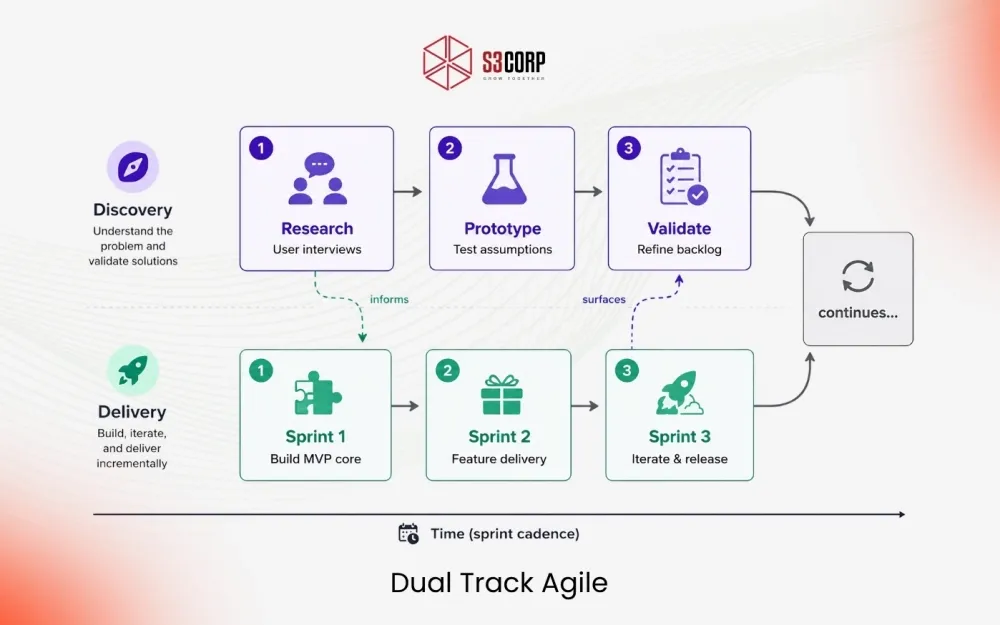 High-performing teams increasingly adopt the Dual Track Agile approach at this stage. Rather than treating discovery and delivery as sequential phases — finish research, then build — Dual Track runs them in parallel. One track continuously validates user needs, tests assumptions, and refines the backlog. The other delivers working software every sprint. The result is a tighter feedback loop: discovery informs delivery in real time, and delivery surfaces new discovery questions as the product evolves. For teams operating in fast-moving markets, this parallel structure is often the difference between building what users actually need and spending a quarter shipping a feature nobody uses.
The product backlog is the ordered list of everything the team might build. It is composed of:
Backlog prioritization is a continuous discipline, not a one-time event. Frameworks like MoSCoW (Must / Should / Could / Won't), WSJF (Weighted Shortest Job First), and customer value scoring help product owners make data-driven decisions about what to build next.
Sprint planning is a time-boxed Agile ceremony where the team selects backlog items for the upcoming sprint and defines how work will be completed — usually two to four hours for a two-week sprint. The team reviews the prioritized backlog, estimates effort using story points, planning poker, or T-shirt sizing. Sprint planning converts backlog priorities into executable delivery goals.
|
Activity |
Example |
|
Sprint Goal |
Improve checkout conversion |
|
Story Selection |
Guest checkout feature |
|
Estimation |
8 story points |
|
QA Tasks |
Cross-browser testing |
|
Deployment |
Feature flag rollout |
The outcome includes sprint goal, sprint backlog, delivery commitment, initial implementation plan
A well-structured sprint planning session creates clarity, improves sprint predictability, and reduces execution risk before development starts.
In simple terms, sprint planning answers three critical questions:
Without effective Agile sprint planning, even experienced Agile software teams struggle with missed deadlines, unclear priorities, and unstable release velocity.
Effective sprint planning requires a Definition of Ready (DoR) — a checklist ensuring that stories are well-formed, acceptance criteria are clear, and dependencies are resolved before work begins. Teams that skip this step spend the first third of every sprint in confusion.
Typical DoR checklist:
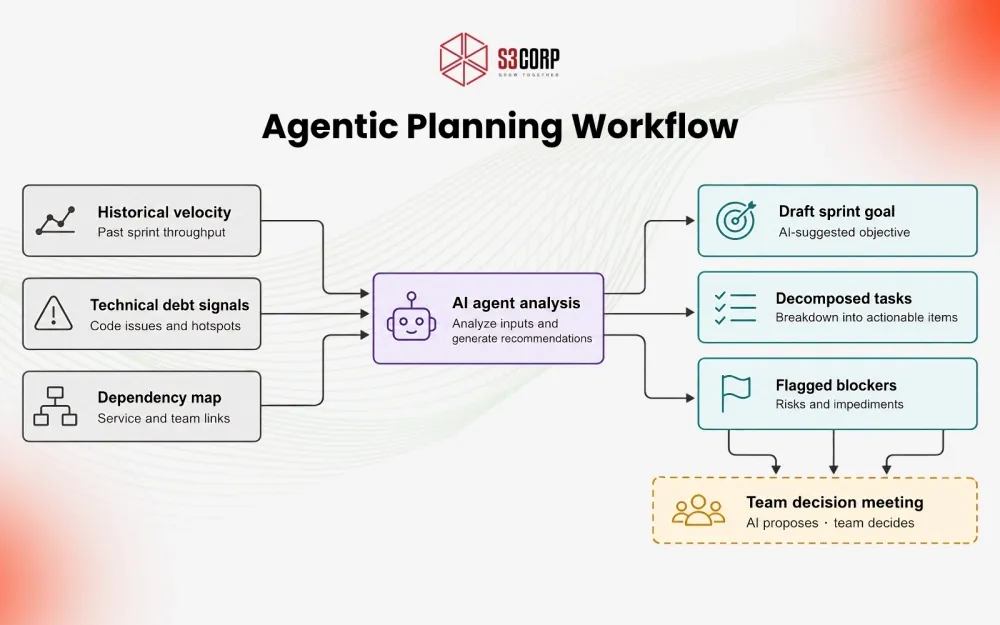
By 2026, high-velocity teams have integrated Agentic Planning into this ceremony. AI agents — operating on historical sprint data, velocity trends, and repository-level technical debt signals — autonomously analyse the backlog before the planning session begins. They propose draft sprint goals aligned to the product roadmap, decompose complex user stories into discrete engineering tasks, and flag potential blockers (dependency conflicts, under-specified acceptance criteria, capacity risks) so the team enters planning informed rather than starting from zero. The planning session shifts from discovery work to decision-making work, which is a meaningful productivity gain. That said, the sprint goal remains a human commitment — AI proposes, the team decides.
 How Long Should a Sprint Be?
This Agile development workflow helps teams align business priorities with engineering capacity.
This is where code gets written. Developers build, QA engineers test, and the team integrates continuously using CI/CD pipelines. The Definition of Done (DoD) — agreed upfront that ensures work meets quality expectations before release — governs when a story can be called complete: code written, tests passing, QA approved, security checks completed, documentation updated, deployed to staging, and verified against acceptance criteria. Clear DoD standards improve software quality significantly.
This phase includes intense collaboration between typical development team: Developers, QA engineers, Product owners, DevOps engineers, Designers.
Modern Agile development workflow models heavily depend on CI/CD automation. Continuous integration ensures developers merge code frequently.
Continuous delivery automates:
A mature CI/CD pipeline improves:
Organizations combining Agile + DevOps Services often achieve faster software delivery process performance.
The Agile standup meeting keeps teams aligned during sprint execution.
The purpose is simple:
A 15-minute time-boxed sync. Every team member answers three questions:
The standup is not a status meeting for managers. It is a team-level coordination tool. Issues raised in standups should be resolved offline — not debated in the meeting itself.
 Common daily standup mistakes:
For remote and distributed Agile teams, async standups via Slack or Jira comment threads — with a shared sprint board as the visual anchor — work well across time zones. Rotating meeting times also prevents consistent timezone penalty for one region.
This reduces meeting fatigue while maintaining transparency.
Many global delivery organizations now combine remote Agile workflows with Outsourced Dedicated Development Team models for international collaboration.
At the end of each sprint, the team demonstrates working software to stakeholders. This is not a slideshow. It is a live product demo against the sprint goal. Stakeholders provide feedback, validate assumptions, and help the product owner refine backlog priorities for the next sprint. This is the customer feedback loop in action. The goal is feedback, not approval theater.
The retrospective is where the team reflects on how they worked, not what they built. It will focus on process improvement. Common formats include:
Retrospectives without follow-through are worse than no retrospectives at all. Every retro should produce two to three actionable improvement items assigned to a specific owner, tracked in the next sprint.
Modern Agile delivery means code can ship to production multiple times per sprint — or even per day. This requires deployment pipelines, observability tooling, feature flags for controlled rollouts, and rollback strategies. Production feedback loops (error rates, user behaviour, performance metrics, infrastructure stability, security events, deployment health) feed directly back into backlog prioritization. This creates production feedback loops that improve future sprint planning.
Not all Agile is the same. The framework you choose shapes your ceremonies, roles, and delivery rhythm.
|
Framework |
Best For |
Core Mechanic |
Team Size |
|
Scrum |
Product development, startups, SaaS |
Sprint-based, fixed cadence |
5–9 members |
|
Kanban |
Operations, support, continuous delivery |
Visual workflow, WIP limits |
Any |
|
XP (Extreme Programming) |
Engineering quality, TDD focus |
Pair programming, CI/CD |
Small teams |
|
SAFe |
Enterprise Agile transformation |
Program Increments, ARTs |
50–5000+ |
|
ScrumBan |
Teams transitioning from Scrum |
Hybrid sprint + flow model |
5–15 |
Scrum remains the most widely adopted framework globally. Its structured ceremonies — sprint planning, daily scrum, sprint review, and sprint retrospective — create predictable delivery rhythm and accountability. Scrum organizes work into fixed sprints with defined roles (Scrum Master, Product Owner, Development Team).
Kanban visualises work on a kanban board, enforces work-in-progress (WIP) limits, and optimises flow metrics like cycle time and lead time. It is excellent for support teams and maintenance workflows where demand is unpredictable.
SAFe (Scaled Agile Framework) addresses the challenge of enterprise Agile transformation — coordinating dozens of Agile teams around shared Program Increments and release trains. It adds Agile Release Trains (ARTs), Program Increments, and Agile governance structures that single-team Scrum cannot provide.
If you are evaluating Software Outsourcing Services for a large program, understanding whether your partner has SAFe experience matters significantly.
Agile software development became the dominant software delivery model because it improves business adaptability, accelerates product delivery, and strengthens collaboration between technical teams and stakeholders.
Organizations across North America, the UK, Singapore, and Asia-Pacific increasingly adopt Agile methodology because modern digital products require continuous evolution. Static delivery models struggle when customer expectations, regulations, market conditions, and technologies change rapidly.
The strongest Agile software teams treat Agile as a business operating model rather than just an engineering process.
Agile development process models reduce release cycles through incremental delivery. Iterative delivery means you ship working features every sprint, not at the end of a six-month waterfall. This accelerates return on investment and lets you compete in fast-moving markets.
Agile software lifecycle models improve quality because testing happens continuously throughout development rather than near project completion. Modern Agile development workflow structures integrate continuous testing, QA automation, CI/CD automation, peer reviews, incremental validation. This reduces defect accumulation significantly.
Agile replaces the "hand over a spec and come back in six months" model with continuous stakeholder involvement. Sprint reviews, product demos, and ongoing backlog refinement ensure you are building what the customer actually needs — not what was documented before development began.
Every sprint review is a validation event. Hence, customers and stakeholders see real software and give feedback before months of additional development go in the wrong direction. This is the difference between minimum viable product (MVP) thinking and building the entire product spec before testing assumptions.
Short sprints limit the cost of being wrong. If a feature assumption fails in sprint 2, you adjust in sprint 3 — not after 18 months of development. This is adaptive planning working as designed.
Agile teams track progress in ways Waterfall cannot: velocity, sprint predictability, burndown charts, deployment frequency, and defect escape rate. This visibility helps executives and product managers make confident decisions.
Sprint burndown charts, velocity tracking, and sprint retrospectives give leadership real visibility into delivery health — without micromanagement. Teams that own their sprint commitments consistently report higher engagement than those operating under command-and-control structures. Collaboration Models matter here: the right engagement model amplifies these benefits significantly.
Agile software development creates major advantages, but implementation failures remain common.
Many organizations adopt Agile ceremonies while keeping rigid management structures, fixed delivery expectations, and waterfall-style governance. This creates “fake Agile” environments where teams follow rituals without achieving flexibility or continuous improvement.
Understanding Agile failure scenarios is critical because successful Agile transformation depends more on organizational behavior than tooling alone.
Many organizations adopt the ceremonies without the mindset. They run daily standups that turn into hour-long status meetings, hold retrospectives where nothing changes, and call their waterfall releases "sprints." This is ritual-based Agile — the form without the function.
The fix: Agile transformation requires leadership behavior change, not just team training.
A disorganised backlog produces disorganised sprints. Without disciplined backlog refinement, teams pull in undefined stories, miss acceptance criteria, and spend sprint time re-scoping work that should have been clarified weeks earlier.
Oversized stories, unclear acceptance criteria, and poor dependency mapping turn sprint planning into guesswork and sprint execution into chaos. Backlog refinement must be a recurring practice, not an afterthought.
The product owner role is demanding. A part-time, unavailable, or indecisive product owner creates a bottleneck that slows every sprint. The entire team's velocity depends on clear direction from a committed PO.
Common issues include:
Strong Product Owners balance:
Agile's adaptive planning creates real tension with fixed-price, fixed-scope contracts. When requirements evolve (and they will), the contractual structure either forces scope creep onto the vendor or creates adversarial renegotiations. Collaboration models like time-and-material or dedicated team engagements are structurally compatible with Agile in ways fixed-price contracts are not.
Flexibility is Agile's strength, but without a strong product owner and clear sprint goals, "flexible" becomes "unbounded." Every stakeholder adds items; the backlog grows; velocity drops.
Scope creep happens when:
Mature Agile governance protects sprint focus through:
Agile works naturally for teams of five to twelve. Coordinating twenty teams across three time zones requires deliberate structure — SAFe, LeSS, or Nexus — and strong Agile governance. Without it, dependency bottlenecks and misaligned roadmaps appear quickly.
"Working software over documentation" does not mean no documentation. Teams that take this too literally produce systems that become unmaintainable as staff turns over.
This creates problems for:
Agile values working software over excessive documentation, not zero documentation.
Modern Agile software methodology still requires:
Velocity is a planning tool, not a performance metric. Teams that optimize for velocity inflate story point estimates. Burndown charts that always hit zero are not a sign of high performance — they are a sign of conservative commitment. Mature teams track deployment frequency, cycle time, lead time, and change failure rate alongside velocity.
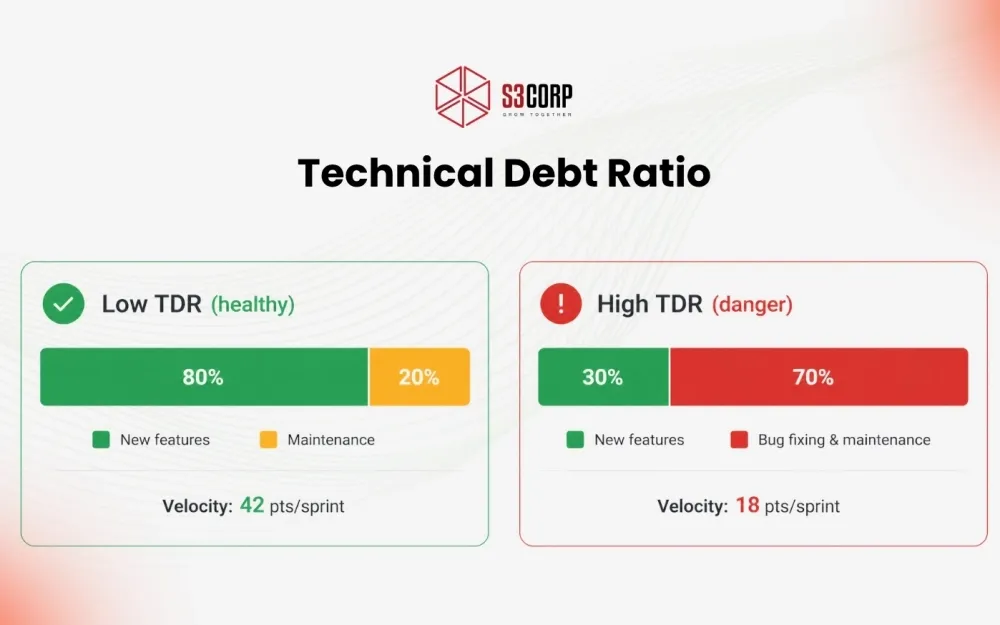
Agile’s rapid iteration cadence creates a structural temptation: cut corners on code quality to hit the sprint goal, then clean it up “next sprint.” Next sprint rarely comes. Over time, this accumulates into a system that is increasingly fragile, slow to change, and expensive to maintain — the classic technical debt trap. The problem is not that Agile causes technical debt. The problem is that Agile without a disciplined debt management strategy accelerates it. When teams skip refactoring, skip test coverage, or merge AI-generated code without proper review in the name of delivery speed, the Technical Debt Ratio climbs quietly until the codebase becomes the team’s primary bottleneck. At that point, new features take three times as long to ship — and leadership has no visibility into why velocity has collapsed.
The fix requires leadership commitment: reserve a fixed percentage of each sprint’s capacity — typically 15–20% — for debt remediation. Make it a sprint backlog item with story points and acceptance criteria, not an informal intention. Track the Technical Debt Ratio (TDR) as a standing KPI alongside velocity, and treat a rising TDR with the same urgency as a rising defect escape rate.
Agile software lifecycle success depends heavily on stakeholder participation. Problems appear when:
Agile delivery weakens without active customer collaboration.
Weak sprint planning creates cascading delivery failures. Common mistakes:
This reduces sprint predictability quickly.
Agile changes how organizations operate. Resistance often comes from:
Successful Agile adoption therefore requires leadership support, cultural alignment, and operational training.
Dependencies frequently slow Agile delivery.
Examples:
Organizations reduce these bottlenecks through:
|
Role |
Primary Responsibility |
Key Accountability |
|
Product Owner |
Defines and prioritises the product backlog |
Business value, ROI, stakeholder alignment |
|
Scrum Master |
Facilitates Agile ceremonies, removes blockers |
Team effectiveness, process health |
|
Development Team |
Designs, builds, and tests software |
Sprint delivery, technical quality |
|
QA Engineers |
Validates acceptance criteria, automates tests |
Defect prevention, release confidence |
|
DevOps Engineers |
Manages CI/CD pipelines, infrastructure |
Deployment speed, system reliability |
|
Stakeholders/Clients |
Provides feedback, validates demos |
Business direction, requirement clarity |
Effective Agile teams are cross-functional — meaning the team collectively holds every skill needed to deliver a complete feature, without waiting on external dependencies. This ownership model reduces handoffs and accelerates delivery.
The critical accountability distinction: the Product Owner decides what to build. The development team decides how to build it. The Scrum Master ensures process health. Conflating these roles — particularly when a manager acts as both Product Owner and Scrum Master — undermines team autonomy and delivery quality.
Web Application Development Services engagements require clear role definition from day one, particularly when the client team provides the Product Owner and the development team is external.
This is one of the most underserved areas in Agile content — and one of the most important for CTOs and product leaders.
|
Metric |
What It Measures |
Target |
|
Velocity |
Story points delivered per sprint |
Stable, predictable trend |
|
Sprint Predictability |
Planned vs. actual story points |
>80% completion rate |
|
Cycle Time |
Time from "in progress" to "done" |
Decreasing trend |
|
Lead Time |
Time from request to delivery |
Below industry baseline |
|
Defect Escape Rate |
Bugs reaching production |
<5% of shipped stories |
|
Deployment Frequency |
How often code ships to production |
Daily or per-sprint |
|
Change Failure Rate |
% of deployments causing incidents |
<15% (Elite: <5%) |
|
Sprint Burndown |
Daily progress against sprint commitment |
Smooth, not cliff-shaped |
|
Technical Debt Ratio (TDR) |
Cost to fix system vs. cost to build it. High TDR signals the team spends more time on maintenance than new features. |
Below 5% (industry benchmark) |
The Technical Debt Ratio deserves special attention. A high TDR signals that your team is spending more time on bug fixes and maintenance than on shipping new value — which is a delivery health problem, not just a code quality one. Agile's rapid iteration nature can quietly inflate TDR if teams do not explicitly budget sprint capacity for debt remediation.
 DORA Metrics (DevOps + Agile):
Teams that track these metrics consistently make better capacity planning decisions, spot process issues early, and build a data-driven case for continuous improvement.
These eight metrics map directly to the DORA metrics framework (DevOps Research and Assessment), which identifies elite software delivery teams. The 2025 DORA report changed the industry conversation in a meaningful way, introducing two concepts now standard in high-maturity teams:
Agile software development and DevOps evolved separately, but modern software organizations increasingly combine them into a unified delivery model.
Agile defines how teams organise and prioritise work. DevOps defines how software gets built, tested, and delivered reliably.
In practice, this means:
|
Agile Area |
DevOps Integration |
|
Sprint execution |
Automated deployment |
|
Backlog prioritization |
Infrastructure automation |
|
QA testing |
Continuous testing |
|
Sprint review |
Deployment analytics |
|
Retrospectives |
Operational improvement feedback |
This integration reduces delivery bottlenecks dramatically.
Agile improves planning, collaboration, and iterative development. DevOps accelerates deployment, automation, infrastructure management, and operational reliability.
Together, Agile + DevOps create continuous software delivery systems that support:
Organizations that combine Agile workflow execution with DevOps automation typically improve software delivery metrics significantly.
The result is a delivery loop where Agile ceremonies produce prioritised, well-formed work — and DevOps pipelines ship that work to production safely and frequently.
AI is actively reshaping how Agile teams plan, build, and learn. Here is what is real versus hype in 2025:
AI is changing the day-to-day experience of Agile delivery in several concrete ways:
The risk is overreliance. AI suggestions need human judgment — especially on acceptance criteria, business context, and architectural decisions. Teams that treat AI output as final decisions skip the deliberation that makes Agile planning valuable. A 2024 GitHub survey found that 97% of developers use AI coding tools, but the most effective teams use AI to accelerate human decision-making, not replace it.
|
Risk |
Impact |
|
Poor code quality validation |
Production instability |
|
Security vulnerabilities |
Compliance exposure |
|
Over-reliance on generated code |
Technical debt growth |
|
Reduced architectural consistency |
Scalability issues |
Mature Agile governance still requires:
AI accelerates delivery, but it does not replace engineering discipline.
|
Tool |
Primary Use |
Best For |
|
Jira |
Sprint management, backlog tracking, reporting |
Scrum and Kanban teams of all sizes |
|
Azure DevOps |
Full ALM, CI/CD, sprint boards |
Microsoft-stack engineering teams |
|
Linear |
Fast, modern issue tracking |
Startup engineering teams |
|
Trello |
Lightweight kanban boards |
Small teams, simple workflows |
|
ClickUp |
All-in-one project management |
Multi-team coordination |
|
GitHub / GitLab |
Source control, CI/CD, PR workflows |
All software teams |
|
Slack |
Team communication, async standups |
Distributed Agile teams |
|
Miro / FigJam |
Remote retrospectives, planning sessions |
Distributed teams |
How to choose: Match tool complexity to team size. A five-person startup does not need the governance overhead of full Azure DevOps. A fifty-person product organisation needs audit trails, reporting dashboards, and integration depth that Trello cannot provide.
Choosing the wrong tool is a real failure mode. Jira's flexibility is also its complexity — small teams often drown in configuration before they ship a sprint. Linear's opinionated design makes it fast to adopt but limits customization at enterprise scale. Match the tool to your team size and maturity, not to what the largest company in your industry uses.
Contact the S3Corp team to discuss your specific context before you commit to a framework
Before writing a single user story, align the business, product, and engineering leadership on the product's purpose, target users, and success criteria. A product vision statement and high-level roadmap are the outputs.
Align leadership on the "why" before any process change. Use an Opportunity Solution Tree or OKRs to connect product goals to business outcomes.
An agile team needs Product Owner, Scrum Master, developers, QA engineers, and a designer — all co-accountable for delivery. Functional silos kill agility. QA/Testing Services integration at team level — not as a downstream gate — is a structural requirement. Avoid siloed teams that hand off work to each other — this reintroduces the bottlenecks Agile is designed to eliminate.
Scrum for teams building defined product roadmaps. Kanban for support and maintenance. SAFe for enterprise-scale delivery. ScrumBan for teams in transition. The framework serves the team — not the other way around.
Write epics and user stories with clear acceptance criteria. Use a backlog refinement session to review, estimate, and order stories before sprint planning begins.
Write user stories with acceptance criteria. Prioritize using MoSCoW (Must Have / Should Have / Could Have / Won't Have) or WSJF (Weighted Shortest Job First). Run a backlog refinement session weekly.
Run your first sprint. Do not wait for a perfect backlog or a perfect process. Learn by doing, then improve through retrospectives.
Start with a two-week sprint. Run all five ceremonies (planning, daily standup, review, retrospective). Do not skip retrospectives — they are how the team improves.
Track velocity, sprint predictability, cycle time, and defect escape rate from sprint one. Use retrospectives to identify one or two process improvements per cycle.
Once one team runs Agile well, expand it. Introduce Agile governance structures (Program Increments, shared roadmaps, cross-team dependencies) to coordinate multiple teams without slowing them down.
|
Level |
Maturity Stage |
Characteristics |
|
1 |
Ad Hoc |
No defined process, reactive delivery |
|
2 |
Defined |
Scrum or Kanban adopted, ceremonies in place |
|
3 |
Managed |
Metrics tracked, retrospectives actioned |
|
4 |
Optimised |
Continuous improvement embedded, DevOps integrated |
|
5 |
Transformative |
AI-assisted planning, outcome-driven delivery, platform engineering |
The team at S3Corp has helped companies across North America, the UK, and Southeast Asia implement Agile delivery from scratch — or fix broken Agile that is producing ceremonies without results.
Many companies claim Agile expertise, yet few show how their Agile workflow operates in practice. Execution clarity matters because Agile success depends on disciplined delivery, transparent communication, and continuous improvement.
Transparency about process is something most outsourcing companies avoid. At S3Corp, it is a differentiator.
With 19+ years of delivering software, S3Corp operates Agile not as a framework to discuss but as the daily operating rhythm of every development team.
S3Corp is a Vietnam-based software outsourcing company with 19+ years of experience delivering Agile software development services to clients in North America, the UK, Singapore, and global markets. Services by S3Corp span web and mobile application development, QA engineering, DevOps, and full-lifecycle software delivery across Fintech, Healthcare, E-Commerce, and SaaS verticals.
Here is what that looks like in practice:
Sprint Workflow: Teams at S3Corp run two-week sprints with a clearly defined sprint goal. Sprint backlog items are accepted into the sprint only when they have written acceptance criteria and a Definition of Ready. The Definition of Done includes code complete, unit tests passing, code reviewed, QA-validated, and staging-deployed.
Client Communication: Clients receive sprint updates asynchronously (via Jira dashboards and weekly summary emails) and participate live in sprint reviews every two weeks. There is no "request a status update" — visibility is built into the process. Contact Us to discuss how we can set up this transparency model for your project from day one.
Daily Standups: Remote teams run async standups via Slack by default, supported by a Jira board update. For projects requiring tighter coordination, live standups are scheduled at times that respect client time zones in NA, UK, and Singapore.
QA and DevOps Integration: Quality assurance is embedded in sprint execution, not appended after it. Every team includes QA engineers who write automated tests alongside feature development. Test engineers work within the sprint team, not as a separate gate.
Retrospectives: Every sprint ends with a retrospective. Action items are tracked in the following sprint backlog. No retrospective is performative — improvement actions are measureable and followed through.
Changing Requirements: Requirement changes land in the backlog as new or updated user stories. They are prioritised, estimated, and slotted into upcoming sprints — not bolted onto the current sprint without impact assessment. This protects sprint goals while preserving flexibility.
Remote Agile Execution: With distributed teams across Vietnam and client stakeholders in NA, UK, and Singapore, S3Corp uses async standup updates in Slack, Jira workflow sync, and timezone-aware sprint ceremonies to eliminate meeting fatigue without losing alignment.
This is what 19+ years of refining software delivery looks like — not just knowing Agile in theory, but having internalized it across hundreds of software development case studies.
Contact the S3Corp team to discuss your specific context before you commit to a framework.
Agile is ideal for:
When Agile may not be the best fit:
AI-Native Agile Teams: AI is moving from a productivity tool to a participant in Agile workflows. Within two years, expect AI agents to autonomously draft sprint backlog items from user research sessions, suggest story point estimates based on code complexity analysis, and flag dependency risks before planning begins. By 2026, AI coding assistants will be embedded in every Agile team's workflow as a standard tool — not a competitive differentiator. The differentiator will be how well teams govern AI output quality.
Continuous Flow Delivery: The boundary between "sprint" and "continuous delivery" is blurring. Kanban-style continuous flow models are gaining ground in product teams that previously used Scrum, particularly in mature DevOps environments with high deployment frequency.
Hybrid Agile Frameworks: Pure Scrum is giving way to hybrid models that blend sprint structure with Kanban flow metrics, programme-level planning from SAFe, and OKR-based outcome measurement. Rigid framework loyalty is becoming less common in mature engineering organisations. ScrumBan — the hybrid of Scrum's structure and Kanban's flow — is growing in organizations that need sprint-based planning but continuous delivery. Expect more hybrid enterprise delivery models as organizations mature beyond pure-framework adoption.
Platform Engineering and Agile: Developer experience platforms (internal tooling, golden paths, self-service infrastructure) are reducing the DevOps overhead inside Agile sprints, letting development teams focus more time on product features.
Async Agile Teams: Distributed teams across multiple time zones are moving to fully async standup models — Slack bots, Loom updates, and documented sprint blockers replacing synchronous meetings. This is not a degraded version of Agile; it is an evolved one for globally distributed talent models.
Outcome-Driven Product Delivery: The shift from "delivering features" to "achieving business outcomes" is maturing. Teams are measuring sprint success not just by velocity, but by whether the shipped feature moved a product metric: conversion rate, retention, activation time. The shift from output metrics (velocity, story points) to outcome metrics (retention, activation, revenue impact) is accelerating. Teams will measure sprint success by business results, not backlog completion rates.
Agile software development is not something you "do" for one project and then stop. It is a continuous practice — a way of organising people, prioritising work, and responding to feedback that compounds in value over time. Teams that run retrospectives consistently improve. Teams that measure velocity honestly plan better. Teams that involve customers in sprint reviews build products people actually use.
The companies that get the most from Agile are not the ones with the most elaborate processes. They are the ones with the clearest sprint goals, the most disciplined product owners, and the commitment to act on what they learn.
If you are starting from Waterfall, start small: one team, two-week sprints, a real product owner. Iterate on your process the same way you iterate on your product.
If you are looking for an experienced Agile partner who has run this playbook for over 19 years — across Fintech, Healthcare, E-Commerce, and SaaS Products— the team at S3Corp is ready to help you build it right from day one.
Whether you are building from scratch, scaling an existing team, or fixing an Agile process that is not delivering — S3Corp offers free technical consultations with senior engineers and delivery leads.
Agile software development is an iterative, incremental approach to building software guided by the Agile Manifesto's four core values: individuals and interactions, working software, customer collaboration, and responding to change. Teams deliver working software in short cycles (sprints) and continuously refine priorities based on feedback.
Agile is a philosophy and set of principles. Scrum is a specific framework for implementing Agile, using fixed-length sprints, defined roles (Scrum Master, Product Owner, Development Team), and ceremonies (sprint planning, daily standup, sprint review, retrospective). All Scrum is Agile, but not all Agile is Scrum.
Sprints typically run one to four weeks. Two-week sprints are the most common — long enough to deliver meaningful work, short enough to course-correct quickly. One-week sprints suit fast-moving teams with clear backlogs; four-week sprints suit teams with longer integration requirements.
A daily standup is a 15-minute synchronization meeting where each team member answers three questions: What did I complete yesterday? What will I work on today? What is blocking my progress? It is a team-coordination tool, not a status report for management.
A sprint retrospective is a post-sprint meeting where the team reflects on their process — what worked, what did not, and what to change. Common formats include Start / Stop / Continue, Mad / Sad / Glad, and the Sailboat retrospective. Action items from retros are tracked in the next sprint.
It depends on the project. Agile outperforms Waterfall for products with evolving requirements, long development timelines, and a need for frequent stakeholder feedback. Waterfall suits projects with stable, well-defined requirements and regulatory constraints where changes are costly. Most modern software products benefit from Agile.
Common tools include Jira (sprint management), GitHub or GitLab (code and CI/CD), Slack (async communication), Confluence (documentation), and Linear (lightweight issue tracking). The right tool depends on team size, maturity, and technical stack.
Yes, with the right scaling framework. SAFe (Scaled Agile Framework), LeSS (Large-Scale Scrum), and Spotify's tribe model all address enterprise-scale Agile delivery. Enterprise Agile transformation requires framework selection, executive sponsorship, and a phased rollout — not a weekend training course.
A user story is a short, customer-centric description of a feature written as: "As a [type of user], I want [action], so that [benefit]." Each story includes acceptance criteria — specific, testable conditions that define when the story is complete. User stories replace long requirements documents with conversation-ready, testable units of work.
The Agile methodology refers to the broader set of frameworks and practices (Scrum, Kanban, XP, SAFe) that apply Agile principles to software delivery. It emphasizes iterative development, customer feedback loops, and adaptive planning over fixed planning and documentation.
During sprint planning, the team reviews the prioritized product backlog, selects stories they can commit to completing in the sprint, estimates effort using story points, defines the sprint goal, and breaks stories into tasks. The output is a sprint backlog and a committed sprint goal.
Scrum is the most widely used Agile framework. It organizes work into fixed sprints (one to four weeks), assigns three roles (Scrum Master, Product Owner, Development Team), and runs four ceremonies (sprint planning, daily scrum, sprint review, sprint retrospective). Scrum gives structure to Agile principles without prescribing engineering practices.
Agile defines the delivery rhythm — what gets built and when. DevOps provides the technical pipeline — how it ships reliably. CI/CD automation, automated testing, and infrastructure as code make Agile's frequent release cadence operationally viable. Without DevOps, Agile teams accumulate release risk with every sprint.