Insights
Table Of Content
TL;DR — SaaS Application Development (2026 Complete Guide)
SaaS Development at a Glance
What Is SaaS Application Development and Why Does It Matter in 2026?
The Pre-Build Phase: Strategy, Validation, and Planning
SaaS Application Architecture
What Tech Stack Should You Choose for SaaS Development?
How Long Does It Take to Build a SaaS Product?
Security-First SaaS Development: Non-Negotiable in 2026
How Much Does SaaS Application Development Cost in 2026?
Should You Build SaaS In-House or Outsource Development?
How Does AI Impact SaaS Application Development?
Industry-Specific SaaS Development: What Changes by Vertical
Why Businesses Choose S3Corp for SaaS Application Development
Conclusion: Build the SaaS That the Market Actually Needs
Frequently Asked Questions About SaaS Application Development
SaaS Application Development in 2026: How to Build, Scale, and Launch Successfully
A strategic and technical guide for founders, CTOs, and product leaders on building production-ready SaaS products — covering architecture, cost, timelines, AI integration, and team models.
15 May 2026
TL;DR — SaaS Application Development (2026 Complete Guide)
- The SaaS market is projected to surpass $887.05 billion by 2030, driven by AI integration and cloud-native adoption.
- AI-powered SaaS is growing at 40%+ CAGR, three times faster than traditional SaaS — building without an AI-ready architecture today means expensive rework tomorrow.
- Your pricing model must be decided before development begins — it directly shapes your database schema, feature gating, billing logic, and onboarding flows.
- Multi-tenancy is the architectural foundation that makes SaaS economically viable; choosing the wrong isolation strategy (row-level, schema, or database-per-tenant) is one of the costliest mistakes to fix post-launch.
- The most proven 2026 stack for most SaaS products: Next.js + Node.js or FastAPI + PostgreSQL + Redis + AWS + Stripe — prioritize community, scalability, and hiring access over trend-chasing.
- Security is an architectural principle, not a feature — OAuth 2.0, RBAC, AES-256 encryption, AI readiness, FinOps discipline, and compliance architecture (SOC 2, GDPR, EU AI Act) must be planned at the start — not retrofitted after launch.
- Realistic development costs: $20K–$50K for a lean MVP, $50K–$150K for a standard MVP, $150K–$350K for a mid-tier SaaS, and $350K–$1M+ for enterprise-grade platforms.
- A focused MVP takes 2–4 months; a full production SaaS takes 6–12 months; enterprise platforms targeting regulated industries take 12–18+ months.
- The hybrid development model (in-house product vision + outsourced engineering velocity) delivers the best balance of speed, cost, and quality for most post-seed SaaS companies.
- Every dollar invested in UX design returns ~$100 — and 88% of users won't return after a bad experience, making design a direct revenue lever, not a cosmetic decision.
- Post-launch, plan for ongoing maintenance at 15–20% of initial development cost annually — SaaS is a living product, not a one-time delivery.
SaaS application development is the process of designing, building, deploying, and continuously improving cloud-hosted software delivered to customers on a subscription basis. It requires multi-tenant architecture, continuous delivery, and scalable infrastructure from day one. In 2026, SaaS dominates enterprise software because it combines a predictable revenue model with the operational agility that modern businesses demand.
The global SaaS market is projected at $512.27 billion in 2026 and is forecast to reach $887.05 billion in 2030, growing at a CAGR of 14.71% through 2026 - 2030. Yet despite this scale, many businesses still confront the same challenge: how do you actually build a SaaS application that is scalable, secure, and commercially viable?
This guide answers that question directly. Whether you are a founder evaluating your first product idea, a product leader modernizing legacy infrastructure, or an enterprise team launching a new vertical SaaS, you will find the strategic frameworks, technical blueprints, and cost benchmarks to make smart, confident decisions. At S3Corp, we have delivered SaaS solutions across healthcare, fintech, logistics, and enterprise software for over 19 years — everything here is grounded in real delivery experience.
Read More: Software Development Services: The 2026 Ultimate Guide
SaaS Development at a Glance
Before diving into the "how," you will need a clear sense of what you are committing to. Based on delivery data across 30+ SaaS projects, S3Corp has identified four broad development tiers. Use this as your starting orientation — not a fixed quote.
|
Product Stage |
Cost Range (USD) |
Timeline |
Team Size |
Key Risks |
|
Lean MVP |
$20,000–$50,000 |
2–4 months |
3–5 people |
Scope creep, poor validation, missing core user flow |
|
Standard MVP |
$50,000–$150,000 |
3–6 months |
5–8 people |
Feature bloat, delayed launch, integration complexity, UX underinvestment |
|
Mid-Tier SaaS |
$150,000–$350,000 |
4–9 months |
8–14 people |
Architecture debt, integration failures, multi-tenancy design errors |
|
Enterprise SaaS |
$350,000–$1,000,000+ |
8–18+ months |
15–30+ people |
Compliance gaps, talent scarcity, Regulatory delays, architecture rigidity |
The numbers above reflect real project scopes. Your specific cost will depend on compliance requirements, AI integration depth, third-party integrations, and team location — all covered in detail below.
What Is SaaS Application Development and Why Does It Matter in 2026?
SaaS application development is the process of building cloud-based software that users access via a subscription model. It requires multi-tenant architecture, continuous deployment, and scalable infrastructure. In 2026, SaaS dominates enterprise software because it delivers flexibility, predictable costs, and a compounding recurring revenue model that traditional software simply cannot replicate.
Unlike traditional packaged software, a SaaS product runs entirely on the vendor's infrastructure. The vendor manages hosting, security, updates, and availability. Customers simply log in and use it — from anywhere, on any device. This fundamentally changes what it means to build software: SaaS is not merely a deployment method. It is simultaneously a product, a business model, and a platform.
It must support multi-tenancy (serving thousands of customers from one codebase), recurring billing, automated onboarding, usage analytics, churn prevention, and long-term reliability under load. Getting any one of these wrong does not just break a feature; it erodes trust across your entire customer base at once.
SaaS vs. Traditional Web Applications: The Key Differences
Understanding what makes SaaS architecturally distinct from a conventional web application is essential before you write a single line of code.
|
Dimension |
Traditional Web App |
SaaS Application |
|
Architecture |
Single-tenant, deployed per client |
Multi-tenant, shared infrastructure |
|
Updates |
Manual upgrades, client-managed |
Continuous delivery, vendor-managed |
|
Scalability |
Limited by hardware |
Elastic, cloud-native scaling |
|
Revenue Model |
One-time license or project fee |
Recurring subscription (MRR/ARR) |
|
Maintenance |
In-house IT required |
Vendor handles all maintenance |
|
Data Strategy |
Isolated per deployment |
Centralized, enables AI/analytics |
|
Compliance Scope |
Per-client customization needed |
Platform-level compliance (SOC 2, GDPR) |
The Pre-Build Phase: Strategy, Validation, and Planning
The single most common reason SaaS products fail is not poor code — it is the absence of market validation before development begins. A CB Insights analysis found that 42% of startups fail because there was no market need. A structured pre-build phase is the antidote, and it should consume 15–20% of your total project budget.
Step 1: Idea Validation
Idea validation is a disciplined process of proving that a real audience has a problem they are currently solving inefficiently — and that they would pay for something better. Conduct 15–20 discovery interviews with your target persona. Build a simple landing page and measure sign-up intent. Run a pricing survey before committing to any architecture. The goal is not to build anything yet — it is to de-risk your investment in building. Every assumption you validate here saves ten times the cost downstream.
Step 2: Project Discovery and Requirements Definition
Project discovery translates business intent into a buildable scope. A thorough discovery phase produces user personas, user journey maps, competitive analysis, and a Software Requirements Specification (SRS). The SRS defines both functional requirements (specific features) and non-functional requirements (performance benchmarks, security standards, compliance needs). Errors found after development begins cost 100x more to fix than those caught during planning — that figure is not an abstraction, it is a consistent pattern across the industry.
Step 3: Choose Your Monetization Model Before You Build
Your pricing model must be decided before development starts, because it directly shapes your database schema, feature gating logic, billing infrastructure, and onboarding flows.
|
Pricing Model |
Best For |
Revenue Ceiling |
Engineering Complexity |
|
Flat-Rate |
Simple, single-use tools |
Low |
Low |
|
Tiered |
Multi-segment markets (SMB to Enterprise) |
High |
Medium (feature gating required) |
|
Per-User (Seat-Based) |
Team collaboration tools |
Scales with org growth |
Low–Medium |
|
Usage-Based |
APIs, infrastructure, data-heavy apps |
High — scales with value |
High (metering infrastructure needed) |
|
Freemium |
High-volume consumer or SMB markets |
Depends on conversion |
Medium |
|
Hybrid |
Enterprise + usage overage |
Maximum flexibility |
High — plan from day one |
Getting this wrong requires expensive engineering rework. The hybrid model is increasingly popular among mid-market SaaS companies because it captures both predictable base revenue and upside from high-usage customers.
Need a SaaS MVP delivered in 3–6 months?
S3Corp builds production-ready SaaS platforms with scalable architecture and AI integration built in from day one.
SaaS Application Architecture
Architecture is the most consequential technical decision you will make in SaaS development. Bad architecture compounds — small shortcuts become major rewrites as you scale. Good architecture creates a platform that grows with your business. Here is the complete layered architecture model applied across SaaS engagements at S3Corp.
The 6-Layer SaaS Architecture Model
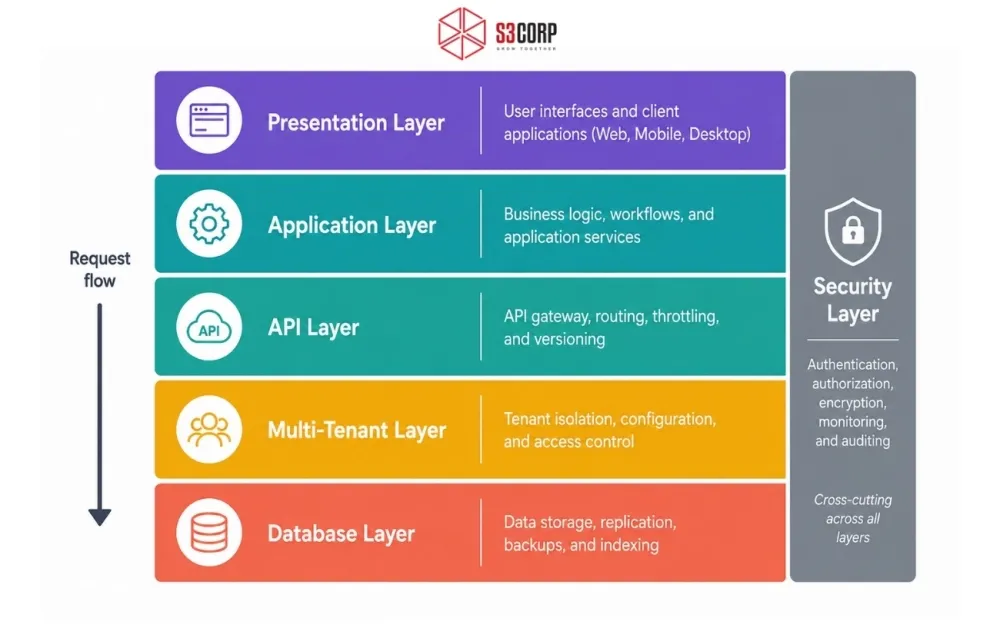 Good architecture creates a platform that grows with your business. S3Corp applies this layered model to every SaaS product built:
|
Layer |
Responsibility |
Key Decisions |
|
Presentation Layer |
UI, routing, accessibility, rendering |
SPA vs SSR, mobile-first, design system |
|
Application Layer |
Business logic, onboarding, billing workflows |
Monolith vs. microservices, DDD, clean architecture |
|
API Layer |
External/internal communication, rate limiting, auth |
REST vs. GraphQL, API gateway, versioning strategy |
|
Multi-Tenant Layer |
Tenant resolution, data isolation, config management |
Row-level, schema-level, or DB-per-tenant isolation |
|
Database Layer |
Data persistence, queries, migrations |
RDBMS vs. NoSQL, sharding, caching strategy |
|
Security Layer |
Cross-cutting: IAM, encryption, audit logs, secrets |
RBAC, OAuth 2.0, MFA, SOC 2/GDPR compliance path |
This layered model is designed for Full-Lifecycle App Development — where every architectural decision accounts for where the product needs to be in 18 months, not just at launch.
What Is Multi-Tenancy and Why Is It Critical?
Multi-tenancy — serving multiple customers from a single shared application instance — is the architectural principle that makes SaaS economically viable. Instead of running separate deployments per client, you share infrastructure while partitioning each tenant's data. There are three primary isolation strategies:
- Row-Level Isolation: All tenants share one database; a Tenant ID column partitions rows. Lowest cost, fastest to build, but highest risk if queries are written carelessly.
- Schema-Level Isolation: Each tenant has a dedicated schema within a shared database. Moderate cost and isolation — popular for mid-market SaaS products.
- Database-Level Isolation: Each tenant has a completely separate database. Strongest isolation and best compliance fit for healthcare and fintech, but highest operational overhead.
Choosing the wrong isolation strategy at the start is one of the most expensive architectural mistakes to fix post-launch. The right answer depends on your compliance requirements, expected tenant count, and data sensitivity profile.
Monolith vs. Microservices: Which Should You Choose?
For most SaaS MVPs, a well-structured monolith is the right choice — not microservices. A monolith is faster to build, simpler to test, and easier to deploy. The S3Corp approach is a modular monolith first, with clearly defined domain boundaries that make future service extraction straightforward when scale demands it.
Microservices become the right choice when independent teams need to deploy services independently, specific components have dramatically different scaling profiles, or regulated data requires strict infrastructure-level isolation. Jumping to microservices prematurely is a common and costly mistake — it multiplies operational complexity before you have the team or traffic to justify it.
What Tech Stack Should You Choose for SaaS Development?
The best SaaS tech stack balances scalability, hiring availability, and development speed. Your technology choices are not just tools — they are a hiring strategy, a community bet, and a long-term maintenance commitment. The best stack is the one your team executes well, not the most fashionable one.
Recommended Tech Stack for SaaS in 2026
|
Category |
Recommended Options |
Notes |
|
Frontend (Web) |
React, Next.js, Vue.js |
Next.js preferred for SSR + SEO requirements |
|
Mobile |
React Native, Flutter |
Cross-platform covers 90% of SaaS use cases |
|
Backend |
Node.js, Python (FastAPI/Django), .NET Core |
FastAPI for AI-heavy workloads; .NET for enterprise compliance |
|
Relational DB |
PostgreSQL, MySQL |
PostgreSQL as default for most SaaS products |
|
NoSQL / Cache |
MongoDB, Redis, DynamoDB |
Redis for sessions/cache; MongoDB for unstructured data |
|
Auth & Identity |
Auth0, AWS Cognito, custom OAuth 2.0 |
Never build auth from scratch |
|
Cloud Provider |
AWS (recommended), Azure, GCP |
AWS offers the broadest managed service ecosystem |
|
Containers / Orch. |
Docker + Kubernetes / Amazon ECS |
ECS for simpler deployments; K8s for complex orchestration |
|
CI/CD |
GitHub Actions, GitLab CI, CircleCI |
Automate testing, staging, and production deployments |
|
Monitoring |
Datadog, Grafana + Prometheus, New Relic |
Observability is non-negotiable for SaaS SLAs |
|
Billing |
Stripe, Braintree |
Never build billing logic in-house |
|
AI/ML Integration |
OpenAI API, AWS Bedrock, Hugging Face |
Plan data pipelines for AI before you need them |
|
Edge Computing |
Vercel Edge Functions, Cloudflare Workers |
Ideal for real-time SaaS: lower latency, geo-distributed logic at the CDN layer |
Stack Combinations by SaaS Product Type
|
SaaS Type |
Frontend |
Backend |
Database |
Best For |
|
Startup / MVP |
Next.js |
Node.js |
PostgreSQL |
Speed-to-market |
|
AI-Native SaaS |
Next.js |
FastAPI |
PostgreSQL + Redis |
ML pipelines, high-performance APIs |
|
Enterprise / Compliance |
React |
.NET Core |
SQL Server / PostgreSQL |
Regulated industries |
|
Real-Time SaaS |
Next.js |
Node.js |
PostgreSQL + Redis |
Collaboration tools, dashboards |
The technology choices you make here also determine your hiring strategy. Cutting-edge or niche stacks create talent scarcity and higher costs. Proven, widely-adopted stacks reduce both risk and cost — a consideration that matters whether you are building with an in-house team or software outsourcing services.
How Long Does It Take to Build a SaaS Product?
A SaaS MVP takes 3–6 months; a full enterprise platform typically takes 6–18 months. The timeline varies based on scope, team size, integration complexity, and compliance requirements. The most reliable way to compress the timeline is not to work faster — it is to scope smarter before development begins.
A mature SaaS development process is not a single build sprint — it is a lifecycle. Here is how that lifecycle unfolds across a professional SaaS engagement.
Phase 1 — UX/UI Design and Prototyping
Great SaaS design reduces friction at every step of the customer journey. User personas, journey maps, wireframes, and clickable prototypes are created before any code is written — because fixing usability problems at the prototype stage costs a fraction of fixing them after development. This will eliminate up to 50% of avoidable developer rework by catching usability issues when they cost the least to fix.
Phase 2 — MVP Development
An MVP is the smallest buildable version of your product that delivers a clear, measurable outcome for a defined user segment. The goal is not to build something minimal because you lack resources — it is to learn from real users as fast as possible before investing in full-scale development. A focused SaaS MVP can typically be delivered in 3–6 months with a cross-functional team. The MVP must include: core user authentication, the primary end-to-end workflow that solves the target problem, basic subscription billing integration, in-app usage tracking, and just enough onboarding to reach the activation moment. Here, usage tracking is not a nice-to-have at MVP stage — it is how you distinguish between users who are genuinely activating and users who signed up and disappeared. Without it, you are iterating blind. Everything else is scope creep.
Phase 3 — Core Feature Development
Following MVP validation, development expands to the full feature set — multi-tenant architecture at scale, advanced role-based access control, third-party integrations (CRM, ERP, payment gateways), analytics dashboards, and enterprise onboarding infrastructure. At S3Corp, major releases ship every 2–4 weeks using Agile sprints, CI/CD pipelines, and automated testing.
Phase 4 — Testing and Quality Assurance
SaaS QA is fundamentally different from traditional software testing because a production bug affects all customers simultaneously. A professional software testing services approach combines comprehensive automated test coverage (unit, integration, API, regression) with manual exploratory testing on critical user journeys. Key test areas include multi-tenant data isolation, subscription lifecycle edge cases, concurrent load performance, and security penetration testing.
Phase 5 — Deployment and DevOps
Modern SaaS deployment is fully automated. S3Corp establishes production-grade CI/CD pipelines that run automated tests, perform staged rollouts, and support zero-downtime deployments with instant rollback capability. Infrastructure is defined as code (Terraform/AWS CDK) for reproducibility. All environments — development, staging, and production — are configured identically to prevent the classic "it works on staging" failure.
Phase 6 — Post-Launch Scaling and Iteration
Launch is the beginning, not the end. Post-launch focus shifts to performance monitoring, infrastructure autoscaling, user feedback loops, and feature iteration based on real usage data. Scaling strategies include horizontal scaling, database read replicas, caching layers, CDN optimization, and where warranted, selective service decomposition.
One area that consistently catches growing SaaS teams off guard is cloud financial operations — FinOps. Cloud costs are elastic by design, which means they scale up with traffic just as readily as they scale down. Without deliberate spending governance, a successful product launch can quietly erode margins within months. Introduce financial accountability into your infrastructure early: tag cloud resources by feature and tenant, set budget alerts, review cost-per-tenant monthly, and evaluate reserved instance pricing once usage patterns are predictable. The teams that scale profitably treat infrastructure spend as a product metric, not just an IT line item.
Need a SaaS MVP in 3–6 months?
S3Corp delivers production-ready SaaS platforms with scalable architecture, AI integration, and CI/CD from day one. Our teams embed directly into your product workflow — shipping, not just consulting.
Security-First SaaS Development: Non-Negotiable in 2026
Security is not a feature you add after launch — it is an architectural principle embedded from the first line of code. For SaaS products, a single breach affects every customer simultaneously, making the regulatory and reputational consequences severe. S3Corp's security engineering practice operates on four layers:
- Identity and Access Management: OAuth 2.0, OpenID Connect, Multi-Factor Authentication (MFA), and Role-Based Access Control (RBAC). Single Sign-On (SSO) support is required for enterprise deals.
- Data Security: Encryption at rest (AES-256) and in transit (TLS 1.3). Secrets management via AWS Secrets Manager or HashiCorp Vault. No credentials in code or version-controlled environment variables.
- Infrastructure Security: Network-level segmentation, WAF (Web Application Firewall), DDoS mitigation, and security group policies. Regular vulnerability scanning on all dependencies via Snyk or equivalent.
- Compliance Architecture: For regulated industries, SOC 2 Type II, HIPAA, GDPR, and ISO 27001 compliance paths must be architected from day one — audit logging, data residency controls, and consent management included. For any SaaS serving the EU market, the EU AI Act is now equally non-negotiable: its risk-classification requirements for AI-enabled software become fully enforceable in late 2026, regardless of where the product was built or outsourced. If your platform uses AI in decision-making workflows, classify your risk tier early and architect accordingly.
Additionally, the OWASP Top 10 for LLM Applications is now relevant for AI-native SaaS products — specifically prompt injection, insecure AI output handling, and sensitive data leakage through model interfaces. If your SaaS embeds generative AI, these controls are mandatory, not optional.
How Much Does SaaS Application Development Cost in 2026?
SaaS application development costs range from $20,000 for a lean MVP to over $1,000,000 for a full enterprise platform. The honest answer is that it depends on scope, compliance requirements, and team model — but the ranges below are based on real project delivery data, not estimates.
|
Product Type |
Cost Range (USD) |
Timeline |
What's Included |
|
Lean MVP |
$20,000 – $50,000 |
2–4 months |
Core workflow, auth, basic UI, hosted |
|
Standard MVP |
$50,000 – $150,000 |
3–6 months |
Full UI/UX, backend, billing, integrations |
|
Mid-Tier SaaS |
$150,000 – $350,000 |
4–9 months |
Multi-tenancy, RBAC, analytics, API layer |
|
Enterprise SaaS |
$350,000 – $1,000,000+ |
8–18+ months |
Compliance, AI, advanced integrations, SOC 2 |
What Actually Drives SaaS Development Costs
Eight variables determine where your project lands in these ranges:
- Product Scope — Feature breadth is the primary cost driver. Each additional integration, user role, or analytics module adds engineering time.
- AI Integration — Embedding AI capabilities requires data pipeline architecture, model selection, and ongoing fine-tuning infrastructure. Budget an additional 20–40% for AI-native features.
- Security and Compliance — SOC 2, HIPAA, and GDPR compliance paths add 15–25% to base development cost, but are non-negotiable for enterprise and regulated-market sales.
- Team Location and Structure — Offshore development teams (Eastern Europe, Southeast Asia) typically run $35–$80/hr versus $100–$200/hr for North American or Western European teams. Quality, timezone overlap, and communication are the trade-offs to evaluate carefully.
- Technology Choices — Niche technology stacks create talent scarcity and higher hiring costs. Proven, widely adopted stacks reduce both risk and SaaS application cost.
- Ongoing Maintenance — Plan for 15–20% of initial development cost annually for maintenance, security updates, and infrastructure management.
- Third-Party Integrations — Every external API (payment processor, CRM, ERP) adds integration development, testing, and ongoing maintenance overhead.
- Scalability Engineering — High-traffic products targeting millions of users require distributed systems design and advanced infrastructure that significantly increases upfront investment.
Should You Build SaaS In-House or Outsource Development?
Most companies succeed with a hybrid model combining in-house strategy with outsourced execution. Full in-house development maximizes IP control and cultural alignment but carries a high burn rate and slow scaling. Full outsourcing delivers speed to market at lower cost, but introduces knowledge transfer risk if managed poorly. The hybrid model covers most scenarios in between.
|
Model |
Best For |
Key Advantage |
Primary Risk |
|
In-House Team |
Long-term, high-IP core product |
Deep domain knowledge, culture fit |
High burn rate, slow to scale |
|
Full Outsourcing |
Defined-scope MVP, time-constrained launch |
Speed to market, cost efficiency |
Knowledge transfer, quality variance |
|
Hybrid (Recommended) |
Most SaaS companies post-seed |
In-house product vision + outsourced velocity |
Coordination overhead if managed poorly |
S3Corp operates as a true hybrid partner through proven Collaboration Models — embedding into your product team rather than working in isolation. Our PMO framework, mature DevOps practices, and weekly reporting cadence ensure full visibility and control without the full cost of an in-house team.
How Does AI Impact SaaS Application Development?
AI enables automation, predictive analytics, and personalization — making it an expectation, not a differentiator, in modern SaaS products. AI-powered SaaS is growing at 40%+ CAGR, three times faster than traditional SaaS. SaaS platforms that embed intelligence at the workflow level — through predictive analytics, automated decision-making, and personalized experiences — demonstrably outperform traditional tool-based competitors on retention, expansion revenue, and gross margins.
For builders, this means AI-readiness is no longer a Phase 2 consideration. The choices you make in your data architecture, API design, and multi-tenant infrastructure during initial development directly determine how fast and cheaply you can embed AI capabilities later. The most expensive time to course-correct is after launch.
The most common AI integrations in production SaaS in 2026 include:
- Intelligent workflow automation that eliminates manual, repetitive steps
- Predictive analytics for churn prevention, demand forecasting, and anomaly detection
- Natural language interfaces that reduce onboarding friction
- Personalized user experiences that adapt to individual behavior patterns
- AI-assisted decision support for complex, data-rich domains like Fintech and Healthcare
If you are building a Mobile Application Development companion to your SaaS platform, AI-powered features like smart notifications, on-device processing, and personalized recommendations are increasingly expected at launch.
Building an AI-Native SaaS Platform?
S3Corp specializes in embedding AI at the architecture level — not as an afterthought. From data pipelines to production ML inference, our engineering teams build AI-readiness into your SaaS from sprint one.
Industry-Specific SaaS Development: What Changes by Vertical
SaaS is not a one-size-fits-all product category. Architecture, compliance requirements, integration landscape, and user expectations vary significantly by industry. S3Corp has delivered SaaS solutions across 31+ industry verticals — here are the most important vertical-specific considerations:
|
Industry |
Key SaaS Use Cases |
Critical Development Considerations |
|
Healthcare & Life Sciences |
EHR, telemedicine, patient portals |
HIPAA compliance, HL7/FHIR integration, audit logging, data residency |
|
Financial Services & Fintech |
Payment processing, loan origination, fraud detection |
PCI-DSS, SOC 2 Type II, real-time transaction processing, regulatory reporting |
|
Retail & E-commerce |
Inventory management, loyalty programs, order fulfillment |
High availability during peak sales, multi-currency, marketplace APIs |
|
Manufacturing & Logistics |
Fleet management, supply chain visibility, predictive maintenance |
IoT data ingestion, real-time telemetry, ERP integrations (SAP, Oracle) |
|
HR & Human Capital |
ATS, performance management, payroll, HRIS |
Multi-jurisdiction compliance, SSO for enterprise, complex workflow automation |
|
Cybersecurity |
SIEM, identity management, threat detection |
Ultra-low latency, zero-trust architecture, SOC 2, FedRAMP |
Why Businesses Choose S3Corp for SaaS Application Development
S3Corp is a full-cycle SaaS development partner with 19+ years of experience and a proven track record across healthcare, fintech, enterprise, and consumer applications. Here is what that means in practice:
- MVP to Production in 1–4 Months — Structured discovery and battle-tested project management frameworks eliminate wasted sprints and scope creep.
- Releases Every 2–3 Weeks — Mature Agile processes and established CI/CD pipelines ensure continuous delivery, not quarterly releases.
- Security-First Engineering — ISO 27001-aligned practices and compliance path architecture for SOC 2, HIPAA, and GDPR from day one.
- AI/ML Capabilities — Deep expertise in embedding AI — from recommendation engines and intelligent automation to generative AI workflows — into production SaaS platforms.
- Industry Expertise Across 31 Verticals — Domain-specific knowledge accelerates development and reduces costly re-learning cycles for industry-specific regulations and integrations.
- Full Lifecycle Partnership — From architecture design through development, QA, deployment, and DevOps, S3Corp manages the entire SaaS lifecycle.
Ready to Launch Your SaaS Product?
From MVP validation to full enterprise launch, S3Corp provides the engineering depth, product thinking, and delivery speed that SaaS founders and CTOs trust. Optimizing cost and performance is built into how we work — not added as a service.
Conclusion: Build the SaaS That the Market Actually Needs
SaaS application development in 2026 is simultaneously more accessible and more competitive than it has ever been. The technical tools, cloud infrastructure, and development frameworks have never been more mature. But the bar for quality, security, and user experience has also never been higher.
Success belongs to teams who do the hard strategic work upfront: rigorous market validation, thoughtful architecture decisions, security-first engineering, and relentless iteration based on real user data. It also belongs to teams who partner with the right development organization — one that brings not just technical execution, but strategic product thinking and deep industry knowledge.
With 19+ years of experience and a track record spanning many industries, S3Corp has helped companies across North America, the UK, and Asia turn SaaS ideas into market-winning products. We launch MVPs in 1–4 months, ship production releases every 2–3 weeks.
If you are ready to turn your SaaS idea into a product your customers love, let's start the conversation. Contact us now
Frequently Asked Questions About SaaS Application Development
What is SaaS application development?
SaaS application development is the process of designing, building, and deploying software hosted in the cloud and delivered to customers on a subscription basis. Unlike traditional software development, it requires multi-tenant architecture, continuous delivery practices, subscription billing integration, and cloud-native infrastructure from the outset.
How long does it take to develop a SaaS application?
A focused MVP typically takes 3–6 months with a dedicated cross-functional team and a clearly defined scope. A full-featured, production-ready SaaS platform — including multi-tenant architecture, enterprise security, third-party integrations, and analytics — typically takes 6–12 months. Enterprise-grade platforms targeting regulated industries can take 12–18+ months.
How much does SaaS application development cost?
Costs range from $20,000–$50,000 for a lean MVP to $350,000–$1,000,000+ for a full enterprise SaaS platform. The primary cost drivers are product scope, compliance requirements, AI integration, and team location. Plan for ongoing annual maintenance costs of approximately 15–20% of initial development investment.
What is multi-tenancy and why does it matter for SaaS?
Multi-tenancy is an architecture where a single instance of your application serves multiple customers (tenants) while keeping their data isolated. It is the foundational design pattern that makes SaaS economically viable — sharing infrastructure across customers reduces cost per customer dramatically. Choosing the wrong isolation strategy (row-level, schema-level, or database-level) is one of the most expensive architectural mistakes to fix post-launch.
What is the best tech stack for SaaS application development?
There is no single "best" stack — it depends on your team, product type, and target market. The most widely proven combination for SaaS in 2026 is Next.js (frontend), Node.js or Python/FastAPI (backend), PostgreSQL (primary database), Redis (caching), AWS (cloud), Docker + Kubernetes (infrastructure), and Stripe (billing). This stack balances developer productivity, community support, SaaS scalability, and hiring accessibility.
Should I build my SaaS with an in-house team or outsource development?
Most SaaS companies benefit from a hybrid model: in-house product leadership and core engineers who own the vision, supplemented by a development partner who provides engineering velocity and scalable capacity. Full outsourcing works well for clearly scoped MVPs with time-to-market pressure. The hybrid approach covers most scenarios in between and is increasingly the standard model for post-seed SaaS companies.
How does AI fit into SaaS application development in 2026?
The most common AI integrations include intelligent workflow automation, predictive analytics, personalized user experiences, natural language interfaces, and AI-assisted decision support. Critically, AI-readiness must be planned into your data architecture from day one — centralized, well-structured data is the prerequisite for all AI capabilities.
What security certifications does a SaaS product need?
The required certifications depend on your target market. SOC 2 Type II is the de facto standard for enterprise SaaS sales in North America. HIPAA is mandatory for healthcare data. GDPR compliance is required for any SaaS serving EU customers. PCI-DSS applies if you store or process payment card data. ISO 27001 is increasingly requested for global enterprise deals. Plan your compliance architecture from day one — retroactive compliance work is significantly more expensive.
What is the difference between SaaS and a traditional web application?
The fundamental differences are the business model and architecture model. SaaS operates on a subscription revenue model with the vendor managing all hosting, updates, and maintenance centrally for all customers (multi-tenancy). Traditional web applications are typically deployed per-client, may be licensed or project-based, and require either the client or a dedicated team to manage ongoing maintenance. SaaS development must account for billing infrastructure, multi-tenant data isolation, continuous delivery, and cloud-native scalability from the start.







_1746790956049.webp&w=384&q=75)
_1746790970871.webp&w=384&q=75)