Insights
Table Of Content
What Conversational AI Development Means for Business Today
Why Businesses Invest in Conversational AI Today
Conversational AI Development Models Compared
The Conversational AI Development Lifecycle
Cost of Conversational AI Development in 2026
Common Conversational AI Failures (From Real Projects)
Conclusion
FAQs About Conversational AI Development
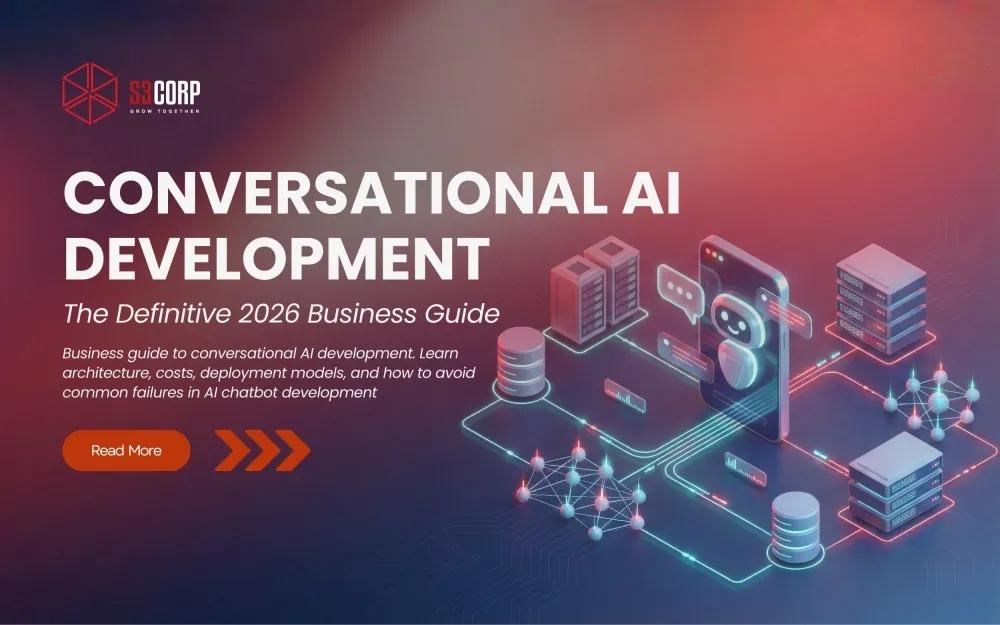
Conversational AI Development: The Definitive 2026 Business Guide
Complete enterprise guide covering conversational AI architecture, development lifecycle, cost models, and deployment strategies.
06 Feb 2026
Customer expectations have shifted dramatically. Yet many organizations still treat the conversational AI systems as basic chatbots rather than strategic enterprise AI solutions. This disconnect costs businesses millions in abandoned implementations and missed automation opportunities.
Conversational AI has evolved far beyond the scripted chatbots that dominated customer service portals five years ago. Modern conversational AI systems combine natural language processing (NLP), machine learning, and contextual understanding to handle complex workflows—from processing insurance claims to qualifying sales leads across multiple channels. However, the complexity of these systems creates new challenges around data governance, model accuracy, and integration with legacy enterprise systems.
The global conversational AI market is projected to reach USD 41.39 billion in 2030, according to Grand View Research, yet 40% of enterprise implementations fail to meet their ROI targets within the first year. The gap between investment and outcome often traces back to one fundamental issue: businesses treat conversational AI development as a technology purchase rather than a strategic capability that requires careful architecture, governance, and continuous optimization.
The difference between a successful conversational AI deployment and a failed one rarely comes down to technology choice. It hinges on understanding what conversational AI development actually requires in 2026—from architecture decisions and AI model training to governance frameworks and ongoing optimization. This guide breaks down the full development lifecycle, cost structures, and decision frameworks that separate functioning systems from transformative ones.
What Conversational AI Development Means for Business Today
Conversational AI development in 2026 extends far beyond scripted chatbot flows. Modern conversational AI systems represent full-stack enterprise automation platforms that combine natural language processing, intent recognition, context management, and decision-making capabilities. Here's what distinguishes true conversational AI from basic automation:
- Context persistence across sessions: The system remembers previous interactions, user preferences, and transaction history to deliver personalized responses without forcing users to repeat information.
- Multi-turn dialogue management: Unlike simple FAQ bots, these AI agents handle complex conversations that span multiple exchanges, clarifying ambiguous requests and maintaining conversational context throughout extended interactions.
- Integration with enterprise systems: Conversational AI architecture connects directly to CRM platforms, ERP systems, databases, and APIs to execute transactions, retrieve real-time data, and trigger workflows across your technology stack.
- Natural language understanding (NLU) at scale: Modern NLU models parse user intent even with typos, slang, or incomplete sentences, handling variations in phrasing that would break traditional rule-based systems.
- Content Moderation & Safety Layer: AI systems often include a separate safety layer that reviews both user input and generated responses. This layer checks for harmful, unsafe, or policy-violating content. It can block, filter, or request a safer response before the reply appears to the user. This step helps protect users, reduces legal risk, and supports safe deployment at scale.
- Dynamic response generation: Instead of selecting from pre-written templates, advanced systems generate contextually appropriate responses using large language models fine-tuned on your business domain.
- Proactive engagement capabilities: AI agents can initiate conversations based on user behavior, trigger events, or predictive signals rather than waiting passively for user queries.
- Omnichannel consistency: A single conversational AI system maintains coherent interactions across web chat, mobile apps, voice channels, messaging platforms, and email.
The distinction between conversational AI system architecture and basic chatbot scripts becomes clear in production environments. A scripted bot can handle "What are your business hours?" but fails when a user asks "Can I reschedule my Thursday appointment to sometime next week when Sarah is available?" The conversational AI system processes this request by understanding temporal references, checking calendar availability, verifying staff schedules, and either completing the booking or asking clarifying questions—all without predefined scripts for every possible variation.
This capability shift explains why enterprise AI automation now focuses on conversational interfaces rather than traditional form-based workflows.
For startup AI automation initiatives, the challenge lies in balancing custom development against platform constraints. Early-stage companies need conversational capabilities quickly but cannot afford the technical debt created by platforms with limited customization options. This tension drives the build-versus-buy decisions that we will examine in detail throughout this guide.
If you are looking to build a foundation for this type of digital transformation, you might consider how this integrates with wider software outsourcing services to ensure your backend infrastructure is ready to support high-load AI queries.
Why Businesses Invest in Conversational AI Today
Enterprise investment in conversational AI centers on three measurable outcomes: cost reduction through automation, customer experience improvement through 24/7 availability, and revenue acceleration through scalable engagement. The business case becomes compelling when organizations calculate the actual cost per interaction across human agents versus AI-assisted or fully automated conversations.
- Operational cost reduction of 30-50% in customer support: Conversational AI handles tier-1 support queries autonomously, reducing headcount requirements while maintaining service levels. A mid-sized financial services client reduced their support team from 120 agents to 68 after deploying a conversational AI system that resolved 67% of inquiries without human intervention.
- CX automation that maintains quality standards – Customer satisfaction scores remain stable or improve when AI systems provide instant responses to common questions while escalating complex issues to qualified human agents. The challenge lies in defining "simple" accurately through intent mapping and confidence thresholds.
- AI scalability during demand spikes – Seasonal businesses face 300-500% volume increases during peak periods. Hiring temporary staff creates training overhead and quality inconsistency. Conversational AI scales instantly to handle surge volume. Retail clients we work with deploy AI to manage Black Friday inquiry volume without degrading response times or adding headcount.
- Revenue acceleration through lead qualification – Sales teams waste 25-50% of outreach time on unqualified leads, according to HubSpot data. Conversational AI conducts initial qualification by asking budget, timeline, and authority questions before routing qualified prospects to sales representatives. B2B companies report 35-50% improvement in sales team productivity when AI handles qualification workflows.
- Global market expansion without proportional headcount – Companies serving multiple regions require 24/7 support across time zones and languages. Conversational AI provides consistent service quality regardless of local time. Multilingual NLP models handle 95+ languages with accuracy rates above 85% for major business languages. This capability allows companies to enter new markets without establishing local support infrastructure immediately.
- Compliance and audit trail requirements – Regulated industries need complete records of customer interactions for compliance audits. Conversational AI systems automatically log every exchange, decision point, and data access event. Financial services clients use AI audit trails to demonstrate regulatory compliance while reducing manual documentation overhead by 70-80%.
The investment thesis breaks down when organizations focus solely on technology deployment without addressing data quality, change management, or integration complexity. Successful conversational AI projects require clean training data, clearly defined use cases, and stakeholder alignment around success metrics. Companies that treat AI as a plug-and-play solution typically abandon projects within 6-9 months when accuracy rates plateau below acceptable thresholds.
From our experience delivering enterprise AI solutions, the business value emerges fastest when organizations start with high-volume, low-complexity use cases that demonstrate ROI within 90 days. This approach builds stakeholder confidence and secures budget for more ambitious automation initiatives. Companies attempting to automate complex, high-stakes workflows as initial projects face extended timelines, budget overruns, and skepticism that undermines future AI investment.
Conversational AI Development Models Compared
Organizations face three primary approaches when building conversational AI capabilities: custom development from scratch, platform-based implementation, or purchasing prebuilt solutions. Each model carries distinct implications for control, cost, timeline, and long-term flexibility.
|
Development Model |
Best For |
Timeline |
Cost Range |
Control Level |
Technical Debt Risk |
|---|---|---|---|---|---|
|
Build from Scratch |
Enterprises with unique workflows, proprietary data models, or competitive differentiation requirements |
6-12 months for MVP |
$250K-800K initial development |
Complete ownership of models, data, and architecture |
Low if maintained properly; High if team lacks AI expertise |
|
Platform-Based Development |
Mid-market companies needing proven frameworks with customization flexibility |
2-4 months for deployment |
$50K-200K implementation + platform fees |
Moderate - confined to platform capabilities |
Moderate - depends on platform maturity and vendor roadmap |
|
Buy Prebuilt Solutions |
Small businesses or pilot projects with standard use cases |
2-6 weeks for configuration |
$500-5K/month SaaS fees |
Minimal - limited to configuration options |
High - vendor lock-in and migration complexity |
Build from Scratch
Custom AI development makes strategic sense when conversational requirements cannot be met through existing platforms or when AI capabilities represent core competitive advantage. Organizations in healthcare, financial services, or specialized B2B markets often need custom solutions because their conversation flows, compliance requirements, or data models differ fundamentally from standard patterns.
The custom AI development process begins with data architecture decisions. Teams must choose base NLP models (transformer architectures like BERT or GPT variants), define training data requirements, establish labeling workflows, and build infrastructure for model versioning and deployment. This approach requires data science expertise, MLOps capabilities, and dedicated engineering resources.
Companies pursuing custom solutions typically invest $250K-800K for initial development, depending on scope complexity and team composition. This cost includes data preparation, model training, integration development, and initial testing cycles. Ongoing maintenance adds 20-30% annually for model retraining, infrastructure costs, and feature enhancements.
The advantage of custom AI model training lies in complete control over intellectual property, data handling, and feature development. Organizations own their models, can optimize for specific business contexts, and avoid dependency on vendor roadmaps or pricing changes. This ownership matters significantly for companies where conversational AI creates competitive differentiation or handles sensitive customer data.
However, custom development demands substantial technical capability. Teams need expertise in machine learning, natural language processing, software engineering, and DevOps practices. Organizations without these capabilities should consider partnering with specialists who can transfer knowledge while building initial systems. Services by S3Corp include custom AI delivery where we build proprietary models while establishing internal team capabilities through structured knowledge transfer.
Read More:
How to Build a Custom AI Chatbot: A Practical Enterprise Guide
The Complete Guide to AI Chatbot Solutions for Business (2026)
Platform-Based Development
Platforms like Dialogflow, Microsoft Bot Framework, and RASA provide pre-built infrastructure for intent recognition, entity extraction, and conversation management. These tools reduce development time by offering tested NLP models, integration connectors, and deployment frameworks. Platform-based development works well for organizations with standard use cases that align with platform capabilities.
The selection process focuses on matching platform strengths against business requirements. Dialogflow excels at simple query-response patterns and Google ecosystem integration. RASA offers more control over conversation logic and data privacy since it can be self-hosted. Microsoft Bot Framework integrates naturally with Azure services and enterprise Microsoft deployments.
Organizations choosing platforms typically invest $50K-200K for implementation, which covers requirements analysis, platform configuration, custom integration development, and team training. Monthly platform fees range from $1K-15K depending on conversation volume and feature requirements. This model reduces initial capital expenditure compared to custom development but creates ongoing operational costs.
The risk profile centers on vendor dependency and platform limitations. Companies find themselves constrained by platform roadmaps, pricing changes, or feature gaps that emerge as use cases evolve. Migration between platforms becomes expensive once significant customization accumulates. We advise clients to evaluate migration costs during initial platform selection—specifically, how much custom code would need rewriting if switching becomes necessary.
From our experience guiding platform selection across enterprise clients, the decision often hinges on risk tolerance and internal capability. Organizations with strong engineering teams prefer RASA or similar open-source frameworks that provide flexibility without vendor lock-in. Companies prioritizing faster deployment and accepting platform constraints choose managed services like Dialogflow. The optimal choice depends on strategic importance, budget constraints, and acceptable risk levels.
Buy Prebuilt Solutions
SaaS conversational AI tools offer the fastest deployment path for standard use cases like customer support FAQs, appointment scheduling, or lead capture. The prebuild one often provide no-code chatbot builders with pre-trained models for common business scenarios.
These solutions work effectively when business requirements align closely with platform templates. A dental office scheduling appointments or an e-commerce company answering shipping questions can deploy functional AI in days rather than months. Monthly costs range from $500-5K depending on conversation volume and feature tiers.
The limitation becomes apparent when organizations need capabilities outside platform scope. Custom workflow automation, proprietary system integration, or specialized conversation logic often requires expensive workarounds or remains impossible within platform constraints. Companies outgrow these tools as AI becomes central to operations rather than a peripheral customer service feature.
We observe clients hitting platform ceilings around 12-18 months into deployment. Initial success with simple automation creates demand for more sophisticated capabilities that prebuilt platforms cannot deliver. At this point, organizations face difficult choices: accept platform limitations, invest in extensive customization that creates fragile solutions, or migrate to more flexible approaches. Migration costs frequently exceed initial platform implementation budgets because production systems now handle critical workflows that cannot be interrupted.
The strategic recommendation depends on AI's role in business strategy. For peripheral use cases unlikely to require significant evolution, prebuilt solutions minimize cost and complexity. For core capabilities expected to differentiate customer experience or operational efficiency, investing in more flexible approaches from the beginning avoids expensive migrations later.
The Conversational AI Development Lifecycle
Successful conversational AI projects follow a structured development lifecycle that addresses business goals, technical architecture, model training, quality assurance, and continuous optimization. Organizations that skip phases or compress timelines create technical debt that undermines AI performance and increases long-term maintenance costs.
Strategy and Goal Definition
The discovery phase establishes clear business objectives, success metrics, and scope boundaries before any technical work begins. This phase prevents the common failure pattern where organizations build technically impressive AI systems that do not address actual business problems.
Effective strategy workshops address several critical questions:
- Which customer interactions create the highest cost or friction? – Analyzing support tickets, call transcripts, and user feedback reveals high-volume, repetitive queries suitable for AI automation
- What does success look like in measurable terms? – Defining specific targets like "reduce tier-one support volume by 50%" or "qualify 200 sales leads monthly" creates accountability and prevents scope drift
- Where are current pain points in customer experience? – Understanding frustration drivers helps prioritize AI capabilities that improve satisfaction rather than just reducing costs
- What constraints must we respect? – Regulatory requirements, data privacy rules, and technical limitations shape feasible solutions
- How will we measure AI accuracy and quality? – Establishing baseline metrics for resolution rate, customer satisfaction, and escalation frequency before deployment enables meaningful performance tracking
The output from this phase includes documented use cases, success metrics, technical requirements, and project timelines. Teams use these artifacts to maintain alignment between business stakeholders and technical implementers throughout development.
Read More: How to Build an AI Software System: Step-by-Step Guide
Architecture and Intent Design
Conversational flow architecture defines how AI systems understand user requests, maintain context, gather required information, and execute actions. This design phase translates business requirements into technical specifications for intent mapping, entity extraction, and dialogue management.
Intent mapping creates the taxonomy of user goals that AI must recognize. A customer support AI might recognize intents like "check_order_status," "initiate_return," "update_payment_method," or "escalate_to_human." Each intent requires training examples that cover linguistic variations, abbreviations, and common misspellings.
Entity extraction identifies specific data points within user messages. For "I want to return the blue shirt I ordered last Tuesday," entities include product_type (shirt), product_color (blue), and order_date (last Tuesday). The system must normalize these entities into formats that backend systems can process—converting "last Tuesday" into a specific date, for instance.
Conversation flow design maps multi-turn dialogues where AI gathers required information through clarifying questions. A booking system might need location, date, time, and participant count. The flow defines question sequences, handles missing information, validates inputs, and confirms final actions before execution.
The architecture phase produces several deliverables: intent taxonomy documents, entity schemas, conversation flow diagrams, and integration specifications. These artifacts guide development teams and establish testing criteria for quality assurance phases.
Architectural decisions during this phase significantly impact long-term maintenance costs. Well-designed intent hierarchies scale gracefully as new use cases emerge. Poorly structured taxonomies require extensive refactoring when business requirements evolve. We advise clients to invest adequate time in architecture rather than rushing to implementation, because correcting structural problems in production systems costs 10-15x more than building correctly initially.
Model Training and Prompt Engineering
AI training transforms architectural specifications into working models that understand and respond to real user language. This phase requires high-quality training data, careful prompt engineering, and iterative refinement to achieve acceptable accuracy.
Training data preparation consumes 40-60% of total development effort in most projects. Teams must collect example conversations, label intents and entities, balance training sets across different intent categories, and validate data quality. Organizations with existing customer interaction data have advantages, but raw data requires significant cleaning and structuring before use in training.
For systems using large language models, prompt engineering replaces or augments traditional training. Developers craft system prompts that define AI behavior, provide examples, and establish guardrails. Effective prompts include role definition, task description, output format specifications, and constraint statements that prevent undesired responses.
The training process involves multiple iterations where teams evaluate model performance against test sets, identify failure patterns, add training examples to address gaps, and retrain models. This cycle continues until accuracy metrics meet defined thresholds—typically 85-90% intent classification accuracy and 90-95% entity extraction accuracy for production deployment.
Organizations often underestimate the expertise required for effective AI training. Data scientists must understand linguistic variation, edge cases, and context ambiguity. They need judgment about when to add training data versus when to restructure intent definitions. Teams without this expertise produce models that work well in demos but fail in production when users deviate from anticipated language patterns.
Testing, Governance, and Human Override
Quality assurance for conversational AI extends beyond functional testing to include accuracy validation, bias detection, and human oversight mechanisms. Organizations must establish governance frameworks that define acceptable AI behavior and specify when human intervention becomes necessary.
Testing protocols evaluate multiple dimensions:
- Intent classification accuracy – Measuring percentage of correctly identified user goals across diverse test cases
- Entity extraction precision – Validating that AI pulls correct data from user messages without hallucinating information
- Conversation completion rates – Tracking how often AI successfully resolves requests without escalation
- Response appropriateness – Ensuring AI responses match context and maintain professional tone
- Edge case handling – Testing AI behavior with unusual requests, ambiguous language, or adversarial inputs
- Integration reliability – Validating that AI correctly triggers backend systems and handles errors gracefully
Human-in-the-loop design establishes thresholds where AI transfers conversations to human agents. These handoff triggers might include low confidence scores (below 70% certainty), requests outside trained intents, or explicit user requests for human assistance. Well-designed systems provide context summaries to human agents so customers do not need to repeat information.
AI governance frameworks document decision-making authority, approval workflows, and audit trail requirements. Financial services clients implement strict governance where AI can provide information but requires human approval before executing transactions. Healthcare applications separate diagnostic support (informational only) from appointment scheduling (execution permitted).
Organizations must maintain audit trails showing what information AI accessed, what decisions it made, and what actions it executed. These logs support compliance audits, quality improvement initiatives, and incident investigations when problems occur. The audit trail architecture should capture conversation transcripts, confidence scores, data sources accessed, and human override events.
We implement multi-tiered approval thresholds and rollback logic in enterprise AI systems. Low-risk actions like providing business hours proceed automatically. Medium-risk actions like password resets require additional identity verification. High-risk actions like account closures require human confirmation. This graduated approach balances automation benefits against risk management requirements.
Deployment and Continuous Optimization
Production deployment requires infrastructure for model hosting, monitoring systems for performance tracking, and processes for continuous improvement based on real-world usage data. Organizations treating deployment as the project endpoint rather than the beginning of ongoing optimization typically see AI performance degrade over time.
Key deployment considerations include:
- Infrastructure scaling – Ensuring systems handle peak conversation volume without latency degradation
- Model versioning – Maintaining rollback capability when new models introduce problems
- A/B testing frameworks – Comparing different model versions or conversation flows against business metrics
- Performance monitoring – Tracking resolution rates, escalation frequency, response times, and user satisfaction in real-time
- Feedback loops – Capturing unhandled requests and user corrections to identify training gaps
MLOps practices for conversational AI include automated model retraining pipelines, continuous integration for conversation flow updates, and automated testing that validates changes before production deployment. These practices reduce manual overhead while maintaining quality standards.
The optimization cycle reviews AI performance data weekly or monthly to identify improvement opportunities. Teams analyze conversations that escalated to humans, examine low-confidence predictions, and review user feedback. This analysis drives decisions about adding training data, refining intent definitions, or adjusting conversation flows.
Organizations maintaining active optimization programs achieve steady accuracy improvements over 6-12 months following initial deployment. Companies that deploy and neglect AI systems experience accuracy degradation as user language evolves, business processes change, or edge cases accumulate that were not addressed in initial training.
Cost of Conversational AI Development in 2026
AI development cost varies significantly based on approach, scope, and complexity. Organizations need realistic budget expectations that account for initial implementation and ongoing operational expenses. The following cost structure reflects current market rates for enterprise-grade conversational AI systems.
|
Cost Component |
Custom Development |
Platform-Based |
Prebuilt SaaS |
|---|---|---|---|
|
Initial Implementation |
$250K-800K |
$50K-200K |
$5K-25K |
|
Monthly Platform Fees |
$0 (self-hosted) or $2K-10K (managed infrastructure) |
$1K-15K |
$500-5K |
|
Ongoing Maintenance |
$50K-150K annually (20-30% of initial) |
$20K-60K annually |
Included in SaaS fees |
|
Team Requirements |
4-8 FTE (ML engineers, data scientists, DevOps) |
2-4 FTE (developers, analysts) |
1-2 FTE (admin, content) |
|
Time to Production |
6-12 months |
2-4 months |
2-6 weeks |
|
Scaling Costs |
Infrastructure only |
Platform tier upgrades |
Per-conversation fees |
Custom Development Detailed Breakdown
Initial development costs include data preparation ($50K-150K), model development ($100K-300K), integration engineering ($50K-200K), and testing/refinement ($50K-150K). Organizations should budget for 6-12 month timelines depending on scope complexity and team capability.
Ongoing costs cover infrastructure hosting, model retraining, feature enhancements, and support operations. Cloud infrastructure for AI hosting typically costs $2K-10K monthly depending on conversation volume. Model maintenance requires dedicated data science capacity at $100K-200K annually per FTE.
Platform-Based Implementation Costs
Platform implementation includes requirements analysis ($15K-40K), platform configuration ($20K-80K), custom integration development ($10K-60K), and training ($5K-20K). Timeline compression compared to custom development reduces labor costs but creates dependency on platform capabilities.
Monthly platform fees vary by vendor and conversation volume. Dialogflow charges per request after free tier limits. RASA Enterprise licenses cost $1K-5K monthly depending on deployment scale. Microsoft Bot Framework pricing ties to Azure consumption.
Prebuilt Solution Economics
SaaS chatbot pricing uses tiered models based on conversation volume, features, and integrations. Entry tiers start around $500 monthly for 1,000 conversations. Enterprise tiers reach $5K+ monthly for unlimited conversations and advanced features.
Hidden costs include integration development for connecting to business systems ($5K-25K one-time), content creation for training AI responses ($5K-15K), and ongoing optimization to maintain accuracy (1-2 FTE part-time).
Total Cost of Ownership
Three-year TCO comparison shows interesting patterns. Custom development has high initial costs ($250K-800K) but lower ongoing expenses ($150K-300K annually), resulting in $700K-1.7M total. Platform implementations have moderate initial costs ($50K-200K) and moderate ongoing expenses ($32K-180K annually including platform fees), totaling $146K-740K. Prebuilt solutions have minimal initial costs ($5K-25K) but higher long-term operational expenses ($18K-60K annually), totaling $59K-205K.
The crossover point where custom development becomes more cost-effective typically occurs around 24-36 months for high-volume applications or systems requiring significant customization. Organizations with standard requirements and lower conversation volumes achieve better economics through platform or SaaS approaches.
From our experience delivering AI development across different budget profiles, we position S3Corp as a cost-transparent partner that helps clients optimize total cost of ownership rather than simply minimizing initial expenditure. We provide detailed cost modeling during discovery phases so organizations make informed decisions about build versus buy tradeoffs based on their specific circumstances.
Read More: AI Chatbot Pricing in 2026: Costs, Models, and Budget Examples
Common Conversational AI Failures (From Real Projects)
Learning from failed implementations prevents organizations from repeating expensive mistakes. The following table presents anonymized lessons from conversational AI projects that underperformed or were abandoned.
|
Problem |
Symptom |
Root Cause |
Solution Approach |
|---|---|---|---|
|
Low accuracy in production |
AI correctly handles only 40-60% of requests despite 85%+ testing accuracy |
Training data does not reflect actual user language patterns |
Collect real user conversations before training. Conduct pilot testing with actual users rather than internal QA teams |
|
Users abandon AI after first interaction |
70%+ of users who try AI chatbot never return |
AI provides technically correct but unhelpful responses that do not solve user problems |
Map conversation flows to actual user goals rather than organizational structure. Measure task completion, not just response accuracy |
|
Escalation rates exceed projections |
40%+ of conversations escalate to humans when target was 15-20% |
Intent taxonomy too narrow or confidence thresholds set incorrectly |
Expand intent coverage based on actual request distribution. Implement confidence calibration using production data |
|
Integration failures in production |
AI makes recommendations but cannot execute actions |
Backend systems lack APIs or require authentication that AI cannot handle |
Complete integration architecture during design phase. Validate API availability and access controls before conversation flow development |
|
Model drift after 6 months |
Accuracy degrades from 85% to 65% over time |
User language evolves, business processes change, but AI training remains static |
Implement continuous monitoring and quarterly retraining cycles. Capture unhandled requests for model updates |
|
Unacceptable response latency |
Users wait 5-10 seconds for AI responses |
Inefficient model architecture or integration bottlenecks |
Performance test under realistic load during development. Optimize integration patterns and consider model quantization |
|
Regulatory compliance gaps |
Audit reveals AI accessed customer data without proper authorization |
Governance framework developed after deployment rather than before |
Design data access controls and audit logging from project start. Include compliance review in architecture phase |
|
Budget overruns during deployment |
Project exceeds budget by 50-100% |
Underestimated integration complexity and data preparation effort |
Conduct technical discovery to validate integration feasibility before commitment. Budget 40-60% of effort for data work |
|
Onboarding time and complexity |
System works correctly but takes months to configure, delaying ROI |
Setup requires manual intent design, data mapping, and integration steps that were not planned or automated |
Define onboarding phases early. Prepare data pipelines and integration tasks before model deployment. Run a limited pilot to confirm timelines and resource needs |
|
Hallucinated or outdated answers |
AI gives confident but incorrect or obsolete information |
Model relies on static training data or prompts without access to current or domain-specific knowledge |
Implement a Retrieval-Augmented Generation (RAG) layer. Connect the model to verified knowledge sources at inference time. Validate responses against retrieved content before delivery |
The most common failure pattern we observe involves organizations treating conversational AI as a technology deployment rather than a business transformation initiative. Projects succeed when executive sponsors champion change management, allocate sufficient resources for training data development, and establish clear success criteria before development begins.
Technical execution quality matters, but business factors typically determine whether AI delivers promised value. Organizations must align stakeholders around use cases, secure budget for multi-month timelines, and commit to ongoing optimization rather than expecting perfect performance at launch.
We advise clients to start with pilot projects that can demonstrate value within 90 days while building internal capability for larger initiatives. This approach validates technical assumptions, builds stakeholder confidence, and creates learning opportunities before committing to enterprise-wide deployments. Companies attempting to automate complex, mission-critical workflows as initial AI projects face much higher failure risk than those building capability through progressive expansion.
Conclusion
Conversational AI development in 2026 requires balancing technical sophistication with practical business focus. Organizations succeed when they treat AI as strategic capability requiring careful planning, adequate resources, and ongoing optimization rather than as technology to be deployed and forgotten.
The decision frameworks presented in this guide—development model selection, architecture design, readiness assessment—help executives make informed choices about AI investment. Success depends on understanding total cost of ownership, establishing realistic performance expectations, and committing to continuous improvement after initial deployment.
Companies that approach conversational AI strategically achieve significant cost reduction, customer experience improvement, and operational scalability. Those treating AI as quick-fix solutions typically abandon projects within 12-18 months when performance fails to meet expectations.
Organizations need AI outsourcing partners who combine technical expertise with business judgment to navigate the complexity of enterprise AI development. The difference between successful AI implementation and failed pilots often comes down to methodology, experience, and commitment to delivering measurable business outcomes.
Ready to explore how conversational AI can address your specific business challenges? Contact our team at S3Corp to discuss your requirements and learn how we can tailor solutions that deliver measurable ROI while building internal AI capabilities for long-term success.
FAQs About Conversational AI Development
What is the difference between a chatbot and conversational AI?
Chatbots follow scripted decision trees with predetermined responses to specific inputs. Conversational AI uses natural language processing and machine learning to understand intent, maintain context across multiple exchanges, and handle linguistic variations without explicit programming for every scenario. Modern conversational AI systems can interpret ambiguous requests, ask clarifying questions, and execute complex workflows across integrated enterprise systems.
How long does conversational AI development take?
Timeline depends on approach and complexity. Prebuilt SaaS solutions deploy in 2-6 weeks with limited customization. Platform-based implementations using tools like Dialogflow or RASA require 2-4 months for configuration, integration, and testing. Custom AI development from scratch typically takes 6-12 months from requirements gathering through production deployment. Organizations should add 2-3 months for data preparation if quality training data does not already exist.
When should we build custom AI versus using a platform?
Build custom AI when conversational requirements differ fundamentally from standard patterns, when AI capabilities represent competitive differentiation, or when data privacy requires complete control over infrastructure. Use platforms when business needs align with standard use cases, when faster deployment matters more than customization flexibility, or when internal AI expertise is limited. The crossover point typically occurs when platform limitations prevent addressing critical business requirements or when vendor costs over 3 years exceed custom development total cost of ownership.
How do we prevent conversational AI from making mistakes?
Implement multi-layered controls including confidence thresholds that escalate low-certainty predictions to humans, comprehensive testing across edge cases before production deployment, human-in-the-loop workflows for high-stakes decisions, audit trails logging all AI actions, and continuous monitoring that detects accuracy degradation. Organizations should start with low-risk use cases like providing information before automating high-stakes actions like processing transactions. AI governance frameworks should define acceptable decision-making authority and establish clear escalation protocols.
What data do we need to train conversational AI?
Minimum viable training requires 10,000+ historical customer interactions covering representative use cases. Data should include diverse linguistic variations, common misspellings, and edge cases. For supervised learning approaches, conversations must be labeled with intents and entities. Organizations without existing interaction data can start with smaller datasets using few-shot learning approaches or large language models requiring less training data. Data quality matters more than quantity—1,000 well-labeled, representative conversations often produce better results than 50,000 poorly structured interactions.







_1746790956049.webp&w=384&q=75)
_1746790970871.webp&w=384&q=75)