Insights
Table Of Content
Key Takeaways
Introduction
What Does It Mean to Outsource Mobile App Development?
Why Should You Outsource Mobile App Development?
What Parts of Mobile App Development Can You Outsource?
Should You Outsource the Whole App or Only Part of the Development?
How Do You Choose Between Native and Cross-Platform Mobile Development?
How Much Does It Cost to Outsource Mobile App Development?
Which Outsourcing Engagement Model Should You Choose?
How Do You Evaluate a Mobile App Development Outsourcing Company?
What Should You Ask an Outsourcing Partner Before Signing?
What Are the Risks of Outsourcing Mobile App Development?
Vietnam vs. India vs. the Philippines vs. Eastern Europe: Which Destination Fits a Security-Conscious Mid-Size Team?
Is Vietnam a Good Location for Outsourced Mobile App Development?
How Should You Manage an Outsourced Mobile App Team?
What Does a Good Mobile App Outsourcing Process Look Like?
Outsource Mobile App Development With a Delivery Partner That Fits Your Requirements
Frequently Asked Questions About Outsourcing Mobile App Development
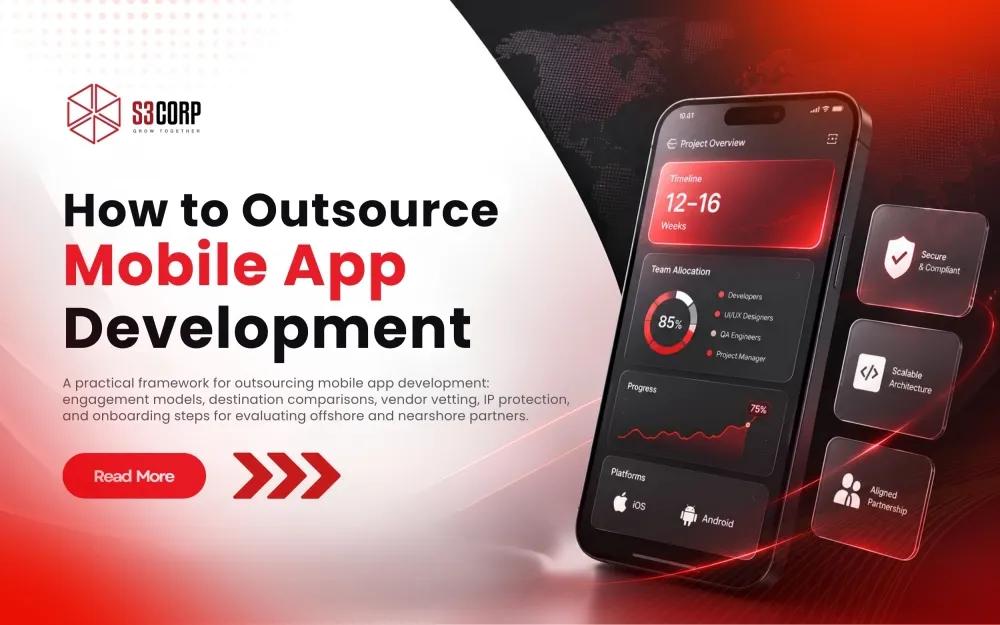
How to Outsource Mobile App Development: A Practical Guide for 2026
A practical framework for outsourcing mobile app development: engagement models, destination comparisons, vendor vetting, IP protection, and onboarding steps for technical leaders evaluating offshore and nearshore partners.
28 Aug 2026
Key Takeaways
- Outsourcing mobile app development means hiring an external team to design, build, test, launch, or maintain an iOS, Android, or cross-platform app, while you keep ownership of product decisions.
- The strongest reasons to outsource are specialist skills and delivery capacity, not just lower cost.
- Scope the work first. Decide whether you need full-lifecycle delivery, a dedicated team, or staff augmentation before you contact vendors.
- Native development suits performance-critical or hardware-heavy apps. Cross-platform suits budget-constrained, multi-platform launches on a shared codebase.
- Hourly rates for software development companies on Clutch commonly run $24–$49 per hour, but a mobile project needs a scope-specific quote, not a generic average.
- Evaluate any outsourcing mobile app development company on QA process, security controls, IP ownership terms, and communication cadence, not portfolio alone.
- Vietnam has become a strong option for security-conscious, mid-size teams: rates close to India and the Philippines, a growing base of ISO/IEC 27001-certified vendors, and strong time-zone overlap with Singapore.
Introduction
Outsourcing mobile app development means hiring an external team, through a fixed-price, time-and-materials, or dedicated-team engagement, to design, build, and maintain your app instead of building an in-house team from scratch.
Companies choose this route to add specialist skills, increase delivery capacity, or avoid the overhead of building an internal mobile team from zero. It works well when the scope is clear and the partner has proven QA, security, and communication practices; it creates risk when either of those is missing.
The real work isn't deciding whether to outsource. It's picking the right destination and vendor, then verifying security, IP-protection terms, and delivery record before you sign anything.
This guide gives you a decision framework, not a marketing pitch. You will learn how to define what to outsource, how to choose between native and cross-platform development, how commercial models actually differ, and what to check before you sign a contract. You will also get a straightforward look at Vietnam as a delivery location, including what to verify rather than assume.
Outsourcing Decision Snapshot
|
Decision Point |
What to Check |
Quick Guidance |
|
When to outsource |
Internal mobile capacity vs. project timeline |
Outsource when skills, capacity, or speed gaps exist internally |
|
What to outsource |
Product lifecycle stage and internal ownership |
Full lifecycle if no internal mobile team; partial scope if you already have engineering leadership |
|
Partner model |
Requirement stability and control needs |
Dedicated team for ongoing work; project-based for fixed-scope builds |
|
Key risk checks |
QA process, security, IP terms, communication |
Verify before signing, not after the first sprint |
|
If you're optimizing for... |
Best-fit starting point |
Why |
|
Lowest cost |
India or Vietnam |
Lowest blended hourly rates for comparable mid-level engineering talent |
|
Security-conscious teams |
Vietnam |
A fast-growing base of ISO/IEC 27001-certified delivery shops at accessible rates |
|
Time-zone overlap with Singapore |
Vietnam or the Philippines |
Same or near-identical time zone, meaning real-time overlap with SG business hours |
|
Technical depth (cross-platform, AI, embedded) |
Vietnam or Eastern Europe |
Higher concentration of senior engineers and specialized capability, including embedded and IoT-adjacent work |
The global IT services outsourcing market illustrates why this decision carries more weight than it used to. According to Grand View Research, the market was valued at approximately $744.6 billion in 2024, with growth expected to reach $1.22 trillion by 2030 at a compound annual growth rate of 8.6%. That growth means more vendors, more marketing claims, and more variance in actual delivery quality. A vetting framework matters more today than it did five years ago, simply because there are more options to sort through.
What Does It Mean to Outsource Mobile App Development?
To outsource mobile app development, a company transfers some or all app delivery work to an external development partner. That partner can cover product discovery, UI/UX, mobile development, backend integration, QA, deployment, and maintenance. You keep control over product priorities and business decisions throughout.
The confusion usually starts with terminology. "Outsourcing," "hiring developers," and "staff augmentation" get used interchangeably, but they describe different levels of ownership and control.
Full project outsourcing hands the entire build to the vendor, from requirements to release. A dedicated team embeds vendor engineers into your workflow long-term, reporting to your product owner. Staff augmentation fills specific skill gaps with individual contractors who plug into your existing team and processes.
|
Model |
Who Owns Delivery |
Best Fit |
|
Full project outsourcing |
Vendor manages scope, timeline, and quality |
No internal mobile engineering team |
|
Dedicated team |
Client directs priorities; vendor supplies the team |
Long-term product with ongoing roadmap |
|
Staff augmentation |
Client manages process and delivery |
Existing team needs specific skills or short-term capacity |
Picking the wrong model early creates friction later. A company that needs full-cycle development but hires individual augmented staff often ends up managing a project it never intended to manage. Review collaboration models used across software outsourcing engagements before you finalize scope, since the commercial structure should follow the delivery model, not the other way around.
In practical terms, an outsourced vendor absorbs recruiting, payroll, benefits administration, tooling licenses, and the ongoing management of a mobile engineering team. You retain the product roadmap, the business logic decisions, and final sign-off on every release. For most companies building a customer-facing or internal app that isn't the entirety of their competitive advantage, that trade makes sense. Full software outsourcing services can cover the complete engineering function, not just extra hands, which is why the model works even for companies with an existing internal team.
There are real exceptions, though, and a vendor who pretends otherwise isn't being straight with you.
|
Outsource when... |
Keep in-house when... |
|
The app is a supporting product, not your primary IP |
The app itself is your core competitive advantage and defensibility |
|
You need to move fast without a multi-month hiring cycle |
You need day-one institutional knowledge that only existing staff carry |
|
Your data-classification policy allows controlled third-party access |
Regulatory or contractual terms rule out third-party access entirely |
|
You want to scale the team up or down as scope changes |
You expect the team size and scope to stay fixed for years |
|
Cost predictability matters more than direct day-to-day control |
Direct, in-person control over every engineering decision is a hard requirement |
If your situation lands clearly in the right-hand column, outsourcing probably isn't the answer regardless of destination or vendor quality. If it lands in the left-hand column, or somewhere in between, the rest of this guide walks through how to make that decision safely.
Why Should You Outsource Mobile App Development?
Companies outsource mobile app development when they need skills, capacity, or delivery capability that is difficult to build internally on the current timeline. Cost matters, but it rarely stands alone as the deciding factor for a technical buyer. Five reasons come up consistently in real scoping conversations.
- Access to specialist engineers. iOS and Android development, plus platform-specific security and performance tuning, are narrow skill sets. Hiring for them internally can take months.
- Flexible team capacity. A partner can scale a team up for a launch push and scale down after release, without the fixed cost of permanent headcount.
- Reduced internal hiring overhead. Sourcing, interviewing, and onboarding senior mobile engineers is slow and expensive, especially in competitive markets like the US, UK, and Singapore.
- Faster access to delivery resources. An established partner already has engineers, QA processes, and DevOps pipelines in place. You are not building infrastructure from scratch.
- Internal focus on core product work. Your in-house team stays on strategy, roadmap, and the parts of the product that create competitive differentiation, while the partner executes assigned engineering work.
These benefits connect directly to delivery capability, not just staffing. A partner offering full software development, QA and testing, and DevOps under one engagement removes the coordination overhead of stitching together separate vendors for build, test, and release.
What Parts of Mobile App Development Can You Outsource?
You can outsource the full mobile product lifecycle or only the segments your internal team cannot cover. Common outsourced areas include discovery, UI/UX design, iOS and Android development, cross-platform development, backend and API work, QA, DevOps, app-store release support, and post-launch maintenance.
Mapping the lifecycle helps you decide where to draw the outsourcing line.
- Discovery: requirements gathering, technical feasibility, architecture planning.
- Design: UI/UX design, prototyping, usability testing, and accessibility compliance (WCAG 2.1 AA).
- Development: native iOS (Swift), native Android (Kotlin), or cross-platform (Flutter, React Native) implementation, plus backend and API integration.
- QA: functional, performance, security, and device-compatibility testing.
- Release: app-store submission, compliance checks, phased rollout.
- Maintenance: bug fixes, OS-version updates, feature enhancements, monitoring.
Accessibility deserves its own line item, not a footnote. The European Accessibility Act has been fully enforced since June 2025, and it requires consumer-facing apps in sectors like banking, transport, and e-commerce to meet WCAG 2.1 AA through the EN 301 549 standard. Building this in at the design stage is far cheaper than retrofitting it after launch, and in some EU member states, non-compliance carries direct legal liability.
Two decision points determine your scope. First, does your internal team already own product strategy and architecture decisions? If yes, you can outsource implementation capacity alone. Second, do you have QA and release processes in place? If not, outsourcing needs to include quality assurance, not just coding.
New feature development, feature enhancement on an existing app, automation test tooling, and ongoing maintenance support are all common standalone engagements. This means you do not have to outsource an entire greenfield build to get value. A dedicated QA and testing function alone can resolve a backlog of release-quality issues without touching feature development at all.
Should You Outsource the Whole App or Only Part of the Development?
The right outsourcing scope depends on what your internal team already owns. A company with strong product and engineering leadership can outsource implementation capacity, QA, or a specific platform. A company without mobile engineering capacity typically outsources the full lifecycle while keeping product strategy and business ownership in-house.
|
Internal Capability |
Project State |
Recommended Scope |
Control Level |
Main Risk |
|
Strong product + engineering leadership |
New feature or platform expansion |
Partial: implementation, QA, or one platform |
High, client-directed |
Coordination overhead across two teams |
|
Some engineering, no mobile specialists |
New mobile app off an existing backend |
Partial: mobile development + QA |
Medium, shared ownership |
Integration gaps between backend and mobile teams |
|
No internal mobile or product team |
Greenfield mobile product |
Full lifecycle outsourcing |
Lower, vendor-directed |
Requirements drift without a strong internal product owner |
|
Existing app, no dedicated maintenance team |
Live app needing ongoing support |
Outsource maintenance and enhancement |
Medium, client-directed |
Knowledge transfer gaps at handover |
Consider a mid-size retail company that already runs a strong web engineering team but has never shipped a mobile app. Full-lifecycle outsourcing, paired with close internal product ownership, usually beats trying to build a first-time mobile team from scratch under launch pressure. A company already running a mobile app that needs a legacy platform migrated to a modern architecture faces a different scope entirely, and should evaluate vendors on migration experience specifically, not general app-building skill.
How Do You Choose Between Native and Cross-Platform Mobile Development?
Choose native development when platform-specific performance, device capabilities, or user experience are critical. Choose cross-platform development when one shared codebase can meet product requirements and the priority is efficient delivery across iOS and Android. The decision should follow product requirements, not framework popularity.
Native development, using Swift for iOS and Kotlin for Android, gives direct access to platform APIs, camera hardware, sensors, and the latest OS features on release day. It typically delivers the smoothest performance and the most polished platform-specific UX, at the cost of maintaining two separate codebases.
Cross-platform development, using frameworks like Flutter or React Native, lets one codebase target both platforms. This speeds up delivery and simplifies maintenance, though performance can lag native for graphics-intensive or hardware-heavy apps, and access to brand-new OS features sometimes arrives later.
|
Factor |
Native Development |
Cross-Platform Development |
|
Performance |
Highest, direct hardware access |
Strong for most apps, can lag for intensive graphics |
|
Platform features |
Immediate access to new OS capabilities |
Access can lag behind native SDKs |
|
Code sharing |
None; separate iOS and Android codebases |
Single codebase for both platforms |
|
Maintenance |
Two codebases to update and test |
One codebase, faster iteration |
|
Team skills needed |
Swift and Kotlin specialists |
Flutter or React Native specialists |
|
Suitable use cases |
Gaming, AR/VR, hardware-heavy apps, banking apps with strict performance needs |
MVPs, content apps, marketplace apps, most business apps |
A fintech app handling biometric authentication and offline transaction signing often justifies native development for the security and performance ceiling it provides. A retail loyalty app or an internal enterprise tool, where time-to-market matters more than milliseconds of animation performance, is usually a better fit for cross-platform. If you are unsure which category your product falls into, review a native vs. hybrid vs. cross-platform comparison against your specific feature list before committing.
How Much Does It Cost to Outsource Mobile App Development?
Outsourced mobile app development cost depends on scope, app complexity, platform count, integrations, UX requirements, QA depth, security requirements, team composition, location, and commercial model. Published benchmarks give you a reference point, but a project-specific estimate is what actually determines your budget.
Clutch's software development pricing research shows that most companies on its platform charge $24–$49 per hour, with reviewed projects commonly falling between $10,000 and $49,000. For mobile-specific work, Clutch's app development pricing data shows a similar $25–$49 per hour range, with typical project costs in the $10,000–$49,999 band. Treat these as general software-development and app-development benchmarks, not a mobile-app quote for your specific requirements.
Cost drivers to walk through with any vendor before comparing numbers:
|
Cost Driver |
Why It Moves the Price |
|
Platform count |
Native iOS + Android roughly doubles implementation work vs. one platform |
|
Integration complexity |
Payment gateways, third-party APIs, and legacy backend connections add engineering and testing time |
|
UX depth |
Custom animations and complex interaction design cost more than standard UI patterns |
|
QA depth |
Security testing, load testing, and device-matrix testing extend timeline and cost |
|
Team composition |
Senior-heavy teams cost more per hour but often ship faster with fewer defects |
|
Location |
Regional rate differences affect hourly cost, though not always total project cost |
|
Commercial model |
Fixed price typically includes a risk premium; time and materials shifts risk to the buyer |
Which Outsourcing Engagement Model Should You Choose?
Fixed-price suits a tightly scoped MVP with a locked budget. So choose a fixed-price model when requirements are stable and acceptance criteria are clear.
Time-and-materials fits evolving requirements where speed of iteration matters more than cost certainty. Choose time and materials when requirements will evolve during the build.
A dedicated team becomes the right model once you're past MVP and need a long-term extension of your engineering organization. Choose a dedicated team when you need sustained capacity, product knowledge, and a long-term engineering relationship.
The right model matches your uncertainty level, control needs, and delivery horizon.
|
Model |
Best Fit |
Advantages |
Risks and Buyer Responsibilities |
|
Fixed price |
Stable, well-documented requirements. Tightly scoped MVP, locked budget |
Predictable budget; clear scope boundaries |
Scope changes are expensive; requires detailed upfront specs |
|
Time and materials |
Evolving requirements, iterative product |
Flexibility to adjust priorities each sprint. ost scales with actual hours |
Requires active client involvement and budget monitoring |
|
Dedicated team |
Long-term product with ongoing roadmap |
Deep product knowledge builds over time; consistent velocity |
Requires clear internal product ownership and governance |
Most mobile products do not fit neatly into one model for their entire lifecycle. An MVP build might run on fixed price to control initial budget, then shift to a dedicated team once the product finds traction and the roadmap becomes continuous. Reviewing available collaboration models before signing helps you avoid renegotiating the entire contract when your product moves from build to scale phase.
How Do You Evaluate a Mobile App Development Outsourcing Company?
Evaluate an outsourcing company on delivery evidence, technical capability, QA practices, security controls, communication, commercial clarity, and relevant industry experience. A strong portfolio alone is not enough. Ask how the team manages architecture decisions, code reviews, testing, release quality, documentation, and ownership of code and data.
Score each candidate on this eight-point scale from 1 (weak) to 5 (strong):
|
Evaluation Criteria |
What Good Looks Like |
|
Technical depth |
Team can explain architecture trade-offs, not just list technologies |
|
QA maturity |
Defined test strategy, automated testing, defect tracking visible to you |
|
Security practices |
Access controls, secure coding standards, and a named security process |
|
IP and code ownership |
Clear contractual terms; source code delivered to you, not held by the vendor |
|
Communication |
Regular structured updates; English proficiency confirmed in a live call |
|
Portfolio relevance |
Delivery experience close to your industry or technical requirements |
|
Commercial clarity |
Transparent pricing, scope-change process, and no hidden fees |
|
References |
Verifiable clients willing to discuss delivery quality directly |
Certifications and track record give you objective signal here, faster than a sales conversation alone. Look for evidence like ISO 27001 information security certification, a documented delivery history, and named industry experience relevant to your product, whether that is fintech, healthcare, or e-commerce and retail. A vendor unwilling to walk you through its QA process in specific, concrete terms is telling you something important before the contract stage.
What "Technical Depth" Actually Means in 2026: The Stack to Vet Vendors On?
A vendor's technical depth in 2026 shows up in specifics, not adjectives. Ask which cross-platform framework they'd recommend and why, whether their native teams work in SwiftUI and Jetpack Compose or older UIKit and View-based code, what their CI/CD and automated-testing setup looks like, and how, or whether, they're integrating on-device or generative AI into recent builds.
Four capability areas separate a genuinely current vendor from one coasting on a stack that hasn't moved in years.
Cross-Platform Frameworks
Flutter and Dart, along with React Native under its New Architecture, remain the default choices for most cross-platform mobile projects heading into 2026. Kotlin Multiplatform (KMP) has become the fast-growing alternative for teams that want to share business logic across platforms while keeping a fully native UI layer on each one.
WebAssembly is worth adding to that shortlist for a specific reason: it compiles languages like Rust, C++, or Go into a compact binary that runs at near-native speed inside a browser or webview, and current Flutter and React Native tooling increasingly use it to offload compute-heavy logic, such as encryption, image processing, or complex calculations, into one shared module instead of duplicating that logic natively on each platform. This matters most for progressive web apps and hybrid, webview-based builds, where WebAssembly closes much of the performance gap that once pushed teams toward native by default. It does not replace native compilation for iOS and Android app-store builds, but it is a genuine leap forward for teams that need one performance-critical codebase across web and hybrid targets.
Ask a vendor: which cross-platform framework would you recommend for this specific app, and why not the others? A confident, specific answer is a good sign. A generic "we work with all of them" answer usually isn't.
Native Stack Modernization
SwiftUI on iOS and Jetpack Compose on Android now represent the current baseline for native development. A vendor still defaulting to UIKit or legacy XML-based layouts for brand-new builds isn't necessarily incompetent, but it's a detail worth asking about directly, since it often signals a team that hasn't kept pace with platform-level changes. Ask: are new builds SwiftUI and Jetpack Compose by default, or does your team still reach for older frameworks?
AI and Generative AI Capability
On-device model integration, including Gemini Nano on Android and CoreML on iOS, along with vector databases, retrieval-augmented generation (RAG) architecture, and AI agent integration, have become 2026-relevant capabilities that buyers increasingly expect vendors to discuss knowledgeably, even on projects that aren't explicitly AI-first. Ask: where have you integrated on-device AI or RAG-based features into a recent build, and what tradeoffs did that involve?
Any generative AI feature also brings a compliance question, and it is worth raising directly. The EU AI Act's transparency rules, covering disclosure that a user is interacting with AI and labeling of AI-generated content, apply across the EU from August 2026. A 2026 simplification package pushed the Act's high-risk system obligations back to December 2027, but that deferral does not touch the transparency duties, so a generative AI feature shipping to EU users still needs disclosure and labeling built in now. Ask any vendor proposing generative AI features how they plan to handle this, and check whether their approach to AI integration already accounts for it.
Mobile DevOps and Security Tooling
Automated CI/CD pipelines using tools like Fastlane and GitHub Actions, automated UI testing through frameworks such as Appium and Maestro, and mobile-specific DevSecOps scanning are the signals of engineering maturity that go beyond a generic claim of "we do QA." Ask: walk me through your CI/CD pipeline and automated testing setup for a typical mobile release. This is the same engineering discipline S3Corp applies across broader DevOps engagements and dedicated QA and automation testing work — and it's a fair, specific line of questioning to bring to any vendor conversation, including one with S3Corp directly.
These four questions take less than ten minutes to ask on a discovery call, and the quality of the answers tells you more about a vendor's actual capability than any portfolio review.
How to Protect Your IP and Data When Outsourcing Offshore?
IP protection starts before the NDA. It means confirming that the vendor holds a recognized information-security certification, not just a verbal assurance, that your contract explicitly assigns code and design ownership to you on payment, and that access to your codebase and data stays controlled and auditable throughout the engagement.
This is the area where most competing advice stops at "sign an NDA," which leaves a security-conscious buyer with almost nothing to actually evaluate. Use this checklist instead:
- NDA scope: Confirm the NDA covers not just the idea, but the technical implementation, business logic, and any proprietary data shared during discovery.
- IP-assignment clause: Confirm code and design ownership transfers to you on payment, in writing, not on some later or undefined milestone.
- Security certification: Ask which specific standard the vendor holds, such as ISO/IEC 27001, and confirm the certifying body and current audit status rather than accepting a logo on a website as proof.
- Access controls: Confirm least-privilege access to your codebase, environments, and user data, with access revoked automatically when the engagement or an individual contributor's involvement ends.
- Audit rights: Confirm you retain the right to request evidence of security practices throughout the engagement, not just during initial vetting.
This is the strongest natural fit for how S3Corp approaches security: ISO/IEC 27001:2022 certification, functions as one verifiable input to your own vetting process rather than the only answer you need. If your project involves particularly sensitive information, it's worth reviewing how a vendor's broader data security practices extend beyond the certificate itself, into daily engineering habits like code review, access logging, and incident response.
What Should You Ask an Outsourcing Partner Before Signing?
Before signing, ask who owns the code, how access is controlled, how QA is measured, who approves releases, how scope changes affect cost, how communication works across time zones, and what happens after launch. These questions expose delivery risk before it becomes a contract problem.
Technical questions
- Who owns the source code and repository access after the contract ends?
- What is the architecture review and code review process?
- How are automated tests and CI/CD pipelines structured?
Security questions
- What access controls apply to your systems and data?
- Is development done in a secure, access-restricted environment?
- What confidentiality agreements cover individual engineers, not just the company?
Commercial questions
- How are scope changes priced and approved?
- What triggers a rate change during a multi-year engagement?
- What is included in the quoted price versus billed separately?
Delivery questions
- What is the sprint cadence and how are blockers escalated?
- How much timezone overlap exists for live communication?
- What documentation is delivered alongside the code?
- Do you provide a Software Bill of Materials (SBOM) with every release?
Support questions
- What service-level agreement applies after launch?
- Who handles emergency bug fixes outside business hours?
- How is knowledge transferred if you later bring development in-house?
An NDA, defined access controls, secure development environments, individual confidentiality agreements, code reviews, automated testing, and CI/CD practices are the baseline safeguards a competent outsourcing partner should already have in place, not features you need to negotiate into existence.
The SBOM question deserves its own attention. By 2026, enterprise procurement teams and government bodies increasingly require a machine-readable inventory of every open-source component and dependency in a release, so security teams can track vulnerabilities in real time rather than waiting for the next audit. Frameworks like the EU Cyber Resilience Act and existing US federal software supply-chain rules are pushing this from best practice toward standard procurement requirement, and a partner who cannot produce one on request is behind where the market already sits.
What Are the Risks of Outsourcing Mobile App Development?
The main outsourcing risks are unclear requirements, scope growth, weak communication, poor code quality, security gaps, vendor dependency, and weak post-launch support. You reduce these risks with clear ownership, measurable acceptance criteria, code visibility, QA gates, security controls, and a contract that defines responsibilities precisely.
|
Risk |
Early Warning Sign |
Prevention |
|
Unclear requirements |
Vendor starts coding without a documented spec |
Require a discovery and requirements phase before development begins |
|
Scope creep |
New features added without cost or timeline discussion |
Define a formal change-request process in the contract |
|
Weak communication |
Delayed responses; unclear who owns decisions |
Set a fixed communication cadence and named points of contact |
|
Poor code quality |
No code review process; bugs recur after fixes |
Require visible QA metrics and automated test coverage |
|
Security gaps |
No documented access control or secure-development policy |
Verify certifications like ISO 27001 and review the security process directly |
|
Vendor dependency |
No documentation; only the vendor understands the codebase |
Require documentation and code ownership as contract terms, not add-ons |
|
Weak post-launch support |
No defined SLA for bug fixes after release |
Negotiate a maintenance SLA before, not after, launch |
None of these risks are unique to offshore partners; they show up with local vendors and internal teams too. The difference is that a well-run outsourcing relationship makes these risks visible through process, while a poorly run one hides them until launch week.
Vietnam vs. India vs. the Philippines vs. Eastern Europe: Which Destination Fits a Security-Conscious Mid-Size Team?
For a mid-size US or Singapore company balancing cost, security compliance, and technical depth, Vietnam now offers a rare combination: rates comparable to India and the Philippines, a growing base of ISO 27001-certified delivery shops, and, for buyers with hardware-adjacent requirements, a smaller pool of vendors who can go beyond standard mobile stacks into embedded and connected-device work.
Cost comparisons alone don't tell you much, because the cheapest hourly rate and the best outcome are rarely the same thing. A more useful comparison weighs cost against security-certification prevalence, English proficiency, and time-zone overlap — three factors that predict how smoothly the engagement will actually run.
|
Destination |
Typical Hourly Range (USD) |
English Proficiency |
Time-Zone Fit (US / SG) |
ISO 27001 Prevalence |
|
Vietnam |
$25 – $55 |
Strong and improving fast in established tech hubs |
Limited overlap with US; strong, near-real-time overlap with Singapore |
Growing steadily among established delivery shops |
|
India |
$18 – $45 |
Strong, widely used in the tech sector |
Limited overlap with US; a few working hours of overlap with Singapore |
Established, with high certificate volume across large vendors |
|
Philippines |
$25 – $50 |
Very strong, near-native business fluency |
Limited overlap with US; strong overlap with Singapore |
Moderate and growing |
|
Eastern Europe (Poland, Romania, Ukraine) |
$35 – $70 |
Strong, especially among vendors serving Western European clients |
Meaningful overlap with US East Coast in the afternoon |
Established, particularly among vendors serving EU-regulated clients |
Regional hourly ranges are estimates drawn from published rate benchmarks and will shift with market conditions — verify current figures at the time you scope a project.
Rates cluster in similar bands across Vietnam, India, and the Philippines, which means rate alone rarely settles the decision. What separates these markets in practice is a combination of English proficiency in technical discussions, real-time overlap with your own working hours, and how many vendors in that market can actually demonstrate a verifiable security certification rather than a marketing claim.
If your product serves a specific regulated industry, ask any destination or vendor for direct experience in that vertical, whether that's fintech, healthcare, e-commerce and retail, education, advertising and entertainment, or blockchain. A vendor with a portfolio full of unrelated projects can still be a fine generalist partner, but a vendor with direct experience in your specific vertical will ask sharper questions during scoping, and that difference shows up later in fewer surprises during development.
Is Vietnam a Good Location for Outsourced Mobile App Development?
Vietnam can be a strong outsourcing option for companies that need software engineering capacity, competitive development rates, and access to an established technology sector. The decision should still rest on the specific partner's delivery record, security practices, communication model, engineering depth, and experience with your industry, not the country label alone.
|
Why Vietnam Comes Up in Outsourcing Shortlists |
What You Should Still Verify |
|
Large, growing pool of software engineers |
The specific vendor's senior-to-junior engineer ratio on your project |
|
Competitive rates relative to US, UK, and Western European markets |
A scope-specific quote, since rates vary widely by provider |
|
Established outsourcing market with decades of delivery history |
The vendor's actual portfolio in your industry and platform |
|
Strong technical education pipeline, especially in software engineering |
English communication quality, confirmed on a live technical call |
|
Time-zone coverage that supports overlap with US, UK, and Asia-Pacific clients |
The vendor's process for daily and weekly communication across time zones |
S3Corp is based in Ho Chi Minh City and has worked with clients across Australia, Singapore, the US, and other global markets for more than 19 years. That history means the engineering team has already navigated the practical friction points, time-zone overlap, requirements translation, and iterative feedback loops, that come with international delivery. Founded in 2007, S3Corp brings 250+ engineers, a track record of 400+ completed projects across 250+ clients in 25+ countries, and experience spanning 8+ industries into every new engagement.
How Should You Manage an Outsourced Mobile App Team?
Keep ownership of product priorities, architecture decisions, security requirements, and acceptance criteria while giving the delivery partner clear responsibility for assigned engineering work. Weekly delivery reviews, shared documentation, visible work tracking, defined quality gates, and agreed escalation paths keep the external team accountable.
A practical weekly governance checklist:
- Sprint planning: Confirm priorities together at the start of each sprint, not after work has already started.
- Daily visibility: Use a shared project-tracking tool so progress is visible without requiring status-update meetings.
- Code review gates: Require review sign-off before code merges, regardless of who wrote it.
- Weekly delivery review: Walk through completed work, blockers, and upcoming risks with both product and technical leads present.
- Escalation path: Define, in writing, who to contact and how fast, when something blocks the sprint.
- Documentation cadence: Require architecture decisions and API changes to be documented as they happen, not reconstructed later.
This governance model works whether your delivery partner sits in Vietnam, Eastern Europe, or down the street. The distance is not the variable that determines success; the clarity of ownership and process is. Companies that treat an outsourced team as a long-term engineering partner rather than a short-term vendor tend to see fewer handoff problems and faster ramp-up on each new feature.
What Does a Good Mobile App Outsourcing Process Look Like?
A practical outsourcing process starts with requirements and discovery, then moves through architecture and UX, development, QA, release, and post-launch support. Each phase needs a clear owner, deliverable, approval point, and quality gate, so both teams know what "done" means before the project moves forward.
|
Stage |
Deliverable |
Approval Gate |
|
1. Discovery |
Requirements document, technical feasibility notes |
Client sign-off on scope |
|
2. Architecture and UX |
System architecture, wireframes, UI design |
Client sign-off on design and technical approach |
|
3. Development |
Working software in incremental sprints |
Sprint review and demo approval |
|
4. QA |
Test plans, automated test coverage, bug reports |
QA sign-off against acceptance criteria |
|
5. Release preparation |
App-store assets, compliance checks, release notes |
Client approval for submission |
|
6. Launch |
Live app on iOS and Android app stores |
Post-launch monitoring confirms stability |
|
7. Maintenance |
Bug fixes, updates, performance monitoring |
SLA-defined response and resolution times |
This structure maps directly onto standard delivery capabilities: software development for stages 1–3, QA and testing for stage 4, DevOps for release automation at stages 5–6, and ongoing maintenance for stage 7. Ask any vendor to walk through this exact structure using their own recent project as the example. If they cannot point to a real, recent delivery that followed a comparable process, treat that as a signal worth investigating further.
Outsource Mobile App Development With a Delivery Partner That Fits Your Requirements
Outsourcing works best when the partner matches your technical requirements, delivery model, security needs, and long-term product plans. Use the evaluation scorecard and checklists above to compare vendors before you commit to any single option.
S3Corp has spent 19+ years building software for clients across 25+ countries, backed by 250+ engineers and 400+ completed projects. The team applies a strategic approach to full-lifecycle application development, from discovery through QA and long-term maintenance, with scalable architecture and cost efficiency built into the delivery process rather than bolted on afterward.
If Vietnam is on your shortlist, assess S3Corp on engineering depth, delivery evidence, security practices, and fit for your specific product. Contact the S3Corp team to discuss your mobile app development requirements and scope a project-specific plan together.
Frequently Asked Questions About Outsourcing Mobile App Development
How do you outsource mobile app development?
Start by defining the product scope, target platforms, integrations, security needs, and internal capabilities. Then shortlist vendors based on technical fit and delivery evidence, compare engagement models and estimates, verify IP and security terms, and run a structured discovery phase before full development begins.
Why outsource mobile app development?
Companies outsource to add specialist skills, increase delivery capacity, avoid long-term hiring overhead, and access teams with experience across mobile development, QA, DevOps, and maintenance. Cost can matter, but technical fit, quality controls, security, and delivery ownership should drive the final decision.
What is mobile app development outsourcing?
Mobile app development outsourcing is the use of an external software company or development team to perform some or all mobile product work. The scope can include design, iOS and Android development, backend integration, testing, release support, and post-launch maintenance.
How much does it cost to outsource mobile app development?
There is no single outsourcing price. Cost changes with app complexity, platforms, integrations, UX, QA, security, team composition, location, and commercial model. Clutch's software development pricing data shows a common company rate range of $24–$49 per hour, but mobile projects still need a project-specific estimate. As a planning range only, published 2026 industry benchmarks put a simple offshore app around $15,000–$40,000, a medium-complexity app around $40,000–$90,000, and a complex app from $90,000–$180,000 or more; the biggest single driver is usually whether you are billed at onshore rates (roughly $95–$180+/hour) or offshore rates (roughly $18–$55/hour) for comparable seniority. Treat these as directional, not a quote, and verify current numbers when you scope a real project.
What should I look for in mobile app development outsourcing companies?
Look for relevant delivery experience, strong engineering practices, transparent communication, QA evidence, security and IP controls, clear ownership terms, suitable engagement models, and credible client references. A portfolio should support the evaluation, not replace technical and commercial due diligence.
Is offshore mobile app development safe?
Offshore development can be safe when the vendor uses clear access controls, secure development practices, contractual IP protection, strong QA, and defined responsibilities. Verify security certifications, data-handling practices, code ownership, repository access, and incident processes before sharing sensitive systems or data.
Is Vietnam a good place to outsource mobile app development?
Vietnam offers rates comparable to India and the Philippines, a growing base of ISO 27001-certified vendors, and strong time-zone overlap with Singapore. S3Corp, for example, has operated in the tech sector in Vietnam for 19+ years and holds ISO/IEC 27001:2022 certification, reflecting the maturity now available in that market.







_1746790956049.webp&w=384&q=75)
_1746790970871.webp&w=384&q=75)