Whether you have any questions, or wish to get a quote for your project, or require further information about what we can offer you, please do not hesitate to contact us.
Contact us Need a reliable software development partner?
S3Corp. offers comprehensive software development outsourcing services ranging from software development to software verification and maintenance for a wide variety of industries and technologies





Software Development Center
_1746790956049.webp&w=384&q=75)
_1746790970871.webp&w=384&q=75)


Insights
Table Of Content
TL;DR — Enterprise Software Development in 2026
What Is Enterprise Software Development and Why Does It Matter?
How Is Enterprise Software Different from Regular Software?
When Do You Need a Development Partner?
What Problems Does Enterprise Software Solve for Businesses?
What Are the Most Common Types of Enterprise Software?
How Does the Enterprise Software Development Process Work?
What Technologies Power Modern Enterprise Software?
What Are the Key Benefits of Enterprise Software Development?
What Challenges Should You Expect in Enterprise Software Projects?
When Should You Build vs Buy vs Outsource Enterprise Software?
How to Choose the Right Enterprise Software Development Partner?
What Does Enterprise Software Development Cost?
What Trends Are Shaping Enterprise Software Development in 2026?
How Does S3Corp Deliver Enterprise Software Solutions?
Conclusion: What You Should Do Next
FAQs About Enterprise Software Development
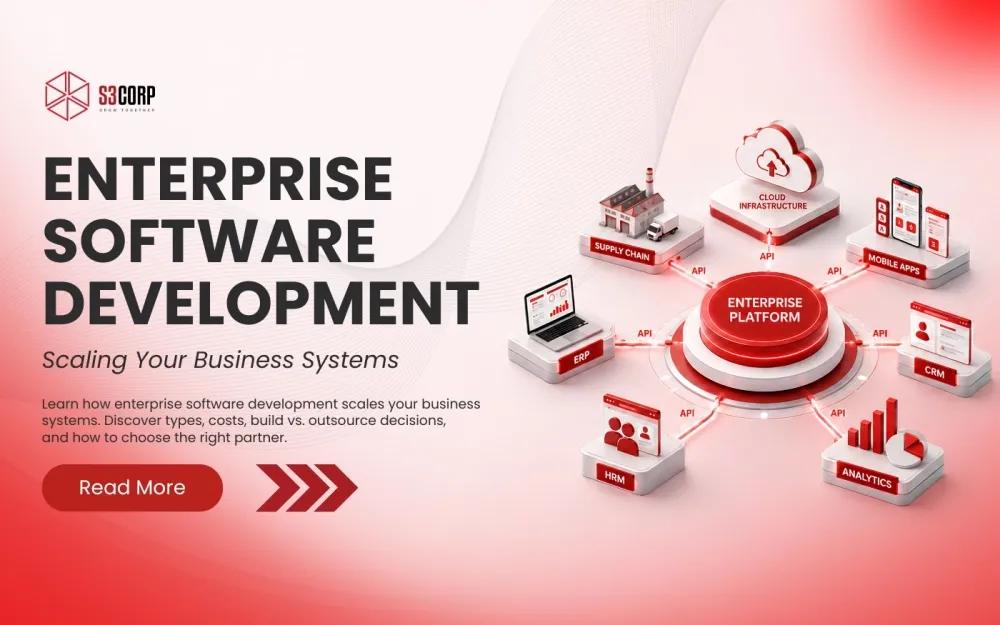
A decision-maker's guide to enterprise software development — covering types, costs, build vs. outsource, technology trends, and how to choose the right development partner for your business.
20 May 2026
Enterprise software development builds the digital backbone of large-scale organizations — connecting departments, automating workflows, and making real-time data accessible across every layer of your business. You use enterprise software when your current tools cannot handle data volume, user load, or integration needs. It matters because scaling without the right system creates bottlenecks, delays decisions, and increases cost
Many companies reach a point where spreadsheets, disconnected apps, or legacy systems start to fail. If your teams duplicate work, your data stays isolated, leadership lacks a clear view of performance, it means at that stage, you need an enterprise software and here enterprise systems become a strategic investment, not a technical upgrade. If all that is your situation, this guide is for you.
By the end of this article, you will understand what enterprise software development actually involves, how enterprise software development works, how it differs from standard software, what it costs, and — most importantly — how to decide whether to build in-house, buy off-the-shelf, or bring in an experienced development partner via outsourcing. You will also learn how modern technologies like cloud computing and microservices architecture support scalability, and how to avoid common risks.
If you plan to scale operations, expand to new markets, or improve internal efficiency, this article gives you a clear path. It focuses on business impact, cost control, and practical decisions, so you can move forward with confidence.
TL;DR — Enterprise Software Development in 2026
What it is: Enterprise software development builds large-scale systems that connect departments, automate workflows, and support organizational growth — handling thousands of users, complex integrations, and high transaction volumes simultaneously.
Why it matters: Fragmented, disconnected systems are a direct drag on revenue and scalability. Companies that invest in well-architected enterprise platforms consistently outperform those that don't, according to McKinsey research on digital transformation.
Key types to know: ERP, CRM, SCM, HRM, and Business Intelligence — plus custom-built platforms when off-the-shelf products can't fit your processes.
The build vs. buy vs. outsource call: Buy standard tools (HR, finance) when your needs are common. Build custom when your process is a competitive differentiator. Outsource when you need specialized talent fast and can't afford a 6–12 month in-house hiring cycle.
What it costs: $150,000 for a focused module to $2,000,000+ for a full enterprise platform. Discovery phases are non-negotiable — any vendor quoting without one is guessing.
Technologies driving it in 2026: Cloud-native architecture (AWS, Azure, GCP), microservices, AI-embedded workflows, Zero Trust security design, and green software engineering for EU-regulated markets.
8 trends shaping the space: AI as infrastructure, cloud-native by default, low-code for business logic, DevSecOps, platform composability, edge computing, Zero Trust as a design principle, and sustainable software engineering.
Choosing a partner: Prioritize delivery experience at your scale, full-lifecycle technical coverage, and clear post-launch support — not just the lowest hourly rate.
Enterprise software development is the process of building large-scale applications that support the operational, analytical, and communication needs of an entire organization — not just individual users or small teams. It helps organizations automate workflows, manage data, and support long-term growth.
Think of it this way: consumer software helps one person get things done. Enterprise software helps thousands of people inside a company — and their systems — work together without friction. They form the backbone of operations such as finance, supply chain, customer management, and analytics.
These are systems built for complexity and volume. They handle payroll for 10,000 employees, track inventory across 50 warehouses, process millions of financial transactions, and synchronize customer data across sales, marketing, and support — all at the same time, without going down.
Why does it matter in 2026? Because the cost of fragmented, disconnected systems is no longer theoretical. Gartner forecasts a 14.4% constant-currency growth for the global enterprise software application market in 2026, with the industry projected to reach a $725 billion valuation by 2029 (a 12.5% CAGR from 2024). This continued growth reflects how critical these systems have become to organizational survival — not just efficiency. McKinsey research shows that companies investing in digital transformation at scale are significantly more likely to outperform competitors on revenue growth and profitability over a five-year horizon.
What enterprise software development delivers:
For example, a retail company that expands to multiple regions needs a single system to manage inventory, orders, and customer data. Without enterprise software, each region may operate in isolation, which creates errors and delays.
At S3Corp, enterprise-grade systems have been built for clients across North America, the UK, Singapore, and Southeast Asia — covering fintech platforms, e-commerce infrastructure, healthcare data systems, and more. The work is always tied to one question: what does your business need to run better, faster, and at greater scale?
Read More: Software Development Services: The 2026 Ultimate Guide
Enterprise software handles large-scale operations, multiple concurrent users, and complex integrations, while regular software focuses on solving specific, bounded tasks.
This distinction matters because many companies try to scale regular software into enterprise roles — and discover, usually at the worst possible moment, that it was never built for that job.
|
Dimension |
Regular Software |
Enterprise Software |
|
Users |
Individual or small team |
Hundreds to thousands |
|
Integrations |
Minimal or none |
Deep integrations with ERP, CRM, APIs |
|
Scalability |
Limited |
Horizontal and vertical scaling |
|
Security |
Basic authentication |
Role-based access, enterprise-grade compliance |
|
Customization |
Low |
High — built for specific processes |
|
Uptime requirements |
Best effort |
99.9%+ SLA-driven |
|
Support model |
Self-serve or basic |
Dedicated support, SLAs, disaster recovery |
Key differences explained
For instance, a CRM system used across global sales teams must handle large datasets, role-based access, and integrations with marketing and finance systems. A simple contact management app cannot meet these requirements.
The architectural gap between these two categories is significant. Regular software is often monolithic — one codebase, one deployment, one failure point. Enterprise software, especially in 2026, is built on microservices architecture, distributed systems, and API-first design. This means individual components can be updated, scaled, or replaced without taking the whole system down.
If your business processes customer data at volume, operates across multiple geographic markets, or needs to comply with regulations like GDPR, HIPAA, or SOX, you are in enterprise software territory whether you planned to be or not.
You need a development partner when your internal team lacks time, scale, or specialized skills to build and maintain enterprise systems.
This decision often appears earlier than expected. Many CTOs delay it, which leads to project slowdowns or poor architecture decisions.
Clear signals
Strategic advantage
Working with a partner gives access to:
This is where collaboration models helps define how you work with external teams, whether through dedicated teams or project-based delivery.
Enterprise software removes data silos, automates repetitive workflows, and improves decision-making by giving the right people access to accurate, real-time information. It connects systems that used to operate separately and gives leadership a clear, unified view of operations.
Here is the honest version of what actually goes wrong in growing businesses — and what enterprise software fixes:
Sales uses one CRM. Finance uses another spreadsheet. Operations has its own system. Nobody has the full picture. Enterprise software — specifically a well-integrated ERP or data platform — creates a single source of truth.
Approval workflows that require five emails. Invoice processing done by hand. Onboarding checklists managed in Word documents. Business process automation removes these entirely.
If your reporting cycle takes two weeks, you are making decisions based on old information. Enterprise systems with embedded business intelligence tools give you live dashboards, exception alerts, and predictive signals.
Your e-commerce platform doesn't sync with your warehouse management system, which doesn't update your finance software. System integration is one of the core problems enterprise software solves — and one of the hardest to get right.
Every time you add a new product line, enter a new market, or onboard a large client, something in your tech stack breaks or slows down. Scalable architecture prevents this by design.
Consider a mid-sized retail business expanding from one country to three. Without enterprise infrastructure, managing inventory, currency, tax compliance, and logistics across borders becomes a manual nightmare. A purpose-built platform connecting ERP, logistics APIs, and regional payment gateways eliminates that chaos — and that is the type of transformation Software Outsourcing Services can help execute efficiently.
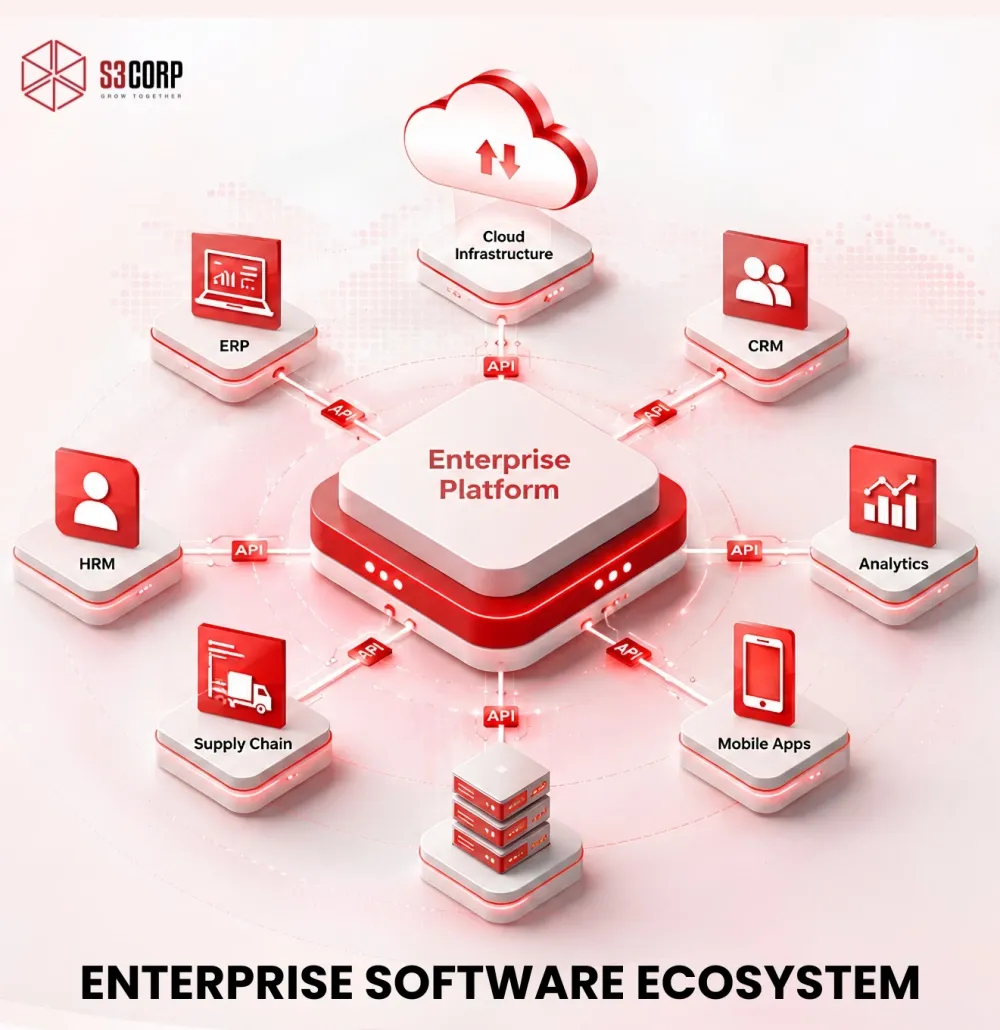
The main types of enterprise software include ERP, CRM, SCM, HRM, and BI systems. Each type supports a specific business function while integrating into a larger enterprise system.
|
Type |
Full Name |
Primary Function |
Common Use Case |
|
ERP |
Enterprise Resource Planning |
Integrates core business processes |
Finance, inventory, manufacturing |
|
CRM |
Customer Relationship Management |
Manages customer data and sales pipelines |
Sales teams, marketing, support |
|
SCM |
Supply Chain Management |
Tracks goods from supplier to customer |
Retail, logistics, manufacturing |
|
HRM |
Human Resource Management |
Manages workforce data and payroll |
HR departments, global teams |
|
BI |
Business Intelligence |
Aggregates data for reporting and analysis |
C-suite, operations, finance |
|
ECM |
Enterprise Content Management |
Manages documents and digital assets |
Legal, compliance, media |
Beyond these core categories, modern enterprise software often includes custom-built platforms that combine elements from multiple categories — for example, a fintech company might need a single platform that handles onboarding (HRM), transaction processing (ERP-adjacent), compliance reporting (BI), and client communication (CRM). That level of integration is where off-the-shelf solutions fall short and custom enterprise application development becomes the right answer.
 How to choose the right type
You should select based on business priorities:
Most organizations combine multiple systems into a single enterprise architecture. This integration requires careful planning and often benefits from Full-Lifecycle App Development to ensure consistency across modules.
The enterprise software development process follows a structured lifecycle: discovery, design, development, integration, testing, deployment, and continuous improvement.
Each phase matters. Skipping or compressing discovery is how projects end up building the wrong thing — and enterprise projects are expensive enough that you cannot afford to course-correct after three months of development.
A structured SDLC reduces risk and improves delivery speed. It also ensures alignment between business goals and technical execution.
This process often integrates with DevOps Services to support automation, faster releases, and system reliability.
Modern enterprise systems rely on cloud platforms, microservices, APIs, and increasingly, AI-driven components. The technology stack you choose will affect performance, cost, and long-term maintainability.
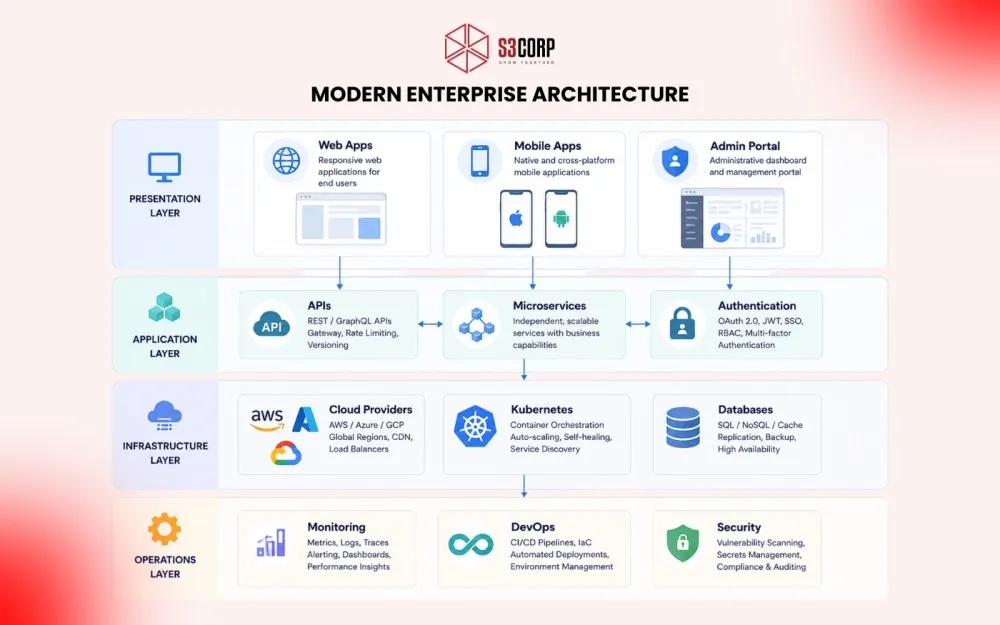 Cloud Platforms
The right technology stack is context-dependent. A healthcare platform has different compliance and latency requirements than an advertising analytics engine. Choosing the wrong stack in year one creates migration headaches in year three.
If you plan to modernize legacy systems or move to cloud-based architecture, connect with our experts to define a clear migration strategy that reduces risk and cost
Enterprise software improves operational efficiency, enables scalability, increases data visibility, and supports faster, better-informed decision-making across every layer of your organization. It turns fragmented systems into a unified platform that supports growth and control.
Here is what well-executed enterprise software actually delivers in measurable terms:
Common challenges in enterprise software development include legacy system integration, change management resistance, scope creep, and finding engineers with the right experience. These issues can delay projects and increase cost if not managed early.
Being aware of these before you start is the difference between a project that delivers and one that drags on for years.
|
Challenge |
Why It Happens |
How to Address It |
|
Legacy system integration |
Old systems use outdated protocols or lack APIs |
Use middleware/adapter layers; plan integration early |
|
Scope creep |
Stakeholders keep adding requirements mid-project |
Fix scope per sprint; use change control processes |
|
Data migration complexity |
Historical data is messy, incomplete, or duplicated |
Run data audits before migration; automate cleansing |
|
User adoption resistance |
Teams are comfortable with old systems |
Invest in training and change management from day one |
|
Talent shortage |
Senior enterprise architects and engineers are scarce |
Consider offshore or nearshore development teams |
|
Budget overruns |
Underestimating integration and testing time |
Add 20–30% contingency; use fixed-price phases for discovery |
|
Security vulnerabilities |
Enterprise systems are high-value targets |
Conduct regular penetration testing; implement DevSecOps |
The developer shortage challenge, in particular, is real and getting harder in North American and UK markets. According to the Bureau of Labor Statistics, software developer employment is projected to grow significantly faster than average through 2030, meaning competition for experienced engineers will intensify. This is one of the structural reasons that outsourcing enterprise software development has become a strategic — not just a cost — decision for many companies.
Practical advice
These challenges often require support from software testing services and Dedicated Development Team to ensure quality and speed.
You should build custom solutions when your processes are genuinely unique and a competitive differentiator. You should buy off-the-shelf software when standard processes need to be automated quickly. You should outsource when internal engineering capacity is limited, time-to-market is critical, or specialized expertise is required.
Most companies default to one of these without thinking through the trade-offs. Here is a decision framework:
|
Scenario |
Recommended Approach |
Reason |
|
Standard HR, payroll, or finance needs |
Buy (SAP, Workday, Oracle) |
Solved problems — no need to rebuild |
|
Unique customer-facing product |
Combining custom software with an outsourced team enables seamless scaling |
Competitive differentiation requires control |
|
Complex custom + fast delivery |
Outsource to a development partner |
Access specialized talent without hiring delays |
|
Prototype or MVP needed quickly |
Build with outsourced team or low-code |
Speed over perfection at this stage |
|
Core IP you want to own |
Build in-house or with outsourced, dedicated team |
IP protection and long-term control |
|
Regulated industry (healthcare, fintech) |
Build or outsource with compliance expertise |
Off-the-shelf rarely meets all compliance requirements |
Simple Decision Matrix
|
Option |
Best For |
Trade-off |
|
Build (in-house) |
Unique business processes |
High cost, longer time |
|
Buy (off-the-shelf) |
Standard needs |
Limited customization |
|
Outsource |
Faster delivery and expertise |
Requires partner alignment |
Outsourcing has become a common approach for global companies. It allows access to skilled engineers while optimizing cost and performance. Consider: hiring a senior enterprise architect in San Francisco costs $200,000–$280,000 per year in salary alone. Building an equivalent team of 8–10 engineers in-house takes 6–12 months and ties up significant HR and management overhead. Outsourcing to an experienced partner with an established Collaboration Models Framework can compress that timeline to 4–6 weeks and deliver a team already calibrated to enterprise delivery standards.
Ready to assess whether outsourcing is the right move for your enterprise project?
Book a no-obligation technical consultation with the engineering team at S3Corp. We will map your requirements to the right delivery model — in plain language, without the sales pressure.
Choose based on demonstrated experience with similar-scale systems, depth of technical expertise across your required stack, and their ability to support you through integration, testing, and post-launch operations — not just build and hand off.
Most companies make this decision based on price. That is understandable, but it is also how projects end up half-built. Here is what actually predicts a successful partnership:
Read More: How to Choose a Software Development Company (Step-by-Step Guide)
Vietnam is a strong destination for outsourcing due to its competitive cost structure, skilled engineering talent, and strong delivery experience for global markets. For teams in North America and Europe, offshore development Vietnam has become a high-credibility option — not because of cost alone, but because of engineering quality. Vietnam produces approximately 57,000 IT graduates per year (Ministry of Education and Training, Vietnam), has a strong engineering culture, and operates in compatible time zones with both Asia-Pacific and, with structured overlap, European markets.
The cost efficiency is real: equivalent engineering talent in Vietnam typically runs 40–60% below US or UK market rates, without the drop in output quality that once characterized offshore development. At S3Corp, with 19+ years of experience and clients across North America, UK, and Singapore, this combination of quality and cost efficiency is a core part of what software outsourcing services delivers.
Enterprise software development costs vary significantly based on system complexity, team size, geographic location of the team, and integration requirements. A realistic range for most enterprise projects falls between $150,000 and $2,000,000+.
|
Project Type |
Estimated Cost Range |
Team Size |
Timeline |
|
Single enterprise module (e.g., one CRM integration) |
$30,000 – $80,000 |
3–5 engineers |
3–5 months |
|
Mid-complexity enterprise platform |
$150,000 – $400,000 |
6–10 engineers |
6–12 months |
|
Full ERP or custom enterprise system |
$400,000 – $1,000,000+ |
10–20+ engineers |
12–24 months |
|
Enterprise SaaS product (multi-tenant) |
$500,000 – $2,000,000+ |
15–30+ engineers |
18–36 months |
One important note: cost estimates without a discovery phase are guesses. Any vendor who gives you a fixed price for a large enterprise system without first conducting a proper technical assessment is either guessing or planning to renegotiate later. Insist on a paid discovery phase before committing to a full development contract.
A strategic approach ensures that cost aligns with business outcomes, not just technical delivery.
Want a realistic cost estimate for your enterprise project?
S3Corp provides detailed technical scoping sessions — free for qualified enterprise engagements. Walk away with a project breakdown, not a ballpark figure.
AI-driven automation, cloud-native architecture, and intelligent integration are the three forces most actively reshaping enterprise software in 2026. These trends focus on speed, flexibility, and data-driven operations.
Embedded AI enterprise software — including predictive analytics, intelligent document processing, and automated anomaly detection — is now a baseline expectation in many enterprise categories. Companies that treat AI as an add-on will find themselves behind competitors who have built it into core workflows.
In fact, most enterprises are shifting to agentic AI. Rather than relying on reactive AI assistants, businesses are increasingly adopting self-directed, autonomous AI agents equipped to handle complex workflows across various departments. This intense, sustained demand highlights a fundamental shift in the corporate landscape: integrating these advanced AI technologies is no longer just about improving efficiency, but is now a strict requirement for business survival.
Cloud-native applications built on containerized microservices, managed databases, and serverless functions have replaced traditional on-premise deployments as the default architecture for new enterprise systems. It will help enterprises build directly on cloud infrastructure, offer better scalability and resilience, and reduce dependency on legacy systems.
Low-code platforms are not replacing developers — they are enabling business teams to manage workflow logic without engineering queues. This hybrid model speeds up iteration and reduces the gap between what business teams need and what engineering delivers.
DevSecOps — embedding security practices throughout the development lifecycle — has moved from best practice to business requirement. Regulatory pressure from GDPR in Europe, CCPA in California, and sector-specific regulations in fintech and healthcare is accelerating this shift.
Rather than building monolithic systems, forward-looking companies are building composable architectures — loosely coupled systems where individual components can be swapped, upgraded, or replaced independently. This reduces technical debt and makes it far easier to integrate future technology.
For applications in logistics, manufacturing, and healthcare that require ultra-low latency, edge computing — processing data closer to where it is generated — is moving from experimental to operational.
Understanding these trends is not just useful for staying current. It is essential for making architecture decisions today that do not create painful technical debt within three years.
Microservices architecture breaks applications into small, independent services that handle distinct business functions. This modular design allows developers to update single features rapidly without risking total system downtime. It also enables precise auto-scaling of high-traffic services, optimizing cloud costs and performance.
For EU clients, large organizations in Europe are now auditing the carbon footprint of their digital infrastructure as part of regulatory compliance and ESG reporting obligations. Enterprise software is increasingly designed for computational efficiency. The response from enterprise software teams is practical: optimizing database queries to reduce unnecessary server load, preferring green-certified cloud data centers (AWS, Azure, and GCP all publish regional carbon intensity data), and implementing carbon-aware computing — scheduling heavy batch-processing jobs when the local energy grid is drawing primarily from renewable sources. For companies building in or selling into the EU market, sustainable software engineering is transitioning from a marketing differentiator to a procurement requirement.
Understanding these trends is not just useful for staying current. It is essential for making architecture decisions today that do not create painful technical debt within three years.
S3Corp provides scalable enterprise software solutions using agile development, dedicated engineering teams, and 19+ years of delivery experience across global markets. The focus stays on business outcomes, system stability, and long-term growth.
You can explore real implementations through Case Studies and see how different industries apply enterprise systems.
Here is how the delivery model works in practice:
Discovery and Technical Scoping; Every engagement starts with a structured discovery phase. The team maps your existing systems, defines integration points, clarifies compliance requirements, and produces a detailed technical specification. This phase prevents the most expensive mistakes.
Dedicated Development Teams: Rather than rotating engineers through your project, S3Corp assigns dedicated teams — architects, developers, QA engineers, and DevOps specialists — who stay with the engagement from inception through post-launch. Continuity matters in enterprise software. Context is hard to rebuild.
Agile Enterprise Delivery: Two-week sprints with working deliverables. Sprint reviews with stakeholders. Documented change control. This is not an approximation of agile — it is structured agile designed for the complexity of enterprise systems, where decisions made in sprint one affect sprint twenty.
Full-Lifecycle Coverage: Enterprise software needs more than developers. Services by S3Corp cover the full spectrum — from Web App Development and Mobile Application Development Services to QA Services and DevOps — which means you are not managing multiple vendor relationships across your project's lifecycle.
Industries with Deep Experience: The team brings domain expertise to regulated and complex industries: Fintech, Healthcare, E-Commerce and Retail, Education, and more. Domain knowledge is not a nice-to-have — it is what allows engineers to ask the right questions and flag integration risks before they become costly problems.
The Vietnam Advantage, Concretely: With offices in Ho Chi Minh City and a talent network built over nearly two decades, S3Corp accesses engineering talent that combines strong technical foundations, English-language fluency, and familiarity with working alongside North American and European product teams. The cost efficiency — typically 40–60% below US rates — is real. So is the quality.
Ready to Scale Your Enterprise?
Building an enterprise system is one of the most consequential technology investments your company will make. The team at S3Corp has helped companies across North America, the UK, and Asia-Pacific build systems that scale. Let's talk about yours.
Enterprise software development is not a purchase decision. It is a strategic architecture decision that shapes how your organization operates, scales, and competes over the next five to ten years.
Enterprise software development is a strategic investment that supports scaling, improves efficiency, and strengthens decision-making. The right system connects your business processes, removes inefficiencies, and prepares your organization for growth.
The key questions to resolve before you move forward:
S3Corp brings 19+ years of experience working with global clients across NA, UK, and Asia. Teams focus on innovative solutions that balance cost, performance, and scalability.
Contact our team to discuss how to scale your enterprise systems with a strategic approach that fits your business goals.
Enterprise software development is the process of building large-scale applications that connect and automate business processes across an entire organization. Unlike standard software, these systems are built to handle high volumes, many users, and complex integrations simultaneously.
Timelines depend on scope and complexity. A focused module or integration might take 3–6 months. A full enterprise platform typically takes 12–24 months. Attempting to compress enterprise timelines without reducing scope is one of the most common causes of project failure.
ERP software (like SAP or Oracle) is a packaged solution covering standard business functions. Custom enterprise software is built specifically for your processes — useful when your workflows are unique, your compliance requirements are specific, or off-the-shelf products cannot integrate with your existing systems.
This depends on your situation. In-house gives you control and culture alignment but requires significant time and cost to build a capable team. Outsourcing enterprise software development provides faster access to specialized talent, lower cost, and less organizational overhead — particularly when working with experienced partners who understand enterprise delivery.
Realistic cost ranges from $150,000 for a focused platform to $2,000,000+ for a complex, multi-tenant enterprise system. Cost is driven by integration complexity, compliance requirements, team size, and the geographic location of the development team.
Modern enterprise systems commonly use cloud platforms (AWS, Azure, GCP), microservices architecture, container orchestration (Kubernetes), API gateways, SQL and NoSQL databases, and increasingly, AI/ML components. The specific stack depends on your performance, compliance, and integration requirements.
Post-launch support by S3Corp includes hypercare periods (active monitoring and rapid response immediately after go-live), ongoing maintenance retainers, performance optimization, and feature development. The goal is continuity — the team that built your system knows it best.
S3Corp has delivered enterprise systems across fintech, healthcare, e-commerce and retail, education, advertising and entertainment, and blockchain. Each engagement is approached with domain-specific knowledge, not just general engineering capability.