Insights
Table Of Content
Key Takeaways
Introduction
What Roles Actually Make Up a Mobile App Development Team?
How Big Should the Team Be for Your App?
In-House, Freelance, Outsourced, or Dedicated Team — Which Model Actually Fits?
How Do You Vet an Outsourced Team's Security and IP Practices?
When Does Your App Need a More Specialized Team?
Choosing the Right Team for Your Build
FAQ
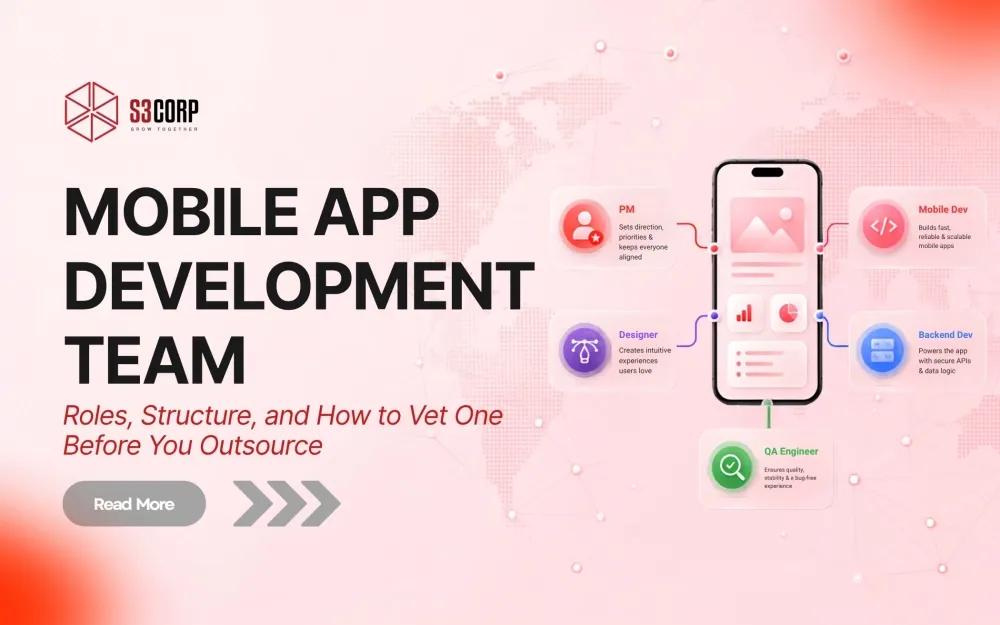
Mobile App Development Team: Roles, Structure, and How to Vet One Before You Outsource
A practical guide to building or outsourcing a mobile app development team: core roles, team size by project, delivery models, security vetting, regional costs, and when you need specialized technical depth
05 Aug 2026
Key Takeaways
- A core mobile app development team has five to seven roles: project manager, UI/UX designer, one or two mobile developers, a backend developer, and a QA engineer. Larger builds add a business analyst, product manager, and DevOps engineer.
- Team size should track app complexity, not budget optimism. Three to five people cover an MVP; six to ten fit a mid-complexity app; ten or more suit large, multi-platform builds.
- The delivery model changes your outcome more than any single hire does. In-house, freelance, project-based outsourcing, and dedicated teams carry very different cost, control, and risk profiles.
- Security and IP vetting deserve a checklist, not a gut feeling. ISO/IEC 27001 certification, clear IP-assignment language, and a documented offboarding process are the three things to confirm before you sign anything.
- Regional cost gaps are wide and worth understanding in detail, not just at the headline hourly rate, before you pick a country to outsource to.
- Apps involving IoT, embedded hardware, or wireless protocols need a different kind of developer than a standard consumer mobile build — generalist teams routinely underestimate this work.
Introduction
A mobile app development team typically includes a project manager, a UI/UX designer, one or more mobile developers, a backend developer, and a QA engineer — five to seven people for a mid-complexity build. The bigger decision isn't the roster. It's whether you build that team in-house, hire freelancers, or bring in a dedicated outsourced team, because that choice affects cost, oversight, and risk far more than any individual hire does.
This guide walks through both halves of that decision. You'll get the role-by-role breakdown, a sizing framework tied to app complexity rather than guesswork, a comparison of the four common delivery models, and — because this is the part most guides skip — a concrete checklist for vetting an outsourced team's security and IP practices before you sign a contract. We'll also cover what a mobile app development team actually costs by region, and when your project needs developers with specialized technical depth beyond standard mobile skills.
Demand for this expertise isn't slowing down. Global IT spending is projected to reach $6.37 trillion in 2026, a 14.2% jump from 2025, according to Gartner's July 2026 forecast — with the surge concentrated in AI infrastructure, data center systems, and cloud platforms rather than spread evenly across the market. Outsourced software development, including mobile app teams, rides that same wave. If you're scoping a team right now, you're one of many companies asking the same questions.
Quick Answer
|
What You're Asking |
Short Answer |
|
How many people do I actually need? |
5–7 for most apps; fewer for an MVP, more for large multi-platform builds |
|
Which delivery model fits most outsourcing buyers? |
A dedicated team, if you want outsourcing speed with closer-to-in-house control |
|
What credential should I verify first? |
ISO/IEC 27001 certification, plus explicit IP-assignment terms |
|
What drives cost the most? |
Region, not role — the same project manager costs 3–5x more in the US than in Vietnam or India |
What Roles Actually Make Up a Mobile App Development Team?
A core mobile app team has five to seven roles. A project manager runs the timeline and keeps communication flowing. A UI/UX designer owns the interface and the user experience. One or two mobile developers write the iOS, Android, or cross-platform code. A backend developer builds the server-side logic the app depends on. A QA engineer tests all of it before release. Larger or more regulated projects add a business analyst, a product manager, and a DevOps engineer.
Here's what each role actually does, stripped of filler:
- Project Manager — Owns the schedule, budget, and risk register. Runs standups, resolves blockers, and is your single point of contact when something needs to change mid-sprint.
- Business Analyst — Translates business goals into technical requirements. Especially valuable when the app touches multiple stakeholders or an existing system, since someone needs to reconcile what sales wants with what engineering can build.
- UI/UX Designer — Researches how users will actually behave, then designs wireframes and high-fidelity screens around that behavior. On strong teams, this person also flags usability problems before a single line of code gets written.
- Mobile Developer (iOS/Android/Cross-Platform) — Writes the app itself. iOS specialists work in Swift, Android specialists in Kotlin, and cross-platform developers in frameworks like Flutter or React Native, which let one codebase serve both platforms at a lower long-term maintenance cost.
- Backend Developer — Builds the APIs, databases, and server infrastructure the app calls. This role matters more than most founders expect; a beautiful app with a fragile backend still fails under real user load.
- QA Engineer — Tests functionality, performance, and security before release, then keeps testing after each update. A dedicated QA function catches the device-specific bugs that a rushed, developer-only test pass tends to miss.
- Product Manager — Owns the app's vision and prioritizes what gets built and when, balancing user needs against business goals. Common on larger teams; often merged into the business analyst role on smaller ones.
- DevOps Engineer — Manages the CI/CD pipeline, release automation, and app store submission process. Mobile release management is genuinely harder than web deployment, because you can't instantly roll back a bad release the way you can on a website — DevOps practices built specifically for mobile matter here.
This is the table-stakes part of the conversation. Every credible development partner should walk you through a version of this list. Where partners actually differ is in the decisions that follow: how big that team should be, which delivery model it operates under, and how well its security and IP practices hold up under scrutiny. That's where the next sections go.
How Big Should the Team Be for Your App?
Team size should scale with complexity, not ambition. Three to five people cover an MVP. Six to ten fit a mid-complexity app with separate frontend and backend work. Ten or more suit large, multi-platform builds that need dedicated QA and DevOps coverage.
Here's the breakdown:
|
Team Size |
Core Roles |
Best For |
|
3–5 people |
1 developer, 1 designer, 1 PM/QA hybrid |
MVPs, single-platform apps, proof-of-concept builds |
|
6–10 people |
Separate iOS/Android devs, backend dev, dedicated QA, PM, designer |
Mid-complexity apps with real user bases and multiple integrations |
|
10+ people |
Multiple platform specialists, backend team, dedicated DevOps, QA team, product manager |
Large-scale, multi-platform apps with regulatory, security, or scale requirements |
A few practical notes worth keeping in mind.
First, adding people doesn't automatically speed up delivery — a five-person team with clear ownership frequently ships faster than a ten-person team without it, because coordination overhead grows faster than headcount does.
Second, undersizing the QA function is one of the most common mistakes on device-heavy mobile projects. Android alone spans hundreds of device and OS combinations, so a single QA generalist testing alongside developers will miss issues a dedicated tester would catch.
Third, if your app connects to hardware, a network, or a wireless protocol, your team size calculation needs an extra specialist role we'll cover later in this guide — a standard mobile developer usually isn't equipped for that work.
In-House, Freelance, Outsourced, or Dedicated Team — Which Model Actually Fits?
The four common models are in-house, freelance, project-based outsourcing, and a dedicated outsourced team. In-house gives you full control at the highest cost and slowest ramp-up. Freelance is cheap but inconsistent. Project-based outsourcing gets you moving fast with less day-to-day visibility. A dedicated team — assembled by a partner and working exclusively on your project — gives you outsourcing's speed with control that's much closer to what an in-house team offers.
This is the pivot point of the whole decision, so it deserves a direct comparison rather than a wall of pros and cons:
|
Model |
Best For |
Key Trade-off |
|
In-House |
Long-term core products where cultural alignment and full control matter most |
Highest cost; hiring and onboarding can take months, particularly for mobile-specific skills that are scarce in your local market |
|
Freelance |
Small, well-scoped tasks or short-term specialist work |
Inconsistent quality and availability; you own the management and quality-control burden yourself |
|
Project-Based Outsourcing |
Fixed-scope builds with a clear finish line |
Less day-to-day visibility; the vendor's incentive is finishing the contract, not necessarily your long-term roadmap |
|
Dedicated Team |
Ongoing product development where you need speed, control, and a stable team over time |
Requires a partner you trust; benefits depend heavily on how well that partner vets and retains talent |
Here's why this matters more than the role list above: two companies can hire the exact same five roles and get wildly different outcomes, because the delivery model determines who's accountable when things go wrong, how quickly you can scale up or down, and how much oversight you actually retain.
A dedicated team model, done well, gives you a team that works only on your product, understands your codebase over time, and integrates with your existing processes — closer to an extension of your own organization than a vendor relationship. This is the model built around long-term partnership rather than one-off delivery, and it's the reason companies exploring collaboration models for outsourced development tend to land on it once they've tried the alternatives.
If you're still deciding between building locally and going offshore at all, it's worth reading a broader comparison of nearshore versus offshore software development before locking in a specific delivery model — the geography decision and the delivery-model decision interact more than most guides admit.
How Do You Vet an Outsourced Team's Security and IP Practices?
Before signing anything, ask for four things: the vendor's information-security certification, their exact IP-assignment clause wording, their code-access and offboarding process, and references from clients in regulated or security-sensitive industries. Most outsourcing guides mention "communication challenges" as a vague con and stop there. That's not good enough when your product's IP and your users' data are on the line.
ISO/IEC 27001 is the credential to look for first. It's the internationally recognized standard for information security management systems, jointly published by the International Organization for Standardization and the International Electrotechnical Commission, and it's widely treated as the benchmark for how an organization manages information-security risk. A vendor holding this certification has an audited system in place for handling access control, risk assessment, and data protection — not just a policy document nobody reads.
Beyond the certificate itself, run through this checklist on your next vendor call:
- IP-assignment clause. Confirm, in writing, that all code, designs, and documentation produced for your project transfer to you, not the vendor, immediately upon creation or payment — not upon final delivery.
- Code access and repository control. Ask who has commit access, whether your repository lives on your own infrastructure or the vendor's, and how access gets revoked when a contractor rolls off the project.
- Offboarding process. A specific, documented process for revoking system access, retrieving devices, and confirming data deletion when a team member or the whole engagement ends.
- NDA scope and enforceability. Check that the NDA covers subcontractors too, not just the vendor's direct employees — a surprising number of outsourcing arrangements involve subcontracted talent the client never meets. Make this enforceable rather than aspirational: push for a strict "no unauthorized subcontracting" clause and an audit right in your Master Services Agreement (MSA). The subcontracting clause requires the vendor to get your written consent before any third party touches your codebase; the audit right lets you verify that's actually happening instead of taking their word for it. Together, these give you real legal leverage if a vendor quietly offshores your work to a subcontractor you never vetted.
- References in regulated industries. A vendor with real clients in fintech, healthcare, or other compliance-heavy sectors has already been through stricter security reviews than a typical consumer app requires, which is a useful proxy for maturity even if your own app isn't regulated.
Data security concerns aren't a fringe worry, either — roughly 42% of organizations cite data-security concerns as a primary restraint on IT outsourcing decisions, which means you're not being paranoid by asking these questions upfront. A vendor that answers all five points above without hesitation has clearly been through this conversation before. One that gets defensive or vague is telling you something too — just not what you want to hear. This is also where dedicated data-security expertise on the vendor's side becomes a genuine differentiator rather than a checkbox.
When Does Your App Need a More Specialized Team?
Standard mobile roles cover most consumer apps, but apps involving IoT, embedded hardware, or custom networking need developers with that specific background. A generalist mobile team will underestimate this work, not because they lack skill, but because protocols like Bluetooth, 802.11 Wi-Fi, SNMP, and IPTV streaming require domain knowledge that a typical iOS or Android developer simply hasn't built up.
Your app probably needs this kind of specialized team if:
- It talks to physical hardware — sensors, wearables, industrial equipment, or connected devices that communicate over Bluetooth or proprietary protocols rather than a standard REST API.
- It depends on network-layer behavior — real-time video streaming, VoIP, or any feature where TCP/IP-level performance and packet loss handling directly affect the user experience.
- It operates in a constrained or regulated environment — think industrial IoT, telecom infrastructure, or embedded systems where a bug isn't just an inconvenience but a safety or compliance issue.
- It integrates AI or machine learning capabilities — embedding an LLM into the user experience, running inference or model updates on-device, or building the data pipelines that keep a model accurate over time. As of 2026, AI integration is arguably the biggest disruptor in mobile development, and it calls for skills a standard, CRUD-focused mobile developer usually hasn't built: prompt and context engineering, on-device model optimization under real memory and battery constraints, and the data engineering that feeds and maintains the model.
This is a genuine differentiator worth being direct about: this kind of engineering bench is exactly where a networking and embedded-systems background separates a specialized outsourcing partner from a generalist app shop. It's also the intersection covered under wire and wireless domain expertise, and it's a large part of why some outsourcing conversations go past "can you build a mobile app" into "can you build a mobile app that reliably talks to hardware we don't fully control." If your project touches IoT-connected mobile app development in any form, it's worth confirming this specific expertise exists on your prospective team before you scope the project, not after development starts and the networking edge cases start showing up.
The same logic applies on the AI side, which is a newer gap but a fast-growing one. Embedding an LLM into a mobile app, running inference on-device, or building the retrieval and data pipelines that keep a model's outputs accurate over time requires a different skill set than a standard mobile build — prompt and context engineering, model quantization and optimization for on-device battery and memory limits, and the data engineering to support it. A generalist team can usually wire up a third-party AI API without much trouble; the gap shows up when the app needs on-device inference, a custom fine-tuned model, or a production-grade retrieval-augmented generation (RAG) pipeline, since those require infrastructure and optimization work most consumer-app teams haven't done before. If your project involves any of this, it's worth confirming the team has actually shipped AI-integrated mobile apps, not just prototyped against an API key.
Real-world delivery in this space looks different from a typical CRUD app project. S3Corp has built mobile and connected-device solutions across several of these scenarios, including a health-monitoring mobile app handling sensor data, a location-sharing web and mobile application, and consumer-facing builds like the HungryGoWhere iOS app — a useful spread for seeing how team composition shifts depending on what the app actually needs to talk to.
Choosing the Right Team for Your Build
The role list at the start of this guide is table stakes — nearly every credible partner can assemble those five to seven roles. The real decision is which delivery model fits how you want to work, whether the vendor can actually prove its security practices rather than just claim them, and whether the team has the specific technical depth your app needs, especially if hardware or networking is involved.
If you're at the stage of comparing options rather than ready to sign with anyone yet, that's a normal place to be — most companies researching this decision are exactly there. A useful next step is a scoping conversation rather than a sales pitch: bring your app's rough requirements, ask the security and IP questions from the checklist above, and see how directly the vendor answers. If you'd like to walk through your specific project with a team that's assembled dedicated mobile teams for clients across 25+ countries since 2007, get in touch with S3Corp and bring the questions — not just the pitch.
FAQ
What is a mobile app development team?
A mobile app development team is the group of specialists who design, build, test, and maintain a mobile application. At minimum, it includes a project manager, a UI/UX designer, a mobile developer, a backend developer, and a QA engineer, with additional roles added as project complexity grows.
How many people are on a typical mobile app team?
Most mid-complexity apps use six to ten people. Simple MVPs can run with three to five, while large, multi-platform builds with regulatory or security requirements often need ten or more, including dedicated QA and DevOps coverage.
Is it cheaper to outsource a mobile app development team?
Usually, yes, particularly when outsourcing to regions like Vietnam or India, where hourly rates run roughly a third to half of US-based rates. The real savings depend heavily on delivery-model fit and vendor quality, not the hourly rate alone.
What's the difference between outsourcing and a dedicated team?
Project-based outsourcing hands off a fixed-scope build to a vendor, with less day-to-day visibility for you. A dedicated team is assembled specifically for your project and works exclusively on it over time, giving you outsourcing's cost advantage with control closer to an in-house team.
How do I know if an outsourced team is trustworthy with my code and data?
Verify their information-security certification (ISO/IEC 27001 is the standard to check for), confirm IP-assignment terms in writing, ask about their code-access and offboarding process, and request references from clients in regulated industries like fintech or healthcare.







_1746790956049.webp&w=384&q=75)
_1746790970871.webp&w=384&q=75)