Whether you have any questions, or wish to get a quote for your project, or require further information about what we can offer you, please do not hesitate to contact us.
Contact us Need a reliable software development partner?
S3Corp. offers comprehensive software development outsourcing services ranging from software development to software verification and maintenance for a wide variety of industries and technologies


Software Development Center






Insights
Table Of Content
Key Takeaways
What PCI DSS Level Are You Likely Dealing With?
What Is PCI DSS Compliance?
What Counts as Cardholder Data?
Who Needs to Comply With PCI DSS?
What Are the 12 PCI DSS Requirements?
How Does PCI DSS Scope Affect Compliance Effort?
How Do You Validate Compliance — SAQ, ROC, or Something Else?
Are You Compliant With PCI DSS v4.0.1?
What Happens If You're Not PCI DSS Compliant?
Does Outsourcing Payment Processing Remove PCI DSS Responsibility?
What Should Companies Check When a Software Development Partner Touches a Payment Environment?
How Can Tokenization and Payment Architecture Reduce PCI DSS Exposure?
How Do Companies Validate PCI DSS Compliance in Practice?
What Is a Practical PCI DSS Compliance Checklist?
What Are the Most Common PCI DSS Compliance Mistakes?
How Should CTOs Evaluate a PCI-Aware Software Development Partner?
Sum Up
Frequently Asked Questions
A practical guide to PCI DSS compliance for CTOs and product leaders — scope, the 12 requirements, validation paths, tokenization, and vendor due diligence for payment-enabled products.
21 Sep 2026
PCI DSS compliance is the process of meeting the Payment Card Industry Data Security Standard's applicable security requirements to protect payment account data. It covers more than storing card numbers. Organizations must account for their cardholder data environment, people, processes, applications, infrastructure, third parties, and the evidence used to prove compliance.
Fintech and SaaS teams tend to hit this standard the moment a product touches a checkout flow. A payments feature ships, a partner integration goes live, or an enterprise client asks for a compliance questionnaire — and suddenly PCI DSS stops being a line item in a security policy and becomes an engineering decision. With an ISO 27001-certified delivery process, engineering teams at S3Corp treat that shift as a design question from day one, not a paperwork exercise bolted on after launch.
This guide walks through what PCI DSS actually requires, who falls inside scope, how the 12 requirements break down, and which architecture choices remove compliance work entirely versus which ones remain a permanent engineering cost. By the end, you will be able to sketch your own scope, identify your likely validation path, and turn PCI DSS into a concrete checklist for your team or your development partner.
Compliance level and validation method depend heavily on transaction volume and how card data moves through the system. Card networks — not the PCI Security Standards Council — set the specific volume thresholds, and Visa publishes its own merchant-level criteria and validation requirements, with Mastercard and other brands using close but not identical numbers.
|
If the business... |
Likely level (Visa-style thresholds) |
What is typically required |
|
Processes fewer than 20,000 e-commerce transactions a year |
Level 4 |
Self-Assessment Questionnaire (SAQ), plus a quarterly ASV scan if applicable |
|
Processes 20,000–1,000,000 online transactions a year |
Level 3 |
SAQ plus quarterly ASV scan |
|
Processes 1,000,000–6,000,000 transactions a year |
Level 2 |
SAQ or ROC, plus quarterly ASV scan |
|
Processes over 6,000,000 transactions a year, or has had a breach |
Level 1 |
Annual Report on Compliance (ROC) by a Qualified Security Assessor, plus quarterly ASV scan |
Treat this table as a starting orientation, not a final answer. The PCI Security Standards Council is explicit that the organization managing the relevant compliance program — a card brand, acquirer, or processor — determines the exact validation and reporting method for a given business, so confirm the current requirement with that party before planning a project around it.
PCI DSS compliance means implementing and maintaining the security controls that apply to an organization's payment-card environment. The PCI Security Standards Council states that PCI DSS is intended for entities that store, process, or transmit cardholder data or sensitive authentication data, or that could affect the security of the cardholder data environment — a group that includes merchants, processors, acquirers, issuers, and service providers.
People often use "PCI DSS" and "PCI compliance" as if they mean the same thing, but a small distinction matters for decision-makers:
|
Term |
What it actually refers to |
|
PCI DSS |
The specific standard: 12 requirements, six objectives, published and maintained by the PCI Security Standards Council |
|
PCI compliance |
The broader state of meeting whichever PCI standards apply to a business — PCI DSS plus, in some cases, standards like Secure Software or PIN Security |
For most software and product teams, PCI DSS is the standard that matters day to day. It sets a security baseline for payment account data — full technical detail lives in the current standard itself, and this guide summarizes it rather than replacing it.
PCI DSS applies to any organization that stores, processes, or transmits cardholder data (CHD) or sensitive authentication data (SAD). That covers primary account numbers, cardholder names, expiration dates, service codes, and full track or chip data. Size does not create an exemption — a startup processing a handful of transactions a month is in scope just as much as an enterprise processing millions.
The PCI SSC glossary draws a further distinction that shapes how much of the standard applies to a given business: merchant versus service provider.
|
Role |
Typical position in PCI DSS scope |
|
Merchant |
Accepts payment cards for goods or services; scope depends on how much of the payment flow touches its own systems |
|
Service provider |
Provides services on behalf of merchants or other service providers that can affect the security of cardholder data — even without directly accepting cards |
A payment gateway, a hosting provider, and — depending on access level — a software development partner can all land in the "service provider" column. That distinction is exactly why an outsourced development team cannot assume it sits outside PCI DSS by default.
PCI DSS is relevant to organizations involved in payment-card processing, well beyond companies that directly store card numbers. The intended audience defined by the PCI Security Standards Council includes entities that store, process, or transmit payment account data and entities that can affect the security of the cardholder data environment.
That second group answers a question a lot of engineering leaders get wrong: "We use a payment provider, so are we out of scope, right?" Not automatically. Scope depends on role and access, not just on whether an entity directly holds card numbers.
A fintech software development partner does not become irrelevant to PCI DSS just because it never stores card numbers directly. If it can reach the cardholder data environment through code deployment, remote access, or shared infrastructure, its practices belong in the scoping conversation.
The PCI DSS framework organizes its controls around 12 requirements, grouped into six objectives. PCI DSS v4.0.1 is the current, sole active version of the standard — the earlier v4.0 was phased out at the end of 2024, and v3.2.1 retired back in March 2024. The requirements below use current terminology rather than older labels still floating around some search results.
|
Requirement |
Plain-English summary |
|
1. Install and maintain network security controls |
Firewalls and segmentation isolate the cardholder data environment from untrusted networks |
|
2. Apply secure configurations to all system components |
Remove vendor-default passwords and settings before systems go live |
|
3. Protect stored account data |
Encrypt or tokenize cardholder data at rest; minimize what is stored at all |
|
4. Protect cardholder data with strong cryptography during transmission |
Use current encryption standards over open, public networks |
|
5. Protect systems and networks from malicious software |
Deploy and maintain anti-malware controls where relevant |
|
6. Develop and maintain secure systems and software |
Patch known vulnerabilities; build security into the development lifecycle |
|
7. Restrict access to system components and cardholder data by business need to know |
Apply least-privilege access |
|
8. Identify users and authenticate access to system components |
Assign unique IDs and require multi-factor authentication for every access path into the environment |
|
9. Restrict physical access to cardholder data |
Control physical entry to facilities and media holding payment data |
|
10. Log and monitor all access to system components and cardholder data |
Maintain audit trails that can reconstruct what happened and when |
|
11. Test security of systems and networks regularly |
Run vulnerability scans, penetration tests, and segmentation checks |
|
12. Support information security with organizational policies and programs |
Maintain a documented security policy and manage third-party relationships |
A scope change worth flagging on Requirement 8: MFA is no longer just for admins and remote users. Under the older v3.2.1 standard, multi-factor authentication only had to cover remote access and administrative access to the cardholder data environment.
Requirement 8.4.2 in the current standard requires MFA for every access into the CDE, including local and non-administrative access, and this has been mandatory since March 31, 2025. Teams that built their access model around the old remote/admin-only rule are often the ones caught off guard during their next assessment.
This table is a practical summary, not a substitute for the applicable PCI DSS assessment documentation. Each top-level requirement carries dozens of sub-requirements — over 400 across the current standard — so treat this as a map, not the territory.
One correction worth flagging directly: some older guides still mention the Payment Application Data Security Standard (PA-DSS) as if it were current. The Payment Application Data Security Standard was formally retired on October 28, 2022 and replaced by the Secure Software Standard and the Secure Software Lifecycle Standard. If a vendor or article still leans on PA-DSS language, that is a sign the content has not been updated in a while.
PCI DSS effort depends on what systems, people, processes, applications, and third parties can interact with or affect the security of payment account data. A smaller, well-isolated cardholder data environment reduces how many components need direct assessment — but scope reduction has to reflect the real payment architecture, not just a diagram drawn to make an audit shorter.
Picture a simple flow: customer → checkout → payment processor → application backend → analytics and support systems. Cardholder data typically exists at the checkout step and briefly at the processor handoff. Everything downstream — the backend, analytics, support tooling — may never see raw card numbers, but can still be in scope if it can affect the security of the systems that do.
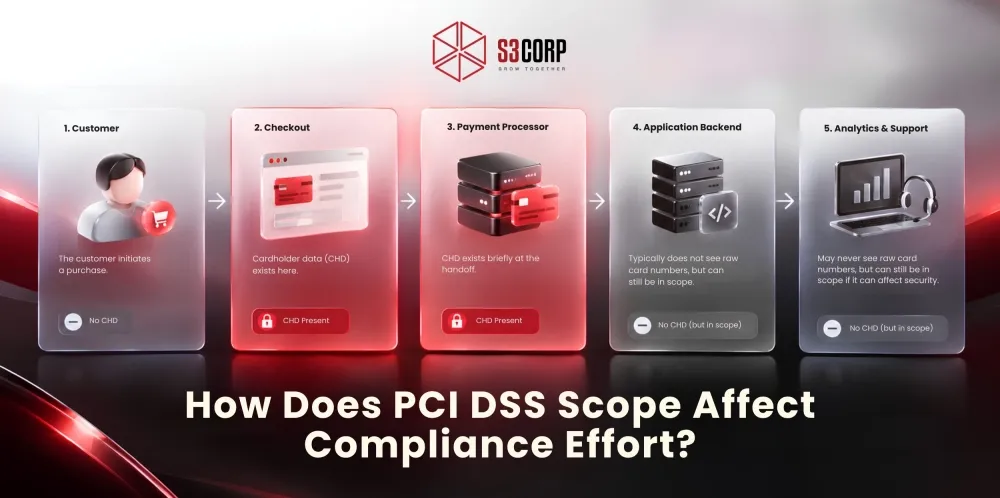 A common scenario illustrates why this matters. A mid-size SaaS platform adds a checkout feature and, to save time, points its own backend directly at the card network rather than a hosted payment page.
Six months later, the product team wants a support dashboard so agents can look up recent orders. Because the backend still touches raw card data, that new dashboard — and every engineer who can deploy to it — now sits inside the same assessment scope as the checkout itself.
Had the original build used a hosted payment page or tokenization from the start, the dashboard would likely never have entered scope at all. Scope decisions made in the first sprint of a payments feature tend to determine audit cost for years, not just for the initial launch.
|
Requirement objective |
Where it usually lands |
|
Network security controls, secure configuration |
Ongoing engineering effort — segmentation and hardening evolve with the infrastructure |
|
Account data protection, encryption |
Can often be engineered away through tokenization or a hosted checkout, removing raw data from the environment |
|
Access control, authentication, logging |
Ongoing engineering and operational effort — access management is never "done" |
|
Physical security, information security policy |
Largely one-time or annual audit-prep work, tied to process rather than code |
Reducing what your systems touch is usually more cost-effective than reducing what your team documents. That is a genuine architecture question worth resolving during payment gateway integration planning, before a single line of checkout code gets written, not after a QSA flags it during the assessment.
Validation method depends on PCI DSS level and on how a business technically handles card data — not on transaction volume alone. Most Level 2–4 merchants complete a Self-Assessment Questionnaire (SAQ), with the specific SAQ type set by integration method. Level 1 merchants and some service providers need a Report on Compliance (ROC) signed by a Qualified Security Assessor (QSA).
|
Integration method |
Likely SAQ type |
What it means in practice |
|
Fully hosted checkout or redirect; card data never touches your servers |
SAQ A |
Smallest scope; card data is entirely outsourced to a compliant vendor |
|
Merchant site delivers or controls part of the payment page (iframe, hosted fields) |
SAQ A-EP |
Slightly broader scope than SAQ A; the site still influences the payment page |
|
Direct API handling of raw card data, or any storage of cardholder data |
SAQ D |
Broadest scope; covers close to the full set of 12 requirements |
Two terms worth knowing alongside SAQ and ROC: an Attestation of Compliance (AOC) is the signed statement confirming the assessment result, and an Approved Scanning Vendor (ASV) runs the quarterly external vulnerability scans most levels require. None of these forms substitute for the others — they apply to different levels and different technical setups, and mismatching them is a common source of failed audits later on.
PCI DSS v4.0.1's "future-dated" requirements became mandatory on March 31, 2025. If the last compliance validation predates that date, the organization may already be behind the current standard.
What changed and now applies:
This is a short list on purpose. A full requirement-by-requirement diff belongs in a QSA engagement, not a business guide — but if a validation predates March 2025, that gap is worth raising with whoever manages the compliance program before the next assessment cycle.
On authentication, passkeys are worth a serious look for a 2026 build. A password rotated every 90 days is still a password someone can phish, reuse, or leak.
A passkey (FIDO2/WebAuthn) replaces that shared secret with a cryptographic key pair unlocked by a device biometric or PIN. PCI SSC guidance confirms that properly implemented phishing-resistant authentication can satisfy the multi-factor authentication requirement on its own.
For any access path moved fully to passkeys, there is no password left to rotate, length-check, or reset. The requirement gets met by removing the weak factor rather than hardening it.
On script security, two specific browser mechanisms do most of the work. Requirement 6.4.3 expects an authorized, justified inventory of every script running on a payment page, and Requirement 11.6.1 expects ongoing monitoring for unauthorized changes to that page.
PCI SSC's own guidance on these two requirements points to Content Security Policy (CSP) and Subresource Integrity (SRI) as the standard mechanisms. CSP controls which domains are allowed to serve scripts on the page; SRI validates that a loaded script has not been altered from its approved version.
Neither one is sufficient alone. CSP does not catch a compromised script from an already-trusted domain, and SRI does not catch a change in script behavior — which is why most teams pair both with an ongoing monitoring or alerting layer rather than treating either as a one-time setup task.
Non-compliance risk is not governed by one published fine schedule. Card networks and acquiring banks set penalties contractually, which is exactly why sources online cite wildly different numbers — everything from a few hundred dollars to well over a hundred thousand dollars a month, depending on the acquirer's contract terms.
One documented structure, reported through acquirer contracts, escalates in tiers: roughly $5,000–$10,000 per month for the first three months of non-compliance, rising to $25,000–$50,000 for months four through six, and further from there. Other sources describe different tiers entirely. Rather than repeat one figure as if it were universal, it is more useful to know that:
That last consequence tends to matter more to a fintech product team than any single fine: losing processing ability can stop revenue outright, while a monthly fine is a cost line that can at least be budgeted against.
Outsourcing payment processing can reduce the controls that apply directly to a merchant's environment, but it does not automatically remove PCI DSS responsibility. The business still needs to understand shared responsibilities, maintain appropriate agreements, verify the provider's compliance status, and complete the validation process that applies to it.
Myth: "We use a PCI-compliant processor, so we are covered."
Reality: The PCI Security Standards Council confirms that PCI DSS still applies even when payment processing is fully outsourced — outsourcing can remove many requirements from direct applicability, but it does not remove the responsibility to confirm the provider protects account data correctly.
A short vendor-oversight checklist for any business that has outsourced part of its payment flow:
A software development partner does not become irrelevant to PCI DSS simply because it never stores card numbers. If the partner can access the cardholder data environment, payment account data, or systems that can affect that environment's security, its role and controls belong in the scoping and assessment conversation.
For a CTO running vendor due diligence, seven questions turn PCI DSS from an abstract standard into concrete evaluation criteria:
These are exactly the kind of questions the information security management system at S3Corp, certified to ISO/IEC 27001:2022, is designed to answer before a project starts — access boundaries, code review gates, and vulnerability tracking are built into engagement setup rather than retrofitted once a client raises them. That is a practice worth confirming with quality assurance and testing services for any partner working near a payment environment, since testing discipline is where a lot of PCI-relevant gaps first surface.
Tokenization replaces sensitive payment data with a non-sensitive token usable by downstream systems without exposing the original account number. Paired with a hosted payment experience or a well-designed integration, tokenization can reduce how much payment data actually moves through an organization's systems — and that, in turn, can reduce the compliance scope that needs active management.
|
Architecture pattern |
Typical scope impact |
|
Direct card-data handling in your own backend |
Broadest scope — close to the full requirement set applies |
|
Hosted or redirect-based payment flow |
Narrow scope — card data rarely, if ever, touches your servers |
|
Tokenized payment flow with a payment gateway |
Reduced ongoing exposure — tokens replace raw data across most systems |
Reducing exposure is not the same as eliminating compliance. Tokenization and hosted checkouts shrink what needs protecting; they do not remove the obligation to validate compliance for whatever remains in scope, including the systems that generate, store, or transmit tokens. Product teams evaluating a payment processing system rebuild or a new integration should treat this as an architecture decision made early, since retrofitting tokenization into a live payment flow is considerably more expensive than designing for it from the start.
Validation is not identical for every organization, and it involves more than picking the right SAQ form. Depending on the entity, its payment relationships, and the requirements of whoever manages the compliance program, validation can involve a QSA-led assessment, a self-assessment, customized approach testing, targeted risk analysis, and specific evidence — not a single fixed template.
Two governance details worth knowing beyond the SAQ table above:
Treat transaction volume as a starting point for the conversation with an acquirer or QSA, not as the final word on what evidence a specific business needs to produce.
A useful PCI DSS checklist starts with scope and data flow, not with individual controls. Once the payment environment is mapped, an organization can assess applicable requirements, identify gaps, assign owners, remediate weaknesses, collect evidence, and set up ongoing monitoring.
The most expensive PCI DSS mistakes usually start before the audit ever begins: unclear scope, undocumented third-party responsibilities, excessive access into payment environments, incomplete evidence, and treating compliance as a one-time project rather than an operating discipline.
That third-party risk is not theoretical. Verizon's 2026 Data Breach Investigations Report found that breaches involving a third party jumped 60% year over year, accounting for close to half of all breaches analyzed. A payment environment with an undocumented vendor or an unmonitored development partner is exactly the kind of gap that trend describes.
|
Failure mode |
Why it happens |
What to do instead |
|
Scope creep |
New features or vendors get added without re-checking their effect on the CDE |
Re-map scope whenever architecture or vendor relationships change |
|
Undocumented third parties |
Teams forget script-based or embedded services can affect security |
Maintain a living inventory of every third party touching the payment flow |
|
Excessive access |
Convenience during development leaves broad production access in place |
Apply least-privilege access and review permissions on a schedule |
|
Incomplete evidence |
Evidence gets collected only right before an assessment |
Build evidence collection into normal operations year-round |
|
One-time mindset |
Compliance treated as a project with an end date |
Assign ongoing ownership and monitoring, not a single project team |
For a CTO, the relevant question is not simply whether a vendor claims to be "PCI compliant." The sharper question is how the vendor's people, access model, development lifecycle, infrastructure, testing practices, documentation, and third-party relationships affect the payment environment — and which responsibilities sit with which party.
A ten-question scorecard for an RFP or technical due-diligence call:
Question 3 deserves a closer look on the SBOM point. Requirement 6.3.2 requires an inventory of custom software and every third-party component built into it, used to identify and patch known vulnerabilities.
PCI DSS 4.0.1 does not use the term "SBOM" by name, but a current, machine-readable SBOM is how most engineering teams satisfy that inventory in practice. It is increasingly what enterprise compliance teams expect a vendor to produce on request, since it turns "which of our systems used the vulnerable library" from a days-long scramble into a lookup.
Note that question 2 also depends on the engagement model itself: a dedicated development team embedded in the client's own infrastructure carries a different access footprint than an offshore team working through a shared environment, so it is worth matching the collaboration model to the access boundaries a payment feature actually needs. Answering the ten questions above is straightforward for a vendor whose information security management system is already certified to ISO/IEC 27001:2022, since access control, code review, and vulnerability tracking are already documented rather than assembled for the RFP.
PCI DSS compliance is not a one-time checklist. It is an ongoing mix of audit paperwork, architecture decisions, and engineering maintenance that shifts as transaction volume and integration methods change. Knowing which of the 12 requirements are fixed costs, and which ones a well-designed architecture can remove, is the difference between a compliance burden that grows with the business and one that does not.
A five-step closing sequence to work from:
If PCI DSS requirements are shaping the architecture, development process, or vendor model behind a fintech or SaaS product, that is exactly the kind of conversation worth having early. Working with an outsourcing partner that treats security and IP protection as part of the engagement — rather than an add-on — tends to save far more engineering time than retrofitting compliance after launch. Contact the team at S3Corp to talk through which architecture choices would actually reduce the compliance footprint of a specific payments feature, backed by an ISO 27001-certified delivery process built to handle exactly this kind of scoping conversation.
PCI DSS stands for Payment Card Industry Data Security Standard. It is a baseline of technical and operational security requirements designed to protect payment account data, maintained by the PCI Security Standards Council, and it applies to organizations that handle or can affect the security of payment-card data.
PCI DSS compliance means meeting the requirements that apply to an organization's payment environment and maintaining evidence that the relevant controls are actually operating. The applicable requirements and validation method depend on the organization, its environment, its payment relationships, and its compliance program.
The requirements cover secure networks and configurations, account-data protection, encryption, malware protection, secure software development, access control, authentication, physical security, monitoring, testing, and information-security policy. Consult the current standard for exact wording and applicability, since PCI DSS versions and reporting details evolve.
Yes. Outsourcing payment processing does not automatically remove PCI DSS responsibility. Using a compliant provider can reduce the controls that apply directly to a business's environment, but the business still needs to understand shared responsibilities, manage the provider relationship, and complete its own applicable validation.
Tokenization can reduce exposure by replacing sensitive payment data with tokens that carry no value if stolen. Depending on the architecture, this can shrink the systems and processes directly exposed to payment data — but it does not automatically exempt an organization from PCI DSS.
PCI DSS is an industry security standard rather than a general government law, but payment brands, acquirers, processors, and contracts can require applicable organizations to validate compliance. Confirm exact validation and reporting obligations with whoever manages the relevant compliance program.
Validation is generally an ongoing process rather than a one-time certification. The required assessment and reporting cadence depends on the organization and its compliance program, so maintain controls continuously and confirm current requirements with the acquirer or payment brand involved.
PCI DSS focuses specifically on protecting payment account data within defined payment environments and entities. SOC 2 is an attestation framework covering controls relevant to specified trust services criteria. A fintech company may need both, and one does not automatically substitute for the other.