Whether you have any questions, or wish to get a quote for your project, or require further information about what we can offer you, please do not hesitate to contact us.
Contact us Need a reliable software development partner?
S3Corp. offers comprehensive software development outsourcing services ranging from software development to software verification and maintenance for a wide variety of industries and technologies


Software Development Center






Insights
Table Of Content
Key Takeaways
What Is A Payment Processing System?
How Does A Payment Processing System Work From Checkout To Settlement?
What Are The Core Components Of A Payment Processing System?
Which Payment Methods Should A Modern Processing System Support?
What Security And Compliance Controls Does A Payment Processing System Need?
How Should A Payment Processing System Handle Failures, Retries, And Duplicate Transactions?
What Should Payment Processing System Architecture Include Beyond The Payment Gateway?
How Do Payment Processing Systems Reduce Operational Errors?
What Should Financial Businesses Evaluate Before Developing A Payment Processing System?
What Does Payment Processing System Development Involve?
How Should You Choose A Payment Processing Approach?
Build Vs. Buy Vs. Embed: The Three Real Paths
Realistic Cost And Timeline To Build Vs. Embed
Evaluating A Development Partner For Payment Infrastructure
Closing recap
FAQ

A practical guide to payment processing system development: architecture, PCI DSS and PayFac compliance, failure handling, and the real build-vs-buy-vs-embed decision.
22 Sep 2026
Payment processing system development means building the software that authorizes, routes, and settles transactions yourself, instead of integrating a third party's ready-made APIs. It covers transaction authorization logic, a payment ledger, reconciliation against processor settlement files, and dispute handling. With ISO 27001-certified delivery processes, S3Corp builds security and IP protection into engagements like this from day one.
Most teams that say they want to "build a payment processing system" have three real options on the table: build the full stack, embed a processor's APIs, or bring in a partner who has done this before. Each path carries a different compliance burden, timeline, and cost, and the right one depends on how central payments are to your product.
This guide walks through what a payment processing system contains, how the transaction lifecycle works, which compliance obligations apply once you're the one holding the system, and how to plan a realistic build. By the end, you will have a framework for deciding whether your team should build, embed, or partner, and what to ask before signing off on any of the three.
A payment processing system coordinates the technology and financial participants required to move a payment from initiation through authorization and settlement. It can support card payments, bank transfers, digital wallets, Automated Clearing House (ACH), and other electronic payment methods, depending on the product and the markets it serves.
Payment processing system development is different from integrating a payment gateway. A gateway integration means plugging into someone else's infrastructure. Building the system yourself means you own the authorization logic, the ledger, and the reconciliation process end to end.
That distinction matters before anything else on this page, because the rest of this guide only applies if your situation calls for a build. If you only need to accept payments, a payment gateway integration usually solves that in a matter of weeks, not months.
|
Term |
What it does |
Who typically owns it |
|
Payment gateway |
Encrypts and transmits payment data from checkout to the processor |
A PSP, or your own system if you build |
|
Payment processor |
Routes authorization and settlement requests among banks and card networks |
A PSP, an acquiring bank, or your own system if you build |
|
Payment processing system |
Owns the full flow: gateway, processor logic, ledger, reconciliation, and dispute handling |
The business, when it chooses to build rather than integrate |
Several commercial providers bundle the gateway and processor roles into one product, which is part of why the terms get used loosely in market comparisons. Being precise about the difference matters once you're the one accountable for uptime, security, and compliance across the full flow.
A typical card transaction moves through several stages: the customer initiates payment, transaction data gets transmitted securely, the processor and financial institutions request authorization, the issuer approves or declines it, and approved funds are captured and settled.
Here is the full flow, from the customer's first tap to the money landing in your account:
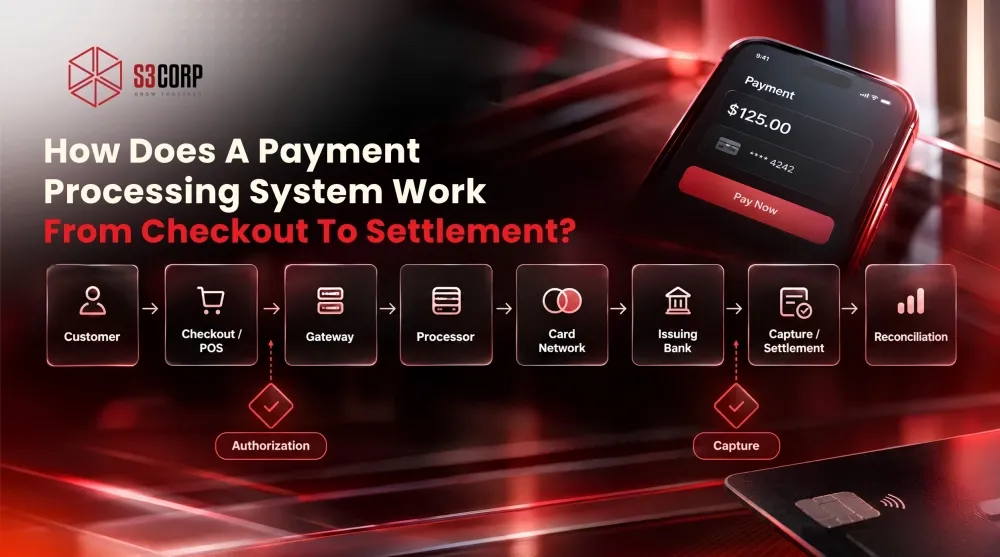 This is the flow every major processor documents in near-identical form, so we're not going to reinvent it here. What most explainers skip is what happens when a step in this chain does not go as planned, which is where the rest of this guide earns its place.
These three terms get used interchangeably in casual conversation, but they represent different states in your transaction lifecycle. Product teams that model them as one state tend to build fragile payment logic.
|
Stage |
What happens |
Why it matters for your build |
|
Authorization |
The issuer confirms funds are available and holds them, without moving money yet |
Authorizations expire (often 1–8 business days for debit cards, up to 30 days for credit cards), so your system needs to track and re-authorize if capture is delayed |
|
Capture |
You instruct the acquirer to act on the held authorization and request the funds |
Capturing too early or too late against your fulfillment model creates chargebacks or failed shipments |
|
Settlement |
Funds move from the issuing bank to your account, usually within a few days |
Your ledger should not treat "authorized" the same as "money in the bank" |
The core components usually include the customer-facing payment interface, a payment gateway, a payment processor, the acquiring side, a card or payment network connection, an issuing-bank relationship, a transaction ledger, fraud and risk controls, and settlement and reconciliation functions.
Each of these pieces either belongs inside your product's architecture, or it belongs to an external financial participant you connect to. Getting that boundary wrong is a common source of scope creep in payment builds.
Component ownership map
|
Component |
Owns / produces |
Communicates with |
|
Payment interface (web/app/POS) |
UI and tokenization at the edge; produces the payment request |
Gateway layer |
|
Gateway |
Encryption and routing; produces the encrypted transaction payload |
Processor, your backend |
|
Processor / acquiring layer |
Authorization and capture logic; produces the auth response and capture confirmation |
Card networks, issuing banks |
|
Card/payment network |
Network rules and interchange; routes the transaction and applies the interchange fee |
Issuing and acquiring banks |
|
Issuing bank |
Cardholder account and approval decision; produces the approve/decline response |
Network |
|
Ledger / payment database |
System of record for every transaction state; produces transaction history and audit trail |
Reconciliation engine |
|
Fraud and risk layer |
Rules, scoring, holds; produces the risk decision |
Ledger, gateway |
|
Reconciliation engine |
Matches settled funds to ledger entries; produces exception reports |
Bank/processor settlement files |
If your roadmap already spans a web application front end, a mobile checkout, and a backend ledger, that is a genuine full-stack engineering effort. S3Corp works across backend payment development, QA, DevOps, and long-term maintenance for this kind of system, without acting as a regulated payment processor itself.
Vietnam has built a deep, technically trained developer pool over the past two decades, which is a large part of why it has become an established offshore engineering base for exactly this kind of regulated, detail-heavy build. S3Corp is Vietnam-based, and our breakdown of why outsourcing to Vietnam covers the cost-to-quality case in more depth for teams weighing delivery locations.
The right payment-method mix depends on your target customers, markets, transaction types, and product model. Card payments are only one option: your system may also need to support bank transfers, ACH, digital wallets, and electronic checks.
Adobe's payment-processing overview groups electronic payments into debit and credit cards, digital wallets, bank transfers, and electronic checks converted into ACH transactions. Each category has different settlement timing, fraud profiles, and integration effort.
Payment method decision matrix
|
Method |
Best fit for |
Implementation & operational considerations |
|
Credit/debit cards |
Broad consumer reach, immediate authorization needs |
PCI scope, Network Tokens, and 3DS2 (3D Secure 2.x); watch for chargebacks and interchange cost |
|
Digital wallets (Apple Pay, Google Pay) |
Mobile-first checkout, faster conversion |
Wallet-specific SDKs and device tokenization; lower fraud rates, but wallet-specific dispute rules |
|
Bank transfers / ACH |
B2B, recurring billing, lower fees |
Slower settlement (1–3 days) and return-code handling; not instant like cards |
|
Electronic checks |
Legacy B2B workflows, some insurance and property use cases |
Conversion to ACH, image capture if paper-based; longer clearing windows |
|
Instant payments (FedNow, SEPA Instant) |
Urgent B2B payouts, real-time settlement needs |
Authorization and settlement happen in one step, and funds are final and irrevocable; no capture window to model in your ledger |
For card payments specifically, tokenization has moved past PCI scope reduction. Visa and Mastercard now issue Network Tokens directly, and these update automatically when a card expires or gets reissued, typically at a lower interchange rate than a raw card number.
Pair Network Tokens with 3D Secure 2.x (3DS2) risk-based authentication to keep Strong Customer Authentication frictionless. The issuer scores the transaction in the background and only interrupts checkout for the small share of transactions that genuinely need a challenge.
Instant payments change the ledger model more than any other method in this table. With FedNow or SEPA Instant, funds move and settle within seconds, with the recipient getting full access immediately, so there is no separate authorization-then-capture window to track.
That collapses the three-stage state machine from the authorization, capture, and settlement breakdown earlier in this guide into a single, irrevocable event. If instant-payment rails are part of your scope, our guide to real-time payments architecture covers the ledger and reconciliation redesign this requires in depth.
Geography changes this mix more than most teams expect. UK and EU platforms increasingly route bank transfers through Open Banking rails under PSD2, Singapore and much of Asia lean on real-time schemes like PayNow and FAST, and US B2B platforms still rely heavily on ACH for lower-fee recurring billing. If instant-payment rails are part of your scope, our guide to real-time payments architecture covers that layer in depth, separately from the processing-system architecture in this guide.
If your product also touches mobile wallets or a standalone mobile checkout experience, that usually intersects with a digital wallet app or mobile banking app build, which is a related but separate engineering scope from the processing system itself. Keep cryptocurrency out of your initial scope unless your product requirements specifically call for it. It sits inside the broader payment-methods landscape, but it is not required to satisfy most B2B or B2C payment builds today.
Payment systems handle sensitive financial and customer data, so security cannot get added after the transaction flow is built. You need to define data protection, access controls, fraud controls, auditability, and payment-security requirements as part of the initial design.
Building payment infrastructure means taking on compliance obligations a PSP normally absorbs for you. That includes PCI DSS as a service provider, not just as a merchant, and in some models, registering as a Payment Facilitator or partnering with a sponsor bank. Skipping this planning step is the single most common reason in-house payment builds stall.
The Payment Card Industry Data Security Standard (PCI DSS) is the global security standard for any entity that stores, processes, or transmits cardholder data. American Express, Discover, JCB International, Mastercard, and Visa formed the PCI Security Standards Council (PCI SSC) in 2006 to maintain it, and the official PCI SSC standards library documents the current control set in full. Compliance level is set by annual transaction volume, and it determines how heavy your validation burden is.
|
PCI DSS level |
Annual transaction volume |
Typical validation |
|
Level 1 |
Over 6 million transactions per year |
Annual Report on Compliance (ROC) via a Qualified Security Assessor, plus quarterly scans |
|
Level 2 |
1 to 6 million transactions |
Self-Assessment Questionnaire (SAQ), quarterly scans |
|
Level 3 |
20,000 to 1 million transactions |
SAQ, quarterly scans |
|
Level 4 |
Fewer than 20,000 transactions |
SAQ, quarterly scans |
|
Compliance step |
What it involves |
Typical timeline |
|
PCI DSS scoping and level assignment |
Determine transaction volume, role (merchant vs. service provider), and applicable SAQ or ROC path |
Weeks, but depends on how cleanly your architecture separates cardholder data |
|
Tokenization and scope reduction |
Replace stored card data with tokens to shrink the systems that fall inside PCI scope |
Built into initial architecture, not bolted on later |
|
PayFac or ISO registration (if applicable) |
Register as a Payment Facilitator, or partner with a sponsor bank, if you plan to onboard sub-merchants |
Months, involves underwriting and risk-management review by the sponsor |
|
Ongoing audits and QSA assessment |
Annual Report on Compliance for Level 1 entities, quarterly vulnerability scans for all levels |
Recurring, not a one-time milestone |
Payment-system security checklist
For a full breakdown of scoping, tokenization architecture, and audit cadence by level, see our dedicated guide to PCI DSS compliance.
A reliable payment system treats failure handling as part of the transaction design, not as an exception added later. Timeouts, declined payments, network failures, duplicate requests, and webhook delays can otherwise produce inconsistent payment states or duplicate charges.
A production payment processing system needs more than an authorization call. It needs idempotent transaction handling, a ledger that never loses a cent in a retry, reconciliation against processor settlement files, and a dispute or chargeback workflow. Most build failures come from treating these as afterthoughts, not from getting the happy path wrong.
|
Failure scenario |
What can go wrong |
What the system needs |
|
Customer sees "payment failed," but the processor later approves it |
Double-charge risk if the customer retries manually |
Status polling or webhook confirmation before allowing a retry |
|
Client retries the same request |
Duplicate authorization or duplicate charge |
Idempotency keys on every write operation |
|
Gateway timeout with unknown transaction status |
System does not know if the charge went through |
A reconciliation job that checks final status instead of assuming failure |
|
Duplicate webhook delivery |
Same event processed twice, inflating the ledger |
Deduplication by event ID before applying state changes |
|
Downstream webhook delivery repeatedly fails |
Naive immediate retries create a self-inflicted denial-of-service (DoS) condition on your own or the receiver's endpoint |
Exponential backoff with jitter between retry attempts, plus a dead letter queue (DLQ) for events that exhaust their retry budget |
|
Partial settlement or reconciliation mismatch |
Ledger and bank settlement files disagree |
Automated exception reports, not manual spreadsheet matching |
Idempotency keys, specifically, deserve early architectural attention: every write to your ledger should be safe to retry without creating a duplicate record. Teams that add this after launch usually do it under pressure, following a real duplicate-charge incident.
Webhook retry strategy deserves the same discipline as authorization retries. Retrying a failed delivery immediately, and at a fixed interval, hammers a downstream system that is already struggling, which turns your own retry logic into the outage.
Exponential backoff with jitter spaces out retry attempts and staggers them across clients, so a struggling endpoint gets room to recover instead of a second wave of traffic. Once an event exhausts its retry budget, route it to a dead letter queue for inspection and manual replay, rather than dropping it permanently.
A gateway is only one part of a payment system. A production payment processing architecture also needs transaction orchestration, payment-state management, risk controls, secure data handling, a ledger, notifications and webhooks, settlement and reconciliation processes, monitoring, and administrative controls.
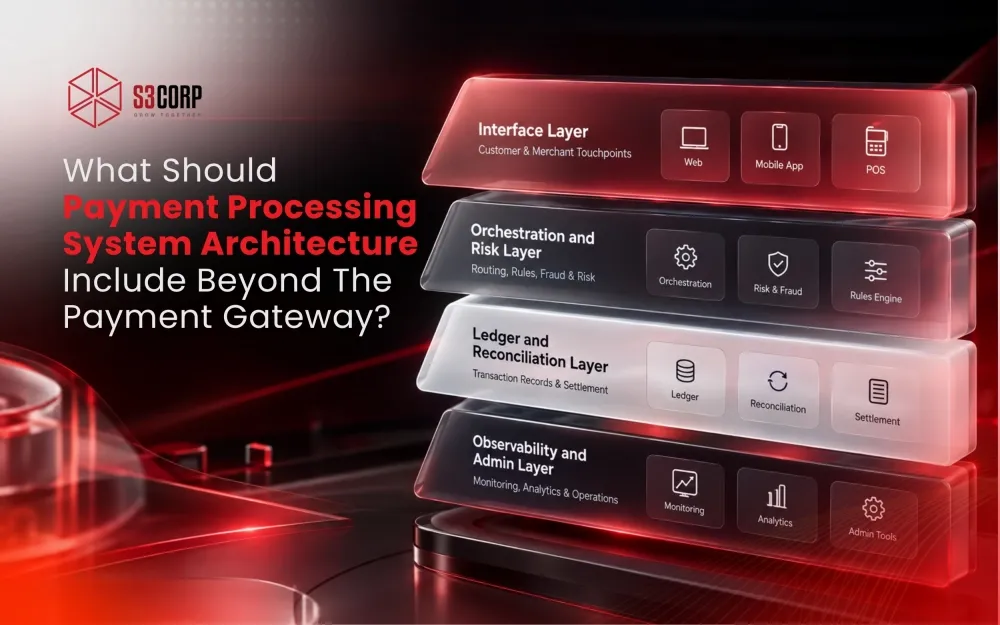 Architecture layers at a glance
This is where a build genuinely needs range across disciplines. Teams typically need backend engineering for the ledger and orchestration logic, QA and testing for failure-state simulation, and DevOps for the monitoring and deployment pipeline that keeps a payment system observable in production.
Reducing payment errors requires more than successful authorization. Systems should maintain consistent transaction states, automate reconciliation, preserve audit trails, and make failed or disputed transactions traceable across the customer, processor, and merchant sides.
Most payment operations teams spend their time chasing manual exceptions: a transaction that shows as paid in one system and pending in another, a chargeback with no clear owner, a settlement file that does not match the ledger. A well-designed system turns those into automated, traceable workflows instead of spreadsheet reconciliation.
Manual risk to system control mapping
|
Manual risk today |
System control that replaces it |
|
Support staff manually check payment status across two dashboards |
Single source-of-truth ledger with real-time state |
|
Someone exports settlement files and matches them by hand |
Automated reconciliation job with exception flagging |
|
Disputes get tracked in a shared spreadsheet |
Dispute workflow tied directly to the transaction record |
|
Duplicate charges get caught only when a customer complains |
Idempotency checks and deduplication at the write layer |
The pattern across all four rows is the same: replace a person doing detective work with automated exception handling that surfaces the problem on its own. That shift is most of what "reducing errors in B2B payment processing" means in practice.
Before development begins, define your payment methods, target markets, transaction volume, settlement requirements, regulatory obligations, integration dependencies, fraud exposure, reporting needs, and failure-handling rules. These decisions set the system boundaries more than your choice of frontend checkout technology does.
Pre-development checklist
With 19+ years delivering software outsourcing work across 400+ projects for 250+ clients in 25+ countries, S3Corp has seen most of these decisions get revisited mid-project when they were not written down before development started. Answering all eight up front is what keeps a payment build on schedule.
Payment processing system development typically moves from requirements and payment-method selection into architecture, secure transaction handling, integrations, testing, operational controls, and production monitoring. Development should validate transaction states and financial reconciliation, not just whether a customer can complete checkout.
Seven-stage development lifecycle
S3Corp positions as a long-term delivery partner rather than a short-term staffing vendor for this kind of build, with security and IP practices built into how engagements run from the first stage onward.
The right approach depends on whether your business needs to integrate an existing processor, orchestrate multiple payment providers, or develop proprietary payment infrastructure. Most businesses should clarify which capabilities genuinely need to be owned before taking on the operational and compliance burden of building more.
Three-path decision framework
If your team is weighing these three paths across different engagement models, our overview of collaboration models covers how staffing, dedicated teams, and full project delivery differ for exactly this kind of decision.
Most companies that think they need to "build a payment processing system" have three real options: build the full stack in-house, embed a processor's APIs directly (Stripe Connect, Adyen for Platforms), or partner with a development team experienced in payment infrastructure. This is the in-house vs. outsourced payment development question in practice, and the right answer depends on how central payments are to your product and how much compliance risk you are ready to own.
Path comparison
|
Path |
What it means |
Best fit for |
|
Build in-house |
Full ownership of ledger, orchestration, and compliance scope |
Products where payments are the core differentiator, with the internal team and budget to sustain ongoing compliance |
|
Embed a PSP's APIs |
Integrate a processor's existing infrastructure (Stripe Connect, Adyen for Platforms) |
Products where payments support the core offering but are not the offering itself |
|
Partner-built custom system |
An external team builds and helps operate the payment infrastructure with you |
Products that need custom logic or compliance ownership, without an internal team that has shipped PCI-scoped systems before |
In practice, a vertical SaaS platform adding payments as a feature (not as the product) usually just embeds a PSP's APIs and is live in weeks. A B2B marketplace that takes a cut of every transaction between buyers and sellers is a different case: it needs PayFac registration or a sponsor-bank partnership, because it stands between two parties' money, not just accepting its own. Same framework, opposite answer.
Embedded payments keep growing for a reason: the embedded finance market is projected to reach roughly US$454.48 billion by 2031, up from about US$155.96 billion in 2026, a 23.84% compound annual growth rate. That growth reflects how many platforms are choosing to embed payments and other financial features rather than build the infrastructure themselves.
Companies that do choose the "custom build with a partner" path need a team that has shipped PCI-scoped systems before, not a generalist software shop bolting a payment feature onto an unrelated project.
A custom-built payment processing system with full PCI scope typically takes longer and costs more upfront than embedding a PSP's APIs, but the crossover point depends on your transaction volume and how much of the payment experience you need to own.
Cost and timeline by approach
|
Approach |
Typical cost range |
Typical timeline |
|
Embed a PSP's APIs |
Primarily integration engineering cost, plus per-transaction fees to the PSP |
Weeks to two to three months |
|
Custom payment gateway (MVP scope) |
US$150,000 to US$250,000 |
Roughly three to six months for an MVP |
|
Full payment processing system (ledger, reconciliation, PayFac/ISO scope) |
Scales meaningfully beyond gateway-MVP cost; driven by transaction volume, compliance tier, and integration count |
Six to eighteen months or more, plus ongoing audit cycles |
That first figure covers a payment gateway MVP specifically, not a full processing system with ledger, reconciliation, and PayFac registration layered in. It is Stripe's own most recently published benchmark, so treat it as a reference point for sanity-checking vendor quotes, not a ceiling.
Cost drivers for the fuller build include team size and expertise, the technology stack, the depth of compliance and security work, and how much ongoing maintenance and support your model requires. Treat the third row above as directional rather than fixed.
It depends heavily on your specific compliance tier and transaction volume. Before committing to a number for a custom payment system, scope the total cost of ownership, not just the initial build, against your own requirements checklist.
One more cost distinction worth separating: the one-time cost of building the system is different from the ongoing PSP take rate (interchange, assessment, and processor markup) you would pay indefinitely if you embedded instead. A build has a larger upfront cost and a lower long-term per-transaction cost; embedding flips that trade-off.
If you are bringing in a partner to build payment infrastructure, the vendor due diligence bar is higher than a typical development engagement. You are vetting for PCI-scoped project experience and security certifications, not just general financial software development capability.
Vendor due-diligence checklist
This checklist works regardless of which vendor you are evaluating, including ones that are not S3Corp. With an ISO 27001-certified delivery process, S3Corp builds security and IP protection into engagements from day one, and you can review examples of delivered engineering work in our case studies.
A payment processing system is successful when it can move transactions securely from initiation through authorization, capture, settlement, and reconciliation, while staying observable and resilient when things go wrong. Financial businesses should define those capabilities before choosing the architecture or development approach.
Whether you build, embed, or partner to build, the decision comes down to how central payments are to your product and how much compliance risk you are ready to own. If you have decided a custom build is the right call, the next step is finding a partner who has shipped PCI-scoped systems before.
Planning a payment processing product or a modernization project? Talk with S3Corp about the engineering scope, integrations, security requirements, and delivery model that fit your specific compliance tier and transaction volume.
A payment processing system is the technology and connected financial infrastructure used to accept, authorize, process, capture, settle, and reconcile electronic payments. It can include payment gateways, processors, transaction records, risk controls, and integrations, depending on the product.
A typical card transaction starts when a customer submits payment information, which travels securely through a gateway to the processor and financial institutions. The transaction gets authorized or declined, then approved funds are captured and settled before the merchant reconciles the resulting records.
Start by defining payment methods, markets, transaction states, security and compliance requirements, integrations, and settlement needs. Then design the architecture, implement secure transaction handling, test failure scenarios, deploy with monitoring, and maintain the system as requirements evolve. See the build-vs-buy-vs-embed and compliance sections above for the full decision framework.
A payment gateway securely transmits payment information between your checkout and the payment infrastructure, while a payment processor handles transaction processing and communication among the relevant financial institutions. Some commercial providers combine both roles into a single product.
They reduce errors by enforcing consistent transaction states, using idempotent request handling, tracking asynchronous payment events, automating reconciliation, and surfacing exceptions for review instead of relying on manual checks. Error reduction depends on both software design and operational process.
Requirements depend on the payment methods, data handled, geography, and your role in the payment ecosystem. PCI DSS applies specifically to card-payment environments, but you should also assess applicable privacy, financial, authentication, and regulatory requirements rather than treating one certification as complete coverage.
This is a narrower question than a full system build. It usually means connecting your point-of-sale hardware or software to an existing gateway or processor's APIs, which is closer to a payment gateway integration project than a ground-up build.
The same reconciliation and idempotency principles covered in the architecture section above apply directly to B2B flows, often with added complexity around invoicing, multi-party settlement, and longer payment terms.
Yes. Fintech and BFSI platforms face PCI DSS and often banking-partner requirements, healthcare platforms add HIPAA-adjacent data handling on top of payment compliance, and marketplaces or insurtech platforms may trigger PayFac or money-transmitter licensing questions depending on how funds flow through the platform.