Whether you have any questions, or wish to get a quote for your project, or require further information about what we can offer you, please do not hesitate to contact us.
Contact us Need a reliable software development partner?
S3Corp. offers comprehensive software development outsourcing services ranging from software development to software verification and maintenance for a wide variety of industries and technologies





Software Development Center
_1746790956049.webp&w=384&q=75)
_1746790970871.webp&w=384&q=75)


Insights
Table Of Content
TL;DR — Top Software Development Frameworks in 2026
Which Software Development Framework Should You Choose in 2026?
Why Do Software Frameworks Matter for Business Outcomes?
What Are the Most Popular Software Development Frameworks Today?
How Do Software Framework Choices Impact Hiring and Cost?
What Factors Should You Evaluate Before Choosing a Framework?
Framework Comparison Matrix: Which One Fits Your Project?
What Are the Risks of Choosing the Wrong Framework?
When Should You NOT Use a Framework?
How Does S3Corp Help Companies Choose and Implement Frameworks?
Conclusion: What Framework Strategy Should You Adopt for 2026?
Ready to Validate Your Stack Choice?
Frequently Asked Questions
A practical guide for CTOs and Product Managers on selecting the right software development frameworks in 2026, covering frontend, backend, mobile, AI, and microservices stacks with a decision matrix.
27 May 2026
Every engineering decision your team makes today will either compound into a competitive advantage or quietly accumulate as technical debt. Choosing the wrong software development framework is one of the most expensive mistakes a product team can make—not because of the licensing cost, but because of the hidden costs that follow: slow hiring, painful migrations, and a codebase that fights your growth instead of enabling it.
So, what is the best software development framework? The short answer to this question is that: Choose a framework based on your project type, scalability requirements, and the talent available in your hiring market. In 2026, React, Spring Boot, and Flutter dominate because of their ecosystem depth, community strength, and global talent supply.
This guide gives you a clear, framework-by-framework breakdown—with comparison tables, selection criteria, and real-world context—so you can walk into your next architecture review with a confident, evidence-based recommendation.
Choosing a software framework is a business decision, not just a technical one. The wrong choice costs you in slow hiring, painful migrations, and a codebase that caps your growth.
What to choose: React (frontend), Spring Boot or Node.js (backend), Flutter (mobile), Next.js (full-stack). These dominate because the talent pools are deep and the ecosystems are proven.
Why it matters: The right framework cuts development time by 30–50%, standardizes code across distributed teams, and directly reduces your hiring cost and risk.
The biggest hidden cost: Niche frameworks spike your hiring difficulty by up to 2.5×. Popular frameworks in offshore markets like Vietnam mean faster team spin-up and lower day rates.
How to decide: Match your framework to your project type → scale requirement → team's existing skills → available talent in your hiring market. In that order.
When NOT to use a framework: Simple scripts, one-time prototypes, or performance-critical low-level components where abstraction overhead matters.
Biggest risk: Choosing a framework your team can't hire for. A great product with an empty hiring pipeline goes nowhere.
2026 trend to watch: LangChain has become the default for LLM/AI feature integration. If your product roadmap includes AI, plan for it now rather than bolt it on later.
The three factors that actually decide the winner for your project:
The one rule to remember: If you cannot hire five senior developers for your chosen framework within 60 days in your target talent market, it is too niche for a business-critical system.
When in doubt, default to talent-rich, ecosystem-mature, AI-friendly stacks — React, Node.js, Spring Boot, Flutter — and only deviate when you have a specific, justified reason to do so.
Again, you should choose based on your project type, scalability needs, and hiring availability. React, Spring Boot, and Flutter dominate due to ecosystem strength and global talent supply. If you are building a customer-facing web app at scale, React is still the most defensible frontend choice. If your backend needs to handle high-concurrency enterprise workloads, Spring Boot remains the gold standard. And for cross-platform mobile, Flutter has extended its lead over alternatives in both performance and developer adoption.
Framework choice shapes delivery speed, hiring cost, and long-term product stability. A wrong decision creates friction at every stage, from onboarding engineers to scaling infrastructure.
The table below gives you a fast orientation before we go deeper:
|
Framework |
Primary Use Case |
Scalability |
Hiring Availability |
|
React |
Frontend / SPAs / SaaS platforms |
High |
Very High |
|
Angular |
Enterprise frontend |
High |
High |
|
Vue.js |
Lightweight frontend |
Medium–High |
Medium |
|
Svelte |
Performance-first UI |
Medium |
Low–Medium |
|
Spring Boot |
Enterprise backend |
Very High |
High |
|
Node.js (Express) |
Real-time / APIs |
High |
Very High |
|
Django |
Data-heavy web apps |
Medium–High |
Medium |
|
Laravel |
Rapid web backend |
Medium |
High |
|
Flutter |
Cross-platform mobile |
High |
High |
|
React Native |
Cross-platform mobile |
Medium–High |
High |
|
Next.js |
Full-stack / SSR |
High |
High |
|
TensorFlow |
AI / ML |
High |
Medium |
S3Corp helps clients evaluate frameworks based on product scope, expected growth, and team scaling needs. Many projects start with a lean stack and expand into microservices as demand grows, often guided through Full-Lifecycle Product Development.
Read More: Software Development Services: The 2026 Ultimate Guide
Frameworks are not just a developer preference or technical tools. They will directly impact cost, speed, scalability, and further shape your business performance. Hence, software development frameworks are a business infrastructure decision.
The business impact is real.
According to Statista research, Node.js, React, and Spring Boot remain the dominant global industry standards for modern development stacks. These technologies continue to define the landscape for enterprise-tier backend and frontend development, impacting vendor availability, ecosystem stability, and beyond. These factors directly correlate with hiring costs and talent availability in outsourcing markets.
Here is why the right framework choice directly moves the needle on your bottom line:
For enterprise frameworks, the choice often determines how fast a team can respond to market changes. This is critical in sectors like fintech and e-commerce, where release cycles define competitiveness.
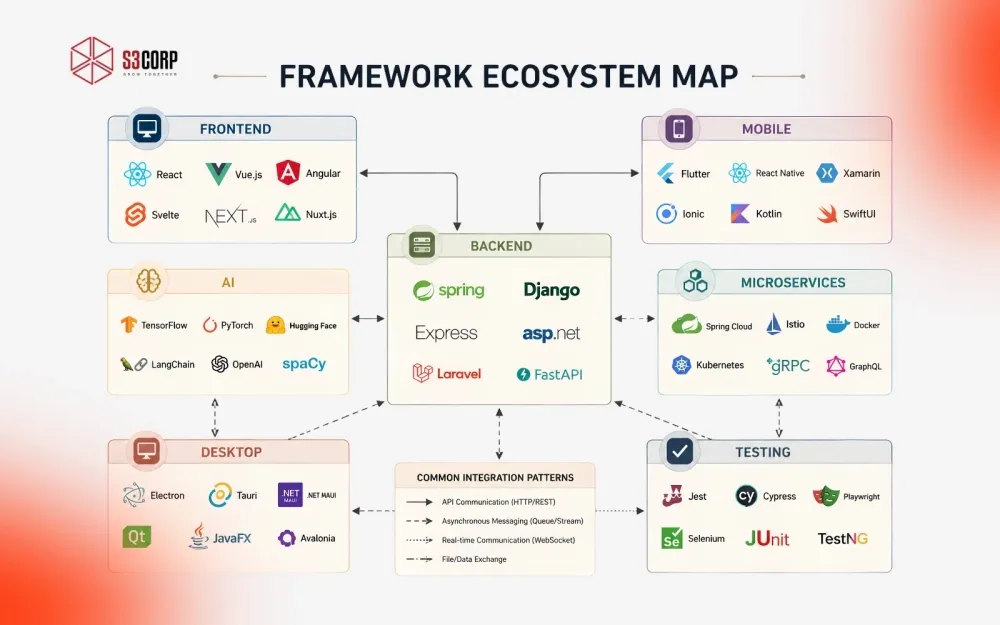 The framework landscape in 2026 is diverse but not chaotic. Clear leaders have emerged in each category:
React leads the frontend landscape in 2026, followed by Angular for enterprise-heavy projects and Vue for teams prioritizing simplicity. Svelte is gaining traction in performance-critical, content-heavy applications.
|
Framework |
Strengths |
Best For |
Ecosystem Maturity |
|
React |
Component reuse, massive ecosystem, Next.js integration |
SPAs, dashboards, e-commerce |
Very High |
|
Angular |
Opinionated structure, TypeScript-first, enterprise ready |
Large enterprise apps, CRMs |
High |
|
Vue.js |
Gentle learning curve, flexible |
Startups, internal tools |
High |
|
Svelte |
No virtual DOM, minimal bundle size |
Performance-critical UIs |
Medium |
React still powers roughly 40% of web application front ends globally. Angular is the go-to in regulated industries—banking, insurance, government—where its opinionated structure reduces the risk of inconsistent patterns across large teams. Vue.js continues to punch above its weight in Southeast Asian development teams, including teams at S3Corp, where its gentle learning curve accelerates onboarding for mid-level developers.
Two frameworks worth watching in 2026: If your use case demands desktop-class interactivity directly inside the browser—think complex data grids, real-time financial dashboards, or CAD-adjacent tooling—two emerging options deserve serious evaluation.
Neither Blazor nor Yew is replacing React or Angular for general-purpose web development anytime soon. But they represent a meaningful shift: the browser is no longer a JavaScript-only execution environment, and CTOs building long-horizon platforms should understand what that unlocks.
S3Corp team experience: Frontend projects delivered by teams at S3Corp use React and Next.js as the default stack for e-commerce and SaaS clients, while Angular is selected for enterprise clients in the Fintech Industry Solutions space where TypeScript enforcement and strict modularization are non-negotiable. Web Application Development Services from S3Corp cover all major frontend frameworks.
Spring Boot is the benchmark for enterprise backend scalability, while Node.js/Express leads for high-concurrency, real-time systems. Django remains the pragmatic choice for data-heavy applications, and Laravel accelerates rapid delivery for mid-tier web projects.
Security is increasingly a first-class selection criterion—not a post-launch afterthought. The OWASP Top 10 is the industry-standard reference for the most critical web application security risks, and the frameworks below differ meaningfully in how much protection they provide out of the box versus how much you need to configure yourself.
|
Framework |
Language |
Best Use Case |
Scalability |
OWASP Top 10 Coverage |
|
Spring Boot |
Java |
Enterprise APIs, microservices |
Very High |
Excellent — Spring Security provides built-in protection for injection, broken auth, XSS, CSRF, and misconfiguration. Extensive enterprise hardening documentation. |
|
Node.js/Express |
JavaScript |
Real-time apps, REST APIs |
High |
Moderate — Minimal by default; relies on middleware (Helmet.js, express-validator, csurf). Requires deliberate configuration. |
|
Django |
Python |
Data platforms, ML-integrated apps |
Medium–High |
Very Good — Django's security middleware covers CSRF, XSS, clickjacking, SQL injection, and secure cookies by default. Strong security defaults out of the box. |
|
Laravel |
PHP |
Content-heavy web apps, SMB tools |
Medium |
Good — Built-in CSRF protection, query builder prevents SQL injection, Blade templating escapes output. Requires additional packages for full OWASP coverage. |
|
Ruby on Rails |
Ruby |
Rapid MVPs, content platforms |
Medium |
Good — Rails ships with CSRF protection, parameterized queries, and secure defaults, though ecosystem fragmentation adds configuration overhead. |
The security column matters more than most teams acknowledge during framework selection. Spring Boot and Django are the standout choices for teams where security compliance is a hard requirement—particularly in fintech, healthcare, and government projects—because their security defaults are comprehensive and well-documented. Node.js/Express gives you full control, which is both its strength and its risk: a team that does not configure Helmet.js and input validation correctly is shipping vulnerabilities by default.
Spring Boot dominates in fintech, logistics, and large-scale enterprise environments because of its mature ecosystem, native support for microservices (via Spring Cloud), and excellent integration with Java Virtual Machine (JVM) tooling. Node.js, meanwhile, is the backbone of platforms like LinkedIn and Netflix for specific high-concurrency components—and its single-language stack (JavaScript front and back) is a meaningful cost advantage for lean teams.
Flutter is the leading cross-platform mobile framework in 2026, offering near-native performance and a single codebase for iOS, Android, and Web. React Native remains competitive, especially for teams already invested in the JavaScript ecosystem.
|
Criteria |
Flutter |
React Native |
|
Performance |
Near-native (compiled to native ARM) |
Good (JS bridge overhead) |
|
Language |
Dart |
JavaScript/TypeScript |
|
Code Reuse |
iOS + Android + Web + Desktop |
iOS + Android |
|
Community |
Very Fast-Growing |
Large & Mature |
|
Hiring Availability |
High (growing rapidly) |
Very High |
|
Best For |
New cross-platform projects |
Teams with existing React skills |
Flutter leads in performance consistency, while React Native benefits from a large JavaScript talent pool. These frameworks often integrate with mobile app to deliver unified user experiences across platforms.
Google's continued investment in Flutter—particularly its Web and embedded targets—makes it a forward-safe choice for teams building new products in 2026. React Native's mature ecosystem and the overlap with React web developers make it the pragmatic choice when your team already knows JavaScript. Mobile Application Development Services at S3Corp deploy both Flutter and React Native depending on the client's roadmap and existing codebase.
Next.js is the dominant full-stack framework in 2026 for React-based applications, offering Server-Side Rendering (SSR), Static Site Generation (SSG), and API routes in a single, cohesive package. Nuxt.js provides the same for Vue. The MERN and MEAN stacks remain popular for teams wanting JavaScript end-to-end.
|
Framework |
Stack |
Best For |
Scalability |
|
Next.js |
React + Node |
SaaS, e-commerce, marketing sites |
Very High |
|
Nuxt.js |
Vue + Node |
Content sites, Vue-first teams |
High |
|
MERN |
MongoDB, Express, React, Node |
Startups, rapid MVPs |
High |
|
MEAN |
MongoDB, Express, Angular, Node |
Enterprise MVPs |
High |
|
Meteor |
Full-stack JS |
Real-time apps, prototypes |
Medium |
Next.js has effectively become the default for production React deployments because Vercel's infrastructure investment has made edge rendering and ISR (Incremental Static Regeneration) accessible to teams of all sizes.
TensorFlow and PyTorch split the deep learning market, with PyTorch leading in research and TensorFlow in production deployments. LangChain has become the dominant orchestration framework for LLM-based applications—a category that barely existed two years ago.
If you are integrating AI capabilities into an existing product—rather than building a pure AI product—LangChain combined with a cloud LLM API (OpenAI, Anthropic, or Google Gemini) is the fastest path to a production-ready AI feature in 2026.
Electron is the default for cross-platform desktop apps, while .NET MAUI leads for Windows-heavy enterprise environments. JavaFX remains in use for legacy enterprise systems.
|
Framework |
Language |
Best For |
Pros |
Cons |
|
Electron |
JavaScript |
Cross-platform desktop (VSCode, Slack) |
Large talent pool, web tech |
High memory usage |
|
.NET MAUI |
C# |
Windows/macOS enterprise desktop |
Deep Windows integration |
Mostly Microsoft ecosystem |
|
JavaFX |
Java |
Enterprise desktop (legacy & new) |
JVM ecosystem |
Slower UI vs native |
Electron's adoption by products like VS Code, Figma's desktop app, and Slack demonstrates that the performance trade-off is acceptable for most business tools. For data-sensitive enterprise environments—particularly in the Healthcare Industry Solutions and financial sectors—.NET MAUI offers tighter OS-level security integration. Desktop Application Development Services from S3Corp cover Electron and .NET stacks for enterprise clients.
Spring Boot remains the industry leader for microservices in 2026, but Quarkus and Micronaut are gaining ground rapidly in cloud-native environments where cold start times and memory efficiency are critical.
|
Framework |
Language |
Container Startup |
Best For |
|
Spring Boot |
Java |
Medium (~2–5s) |
Enterprise microservices |
|
Quarkus |
Java/Kotlin |
Very Fast (<0.1s) |
Kubernetes-native, serverless |
|
Micronaut |
Java/Groovy/Kotlin |
Fast (~0.5s) |
Cloud functions, low-latency services |
If you are deploying on Kubernetes with frequent pod scaling, Quarkus or Micronaut will reduce your cloud compute bill meaningfully compared to traditional Spring Boot. However, Spring Boot wins on talent availability: there are simply far more senior Spring developers globally than Quarkus specialists.
JUnit is the standard for Java, Pytest for Python, and Mocha/Chai for JavaScript. The "best" depends entirely on your primary language stack.
|
Framework |
Language |
Strengths |
Best For |
|
JUnit 5 |
Java |
Deep integration, annotations |
Spring Boot, enterprise Java |
|
Pytest |
Python |
Simple syntax, fixtures, plugins |
Django, Flask, AI/ML pipelines |
|
Mocha/Chai |
JavaScript |
Flexible, browser + Node |
Node.js, React backends |
Quality assurance is not optional—and the testing framework you choose should integrate natively with your main framework. QA and Testing Services at S3Corp embed testing frameworks into CI/CD pipelines from the beginning of each engagement, not as an afterthought.
Framework popularity directly affects hiring cost, onboarding time, and project risk. This is one of the most underestimated business factors in technology decisions.
Key insights:
Consider this reality: a React developer in Vietnam earns approximately $1,200–$2,500/month depending on seniority (general market data, 2024–2025). The equivalent in the United States ranges from $8,000–$15,000/month. That cost differential—combined with the large Vietnamese developer community's strong adoption of React, Node.js, and Flutter—is why offshore hiring for mainstream frameworks delivers a structurally better ROI than hiring for niche stacks domestically.
This allows companies to optimize cost and performance while maintaining quality through Software Outsourcing Services.
Conversely, choosing an obscure or rapidly declining framework (CoffeeScript, Backbone.js, older Ruby on Rails versions) creates a talent scarcity problem that no amount of salary premium fully solves. You may find developers, but senior engineers who want to grow their careers will avoid those roles. Attrition becomes a hidden cost.
There is a new dimension to framework selection in 2026 that most cost models have not fully accounted for: the accuracy of AI coding assistants is not uniform across frameworks—it is directly proportional to how much public training data exists for that framework.
Tools like GitHub Copilot, Cursor, and Claude Code generate code by drawing on billions of lines of publicly available source code. React, Spring Boot, Node.js, and Angular have enormous representation in that training data—years of Stack Overflow answers, GitHub repositories, and documentation. The practical result is that AI assistants are significantly more accurate, more contextually aware, and far less likely to hallucinate APIs or deprecated patterns when generating code for these mainstream frameworks.
Choose a niche framework—Yew, Roc, or a proprietary internal DSL—and your developers get limited benefit from AI tooling. The assistant either confabulates plausible-but-wrong code, or falls back on generic patterns that do not reflect the framework's idioms. Your team ends up spending more time reviewing and correcting AI output than they save.
The velocity multiplier is real. GitHub's own research (published in the GitHub Octoverse 2023 report) found that developers using Copilot completed tasks up to 55% faster. That benefit concentrates almost entirely in high-training-data frameworks. For a team of ten developers, the compounding productivity difference between a high-AI-coverage framework and a low-coverage one can equal one to two additional full-time engineers' worth of output annually—without adding headcount.
The updated decision principle for 2026: Framework popularity no longer just affects hiring pools. It now affects how much leverage your team gets from AI tooling. Choosing React over a comparable but niche alternative is not just a talent decision—it is a productivity infrastructure decision.
The talent cost multiplier, updated for AI-assisted development:
|
Framework Popularity |
Hiring Difficulty |
Relative Cost Index |
AI Tooling Accuracy |
|
Very High (React, Node.js) |
Low |
1.0× |
Excellent |
|
High (Angular, Spring Boot) |
Low–Medium |
1.1–1.3× |
Very Good |
|
Medium (Vue, Django, Laravel) |
Medium |
1.3–1.6× |
Good |
|
Low (Svelte, Quarkus, Meteor) |
High |
1.8–2.5× |
Fair |
|
Very Low (Yew, niche DSLs) |
Very High |
3.0×+ |
Poor |
Evaluate scalability potential, community support, hiring availability, and long-term maintenance cost. Here is the practical checklist:
Even though AI can answer quickly nowadays, it can still make mistakes. Hence, a framework's community is its immune system. Larger communities produce more Stack Overflow answers, more open-source plugins, more tutorials, and faster security patches when vulnerabilities emerge. React's community, for example, has produced thousands of tested UI component libraries—from shadcn/ui to Material UI—that eliminate entire categories of frontend development work.
Smaller communities are not automatically bad. Svelte has a dedicated, high-quality community despite its smaller size. But the risk surface is higher: if the core maintainers step back, the framework can stagnate quickly. For enterprise commitments spanning five or more years, community size is an important risk factor.
When you work with an outsourcing partner—whether in Vietnam, Eastern Europe, or Latin America—the available talent pool in that region defines your actual options. A framework that is theoretically perfect but sparsely adopted in your partner's location means longer hiring cycles, higher day rates, and more onboarding friction.
React, Node.js, Spring Boot, and Flutter are the strongest performers across major offshore development markets. These frameworks are heavily taught in Vietnamese universities and bootcamps, making them the natural choice for clients engaging with software outsourcing services from S3Corp.
Scalability is not a single dimension—it has horizontal scaling (adding more servers), vertical scaling (more powerful servers), and architectural scalability (how cleanly the codebase decomposes into independent services).
Spring Boot's native Spring Cloud ecosystem supports service discovery, distributed tracing, and circuit breaking out of the box. Next.js's edge rendering capabilities allow for globally distributed rendering with minimal latency. React's component-based architecture scales development teams by allowing parallel feature work without constant merge conflicts.
Choosing a framework that fights your scale ambitions will cost you a full architectural rewrite later. Netflix's well-documented migration from a monolithic Java application to a microservices architecture (largely Spring Boot) is a reference case that has influenced enterprise backend decisions globally.
Use this matrix to orient your decision quickly. It is a starting point, not a final answer—but it surfaces the most important trade-offs.
|
Framework |
Best For |
Scalability |
Hiring Difficulty |
Learning Curve |
|
React |
SPAs, dashboards, e-commerce |
High |
Low |
Medium |
|
Angular |
Large enterprise frontends |
High |
Low–Medium |
High |
|
Vue.js |
Lightweight apps, internal tools |
Medium–High |
Medium |
Low |
|
Svelte |
High-performance UIs |
Medium |
High |
Low–Medium |
|
Spring Boot |
Enterprise backend, microservices |
Very High |
Low–Medium |
High |
|
Node.js/Express |
REST APIs, real-time systems |
High |
Low |
Low |
|
Django |
Data-heavy web apps, ML backends |
Medium–High |
Medium |
Medium |
|
Laravel |
Rapid web backend delivery |
Medium |
Medium |
Low–Medium |
|
Flutter |
Cross-platform mobile |
High |
Medium |
Medium |
|
React Native |
Mobile (JS-first teams) |
Medium–High |
Low |
Medium |
|
Next.js |
Full-stack React apps, SSR |
High |
Low–Medium |
Medium |
|
TensorFlow |
Production ML systems |
High |
Medium |
High |
|
LangChain |
LLM apps, RAG pipelines |
Medium |
Medium |
Medium |
|
Electron |
Desktop apps (cross-platform) |
Medium |
Low |
Medium |
|
.NET MAUI |
Windows enterprise desktop |
High |
Medium |
Medium |
|
Spring Boot (µsvc) |
Microservices, cloud-native |
Very High |
Low–Medium |
High |
|
Quarkus |
Serverless, Kubernetes-native |
Very High |
High |
High |
Quick-decision rule: If you cannot easily hire five senior developers for the framework in your primary talent market within 60 days, it is too niche for a business-critical system.
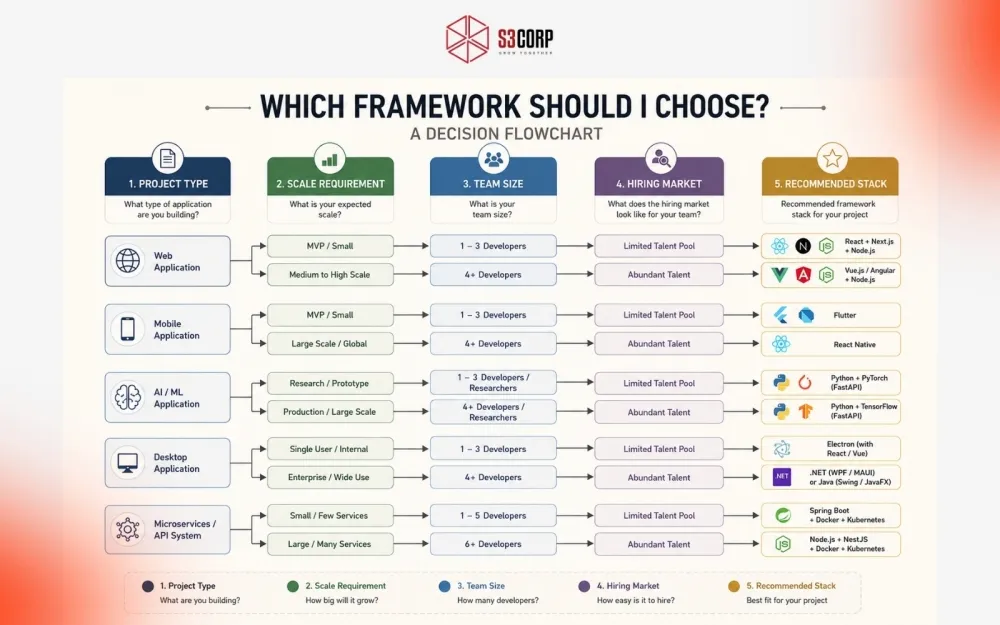 What Are the Risks of Choosing the Wrong Framework?
Wrong framework choices are not immediately visible. They reveal themselves slowly—through developer frustration, growing maintenance tickets, and a hiring funnel that stays empty. Here are the concrete business risks:
Framework lock-in. Some frameworks, particularly older or highly opinionated ones, make it architecturally painful to migrate away. The cost of migrating a 200,000-line codebase from AngularJS (not Angular 2+) to React was estimated at six to eighteen months of engineering work for most mid-sized teams.
Scalability ceiling. Frameworks designed for simplicity often hit performance walls at scale. PHP-based frameworks without proper architecture struggle at high-traffic volumes without significant infrastructure investment.
Hiring pipeline failure. A company that bets its product stack on an exotic framework cannot hire fast when it needs to scale. Growth stalls not because of lack of product-market fit, but because of a talent bottleneck.
Security debt. Frameworks with declining community activity receive fewer security updates. Enterprise software left on End-of-Life framework versions becomes a compliance risk, particularly in regulated industries like fintech and healthcare.
Framework popularity directly impacts hiring cost and speed in outsourcing engagements. Choosing widely adopted frameworks like React or Node.js reduces hiring friction because the available talent pool is larger, more price-competitive, and more immediately deployable.
Less popular frameworks require sourcing specialists—which takes longer, costs more, and creates key-person dependency risk. A single developer who is the only team member who knows a niche framework becomes a single point of failure.
S3Corp helps clients reduce hiring time by providing pre-vetted developers across the most in-demand modern frameworks. The offshore delivery model is built around frameworks with proven global talent depth—so your project does not wait while recruiters search for someone who knows a specific niche stack.
Frameworks are not always the right answer. There are specific scenarios where the overhead of a framework creates more problems than it solves.
Avoid frameworks for:
The principle is straightforward: use a framework when you are building something that will grow, be maintained, and be worked on by a team. Skip the framework when you are writing a one-time script, a quick prototype, or a performance-critical micro-component.
Over 19 years of software delivery across North America, the United Kingdom, Singapore, and Asia-Pacific markets, the engineering teams at S3Corp have developed a repeatable, evidence-based process for framework selection and implementation.
The S3Corp framework evaluation process:
Industries served and framework expertise:
Full-Lifecycle Application Development by S3Corp supports clients from architecture selection through to production deployment and ongoing maintenance.
The most important insight from this guide is simple: framework strategy is business strategy. Your choices determine how fast you ship, how much you spend on talent, and how gracefully your system scales.
The 2026 framework strategy in three principles:
The risk of paralysis is real. Teams that endlessly debate frameworks delay shipping products that could be learning from real users. Make the decision with the best available information, build in a way that does not lock you into a single architecture forever, and evolve as you learn.
S3Corp has guided hundreds of product teams through exactly this decision process. With experience spanning 19+ years, serving clients across North America, the UK, Singapore, and global markets, the team brings both the technical depth and the business context that pure engineering firms often lack.
The right framework can reduce your development cost by 30–40% and cut time-to-market by months. The wrong one creates technical debt that compounds every quarter.
Talk to S3Corp's engineering team. With over 19 years of experience delivering software across fintech, e-commerce, healthcare, and SaaS, the team evaluates your product requirements and recommends the optimal stack—backed by real delivery data from hundreds of projects. Contact S3Corp to schedule a free architecture consultation.
React is the most in-demand frontend framework globally in 2026, consistently topping developer surveys and job listing analyses. For backend, Node.js and Spring Boot share the top positions. Flutter leads the mobile category. These frameworks dominate hiring pipelines in the United States, United Kingdom, Singapore, and offshore markets like Vietnam.
For startups prioritizing speed-to-market, the MERN stack (MongoDB, Express, React, Node.js) or Next.js with a managed database (Supabase, PlanetScale) are the most practical choices. They use a single language (JavaScript/TypeScript) across the full stack, which simplifies hiring and reduces context switching. If your product has a strong AI component, add Django or FastAPI (Python) for your data layer.
Spring Boot scales best for complex enterprise workloads with high transaction volumes and strict data consistency requirements. For real-time, event-driven systems at scale (chat, notifications, streaming), Node.js with an appropriate message queue (Kafka, RabbitMQ) performs exceptionally well. The right answer depends on your specific load profile, not a universal ranking.
Yes. React is not only still relevant—it is more entrenched than ever. The React ecosystem, including Next.js, React Native (for mobile), and a vast library ecosystem, means that investment in React skills and architecture compounds over time. Meta and Vercel continue to invest heavily in the React/Next.js roadmap. Server Components and the React 19 release cycle have addressed long-standing performance criticisms.
Choose Angular when you are building a large, multi-developer enterprise application where enforced structure, built-in TypeScript, and strong opinion on architecture reduce coordination costs. Angular's opinionated nature is a feature at scale, not a constraint. Choose Vue when you have a smaller team, shorter delivery timeline, or a codebase where onboarding speed matters more than architectural rigidity. Vue's progressive adoption model also makes it easier to introduce into an existing project incrementally—which Angular does not support as cleanly.