Whether you have any questions, or wish to get a quote for your project, or require further information about what we can offer you, please do not hesitate to contact us.
Contact us Need a reliable software development partner?
S3Corp. offers comprehensive software development outsourcing services ranging from software development to software verification and maintenance for a wide variety of industries and technologies





Software Development Center
_1746790956049.webp&w=384&q=75)
_1746790970871.webp&w=384&q=75)




Insights
Table Of Content
Quick Comparison Table: Top Offshore Development Countries 2026
What Offshore Software Development Rates Actually Look Like in 2026
Talent Pool Size and Communication Fit, by Region
The AI Factor: Why 2026 Rate Cards Need a Second Look
Best Offshore Software Development Countries: Regional Breakdown
Regional Comparison: Asia vs Eastern Europe vs Latin America
Offshore Development Rates Comparison by Cost Tier
Best Country Based on Project Type
How to Choose an Offshore Development Country
Final Recommendation: Choose Offshore Development Country by Your Priorities
Conclusion
Frequently Asked Questions
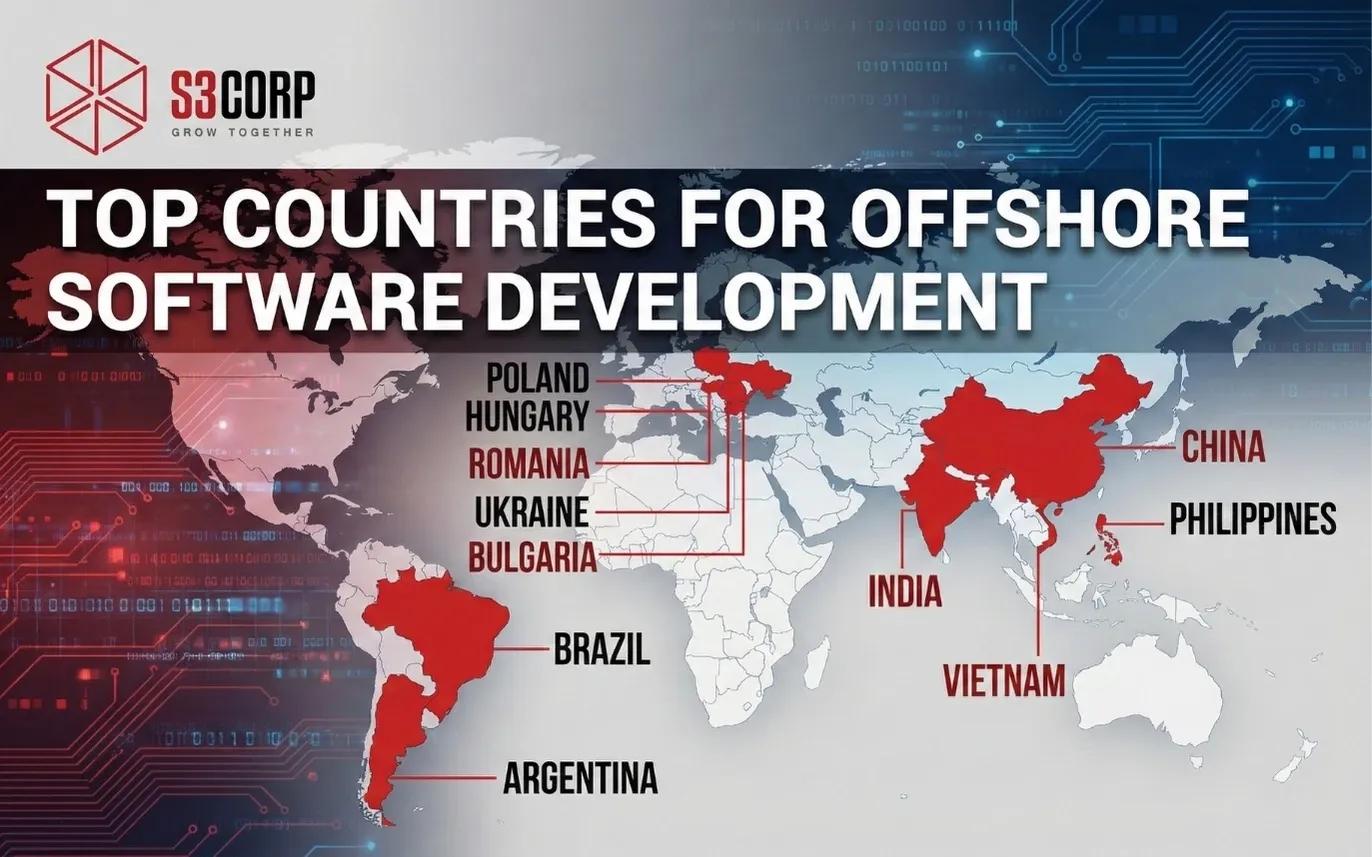
A practical comparison of the 11 best offshore software development countries, covering rates, talent availability, English proficiency, and regional advantages to help you choose your development partner.
25 Mar 2021
Every engineering budget conversation in 2026 eventually lands on the same question: what does an offshore developer actually cost, and where do you get the best return on that cost? Here is the direct answer. Offshore hourly rates in 2026 run from roughly $18 an hour in South and Southeast Asia to $70 an hour for senior specialists in Eastern Europe, with Vietnam, the Philippines, and India sitting at the lower end and Poland, Ukraine, and Hungary at the upper end. That range alone will not tell you which country fits your project, though. The country you pick shapes your timezone overlap, your compliance posture, and how fast your roadmap actually ships. This guide breaks down real rate data across 11 destinations, explains why 2026 pricing looks different than it did two years ago because of AI-assisted engineering, and gives you a framework for choosing a partner instead of just a price tag.
|
Country |
Hourly Rate (USD) |
Talent Pool Size |
English Level |
Time Zone (vs. US EST) |
Core Strengths |
|
India |
$18-40 |
5M+ developers |
Moderate-High |
+10.5 hours |
Enterprise, fintech, large teams |
|
China |
$20-45 |
7M+ developers |
Moderate |
+12-13 hours |
AI, hardware integration, manufacturing tech |
|
Philippines |
$18-35 |
200K+ developers |
High |
+12-13 hours |
US cultural fit, customer-facing apps |
|
Vietnam |
$18-40 |
500K+ developers |
Moderate-High |
+12 hours |
Mobile, e-commerce, fintech |
|
Poland |
$35-70 |
430K+ developers |
High |
+6 hours |
Enterprise systems, banking |
|
Romania |
$30-60 |
180K+ developers |
High |
+7 hours |
Cybersecurity, cloud infrastructure |
|
Ukraine |
$30-65 |
285K+ developers |
High |
+7 hours |
AI/ML, blockchain, gaming |
|
Hungary |
$35-65 |
120K+ developers |
High |
+6 hours |
Automotive software, IoT |
|
Bulgaria |
$28-55 |
90K+ developers |
High |
+7 hours |
Gaming, SaaS platforms |
|
Argentina |
$30-60 |
140K+ developers |
High |
+1-2 hours |
Nearshore for US, agile teams |
|
Brazil |
$25-55 |
500K+ developers |
Moderate-High |
+1-3 hours |
Fintech, large-scale systems |
A rate card is a starting point, not a budget. Three variables move the number more than country selection alone does.
Seniority spread within a country is wider than the spread between countries. A junior developer in Vietnam and a senior architect in Vietnam can be $30- $40 an hour apart from each other — a bigger swing than the gap between Vietnam's average rate and the Philippines' average rate. When you compare offshore developer rates by country, always ask for a breakdown by seniority level, not a single blended number.
Specialization pushes rates up regardless of geography. AI/ML engineering, DevSecOps, and platform engineering command a premium in every country on this list, because demand for those skills has outpaced supply everywhere at once. Analysts at CB Insights tracked a record $469 billion in global venture funding in 2025, with AI companies alone pulling in $226 billion — 48% of the total, the largest share on record. Coding AI agents and copilots were among the single most active investment categories for the top-performing venture funds that year. Capital moving at that pace into AI-native software means the engineers who can build with those tools are getting scarcer and more expensive, no matter which country they sit in.
Engagement model changes the effective rate. A dedicated development team, a project-based contract, and staff augmentation all price differently even at the same nominal hourly rate, because they carry different overhead, ramp-up, and management cost. If your team is choosing between models, it is worth reviewing Collaboration Models before locking in a rate card, since the wrong model can erase a favorable hourly rate within a quarter.
Cost is only half the equation. The other half is whether the team you hire can actually work the way your organization works — which comes down to talent depth and communication fit.
|
Region |
Talent Pool Depth |
English Proficiency |
|
Asia (India, Vietnam, Philippines, China) |
Largest global pool; India alone counted over 5 million new GitHub developer sign-ups in a single year |
Moderate to high, strongest in the Philippines and among younger developers in Vietnam |
|
Eastern Europe (Poland, Romania, Ukraine, Hungary, Bulgaria) |
Smaller but senior-weighted, strong computer science education base |
High across the region |
|
Latin America (Argentina, Brazil) |
Mid-sized, growing fast, real-time overlap with US business hours |
High in Argentina, moderate to high in Brazil |
The scale of Asia's talent pool is not a marketing claim — it shows up in the platform data. According to GitHub Octoverse 2025, the platform crossed 180 million developers worldwide after adding more than 36 million new developers in a single year, the fastest absolute growth rate in the history of the platform. India alone added over 5 million of those developers, accounting for 14% of every new sign-up globally, and is on track to represent one in three new developers on GitHub by 2030. That kind of supply growth is one reason Asian offshore software development countries can sustain large teams without the rate inflation seen in smaller markets.
Compensation data tells the other half of the story. The Stack Overflow Developer Survey 2025, which polled more than 49,000 developers across 177 countries, found that the median salary for an engineering manager sits at $200,000 in the United States, compared with $118,000 in Germany and $52,000 in India — a gap that explains why offshore developer rates by country vary as widely as they do, and why the cost advantage of the right destination compounds fast once you scale a team past five or six engineers.
Here is the part most comparison guides miss. In 2026, the hourly rate tells you less about total delivery speed than it did even a year ago, because AI-assisted engineering has changed what "productive" looks like — and not every offshore team has caught up equally.
The 2025 DORA Report from Google Cloud, based on survey responses from nearly 5,000 technology professionals worldwide, found that AI adoption among developers reached 90% this year, up 14 points from 2024, with the typical developer now spending a median of two hours a day working directly with AI tools. For the first time since DORA began tracking this, AI adoption showed a positive relationship with software delivery throughput — teams are genuinely shipping faster. But the same research found AI adoption still correlates with delivery instability in teams that lack strong engineering practices underneath it. In other words, AI does not fix a weak team. It amplifies whatever is already there, for better or worse.
GitLab's 2025 Global DevSecOps Report, surveying 3,266 DevSecOps professionals, found a similar pattern: 97% of respondents are using or planning to use AI in the software development lifecycle, and 82% now deploy to production at least weekly. Yet the same organizations report losing close to a full workday per engineer, per week, to tool sprawl and process friction — 60% of teams use more than five separate tools just for development, and 49% use more than five AI tools on top of that. The report also found that 76% of respondents believe coding getting easier through AI will mean more engineering roles, not fewer, since faster code generation shifts human attention toward architecture, review, and system design rather than eliminating the need for it.
The practical takeaway for anyone comparing offshore developer rates by country: ask a prospective partner how AI tooling is standardized across their engineering process, not just whether individual developers happen to use Copilot or similar tools. A team with mature platform engineering and AI governance will out-deliver a cheaper team using AI in an ad hoc way, even at a higher blended hourly rate. This is also where offshore development center models earn their premium — a structured, governed engineering environment converts AI adoption into throughput instead of instability.
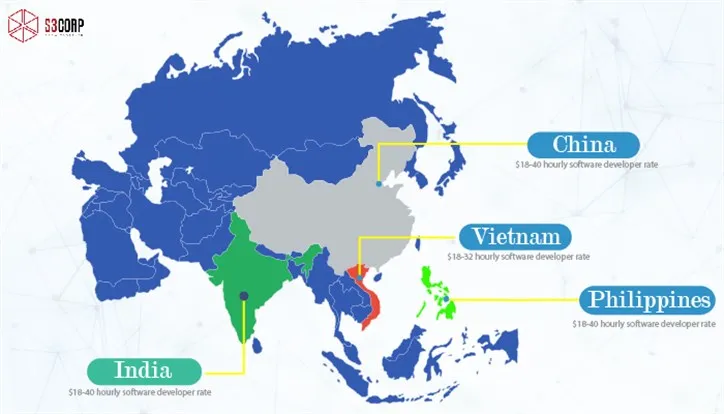
Hourly Rates: $18-40
Talent Pool: Over 5 million software developers
English Level: Moderate to High (strong in tech communication)
Key Strengths: India dominates when you need large development teams fast. The country graduates 1.5 million engineering students annually, creating a massive pipeline of developers across all experience levels. Indian developers excel in enterprise software, financial technology, and complex backend systems. Cities like Bangalore, Hyderabad, and Pune host thousands of software companies, from startups to global tech giants.
The offshore developer rates by country comparison shows India offers exceptional value for enterprise-grade projects. You can assemble a 20-person team within weeks, something difficult in smaller markets. Indian developers bring experience with modern frameworks, cloud platforms, and agile methodologies.
Best For: Enterprise applications, large team requirements, long-term partnerships, and projects needing deep expertise in Java, Python, and cloud technologies.
Hourly Rates: $20-45
Talent Pool: Over 7 million developers
English Level: Moderate (improving rapidly in tech hubs)
Key Strengths: China leads in artificial intelligence, hardware-software integration, and manufacturing technology. Developers in Shenzhen, Beijing, and Shanghai work at the intersection of software and hardware, making them ideal for IoT projects, robotics, and consumer electronics.
Chinese developers show strong mathematical and algorithmic skills, particularly in machine learning and computer vision. The country invests heavily in technical education, producing graduates skilled in cutting-edge technologies. However, communication can require more structured documentation and clear specifications.
Best For: AI/ML projects, hardware integration, manufacturing software, and products targeting Asian markets.
Hourly Rates: $18-35
Talent Pool: Over 200,000 developers
English Level: High (American English proficiency)
Key Strengths: Filipino developers offer the best cultural fit for US companies among top IT outsourcing hubs in Asia. The country uses American English, celebrates similar holidays, and understands Western business practices deeply. This cultural alignment reduces friction in daily collaboration.
The Philippines excels in customer-facing applications, mobile development, and projects requiring strong communication with end users. Developers often have experience in BPO (business process outsourcing), giving them insight into business operations alongside technical skills.
Best For: Customer-facing applications, mobile apps, e-commerce platforms, and teams requiring frequent verbal communication.
Hourly Rates: $18-40
Talent Pool: Over 500,000 developers
English Level: Moderate to High (strongest among younger developers)
Key Strengths: Vietnam combines competitive pricing with rapidly improving technical capabilities. The country has become a software outsourcing powerhouse, with developers skilled in mobile development, web applications, and fintech solutions. Cities like Ho Chi Minh City and Hanoi host thriving tech communities with strong startup ecosystems.
Vietnamese developers demonstrate strong work ethic, loyalty to long-term partnerships, and quick adaptation to new technologies. The government actively supports the tech sector through education programs and infrastructure investments. Offshore outsourcing 2026 trends show Vietnam gaining market share from more established locations.
Best For: Mobile applications, e-commerce platforms, fintech solutions, and companies seeking stable long-term partnerships.
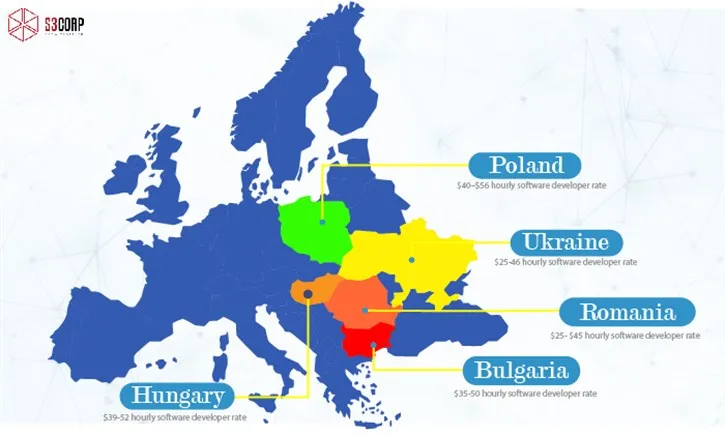
Hourly Rates: $35-70
Talent Pool: Over 430,000 developers
English Level: High
Key Strengths: Poland stands out in Eastern Europe for enterprise software development and banking systems. Polish developers bring strong computer science fundamentals, with many holding advanced degrees. The country hosts major R&D centers for global technology companies, indicating high developer quality.
Warsaw, Krakow, and Wroclaw offer sophisticated tech talent familiar with complex regulatory requirements, making them ideal for financial services and healthcare projects. Polish teams excel in creating maintainable, well-documented code for long-lived systems.
Best For: Enterprise systems, banking and financial services, healthcare applications, and projects requiring EU data compliance.
Hourly Rates: $30-60
Talent Pool: Over 180,000 developers
English Level: High
Key Strengths: Romania specializes in cybersecurity and cloud infrastructure development. Bucharest and Cluj-Napoca host vibrant tech scenes with developers skilled in modern DevOps practices, security protocols, and distributed systems architecture.
Romanian developers often have backgrounds in mathematics and cryptography, making them strong in security-critical applications. The best region for software outsourcing in Eastern Europe includes Romania for projects demanding high security standards.
Best For: Cybersecurity solutions, cloud infrastructure, SaaS platforms, and security-sensitive applications.
Hourly Rates: $30-65
Talent Pool: Over 285,000 developers (pre-conflict estimates)
English Level: High
Key Strengths: Ukrainian developers have earned a reputation for innovation in blockchain, AI/ML, and gaming. Despite ongoing challenges, the tech sector remains active, with many developers working remotely from safe locations or abroad.
Ukraine produces developers with strong algorithmic thinking and creative problem-solving abilities. The country has a deep pool of senior developers and technical leads experienced in complex projects.
Best For: Blockchain projects, AI/ML applications, gaming development, and companies comfortable with distributed remote teams.
Hourly Rates: $35-65
Talent Pool: Over 120,000 developers
English Level: High
Key Strengths: Hungary specializes in automotive software and IoT development. Budapest hosts numerous automotive R&D centers, creating developers experienced in embedded systems, real-time processing, and hardware-software integration.
Hungarian developers combine strong engineering education with practical experience in manufacturing and industrial applications. The country offers excellent intellectual property protection and EU regulatory compliance.
Best For: Automotive software, IoT solutions, embedded systems, and industrial automation.
Hourly Rates: $28-55
Talent Pool: Over 90,000 developers
English Level: High
Key Strengths: Bulgaria has become a hub for gaming development and SaaS platforms. Sofia hosts numerous game studios and product companies, creating developers skilled in graphics programming, real-time systems, and user experience.
Bulgarian developers offer lower rates than Western European countries while maintaining high quality. The offshore software development cost comparison shows Bulgaria providing excellent value in Eastern Europe.
Best For: Gaming development, SaaS products, graphics-intensive applications, and startups watching budgets.
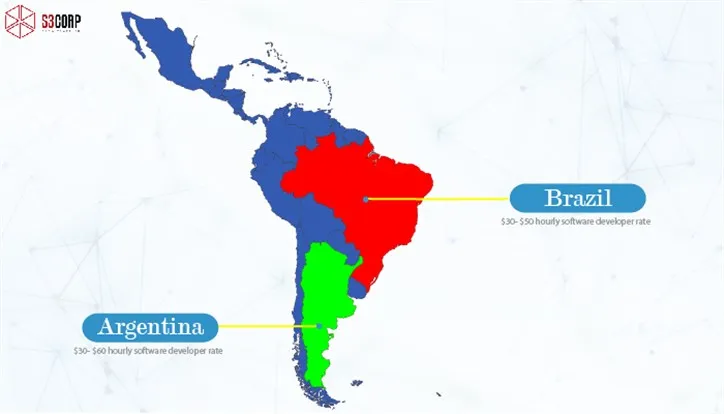
Hourly Rates: $30-60
Talent Pool: Over 140,000 developers
English Level: High
Key Strengths: Argentina offers nearshore advantages for North American companies. Buenos Aires developers work in time zones overlapping with US business hours, enabling real-time collaboration impossible with Asian teams.
Argentine developers embrace agile methodologies and show strong cultural alignment with US business practices. The country produces creative problem solvers comfortable with ambiguity and iteration.
Best For: Nearshore projects for US companies, agile development teams, and projects requiring real-time collaboration.
Hourly Rates: $25-55
Talent Pool: Over 500,000 developers
English Level: Moderate to High (improving in tech sector)
Key Strengths: Brazil has Latin America's largest developer community, offering scale comparable to India at nearshore time zones. São Paulo and Florianópolis host mature tech ecosystems with experience serving global clients.
Brazilian developers excel in fintech, having built solutions for the country's advanced digital banking sector. They bring experience with high-transaction systems and payment processing.
Best For: Large-scale systems, fintech applications, nearshore teams for Americas, and projects requiring significant team sizes.
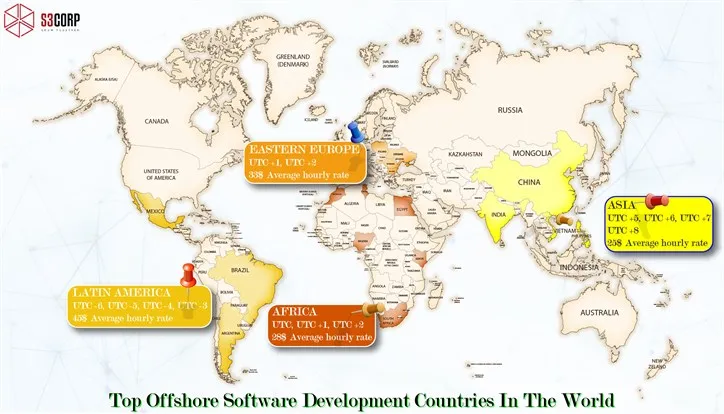
Different regions offer distinct advantages when comparing offshore software development countries.
|
Region |
Cost Range |
Time Zone (US) |
Key Strengths |
Key Challenges |
|
Asia |
$18-45/hour |
+10-13 hours |
Largest talent pools, lowest costs, strong technical skills, massive scaling capability |
Limited time overlap, cultural differences, communication requires more documentation |
|
Eastern Europe |
$28-70/hour |
+6-7 hours |
High English proficiency, strong computer science education, EU compliance, excellent for enterprise |
Higher costs, smaller talent pools, limited availability of junior developers |
|
Latin America |
$25-60/hour |
+1-3 hours |
Real-time collaboration, cultural fit with US, nearshore benefits, agile methodology adoption |
Smaller talent pools than Asia, mid-range pricing, fewer developers in cutting-edge specializations |
When Asia wins: Projects prioritizing cost efficiency, needing large teams, or following asynchronous workflows. Asia offshore development talent pool sizes enable rapid scaling.
When Eastern Europe wins: Enterprise projects requiring high compliance standards, sophisticated architecture, or EU market focus. Eastern European developers excel in complex, long-lived systems.
When Latin America wins: US companies needing daily collaboration, startups requiring agile flexibility, or projects where real-time communication drives success.
Read More: Offshore Development Center Model Explained
Understanding rate tiers helps budget planning.
Low-Cost Range ($18-30/hour):
This tier works for straightforward projects, MVP development, or when maximizing team size matters more than individual seniority.
Mid-Range ($30-50/hour):
This tier balances experience with cost effectiveness. You get senior developers from Asian countries or mid-level talent from Eastern Europe and Latin America.
High-End ($50-70/hour):
This tier delivers architects, technical leads, and specialists in cutting-edge technologies. Still significantly below US rates ($100-200/hour) while maintaining exceptional quality.
Matching countries to project types improves outcomes.
Best for Enterprise Systems: Poland and India lead for complex enterprise applications. Polish developers bring EU compliance expertise and architectural sophistication. Indian teams offer scale and experience with global enterprise platforms.
Best for Cost-Efficient Development: Vietnam, Philippines, and Bulgaria deliver strong quality at competitive rates. These countries offer the best offshore software development cost comparison results for budget-conscious projects without sacrificing reliability.
Best for AI and Emerging Tech: China, Ukraine, and India excel in artificial intelligence and machine learning. China leads in computer vision and hardware-AI integration. Ukraine specializes in innovative algorithms and blockchain. India offers large teams for AI implementation at scale.
Best for US Time Zone Alignment: Argentina and Brazil provide nearshore advantages with real-time collaboration potential. These Latin America nearshore software development locations eliminate the overnight wait for responses that Asian partnerships create.
Best for Rapid Team Scaling: India, Vietnam, and Brazil offer the talent pool depth needed to grow from five developers to fifty quickly. Their large developer populations prevent quality drops during rapid expansion.
Rate comparisons only work once you have weighed them against your actual constraints. Run through this checklist before committing to a country or a partner:
Read More: Offshore Software Development Collaboration: Proven Strategies for Seamless Teamwork
No single country wins every category when you compare offshore development rates and capabilities.
Choose Asia when: Cost efficiency drives decisions, you need large teams, your project follows clear specifications, or asynchronous communication works for your workflow. India suits enterprise scale. Vietnam balances cost and quality. Philippines offers cultural fit. China excels in AI and hardware integration.
Choose Eastern Europe when: Project complexity demands sophisticated architecture, EU compliance matters, you need high English proficiency, or moderate time zone differences help collaboration. Poland leads in enterprise systems. Ukraine innovates in emerging tech. Romania specializes in security. Hungary excels in automotive and IoT.
Choose Latin America when: Real-time collaboration drives success, you need nearshore advantages, agile methodology flexibility matters, or your team culture values direct communication. Argentina offers best time zone overlap for US companies. Brazil provides scale with nearshore benefits.
Vietnam offers balanced value for companies seeking competitive offshore software development countries with strong technical capabilities, reasonable rates, and stable partnerships. The country combines Asia's cost advantages with growing expertise in modern technologies, making it strong for mobile development, e-commerce, and fintech projects.
The best offshore development destinations for 2026 depends on weighting these factors according to your specific situation. Most successful companies eventually partner with multiple countries, using each for its strengths. Start with one location matching your primary need, then expand strategically as you learn what works for your projects.
This article provided information on the best offshore software development hubs around the globe.
These countries are all worth your consideration. Some countries offer lower rates while others provide better quality. Hence, to figuring out the software vendor that you can partner with and establish a long-term working relationship, you should take time to do some more researches and discuss with your business team to choose the best one.
Here are some aspects that you might need to consider: your needs and requirements, the locations, language proficiency, development rates, technical capabilities, quality of education, culture. And so on.
In our experience, by limiting your research destinations, you will get more chances to find out the best offshore software outsourcing countries for your business needs. The following countries might be valid options for your software development needs: China, Ukraine, Poland, India, and Vietnam.
As a trusted Vietnam software outsourcing partner, our motto at S3Corp. is 'grow together. We believe that IT outsourcing is about sharing common goals and strive for success. Together we can help your business grow with the help of the latest technology and a professional team. Reach out with any questions relating to the topic or your software project.

What are the best offshore destinations for building a dedicated software engineering team in 2026? It depends on the priority. Vietnam and the Philippines offer strong value for dedicated teams focused on mobile, e-commerce, and fintech work. Poland and Ukraine suit teams that need deep enterprise or security expertise. Argentina and Brazil work best when daily, real-time collaboration with a US-based product team is the priority.
Are offshore software development rates increasing in 2026? Yes, gradually. Rates in established destinations like India and Vietnam have risen year over year as demand grows, and Eastern European rates have climbed further given the region's senior-talent concentration. Even with these increases, offshore rates remain well below the roughly $64-an-hour full-time-equivalent cost implied by the U.S. median software developer salary.
Which countries have the best offshore talent for e-commerce and retail brands? Vietnam and the Philippines have strong track records in e-commerce platform work, supported by large volumes of mobile and web development experience. Brazil offers similar strength for Latin America-focused retail brands needing nearshore delivery.
How do I choose the best offshore software development company, not just the cheapest one? Look past the hourly rate to three things: demonstrated experience in your specific industry, a clear QA and delivery process rather than an ad hoc one, and — increasingly in 2026 — how AI tooling is governed across their engineering process rather than left to individual developers.
Which region offers the strongest IP protection for offshore development? Eastern European countries within the EU, including Poland, Romania, and Hungary, offer the strongest regulatory framework for intellectual property protection. Regardless of country, always secure explicit IP assignment and code ownership terms in the contract itself rather than relying on the destination's legal framework alone.
What's the difference between offshore, nearshore, and onshore software development? Offshore means contracting a team in a distant country and time zone, typically for the strongest cost advantage. Nearshore means a neighboring country with closer time zone overlap. Onshore means contracting within your own country, which removes language and time zone friction but carries the highest cost.