Whether you have any questions, or wish to get a quote for your project, or require further information about what we can offer you, please do not hesitate to contact us.
Contact us Need a reliable software development partner?
S3Corp. offers comprehensive software development outsourcing services ranging from software development to software verification and maintenance for a wide variety of industries and technologies





Software Development Center





Insights
Table Of Content
Key Takeaways (TL;DR)
What are the key answers on RegTech compliance automation at a glance?
What is RegTech compliance automation, and how does it differ from related technology categories?
Which compliance tasks can you automate, and where must a person make the decision?
What are the main types of RegTech automation, and how is the vendor landscape organized?
How does a compliance automation stack fit together?
How do you build a compliant fintech app?
How do you roll out compliance automation without creating new risk?
Where should you read next to go deeper on fintech compliance?
Frequently asked questions
Putting it together: what to automate, what to keep human, and where to go next
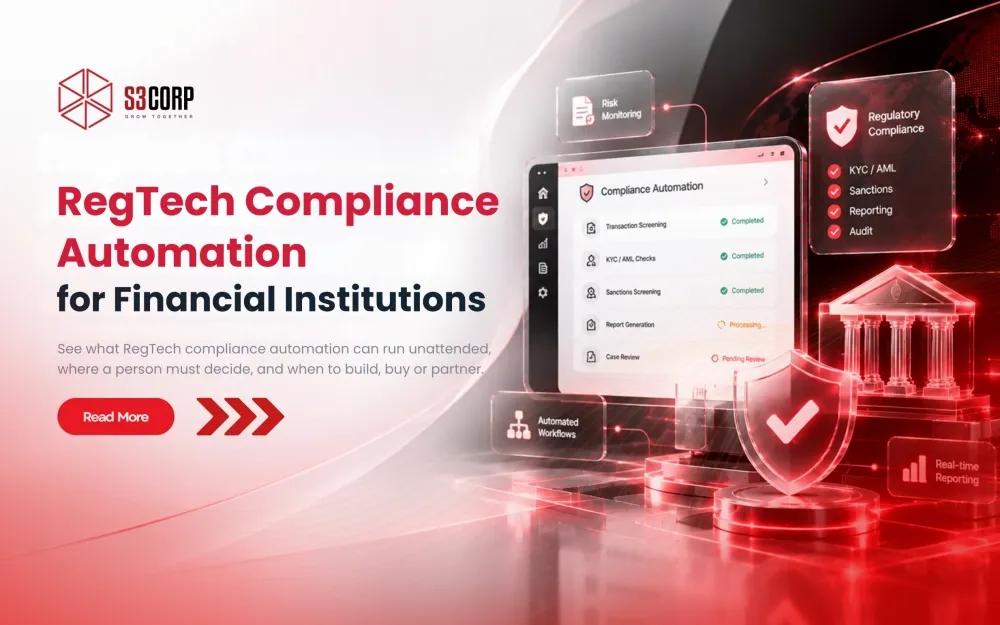
RegTech compliance automation runs repeatable compliance steps in software and leaves judgment calls to named people. This guide shows what to automate, how the stack fits together, and when to build, buy or partner.
30 Oct 2026
RegTech compliance automation is software that runs the repetitive, rules-based parts of financial regulation. These parts include onboarding checks, transaction monitoring, sanctions screening, regulatory reporting and audit evidence. It frees compliance teams for judgment calls and works when you can explain every decision, because regulators hold the institution accountable, not the software.
Building compliance software for a bank, lender or payments product?
Browse delivery examples from S3Corp engineering teams, including data security and approval workflow projects.
A regulator rarely asks how fast your compliance software runs. The question is who approved the rule that flagged a payment, and where the record of that approval sits.
That question shapes every choice you make about RegTech compliance automation. Speed helps, but a decision you cannot explain, reproduce or reverse adds risk instead of removing it.
This guide shows you how to build a program that is audit-ready from day one, with no surprises when an examiner asks for proof. You will learn how to:
S3Corp has spent 19+ years delivering software outsourcing work, across 400+ projects for 250+ clients in 25+ countries. That experience shapes the engineering advice below, and the framework fits in-house and partner teams alike. For the wider product picture, see our guide to fintech software development.
The table below answers the four questions that technical leaders ask first. Later sections explain the reasoning behind each answer.
| Question | Answer |
|---|---|
| What can run unattended? | Data collection, list screening, threshold monitoring, report assembly and evidence logging. |
| What needs a person to decide? | Suspicion determinations, true-match sanctions hits, high-risk customer approval and filing attestation. |
| Should you build, buy or partner? | Buy data that changes fast, and buy verification. Build policy logic and the evidence layer. Partner when engineering capacity limits you. |
| Where do programs fail? | Unclean data, unexplainable models and rules changed without an approval trail. |
RegTech, short for regulatory technology, is software that helps regulated firms meet legal obligations. Compliance automation is the part of RegTech that runs those obligations as repeatable workflows: verify, screen, monitor, report and log. RegTech complements supervisory technology (SupTech), the tools that regulators use to supervise firms.
| Term | Who uses it | What it does |
|---|---|---|
| Financial technology (FinTech) | Financial firms and their customers | Delivers products such as payments, lending and banking through software |
| Regulatory technology (RegTech) | Regulated firms | Helps firms meet legal obligations through verification, monitoring, reporting and logging |
| Supervisory technology (SupTech) | Regulators and supervisors | Helps supervisors collect, analyze and act on data from firms |
| Governance, risk and compliance (GRC) platform | Risk, compliance and audit teams | Tracks policies, risks and controls in one workspace |
Three forces push firms toward automation:
Estimates differ by method, so read the range and the direction, not one number. Fortune Business Insights values the global RegTech market at USD 19.06 billion in 2025 and projects USD 105.23 billion by 2034. IMARC Group estimates USD 18.6 billion in 2025 and USD 77.0 billion by 2034.
Automate work that is repetitive, rules-based and verifiable: data collection, list screening, threshold monitoring, report assembly and evidence logging. Keep a named person accountable wherever the regulation asks for judgment. Examples include deciding that activity is suspicious, clearing a sanctions match, approving a high-risk customer and attesting a filing.
The two tables below show the boundary for seven common obligations. Read them as one matrix split into two views.
| Obligation | Automate fully | Automate with human sign-off |
|---|---|---|
| Anti-money laundering (AML) transaction monitoring and suspicious activity report (SAR) or suspicious transaction report (STR) filing | Rule and threshold screening, alert de-duplication, case data assembly | Machine learning alert scoring, drafted narratives |
| Sanctions screening and politically exposed person (PEP) screening | Re-screening on list updates, match scoring, auto-closing of low-score hits under documented thresholds | Threshold approval and periodic quality assurance (QA) sampling of auto-closed hits |
| Know your customer (KYC) and know your business (KYB) onboarding and ongoing due diligence | Document capture, liveness checks, registry lookups, scheduled periodic reviews, event-driven refreshes (often called perpetual KYC) | Tiered risk scoring, low-risk approvals, low-risk refresh outcomes |
| Regulatory reporting | Data extraction, validation, formatting, scheduling | Report review |
| Card-data security under the Payment Card Industry Data Security Standard (PCI DSS) | Scope and asset discovery, configuration and vulnerability scans, log collection | Evidence packages for the assessor |
| Policy attestations and third-party information and communications technology (ICT) risk | Attestation scheduling, certificate-expiry tracking, questionnaire routing | Vendor risk scoring |
| Regulatory change management | Monitoring publications, tagging by jurisdiction and topic | Draft mapping to internal controls |
| Obligation | Keep human | Evidence to log |
|---|---|---|
| AML transaction monitoring and SAR or STR filing | Suspicion determination, filing decision | Rule or model version, alert rationale, analyst decision, filing timestamp |
| Sanctions screening and PEP screening | True-match disposition on high scores, freeze or block decisions | List source and version, match score, disposition, approver, QA sample results |
| KYC and KYB onboarding and ongoing due diligence | Enhanced due diligence, beneficial ownership exceptions, high-risk approvals | Checks run, data sources, score inputs, refresh trigger, approver |
| Regulatory reporting | Management attestation, restatement decisions | Data lineage, reconciliations, version history, submission receipts |
| Card-data security | Compensating-control approval, attestation | Scan results, change records, access reviews |
| Policy attestations and third-party ICT risk | Risk acceptance, vendor exit decisions | Policy versions, completion records, vendor due-diligence file |
| Regulatory change management | Legal interpretation, impact decisions | Change log linking source text, control, rule version and release |
Thresholds and filing rules differ by jurisdiction, so link every rule in your engine to the primary regulator text. These three examples show how regional rules change system design.
| Region | Example obligation | Design impact |
|---|---|---|
| United States (US) | The SAR filing instructions from the Financial Crimes Enforcement Network (FinCEN) set a 30 calendar day deadline from initial detection of facts, or up to 60 days if you have not identified a suspect. | Timestamp every alert, review and filing decision so you can prove the clock. |
| European Union (EU) | The Digital Operational Resilience Act (DORA) applies from 17 January 2025 and requires a register of ICT third-party arrangements. | Store vendor records in the evidence layer and keep them current. |
| Singapore | The Monetary Authority of Singapore (MAS) issued final AI risk management guidelines on 7 October 2026, which phase in from October 2027. | Inventory every model and rate its risk materiality. |
If a rule has no owner, no version and no source link, it does not belong in production.
RegTech tools fall into five functional areas. The Deloitte RegTech Universe 2024 uses the same taxonomy: regulatory reporting, risk management, identity management and control, compliance, and transaction monitoring. Vendors then fall into four delivery types, and matching function to delivery type turns a long vendor list into a short list.
That edition lists 531 companies, so any vendor list dates fast. Innovative solutions appear every quarter in identity verification and alert scoring, so judge each one by its audit trail, not its feature list.
These tools extract, validate and format data for supervisors, then store submission receipts. Data lineage matters more than the report template.
These tools verify people and businesses, query registries and score onboarding risk. Pair them with a decision log so every approval has an owner. Read more in our guide to KYC and AML solutions for fintech.
These tools score payments against rules and models, then route alerts to analysts. Alert quality matters more than alert volume. Our article on AI fraud detection in financial services covers the scoring side.
These tools track operational, third-party and model risk, and many sit inside GRC platforms. Third-party ICT risk now falls under rules such as DORA in the EU.
These tools manage policies, attestations and regulatory change, and they link each control to its source text. Card-data evidence belongs here too.
RegTech-as-a-Service cuts across the first three delivery types in the table below. It gives you a fast start, but you get less control over rule logic and data residency.
| Delivery type | Best when | Watch-out |
|---|---|---|
| Point solution | You need one function fast, such as identity checks | Integration effort grows with each added tool |
| Platform suite | You want one contract and one data model | Switching cost rises over time |
| Data provider | You need sanctions lists, registries or adverse media | You must verify source, version and update speed |
| Custom-built system | Your policy logic differs from the market | You own upkeep, testing and evidence |
A compliance automation stack has six layers. They are source data, a rules engine, monitoring and screening, case management, regulatory reporting and an evidence store that logs every decision. Regulatory change enters at the rules layer and must reach production with an approval trail.
If that path is manual, the stack drifts out of date.
Three seams cause most failures: data lineage, rule versioning and evidence capture. If your core systems cannot expose data through application programming interfaces (APIs), plan legacy system modernization before you connect a rules engine.
Three engineering choices keep the audit trail trustworthy:
Follow five steps, in this order:
A regulation change is a release, not a settings edit.
A decision log is the record an examiner reads first. Use the sample below as a starting point for one alert or one rule change, and adapt the fields to your obligations.
| Field | Purpose |
|---|---|
| Record identifier and timestamp | Identify the event and prove when it happened |
| Subject | Link to the alert, customer or rule change |
| Rule or model version | Show which logic produced the output |
| Input reference | Point to the data and lineage used |
| System output | Store the score, flag or draft produced |
| Maker and checker | Name the person who proposed and the person who approved |
| Decision and reason | Record the outcome in plain language |
| Evidence links | Attach documents, test results and source text |
Build compliance into the first sprint, not the week before launch. Scope the rules that apply, design audit logging into the architecture and test rules like code. Retrofitting controls after an examiner asks for proof costs more and holds up worse.
Buy what changes fast, build what reflects your risk appetite, and partner when delivery capacity is the constraint. This strategic approach helps you optimize cost and performance without losing control of your rules.
| Choice | What it fits | Guardrail |
|---|---|---|
| Buy | Identity verification, sanctions data, registries that change fast | Log the vendor, version and fallback for every call |
| Build | Policy logic, case workflows, the evidence layer | Keep rules versioned and tests automated |
| Partner | Delivery capacity or specialist engineering is the constraint | Require audit-ready documentation and clear intellectual property (IP) terms |
Short on engineering capacity for your compliance build?
Compare the collaboration models that let a dedicated team join your delivery without owning your risk decisions. If you already know your scope, share your obligation matrix with the team at S3Corp.
Consider a payments firm that enters a second market and keeps its sanctions data vendor, while thresholds and filing rules change. The rules live as versioned code with tests and an owner. The team ships the change as a normal release and attaches the test evidence for the approver.
Start with license type, target markets and data types. Then work through three steps:
A scalable architecture adds jurisdictions as new rule sets, not new code branches. Build these controls in from day one:
Scope decisions made in the first sprint shape audit cost for years. The guide to PCI DSS compliance explains how architecture choices reduce the systems an assessor must review.
Connect each provider through an API, add a fallback, and log every vendor call. Outsourcing a function does not outsource accountability, and DORA states the same principle for EU financial entities.
If you route card payments through a provider, the work overlaps with payment gateway integration. If you embed compliance in a new digital bank, read neobank app development.
A missed alert carries more risk than a noisy one, so test for false negatives first. Use this test set:
If your team needs extra capacity for regression suites, look at fintech testing and QA.
Route every rule or model change through an approval workflow, attach release evidence and keep a rollback path. Pipelines that block a release without approval evidence belong to DevOps services.
For an example of approval workflows in production, read our legal document management case study. In that project, S3Corp automated contract approval workflows on SharePoint for a food and beverage company in Vietnam.
Review your rules on a schedule and keep audit-ready exports for every report. Test evidence retrieval the way you test any other feature, so you answer an examiner with a query, not a scramble.
With an ISO 27001-certified delivery process, S3Corp builds security and IP protection into the engagement from day one. Delivery covers software development, QA and testing, and DevOps, which maps to the phases of testing rules like code and releasing with evidence.
Start with one high-volume workflow and fix its data first. Prove it end to end with a full decision log before you expand. Measure alert quality, time to disposition, filing timeliness and evidence retrieval time.
Treat every rule or model change as a controlled release.
Consider a digital lender that pilots automation on onboarding checks. It cleans customer records first and runs the pilot beside the manual process. It expands only after the decision log answers every sample examiner request.
| Metric | What it tells you | Warning sign |
|---|---|---|
| False-positive rate | Share of alerts that analysts close as not suspicious | The rate rises after a rule change |
| Time to disposition | How fast analysts resolve an alert | Queue age grows each week |
| Filing timeliness | Shows if you meet regulator deadlines | Filings land close to the deadline |
| Evidence retrieval time | How fast you answer an examiner request | Staff rebuild records by hand |
| Rule change lead time | How fast a regulation change reaches production | Changes wait for manual steps |
| Model drift indicators | Whether model outputs still match outcomes | Score patterns shift and no owner notices |
Five failure modes appear again and again. Each one gives an early signal that you can control.
Use AI to triage alerts, summarize cases and draft narratives. Keep a human-in-the-loop for every material decision, with a named approver in the decision log. For wider use cases, read AI in fintech.
Three US banking agencies issued revised model risk management guidance on April 17, 2026. Each agency published its own reference:
The guidance replaces SR 11-7 from 2011 and the 2021 Bank Secrecy Act model statement. It asks banks to scale model risk effort to size and model use, and it sets no enforceable standards.
The guidance is most relevant to banks with over USD 30 billion in total assets. It excludes generative and agentic AI from scope, and the agencies plan a request for information on bank AI use.
These are predictions, not facts. They follow the direction of the rules above.
These pages extend the topics in this guide:
RegTech is the broad category of software that helps regulated firms meet legal obligations, from reporting to identity checks. Compliance automation is the narrower practice of running those obligations as automated workflows with logged decisions. Every compliance automation tool is RegTech, but a regulatory-intelligence library is RegTech without a workflow.
Start with the workflow that is most manual, highest in volume and cleanest in data, usually onboarding checks or alert triage. Rules-based steps give quick, measurable wins and create decision logs from day one. Keep judgment-heavy steps, such as suspicion determinations, under human sign-off until you prove your logging and governance.
Regulators hold the firm accountable for outcomes, whether a person or a model produced them. Use AI to triage alerts and draft narratives, and keep a named person as approver for material decisions. Keep validation, drift monitoring and explainable reasons on file, because you cannot defend a decision you cannot explain.
Most firms buy capabilities that need constant upkeep, such as identity verification and sanctions data. They build the policy logic, case workflows and evidence layer that reflect their own risk appetite. If delivery capacity limits you, partner with an engineering team and require audit-ready documentation and clear IP terms.
Treat regulatory change as a pipeline that monitors official sources, tags changes by jurisdiction and topic, and maps them to internal controls. Then update versioned rules through an approval workflow and release them with test evidence. Keep a change log that links source text to control and rule version, so an examiner sees when and why logic changed.
Scope, data quality and integration depth drive cost more than tooling does. One high-volume workflow on clean data costs the least, while a full stack across several legacy systems costs the most. The number of jurisdictions and the level of AI involvement also move budgets, and our guide to fintech app development cost covers the drivers.
You can now sort any compliance obligation into three groups: run it unattended, run it with sign-off, or keep it a human decision. The stack that carries that boundary needs versioned rules, a decision log and a controlled path for regulatory change.
Take three steps this quarter:
Your build-or-buy choice follows from where your own policy logic differs from the market.
S3Corp brings 19+ years of experience to this work. The tech sector in Vietnam offers a strong cost-to-quality ratio, deep stack proficiency and a young developer talent pool. Teams run Agile sprints across time zones and deliver customized solutions that fit your risk appetite.
Many partner engagements begin with a small dedicated team that owns the rules engine and the evidence store. QA and DevOps engineers join as the stack grows.
Ready to turn your obligation matrix into audit-ready software?
Bring it to a first conversation with the S3Corp team, or see how our engineering teams build fintech software.