Insights
Table Of Content
Key Takeaways
What's Actually Inside a Food Delivery App?
Which Features Go in Your MVP, and Which Wait for Version Two?
Which Business Model Fits Your Food Delivery App?
In-House vs. Outsourced Development: How to Actually Decide
How to Vet an Outsourcing Partner: A Due-Diligence Checklist
What Does a Food Delivery App Cost by Region?
The Development Process, Step by Step
Tech Stack and Infrastructure for a Food Delivery App at Scale
Delivery App Development in Singapore: What's Different
Where This Leaves You
Frequently Asked Questions
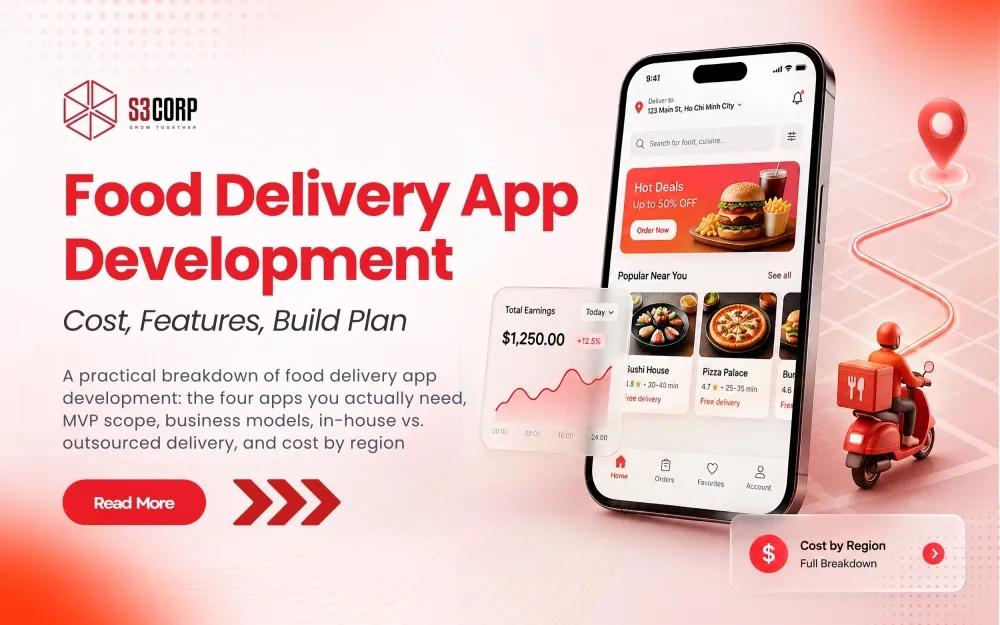
Food Delivery App Development: Cost, Features, Build Plan
A practical breakdown of food delivery app development in 2026: the four apps you actually need, MVP scope, business models, in-house vs. outsourced delivery, and cost by region.
17 Aug 2026
Key Takeaways
- A food delivery platform is four connected applications: a customer app, a restaurant dashboard, a driver app, and an admin panel.
- A basic MVP runs $20,000–$40,000. A mid-range platform runs $50,000–$120,000. A full-scale build competing with Uber Eats runs $150,000–$300,000 or more.
- Hiring in-house takes two to four months before a single feature ships. For most mid-size companies, an outsourced team is the faster and cheaper starting point, not a fallback option.
- Vietnam offers senior engineering talent at roughly a third to half the hourly cost of the United States, with meaningfully lower staff turnover than several other outsourcing regions.
- Dispatch logic, ETA prediction, and order-queue infrastructure separate a serious engineering partner from a template shop. Ask about these directly during vendor evaluation.
Commission fees from third-party delivery marketplaces now eat into restaurant margins so heavily that a growing number of food brands are choosing to build and own their ordering experience instead of renting space on someone else's platform. That decision opens a harder question than most teams expect. It is not just what features to build. It is who should build them, and where that team should sit.
Food delivery app development means designing and building four connected pieces of software: a customer ordering app, a restaurant dashboard, a driver app, and an admin panel. A working platform typically costs between $30,000 and $300,000 or more, and takes three to nine months depending on scope.
The technical side of this problem is largely solved in 2026 — dozens of companies build these platforms every year, and the patterns are well understood. What actually determines whether your project ships on time and on budget is a decision most teams underweight: build in-house or bring in an outsourcing partner, and which region that partner operates from.
This guide walks through what belongs in an MVP, which business model fits your situation, how to decide between in-house and outsourced development, what a due-diligence checklist for an outsourcing partner actually looks like, and what the build costs region by region.
Quick Answer
|
If you're in this position... |
This is probably your starting point |
|
Validating demand on a tight budget |
A basic MVP built on the aggregator model, $20K–$40K, built in-house or with one small outsourced team |
|
A mid-size company scaling past your first version |
A mid-range platform ($50K–$120K) with a dedicated outsourced delivery team |
|
An enterprise or funded startup building a real competitor to Uber Eats |
A full-scale platform ($150K–$300K+), usually a hybrid: strategy and product ownership in-house, execution outsourced |
|
Cost-conscious but unwilling to trade away engineering depth |
An outsourcing partner vetted on security certifications, staff retention, and named case studies — not hourly rate alone |
What's Actually Inside a Food Delivery App?
A food delivery platform is not one app. It is four, and skipping or under-building any of them creates operational problems that are expensive to fix after launch.
The customer app is where people search restaurants, place orders, pay, and track delivery. This is the piece most founders picture when they say "food delivery app," but it depends entirely on the other three working correctly behind it. It is also worth scoping as more than a single downloadable product from the start: in Southeast Asia specifically, a growing share of orders now come through social mini-apps embedded inside platforms people already have open, such as Zalo or WhatsApp, rather than a standalone native install, so the customer-facing layer increasingly needs to work as an ordering experience that lives across channels, not just an app store listing.
The restaurant dashboard is where a restaurant manages its menu, accepts or rejects orders, and updates prep status — a clunky dashboard here is the single most common reason orders run late, because delays inside the kitchen cause more missed delivery windows than traffic does.
The driver app handles order assignment, navigation, and status updates for the person actually carrying the food.
The admin panel gives you visibility into all of it: order volume, payouts, commission rates, and dispute resolution.
A few things worth knowing before scoping any of these:
- Real-time order tracking touches all four apps at once, so it is one of the more expensive features to build correctly, not a simple checkbox item.
- The restaurant dashboard needs to work well on a shared tablet in a loud, busy kitchen. Interface design matters more here than almost anywhere else in the platform.
- The driver app is the one piece most teams try to build later and regret. Drivers churn quickly if the app fights them, and that churn shows up in your delivery times within weeks.
- Point-of-sale integration is what actually gets an order into the kitchen without someone re-typing it. Mature platforms in 2026 connect directly into an existing POS system — Toast is the common example — or route through an aggregator layer such as Deliverect, so an order placed in the app lands on the kitchen display system automatically instead of triggering a second tablet a staff member has to babysit.
If your team has built consumer-facing apps before but never a four-sided marketplace like this, it is worth reading a broader breakdown of mobile app development team structure before you scope roles, because the staffing pattern for a multi-app platform looks different from a single consumer app.
Which Features Go in Your MVP, and Which Wait for Version Two?
Most of your initial budget should go toward five features: search and browse, order placement and tracking, payments, delivery assignment, and notifications. These five validate whether your business model actually works and get real orders flowing through the system. Everything past this point is a version-two decision, not a launch requirement.
Build these first (MVP):
- Restaurant search with basic filters (cuisine, distance, price)
- Order placement with a straightforward cart and checkout flow
- Real-time order and delivery status tracking
- Payment processing through one reliable gateway
- Order assignment to an available driver
- Push notifications for order confirmation, prep status, and delivery
Add these once you have order volume (V2):
- Multiple delivery time slots and scheduled ordering
- Ratings and reviews
- Promotions, coupon codes, and referral programs
- A loyalty or wallet system
Reserve these for scale (Advanced tier):
- Dynamic dispatch algorithms
- AI-driven ETA prediction
- Predictive batching of nearby orders
That last group is worth naming specifically - AI-powered recommendations. Dynamic dispatch assigns the right driver in real time based on live location and current load, not just whoever happens to be closest.
AI-driven ETA prediction factors in live traffic conditions alongside kitchen prep time, which matters because a five-minute prep delay affects your promised delivery window exactly as much as a five-minute traffic delay does, yet most platforms only model the traffic half.
Predictive batching groups nearby orders onto a single driver run when timing allows, without blowing individual delivery promises. The full technical picture for these three capabilities — what infrastructure they run on and what a partner needs to demonstrate before you trust them with it — is covered later in this guide. Teams planning their MVP timeline in more detail may also want to read a dedicated walkthrough of MVP development.
Which Business Model Fits Your Food Delivery App?
Most food delivery apps run on one of four models, and the model you choose changes your cost, operational complexity, and margin structure more than any single feature does.
|
Model |
How It Works |
Best For |
|
Aggregator |
Restaurants list on your marketplace and handle their own delivery; you earn commission per order |
Fast market entry, low operational overhead |
|
Marketplace + Logistics |
You manage both the restaurant listings and the delivery fleet |
Brands that want consistent delivery quality and full customer-experience control |
|
Full-stack / Cloud Kitchen |
You control food preparation and delivery, often with no physical storefront |
Founders launching multiple virtual restaurant brands from one kitchen |
|
White-label / Subscription |
A single restaurant or chain runs its own branded ordering app instead of relying on aggregators |
Restaurants prioritizing direct customer data and margin over third-party reach |
The aggregator model is the lowest-risk entry point, which is why it dominates early-stage builds — restaurants absorb the delivery logistics, so your engineering scope stays lighter.
Marketplace-plus-logistics costs more to build because you are now responsible for driver assignment, routing, and real-time coordination across three separate user groups instead of two.
Full-stack and cloud kitchen models shift the complexity toward operations rather than software, since you are managing physical kitchen capacity alongside the app.
White-label is the odd one out on this list: it is not really about scale at all, it is about ownership, and restaurants choose it specifically to avoid the 20–30% commissions that aggregator platforms typically charge.
A closer look at how this plays out for a real restaurant and dining brand is worth reading in a dedicated restaurant app development guide, since the feature priorities shift noticeably once a single restaurant owns the whole customer relationship instead of sharing it across a marketplace.
In-House vs. Outsourced Development: How to Actually Decide
Building in-house makes sense only if you already have a full-stack engineering team with real bandwidth to spare. Outside of that specific situation, the hiring timeline alone — typically two to four months to staff a qualified team in most Western markets — usually costs more than an outsourced build finishes in.
For most mid-size companies and funded startups, outsourcing is not a fallback plan. It is the default path, and the actual decision in front of you is which outsourcing model fits and which region that team should sit in.
A few honest markers for each side:
Keep it in-house if:
- Your core product is already this app, meaning long-term ownership of the codebase is a competitive advantage, not just a delivery mechanism
- You already employ engineers with idle capacity and the specific skill set this build needs
- The project touches proprietary systems your legal or security team will not let outside the building
Bring in an outsourcing partner if:
- You need to ship an MVP or full platform on a fixed timeline and do not currently have the headcount
- You want engineering depth (real-time systems, dispatch logic, mobile) without carrying that payroll permanently
- Cost efficiency matters, but not at the expense of quality — meaning you are looking for a long-term delivery partner, not the cheapest bid in your inbox
Companies weighing this tradeoff for the first time often underestimate how much of the friction is not really about writing code at all — it is about recruiting, onboarding, and retaining a team that stays intact through the entire build. A closer look at the recruiting side specifically is covered in a piece on the challenges of hiring an in-house software team, and a broader case for the outsourced path sits in the advantages of outsourcing software development.
S3Corp operates as a long-term delivery partner rather than a staffing vendor, with 19+ years of software outsourcing experience and 250+ engineers covering full software development, QA and testing, and maintenance support after launch.
How to Vet an Outsourcing Partner: A Due-Diligence Checklist
Before signing with any outsourcing partner, verify four things.
Security certifications come first, because a vendor handling customer payment data and location history without a real information security management system is a liability you are inheriting, not a cost you are saving.
Staff retention comes second, since a team that turns over every few months costs you in rework and lost context regardless of what the hourly rate says.
Named, verifiable case studies come third.
A maintenance and support model that extends past launch day comes fourth.
- Security certifications. ISO/IEC 27001 is the baseline standard for information security management, and it matters specifically because it requires independent third-party audits, not a vendor's own self-assessment. S3Corp holds current ISO/IEC 27001:2022 certification, covering encryption, access control, and incident response — the exact controls relevant to a platform handling payment data and real-time location tracking for customers and drivers.
- Staff retention. This one gets skipped constantly during vendor evaluation, and it should not be. Attrition data across the region shows why: Vietnam commonly runs developer turnover in the 10–15% range at well-managed firms, compared with 20–30% attrition reported across several other outsourcing markets, according to a comparison of outsourcing to Vietnam. A team that stays intact for the life of your project keeps the context in their heads instead of forcing a new engineer to relearn your codebase every quarter.
- Named case studies with real, checkable clients. Ask for specifics you can verify, not anonymized logos.
- Post-launch support. Ask directly what happens the week after go-live. A partner offering full-lifecycle coverage — development, QA and testing, and ongoing maintenance under one roof — avoids the handoff gap where the build team disappears right as real users start hitting edge cases.
This checklist describes the credentials worth checking for in any outsourcing partner, food delivery or otherwise. If you want a deeper walkthrough of the evaluation process itself, how to choose a software development company covers the vendor-selection process in more depth than fits here.
What Does a Food Delivery App Cost by Region?
A senior software engineer in the United States runs roughly $95–$180 per hour for a dedicated developer, with full-service agency rates reaching $250 per hour once project management and QA overhead are included.
The same seniority level in Vietnam runs closer to $25–$60 per hour for most engagements, with specialized or niche roles running up to $80 — a difference of roughly a third to half the US cost, sometimes more.
|
Region |
Typical Hourly Range (Junior to Senior) |
What to Know |
|
United States |
$60–$180/hr for a dedicated developer; full-service agency rates can reach $250/hr |
Highest cost; makes sense for in-house co-location or narrow specialist roles you cannot outsource |
|
Vietnam |
$15–$60/hr across seniority, climbing to $80/hr for specialist/niche roles |
Strong cost advantage, competitive engineering depth, comparatively lower attrition than several regional alternatives |
|
India |
$15–$50/hr |
Largest talent pool and fastest ramp for big teams; senior rates in major hubs trending toward the top of this range |
|
Philippines |
$15–$50/hr |
Strong English fluency; smaller pool of senior, deep-engineering talent compared with Vietnam or India |
|
Singapore (local hire) |
$50–$80/hr |
Senior local rates run close to US rates — a mature talent hub, not a discount-pricing region |
In Vietnam specifically, junior developers typically run $15–$25 per hour, mid-level talent $20–$40, and senior engineers $25–$60 for standard roles, climbing toward $80 for specialized skills in short supply. That puts total project cost roughly 40–75% below equivalent US or Western European rates, depending on the seniority mix and engagement model. Rates also vary by city — Ho Chi Minh City runs somewhat higher than Hanoi or Da Nang — and by whether you contract through an established outsourcing partner or hire independent freelancers directly, which changes what is actually included in that hourly number.
A US-based developer alone can consume an entire startup's engineering budget on nothing more than an MVP. The same budget, spent in Vietnam, typically covers a full cross-functional team: development, UI/UX, QA, and project management, running in parallel rather than sequentially. That is the actual argument for looking at Southeast Asia, and it has less to do with cutting corners than with what a fixed budget can realistically buy. For a fuller breakdown of what drives food delivery app development cost specifically — not just hourly rates but integrations, third-party services, and ongoing infrastructure — see the general guide on software development cost and the more granular mobile app development cost breakdown.
These are directional 2026 figures gathered from current market reporting, and they move by a few dollars an hour depending on methodology and which cities and engagement models a given source is measuring. Treat them as a budgeting range, confirm specifics with any vendor you are evaluating, and expect the quoted hourly rate to sit 15–40% below your actual total project cost once management, QA, and ramp-up time are factored in.
The Development Process, Step by Step
A typical build moves through six stages, and most MVPs land within three to six months, with full platforms taking six to twelve.
- Discovery and scoping. Business model, core workflows, and success metrics get defined before a single line of code gets written. Skipping this step is the single most common reason projects run over budget.
- UX/UI design. Wireframes and interactive prototypes get built for all four apps, because a design decision that looks fine on the customer app can create real friction on the restaurant dashboard or driver app.
- Architecture and core development. The backend, database, and real-time communication layer get built first, since every customer-facing feature depends on this layer working correctly.
- Third-party integrations. Payment gateways, mapping and location services, and SMS or push notification providers get wired in here, and this stage tends to eat more time than teams initially budget for.
- QA and security testing. Functional testing across all four apps, load testing for peak-hour traffic, and a security review of payment and location data handling happen before launch, not after.
- Launch and iterate. Real usage data starts shaping the roadmap from day one, and most teams find their actual V2 priorities look different from what they guessed pre-launch.
For a more detailed walkthrough of how each stage actually runs in practice, see the full breakdown of the software development process.
Tech Stack and Infrastructure for a Food Delivery App at Scale
Most modern food delivery platforms run on React Native or Flutter for cross-platform mobile, Node.js or Django for the backend, and PostgreSQL or MongoDB for the database. That part is standard, and nearly every guide on this topic covers it. What separates a serious engineering partner from a template shop is the layer underneath: how the system handles order concurrency at peak volume, how ETAs actually get predicted, and how routing works once real traffic hits the app.
|
Layer |
Common Choices |
|
Mobile (customer, restaurant, driver, admin) |
React Native, Flutter, Swift, Kotlin |
|
Backend |
Node.js, Django, Go |
|
Database |
PostgreSQL, MongoDB, Redis for caching |
|
Cloud hosting |
AWS, Google Cloud |
That table covers the table-stakes layer. The part that actually matters at scale sits one level below it.
Infrastructure and concurrency. A dinner-rush order spike can hit a poorly architected system all at once, and a naive REST-only setup chokes exactly when you need it most. A cloud-native approach — Kubernetes for orchestration, AWS Lambda for event-driven and serverless workloads — handles elastic scaling during those spikes without over-provisioning for the quiet hours in between. Alongside that, a message broker such as Apache Kafka or RabbitMQ queues and sequences incoming orders so nothing gets dropped or duplicated when volume spikes fast, which is a very different problem from simply "handling more traffic." Driver location is a separate real-time problem from order queuing, and it needs a different connection model: most platforms stream that continuous telemetry over WebSockets or MQTT (Message Queuing Telemetry Transport), both built for frequent, low-overhead updates rather than the one-request-one-response pattern a standard REST API uses, which matters when a driver app is pinging location every few seconds for the length of a shift.
AI and machine learning for dispatch and ETA. Three specific capabilities do the heavy lifting here, and naming them matters more than gesturing at "AI-powered" features in general. Dynamic dispatch assigns the right driver in real time based on current location and load. AI-driven ETA prediction models live traffic conditions alongside kitchen prep time, not distance alone, which is the detail most competitor platforms skip. Predictive batching groups nearby orders onto a single driver run when timing allows without breaking individual delivery promises. None of this is decoration — it is the difference between a platform that degrades gracefully during a Friday night rush and one that falls over.
Mapping and geolocation. Google Maps Platform and Mapbox both handle geofencing — defining delivery-zone boundaries and surge pricing areas — and routing. This sits in the infrastructure layer, not the customer-facing feature list, because it quietly determines whether your promised delivery windows hold up in practice.
Engineering depth here is not something you should take on faith from a vendor's marketing page — ask what they have actually built. Teams evaluating a partner for this kind of real-time, high-concurrency work may also want to look at how the same infrastructure decisions apply more broadly through DevOps services and AI application development, since the same orchestration and event-driven patterns show up across most real-time platforms, not just food delivery specifically.
Delivery App Development in Singapore: What's Different
Singapore's food delivery market is smaller than the United States but considerably more mature, which changes what "winning" actually looks like there. According to Statista's Singapore food delivery market data, the market generated approximately $1.6 billion in 2024 and is projected to reach around $1.9 billion by 2029, growing at roughly 3.6% a year. That is steady, unspectacular growth in an already-saturated category, not the land-grab dynamic you see in earlier-stage Southeast Asian markets.
One platform dominates that landscape by a wide margin. Rakuten Insight's regional survey data found that 84% of Singaporean consumers name GrabFood as their most-used food delivery app, with Foodpanda and Deliveroo splitting most of the remaining share. What this means practically: a new entrant in Singapore is rarely trying to prove that demand exists. The demand is already there and already served. The realistic competitive angle is a faster delivery window, a sharper vertical (a specific cuisine, a specific dietary niche, a B2B catering play), or a white-label build for a restaurant chain that wants to own its customer relationship instead of feeding it to GrabFood's commission structure.
Working with a Vietnam-based team from Singapore also comes with a practical advantage that rarely gets mentioned: full working-day overlap. Vietnam sits in the same GMT+7 time zone as Singapore, so a Singapore-based product team gets real-time collaboration with an outsourced engineering team throughout the working day, rather than the asynchronous, next-morning handoff a US-based client typically deals with.
S3Corp has built exactly this kind of Singapore-market, food-and-dining platform before. A prior engagement for Singtel involved rebuilding the HungryGoWhere web platform, merging two established Singapore food and dining destinations — the inSing.com Food channel and HungryGoWhere.com — into a single responsive, CMS-driven site within a three-month window, with the production site live in two months despite the initial requirements not being fully defined at kickoff. A companion HungryGoWhere iOS app followed, bringing the same content and dining-discovery experience to mobile. Worth being precise here: that project was a food and dining discovery and content platform, not an on-demand delivery-and-dispatch system, but it demonstrates real, verifiable experience building consumer-facing food platforms for a named enterprise client in the Singapore market, under a tight and shifting timeline.
Where This Leaves You
The technical build behind a food delivery app is not the hard part anymore — the patterns are well understood, and plenty of teams execute them competently every year. The real leverage sits in who builds it for you: a partner with real security certifications, low staff turnover, verifiable case studies, and infrastructure experience that goes past a features checklist.
If you are looking for building food delivery app, it is worth running the ISO 27001-certified team, 19+ years of outsourcing experience, and named enterprise track record at S3Corp against whatever checklist you are already using. Get in touch to talk through your specific scope, timeline, and budget with the team directly.
Frequently Asked Questions
How do you develop a food delivery app?
Start with discovery and business-model selection, then build the five MVP features — search, ordering, tracking, payments, and delivery assignment — across all four apps (customer, restaurant, driver, admin). Most teams outsource execution to a partner with real-time systems experience rather than hiring a full in-house team from a standing start.
How much does it cost to develop a food delivery app?
A basic MVP runs $20,000–$40,000. A mid-range platform with driver tracking and a full admin panel runs $50,000–$120,000. A full-scale, Uber Eats-level build runs $150,000–$300,000 or more. Region matters as much as scope: the same build in Vietnam can cost a third to half of US pricing.
How do you build a food delivery app?
You need all four apps at production quality, plus dynamic dispatch, AI-driven ETA prediction, and infrastructure that survives dinner-rush concurrency — Kubernetes, a message broker such as Kafka or RabbitMQ, and mapping APIs for geofencing and routing. This is a full-scale build, typically $150,000 and up, not an MVP scope.
How do you develop an on-demand food delivery app?
On-demand specifically means real-time order assignment and live tracking, which puts weight on your backend architecture and message-queuing setup from day one. Build the MVP feature set first, then layer in dynamic dispatch and predictive batching once order volume justifies the added complexity.
Should you build a food delivery app in-house or outsource it?
Outsource unless you already have an idle, qualified engineering team and this app is your core long-term product. In-house hiring typically takes two to four months before any code ships, which usually costs more in lost time than an outsourced build finishes in.
Is Vietnam a good outsourcing destination for food delivery app development?
Yes, for most mid-size and startup budgets. Vietnam offers senior engineering talent at roughly a third to half of US hourly rates, comparatively lower staff turnover than several regional alternatives, and full working-day time zone overlap with Singapore and the rest of the Asia-Pacific region.







_1746790956049.webp&w=384&q=75)
_1746790970871.webp&w=384&q=75)