Insights
Table Of Content
Key Takeaways
Mobile App Development Cost at a Glance
What Actually Determines Mobile App Development Cost?
Mobile App Development Cost by Complexity Tier
AI and Machine Learning Integration: The Primary 2026 Cost Driver
What Does Mobile App Development Cost by App Type?
Mobile App Development Cost by Region: Hourly Rate Benchmarks
Vendor Risk: The Cost Variable Most Budgets Leave Out
How This Plays Out in Practice
Mobile App Maintenance and Post-Launch Costs
How to Reduce Mobile App Development Costs Without Cutting Corners
Where Mobile App Development Cost Is Headed Next
Getting an Accurate Number for Your Project
Frequently Asked Questions
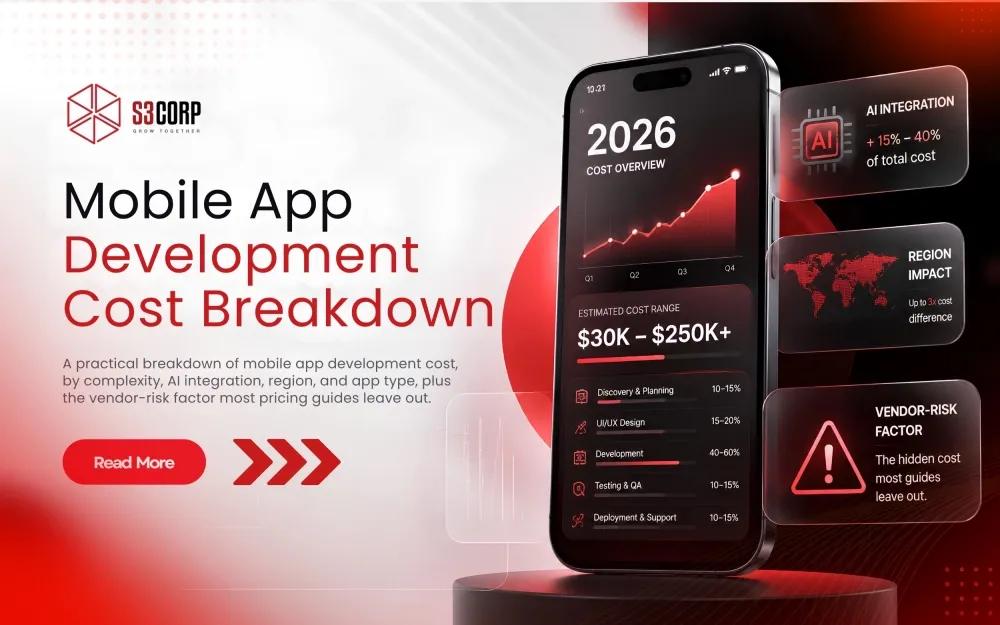
Mobile App Development Cost: A 2026 Pricing Breakdown
A practical breakdown of mobile app development cost in 2026, by complexity, AI integration, region, and app type, plus the vendor-risk factor most pricing guides leave out.
24 Aug 2026
Key Takeaways
- Mobile app development cost runs from $40,000 for a simple app to $400,000+ for a complex, enterprise-grade build, with most mid-market projects landing between $80,000 and $200,000.
- AI features are now a separate budget line, not a footnote. On-device machine learning, generative AI chatbots, and RAG infrastructure can add $30,000 to $150,000 or more on top of the base build.
- Developer hourly rates run from roughly $20 to $40 in Vietnam and India, up to $130 in the US, UK, and Australia. That gap explains most of the difference between two quotes for the same app.
- A cheap quote only stays cheap if the vendor manages IP, security, and code quality well. Rework, security remediation, and disputes over code ownership erase the savings fast.
- Budget 15 to 20 percent of your initial build cost every year for maintenance. Regulated industries such as fintech and healthcare often run higher.
Ask three development partners to quote the same mobile app, and you will likely get three different numbers, sometimes with a gap of well over $100,000 between the lowest and the highest bid. That is the reality of mobile app development cost today, and it is a fair reason so many business leaders start their research already confused before they even open a spreadsheet.
Mobile app development cost typically ranges from $40,000 for a simple, single-platform build to $400,000 or more for a complex, enterprise-grade product, with most mid-market projects landing between $80,000 and $200,000. The bigger driver of your final number usually is not the feature list. It is the delivery model and the vendor you choose, since the exact same app specification can be quoted anywhere from $15,000 to $300,000 or more depending on where the team sits and how the engagement is structured.
The stakes behind that number are real. The global app market is on track to generate $739.61 billion in revenue in 2026, according to Statista, and getting your budget wrong either burns cash on features nobody asked for or leaves your app under-built for a market that size.
This guide walks through what actually sets the price: complexity, app type, region, and a 2026-specific factor most cost guides bury as a footnote, artificial intelligence, plus the one variable almost no pricing page accounts for honestly, the hidden cost of vendor risk.
Mobile App Development Cost at a Glance
|
Complexity |
Estimated Cost |
Timeline |
What's Included |
|
Simple / MVP |
$40,000 – $100,000 |
3–6 months |
Core authentication, basic UI, single platform |
|
Moderate |
$100,000 – $200,000 |
6–9 months |
Payments, push notifications, social or API integrations |
|
Complex / Enterprise |
$200,000 – $400,000+ |
9–15 months |
AI/ML, real-time sync, custom backend, multi-platform |
What Actually Determines Mobile App Development Cost?
Six variables set your final price. App complexity drives the biggest share, since feature count and backend sophistication decide how many engineering hours a build needs. Platform choice matters next, because native iOS and Android development takes more hours than a single cross-platform codebase. Design scope, AI and machine learning integration, team composition, and ongoing maintenance round out the list, and each one moves the number independently of the others.
- App complexity – The number of screens, user flows, and backend logic involved. A basic dashboard costs far less to build than real-time data sync across a distributed database.
- Platform choice – Native iOS and Android development means writing and testing two separate codebases. Cross-platform frameworks cut that work close to in half, at the cost of some native performance. The native versus hybrid versus cross-platform decision deserves its own conversation before you scope a budget.
- Design scope – A template-based UI keeps the design budget low. A fully custom UI and UX system, with its own component library and motion design, adds real cost, but often earns it back in user retention. One of the highest-leverage moves here is investing in an interactive Figma prototype and a reusable design system before engineering starts. It lets stakeholders click through and validate user flows on screen, catching the wrong decisions early, instead of paying engineering hourly rates to build something that then needs to be reworked.
- AI and machine learning integration – A standalone cost driver in 2026, not a sub-point buried inside "complexity" anymore. The breakdown further down covers this in detail.
- Team composition – In-house, agency, or offshore team, and how those roles split across the project. Region and hourly rate come into play here, covered further down, and so does how you structure the development team itself.
- Ongoing maintenance – Budget 15 to 20 percent of your build cost annually for updates, patches, and OS compatibility work. Skipping this line item is the most common budgeting mistake first-time app owners make.
Mobile App Development Cost by Complexity Tier
A simple app with login, a basic dashboard, and limited admin functionality runs $40,000 to $100,000. Add payments, push notifications, and social or API integrations, and you move into moderate territory at $100,000 to $200,000. Complex, enterprise-grade builds with AI and machine learning, real-time data sync, or custom multi-platform architecture start at $200,000 and can pass $400,000.
These ranges hold up across most published industry estimates, though the exact numbers shift depending on whose regional rate and whose definition of "simple" a given source is using. Research from Business of Apps puts simple app development between $5,000 and $50,000, medium complexity between $50,000 and $120,000, and complex projects between $120,000 and $300,000, a somewhat lower band than some agency-published guides. The gap usually comes down to region: a US-based team quoting "simple" is pricing in $60 to $130 an hour, while an offshore or nearshore team pricing the same scope of work starts closer to $20 to $40 an hour. Complexity sets the number of hours a build needs. Region sets the price of each hour. Multiply the two together, and you get the real spread between quotes.
|
Tier |
Cost Range |
Example Features |
|
Simple |
$40,000 – $100,000 |
Login, basic dashboard, limited admin panel, single platform |
|
Moderate |
$100,000 – $200,000 |
Payments, push notifications, social login, API integrations |
|
Complex / Enterprise |
$200,000 – $400,000+ |
AI/ML features, real-time sync, custom backend, multi-platform, advanced security |
A real project illustrates the simple-to-moderate tier well. S3Corp built a native Android application for an American gaming hardware company that needed in-store product demo video playback on retail tablets, including offline playback and a private backend server for managing content. A four-person team, two mobile developers, one backend engineer, and one QA specialist, delivered the full build in three months: single platform, a defined feature set, a small team, and a short timeline, which is exactly the profile behind most simple-tier cost estimates. See the full case study.
AI and Machine Learning Integration: The Primary 2026 Cost Driver
AI is no longer a line item buried inside the "complex app" tier. It has become one of the largest single costs in a 2026 app budget, often on its own. On-device machine learning for personalization typically adds $30,000 to $80,000.
A generative AI chatbot or virtual assistant adds $40,000 to $120,000, depending on whether you integrate an existing large language model through an API or fine-tune a custom one. Retrieval-Augmented Generation, or RAG, infrastructure, increasingly the standard pattern for apps that need AI to answer from a company's own data rather than generic training data, adds $50,000 to $150,000 or more, driven by vector database setup, embedding pipelines, and the ongoing model-operations work needed to keep retrieval accurate as the underlying data changes.
|
AI Feature |
Added Cost |
What Drives the Cost |
|
On-device ML (personalization, recommendations) |
$30,000 – $80,000 |
Model tuning, on-device inference optimization, cross-device testing |
|
Generative AI chatbot / virtual assistant |
$40,000 – $120,000 |
LLM API integration or fine-tuning, conversation design, guardrail testing |
|
RAG infrastructure |
$50,000 – $150,000+ |
Vector database setup, embedding pipeline, retrieval tuning, ongoing data-freshness maintenance |
|
Full AI-native app |
$150,000 – $500,000+ |
Custom model development, MLOps, continuous training and monitoring |
Two things are worth knowing before you lock these numbers into a budget. First, this is a fast-moving category. Unlike traditional feature costs, which have stayed fairly stable for years, AI implementation costs are still settling as tooling matures and LLM API pricing shifts, so treat the ranges above as directional and revisit them close to the point when you actually scope the build. Second, many project budgets still treat AI as a checkbox feature rather than its own line item, which under-prices what it actually takes to ship AI well: a chatbot that hallucinates answers or a recommendation engine that never gets past a demo does more damage to user trust than skipping the feature entirely. Third, AI cost does not stop at launch. Ongoing LLM API token consumption, or cloud GPU hosting if you run inference yourself, becomes a real variable cost that scales with usage rather than a one-time build expense, so a monthly line for a provider like OpenAI or Anthropic belongs in your maintenance budget from day one, not as an afterthought once the first bill arrives.
The goal with AI integration is not feature-for-feature parity with the biggest tech platforms. It is optimizing cost and performance for the specific problem your users actually have. The approach to AI integration used by S3Corp starts from that premise, scoping the AI component on its own terms, with its own budget and its own success metrics, rather than folding it into a general app quote. If a chatbot specifically is on your roadmap, chatbot pricing follows its own logic worth understanding before you commit to a number.
What Does Mobile App Development Cost by App Type?
Cost varies by category almost as much as it varies by complexity.
An e-commerce app with a product catalog, shopping cart, and payment integration typically runs $50,000 to $250,000.
A fintech app with compliance and security requirements runs $75,000 to $300,000 or more, since regulatory review and security testing add hours a simple content app never needs.
Healthcare apps that require HIPAA-grade compliance start around $80,000 and climb quickly once patient data handling, EHR integration, or telehealth features enter the scope.
On-demand and marketplace apps with dual-sided user flows, a driver app and a rider app running on the same backend, for example, run $50,000 to $200,000.
|
App Type |
Cost Range |
Key Cost Drivers |
|
E-commerce |
$50,000 – $250,000 |
Catalog, cart, payment gateways, inventory sync |
|
Fintech |
$75,000 – $300,000+ |
Compliance, encryption, fraud detection, audit trails, penetration testing |
|
Healthcare |
$80,000 – $300,000+ |
HIPAA compliance, EHR integration, data security, penetration testing |
|
On-demand / marketplace |
$50,000 – $200,000 |
Dual-sided app logic, GPS, real-time matching |
|
IoT-connected / hardware-linked |
$60,000 – $350,000+ |
Device pairing, firmware coordination, connectivity |
One line item in the fintech and healthcare rows is easy to leave out of an early budget: third-party penetration testing. For enterprise, fintech, and healthcare apps handling sensitive financial or patient data, an independent pen test before launch is not optional. It typically adds $5,000 to $15,000 or more on top of the ranges above, and skipping it is not really an option once a compliance review or an enterprise customer's security team asks for the report.
An app that talks to a wearable, a point-of-sale terminal, or a piece of industrial hardware needs engineers who understand both mobile development and the networking layer underneath it, a combination that is less common than it should be. It tends to show up as scope creep mid-project, when a team discovers, months in, that it needs outside help for the hardware-communication piece. Engineering depth that spans application development and the wireless and embedded systems connecting hardware to software is exactly why IoT-connected mobile app projects tend to move faster once that combination sits inside one team instead of two.
If your project sits in a regulated vertical, it is worth reading the domain-specific guidance directly. Fintech app development and healthcare app development both carry compliance considerations that change the cost structure well before a single screen gets designed. For retail-adjacent builds, e-commerce and retail covers the pattern in more depth, and food delivery app development is a common enough request that it merits its own guide.
Mobile App Development Cost by Region: Hourly Rate Benchmarks
Hourly rates for mobile developers range from roughly $15 to $35 an hour in India and Vietnam, to $30 to $70 an hour across Eastern Europe and the Middle East, up to $60 to $130 an hour across the US, UK, Canada, and Australia. Since total cost is hours multiplied by rate, building the exact same app specification in a lower-cost region can land 30 to 60 percent cheaper than building it with a US-based team.
|
Region |
Avg. Hourly Rate (USD) |
Notes |
|
Vietnam / Southeast Asia |
$20 – $40 |
Among the lowest globally, per Business of Apps research, without sacrificing English-language project management |
|
India |
$15 – $35 |
Large talent pool, wider quality variance between vendors |
|
Eastern Europe |
$30 – $55 |
Strong technical depth, closer time-zone overlap with the UK and EU |
|
Middle East |
$30 – $70 |
Growing market, rates vary widely by country |
|
US / Canada |
$60 – $130 |
Highest rates, easiest in-person collaboration for domestic teams |
|
UK / Australia |
$55 – $120 |
Comparable to North America, wider range by city |
That savings figure is real, and it is also incomplete on its own. A 60 percent discount on an hourly rate does not automatically mean a 60 percent lower total project cost, because total cost also depends on how efficiently those hours get used, and that depends on the vendor, not the region. This is exactly where the next section matters more than the table above.
If you are weighing outsourcing against building an in-house team, or comparing nearshore against offshore delivery, two related guides go deeper on the trade-offs: nearshore versus offshore software development and why companies choose Vietnam for outsourcing. The collaboration model you choose, fixed price, dedicated team, or staff augmentation, shapes your total cost independently of region as well.
Vendor Risk: The Cost Variable Most Budgets Leave Out
A $30-an-hour offshore quote and a $90-an-hour US quote are not actually comparable numbers until you price in the risk each vendor carries. Unclear intellectual property and code-ownership terms, thin security practices, high developer turnover, and inconsistent QA discipline do not show up anywhere in an hourly rate. They show up later, as rework, security remediation, a delayed launch, or a dispute over who owns the codebase once the relationship ends. A lower quote only stays cheaper if the vendor does not also cost you a second build.
|
Risk Category |
Real Cost If Ignored |
What Reduces It |
|
IP and code ownership |
Legal disputes, inability to switch vendors, lost leverage |
Clear contract terms defining code and IP ownership from day one |
|
Security practices |
Breach remediation, regulatory penalties, reputational damage |
Independently audited certification, such as ISO/IEC 27001 |
|
Delivery stability |
Missed deadlines, knowledge loss from developer turnover |
A vendor with a long, verifiable delivery track record |
|
Communication and QA discipline |
Rework, technical debt, a second build to fix the first |
Structured QA processes and documented engagement models |
Ask about security certification and intellectual property terms before you compare hourly rates, not after. A vendor that cannot answer those questions clearly in the first conversation is telling you something about how the rest of the project will go.
This is where a track record does real work. S3Corp holds ISO/IEC 27001:2022 certification, covering data protection, access control, and incident response across every active project. That certification was renewed under the updated 2022 standard, which added specific controls for cloud security, remote-team access, and supply-chain risk, exactly the categories of risk a distributed development engagement introduces.
Before signing with any outsourcing partner, ask to see the certification, ask how code ownership is handled in the contract, and ask for references from clients who have worked with the team across more than one project cycle. A pattern worth watching for, covered in more depth in why mobile apps fail, is that most app failures trace back to a vendor-selection mistake made months before a single screen was designed, not a technical failure during the build itself.
How This Plays Out in Practice
Two more examples show how these variables combine in real projects. A subsidiary of one of Asia's largest telecommunications groups needed a movie-focused mobile app covering showtimes, reviews, trailers, and booking, deployed across both iOS and Android with ongoing performance upgrades after launch. That is a moderate-to-complex build: cross-platform from day one, a transactional booking flow, and continuous feature work rather than a single fixed-scope delivery. Read the case study.
A separate project built a location-sharing and navigation app that let users post points of interest, such as restaurants and ATMs, while also serving as a GPS-based navigation tool referencing geographic information system data. That combination, user-generated content plus real-time location services, sits in the moderate complexity band and shows why cost by app type and cost by complexity need to be read together rather than in isolation. See how the location and navigation app was built.
Mobile App Maintenance and Post-Launch Costs
Budget 15 to 20 percent of your initial development cost every year for maintenance. That covers bug fixes, operating system and device compatibility updates, security patches, and minor feature work. Regulated industries such as fintech and healthcare often run higher, 20 to 25 percent or more, because of compliance and audit overhead layered on top of standard maintenance work.
Maintenance breaks down into a few recurring categories:
- Bug fixes and stability work – Even a well-tested app surfaces edge cases once real users start using it at scale.
- OS and device compatibility – Apple and Google release major platform updates annually, plus device manufacturers ship new hardware year-round. An app that ignores these updates degrades quietly until users notice.
- Security patches – New vulnerabilities surface constantly. A maintenance plan without a security patch cadence is not really a maintenance plan.
- Server and backend costs – These scale with your user base rather than a fixed annual number, so budget flexibly here.
- Minor feature updates – Small improvements based on user feedback and analytics, kept separate from major version releases.
This is the line item most first-time app owners underbudget, largely because it does not show up in the initial development quote.
One more cost sits outside the maintenance budget entirely, and it catches more first-time app owners off guard than anything on the list above: the platform commission. Apple and Google both take a cut of in-app purchases and subscriptions, typically 15 to 30 percent depending on revenue tier. It is not a development cost, but it hits your margins every month for as long as the app generates revenue through the store. Enough businesses find that cut large enough to justify building a separate, out-of-app payment flow instead, which adds engineering hours most people never budget for until the first store statement arrives.
If performance at scale is already on your mind, mobile app performance optimization covers the technical side of keeping an app fast as your user base grows, closely tied to how much your maintenance budget actually needs to cover.
How to Reduce Mobile App Development Costs Without Cutting Corners
The most reliable cost levers are starting with a minimum viable product instead of a full feature set, choosing a cross-platform framework over building native twice, and working with a properly vetted offshore or nearshore partner instead of a purely local team. AI tooling for development itself, distinct from AI features inside the app, is also emerging as a legitimate lever, with teams reporting 10 to 25 percent reductions in coding time on small to medium projects.
- Start with an MVP. Build the smallest version that solves the core problem, launch it, and let real user feedback guide what gets built next. MVP development exists precisely to stop teams from over-building a version one that nobody has validated yet.
- Choose cross-platform frameworks where they fit. Flutter and React Native let one codebase serve both iOS and Android, cutting development time meaningfully compared with building two native apps. Reserve native development for apps that lean heavily on device-specific hardware or animation.
- Work with a vetted outsourcing partner. The savings from a lower regional rate only hold up if the vendor delivers clean, well-documented code the first time. Revisit the vendor-risk section above before choosing on price alone.
- Use AI-assisted development tooling. Coding assistants speed up routine work like boilerplate generation and test writing, freeing engineering hours for the harder problems that actually need human judgment.
- Prioritize ruthlessly. Every feature added before launch delays the point where you start collecting real user data. Rank features by user value, not by how interesting they are to build.
- Plan the tech stack for where the app is going, not just where it starts. Choosing a scalable architecture on day one costs more upfront and avoids an expensive rebuild once the user base outgrows the original design.
Flutter, React Native, and Kotlin Multiplatform are the frameworks worth budgeting around today, alongside no-code and AI-assisted app builders, which now represent a legitimate fourth path for simple, low-complexity apps rather than a stopgap.
Where Mobile App Development Cost Is Headed Next
Three shifts are worth watching as 2026 moves toward 2027. AI integration cost will likely start splitting into two tiers: a lower-cost tier for teams using off-the-shelf LLM APIs with light customization, and a higher-cost tier for teams building proprietary models or heavy RAG infrastructure around sensitive data. That split does not exist cleanly yet in most budgets, but it will, as more projects move past the experimentation phase.
Vendor security certification is also moving from a competitive differentiator to a baseline expectation. Enterprise buyers in regulated industries increasingly ask for proof of information security management before the first technical conversation even starts, which means vendors without a certification like ISO/IEC 27001 will find themselves excluded from more RFPs over time rather than simply competing on price.
Finally, expect the gap between a "simple" app and an "AI-enabled simple" app to keep widening. A basic app with one AI feature bolted on now costs closer to a moderate-tier build than a simple one, and that reclassification is likely to become the norm rather than the exception as AI features shift from differentiator to default user expectation.
Getting an Accurate Number for Your Project
Every range in this guide is a starting point, not a quote. Your actual mobile app development cost depends on your specific feature list, your compliance requirements, and the vendor you choose to build it, and no calculator or blog post can account for all three at once. The fastest way to get a real number is a scoped conversation with a team that can show its work: past projects, a clear breakdown of hours by feature, and a straight answer about security and code ownership.
If a feature list is already taking shape, or even just a rough problem worth solving, the application development team at S3Corp can walk through a scoped estimate, feature by feature, built around innovative solutions rather than an industry average. Get in touch to start that conversation.
Frequently Asked Questions
How much does it cost to develop a mobile app?
Mobile app development cost typically runs from $40,000 for a simple, single-platform app to $400,000 or more for a complex, enterprise-grade build. Most mid-market projects land between $80,000 and $200,000. The exact number depends on feature complexity, platform choice, AI integration, and which region and vendor build it.
How does mobile app development cost in India compare to Vietnam?
Hourly rates in both India and Vietnam typically fall between $20 and $40, among the lowest globally. India offers a larger talent pool with wider quality variance between vendors. Vietnam has built a reputation for strong English-language project management and a consistent quality bar across established outsourcing firms.
What does it cost to develop an e-commerce mobile app?
An e-commerce mobile app with a product catalog, shopping cart, and payment gateway integration typically costs $50,000 to $250,000. Costs rise with inventory sync complexity, the number of payment methods supported, and features like AR-based product try-on or personalized recommendation engines.
What is driving mobile app development cost in 2026?
AI integration is the biggest new driver. On-device machine learning, generative AI chatbots, and RAG infrastructure now add $30,000 to $150,000 or more on top of a base build, a cost category that barely existed in most project budgets even two years ago.
What should be included in an app maintenance budget?
Budget 15 to 20 percent of your initial development cost annually for maintenance. That covers bug fixes, operating system and device compatibility updates, security patches, server costs that scale with usage, and minor feature updates based on user feedback.







_1746790956049.webp&w=384&q=75)
_1746790970871.webp&w=384&q=75)