Insights
Table Of Content
Key takeaways
What Counts as a Money Transfer App? (Types and Where They Differ)
What Should You Define Before Development Starts?
What Features Does a Money Transfer App Need?
How Should the Transaction Flow Work From Sender to Settlement?
What Architecture Supports a Reliable Money Transfer App?
Which Integrations Does a Money Transfer App Need?
Compliance and Licensing: What Actually Applies to Your Build?
How Do You Test a Money Transfer App Before Launch?
What Does Money Transfer App Development Cost, and How Long Does It Take?
What Should a Realistic MVP Include?
In-House, Outsourced, or White-Label: Choosing How to Build It
How Do You Choose a Money Transfer App Development Partner?
Closing Recap: Build One Reliable Money Movement Path First
FAQ
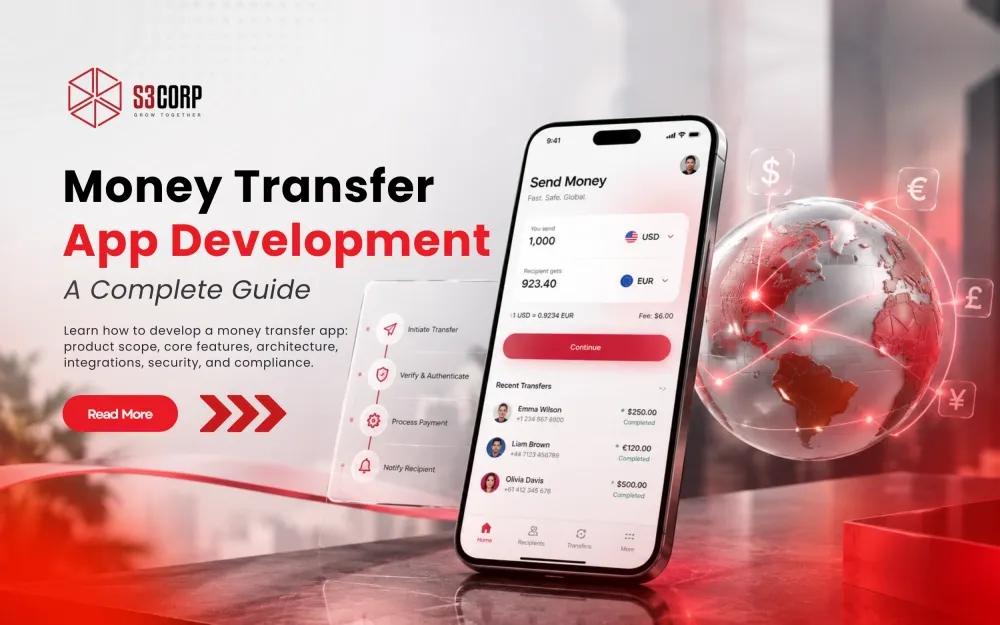
A practical, engineering-first guide to money transfer app development, covering transfer models, transaction lifecycle, architecture, integrations, compliance, testing, cost drivers, and how to choose a delivery partner.
25 Sep 2026
Money transfer app development pulls product design, transaction processing, financial integrations, security, and compliance into a single build, and most teams get the sequencing wrong before they write a line of code. The instinct is to start with a feature list: what the Send screen should look like, which currencies to support, how many taps a transfer should take. That instinct builds the wrong app.
The feature list should come second. What shapes the build is your transfer model, target corridor, funding and payout methods, and regulatory scope, decisions that determine which licenses you need, how your ledger has to behave, and which integrations are mandatory rather than optional.
Get that sequencing right and the transaction lifecycle and architecture follow naturally. Get it wrong and you end up redesigning the ledger six months in, after a compliance review flags a gap nobody scoped for.
Security-conscious teams tend to raise certification early, and for good reason: once a regulator or a compliance review starts asking about your delivery process, retrofitting controls costs far more than building them in from the start. Delivery under S3Corp runs on an ISO 27001-certified process, so security and IP protection are part of the build from day one rather than a checklist bolted on right before launch.
Demand for this category keeps climbing, and the numbers explain why. The global money transfer app market was valued at roughly $22.5 billion in 2024 and is projected to reach $52 billion by 2030, at a 15% compound annual growth rate, according to ResearchAndMarkets.
Cross-border remittances alone moved an estimated $685 billion into low- and middle-income countries, per the most recently published World Bank estimate, more than foreign direct investment and official development assistance to those countries combined. That scale is why banks, remittance operators, marketplaces, and payment companies keep building better transfer products instead of routing everything through legacy rails.
|
App Type |
Typical Cost Band |
Typical Timeline |
Who Usually Builds It |
|
P2P (linked-account transfers) |
$40K–$150K |
3–5 months |
In-house team or outsourced squad |
|
Domestic bank-to-bank |
$60K–$200K |
4–6 months |
Outsourced custom build or internal IT team |
|
Cross-border / remittance |
$150K–$600K+ |
6–10 months |
Outsourced custom build with fintech experience |
|
B2B / business payments |
$120K–$500K |
5–9 months |
Outsourced build or white-label plus customization |
|
Bank-integrated wallet feature |
$75K–$300K |
4–7 months |
In-house extension or augmented team |
Money transfer apps fall into five working categories: peer-to-peer, domestic bank-to-bank, cross-border remittance, business/B2B, and bank-integrated wallet features. Which one you build changes your compliance scope, architecture, and cost more than any single feature on the roadmap, and most teams only discover this the hard way, after licensing or settlement complexity forces a redesign midway through the build.
Users send money directly to another person, usually through a linked bank account or card. These apps let people send and receive funds from a mobile device without sharing bank details with the recipient. P2P apps rarely need to hold customer balances even briefly, and that detail is what keeps most of them out of money-transmitter territory: they can often run under a payment processor's existing license instead of registering one of their own.
Funds settle within one country's banking rails, so currency conversion drops out of the picture entirely. That doesn't make the engineering easy. Domestic rails move faster than cross-border ones, which leaves less time to catch a fraud pattern or a bad transaction before it settles, so fraud controls and transaction limits still need real attention.
Money moves between currencies and jurisdictions, which is where the real complexity starts. This model needs an FX engine, local payout partners in every corridor served, and, in most cases, its own money transmitter or MSB licensing. Of the five categories, this is the one that punishes shortcuts.
Businesses send batch transfers, usually with an approval workflow sitting in front of them. Speed matters less here than it does for consumer P2P; what a finance team cares about is whether every transfer traces cleanly back through the ledger during a month-end close.
A transfer capability sits inside an existing banking app rather than standing alone. Because it inherits the bank's license and compliance stack, the hard part of this build isn't new regulatory work, it's integration discipline: making sure the new feature doesn't destabilize systems the bank already depends on. Our guide to digital wallet app development covers this pattern in more depth.
|
App Model |
Primary User |
Key Compliance / Architecture Implication |
|
P2P |
Individuals sending to contacts |
Often rides an existing processor's license; avoid holding customer balances |
|
Domestic bank-to-bank |
Individuals and businesses, one country |
Simpler FX, but still needs strong fraud and AML controls |
|
Cross-border / remittance |
Migrant workers, families, freelancers |
FX engine plus local payout partners plus your own licensing |
|
B2B / business payments |
Finance teams, marketplaces |
Ledger accuracy and audit trail outrank instant UX |
|
Bank-integrated wallet |
Existing bank customers |
Inherits the bank's license; integration discipline matters most |
If P2P is your model, the build has more in common with a general mobile app development project with a financial core attached than with a full banking platform, which is worth knowing before you start pricing the engineering effort.
Before you choose a framework or write a line of transfer logic, define the money movement itself: who sends, who receives, where funds originate, where they settle, which currencies apply, which providers touch the transaction, and what happens when any one step fails.
Written out like that, it sounds obvious, which is exactly why teams skip it. They jump straight to wireframes and sprint planning, then rebuild half the system months in, once a decision they never made explicitly turns out to matter.
Work through this checklist in a product workshop before any code gets written:
This is a strategic approach most roadmaps skip in favor of jumping straight to design, and it is the single most common reason fintech builds run over budget.
Corridor, geography, user type, and transfer method aren't implementation details you can defer to a later sprint; they're foundational decisions that touch everything downstream. Get one of them wrong, and the fix rarely stays contained. It ripples through your ledger, your compliance workflow, and your provider contracts all at once.
A production money transfer app needs more than a Send button. Core capability spans onboarding, identity verification, recipient management, funding, transfer creation, fee and FX display, transaction status, notifications, support, and an operational back office. The scoping question that actually matters isn't "what features exist," it's "what belongs in the first release."
|
Capability |
MVP |
Later Stage |
|
Onboarding & KYC |
Account creation, identity checks where required, biometric or passkey (FIDO2) step-up authentication in SCA-regulated markets |
Progressive KYC tiers, expanded biometric enrollment options |
|
Recipient management |
Add and save recipients, basic validation |
Recipient risk scoring, contact sync |
|
Funding |
One funding method (bank or card) |
Multiple funding rails, wallet balance |
|
Transfer creation |
Single transfer flow, fee/FX shown upfront |
Scheduled or recurring transfers, bulk sends |
|
Status & history |
Real-time status, transaction history |
Predictive delivery estimates, richer analytics |
|
Notifications & support |
Push/email status updates, basic support |
In-app chat, support automation |
|
Admin / back office |
Manual review queue, basic reporting |
Automated reconciliation, fraud dashboards |
One line in that MVP column is not optional for teams launching in the EU or UK: biometric or passkey step-up authentication. PSD2's Strong Customer Authentication (SCA) rules have been in force across the EU since 2019, and they're tightening further as PSD3 and its companion Payment Services Regulation phase in through 2026 and 2027.
Under SCA, initiating an electronic payment generally requires two of three authentication factors: something the user knows, something they possess, and something they are.
Biometric authentication through FIDO2 passkeys is quickly becoming the standard way to satisfy that third factor without adding checkout friction. Treat it as a later-stage nicety in a regulated market, and you end up re-architecting your login and transfer-authorization flow under a live compliance deadline instead of shipping it correctly the first time.
Leave cryptocurrency, bill payments, voice-activated transfers, geo-fencing, and predictive analytics out of the MVP. These additions show up on feature wish lists often enough, but every one of them adds scope without answering the question that matters most at launch: can this app move money reliably, every single time?
Design the transaction flow as an explicit state machine, not a single API call. A typical flow runs: authenticate, verify eligibility, validate recipient, calculate fee and FX, authorize funding, screen for risk, create the transfer, route to a provider, receive settlement status, reconcile, and notify. Treat any one of those steps as an afterthought, and it becomes the place your production incidents cluster.
Authenticate → Verify eligibility → Validate recipient → Calculate fee/FX → Authorize funding → Risk screen → Create transfer → Route to provider → Settlement status → Reconcile → Notify
|
Stage |
System Responsibility |
Common Failure Condition |
|
Quote & fee calculation |
Lock fee and FX rate for a short window |
Rate expires before the user confirms |
|
Recipient validation |
Verify account or wallet details with the provider |
Invalid or mismatched recipient data |
|
Funding authorization |
Hold or debit sender funds |
Funding declined or times out |
|
Compliance / risk decision |
Screen sender, recipient, and transfer |
Transfer flagged for manual review |
|
Transfer creation |
Write an immutable ledger entry before routing |
A retried request creates a duplicate entry |
|
Routing & payout |
Hand off to a banking or payment provider |
Provider timeout or duplicate callback |
|
Reconciliation |
Match provider settlement data against the ledger |
Mismatch between provider and internal records |
|
Notification |
Update the user-visible status |
Status update sent before settlement is confirmed |
Two habits prevent most of the production incidents that show up at this layer. The first is idempotency: a retried request must never create a second transfer, no matter how many times a flaky client resends it. The second is ledger discipline: keep one internal ledger as the source of truth for balances, and treat every provider callback as an update to that ledger rather than as the record itself.
Retry handling deserves the same level of care, and it catches teams off guard because the failure mode is counterintuitive. A payment provider can time out on your side and still complete the transfer on its own, which means the sender sees a failure message while the money has actually moved.
Without retry-safe design, that mismatch turns into a wave of support tickets and a reconciliation headache days later. The fix is architectural, not procedural: stop treating provider callbacks as synchronous request-response calls, and start treating them as events on a message queue such as Kafka or RabbitMQ. If a callback handler crashes or a downstream service is briefly unavailable, the message waits in the queue instead of vanishing.
Pair that queue with a Dead Letter Queue (DLQ): messages that fail processing after a defined number of retries get routed there automatically instead of disappearing silently. That single design choice turns a dropped callback into a monitored, actionable alert, rather than a ledger mismatch someone discovers three weeks later during reconciliation.
Our guide to real-time payments architecture covers this state-machine pattern in more depth for instant-rail use cases.
A reliable money transfer platform separates the customer experience from the systems that own money movement. At minimum, isolate the customer interface, transaction orchestration, ledger and balance logic, compliance and risk controls, external integrations, and operational reporting into distinct layers, so that a change in one never quietly breaks another.
A layered structure typically looks like this:
A few principles carry more weight here than any specific framework choice:
That first point is worth pausing on, because it's where most home-grown ledgers fail an audit. A single mutable balance field, the kind you get from an UPDATE accounts SET balance = balance - amount query, gives an auditor nothing to reconcile against once something goes wrong.
Financial-grade systems store transactions as immutable, append-only entries in a double-entry model, where every debit has a matching credit and nothing gets edited in place. A correction becomes a new offsetting entry, not a rewrite of history, which is exactly the kind of trail regulators and auditors expect to see.
This layered approach pays off later. It gives you scalable architecture from day one, so adding a new corridor or payout partner means extending a layer, not touching the ledger core.
Most teams converge on a similar technical shape regardless of which specific framework they pick: a ledger-accurate backend, usually Java/Spring, Node.js, Go, or Python, paired with a cross-platform or native mobile frontend and integrations into a banking API, a KYC/AML provider, and an FX-rate provider.
Go and Java tend to win the ledger and orchestration layer specifically, because both handle high transaction concurrency well, but the framework matters far less than getting the settlement logic right. A well-built ledger on an unfashionable stack will outlast a fragile one on a trendy stack every time. For teams modernizing an existing platform rather than starting fresh, our custom banking software development guide covers that migration path.
Your integration map depends entirely on the corridor and transfer model you settled on earlier. Depending on those choices, common dependencies include banking APIs, payment gateways, card or wallet rails, KYC/identity providers, sanctions and AML screening services, FX-rate providers, payout partners, notification services, and accounting or reconciliation tools.
|
Integration |
Why It Exists |
Design Consideration |
|
Banking API |
Moves funds in and out of accounts |
Confirm settlement SLAs and callback reliability upfront |
|
KYC / identity provider |
Verifies sender and recipient identity |
Design for provider failover so one outage does not block onboarding |
|
AML / sanctions screening |
Screens parties and transfers against watchlists |
Log every screening decision for audit, even automated passes |
|
FX-rate provider |
Sources live exchange rates |
Lock rates for a defined window and handle expiry gracefully |
|
Payout provider / rail |
Delivers funds to the recipient |
Abstract behind your own interface so you can add corridors later |
|
Notification service |
Delivers status updates |
Treat as best-effort, never as the transfer's source of truth |
Resist the urge to integrate everything on that list by default. Tie each dependency to your selected transfer model and geography instead: a single-country P2P product might only need one banking API and one KYC provider, while a five-corridor remittance platform can need three or four payout partners just to cover its first markets.
Our payment gateway integration guide covers the gateway layer specifically, including how to isolate provider logic from your core transfer flow.
Every money transfer app needs KYC and AML controls, full stop. What varies sharply is the licensing layer sitting on top of that baseline. Pure in-app P2P transfers between linked bank accounts often run under a payment processor's existing license, while holding customer balances or moving money cross-border usually pushes you into your own MSB registration, a state money transmitter license, or an EMI license in the EU/UK.
If you only move money between accounts your users already hold at other institutions, you can often operate under a payment processor's existing license. Compliance work centers on KYC at onboarding and standard AML monitoring, not registering as a money transmitter yourself.
If you hold customer balances, even briefly, the picture changes fast. Most US states require a money transmitter license once you custody funds, and the EU/UK equivalent is an Electronic Money Institution (EMI) license or a partnership with an existing EMI.
If you move money across borders, add jurisdiction-specific licensing in every country you touch, plus sanctions screening tuned to each corridor. A remittance corridor between the US and the Philippines carries different screening requirements than one between the UK and India, and treating the two as interchangeable is one of the more expensive mistakes a team can make.
Licensing is only half of the cross-border picture. The FATF Travel Rule, formally Recommendation 16, requires the originating and beneficiary institutions on a cross-border transfer above a de minimis threshold, set at USD/EUR 1,000, to collect and exchange verified sender and recipient identifying information alongside the payment itself.
That's not a paperwork detail you bolt on after launch. It shapes your API design directly: every payout-partner integration needs a field for a verified identity payload, not just an account number and an amount, and your architecture needs a secure channel to exchange that payload institution to institution.
Treat all of this as a starting orientation, not legal advice, and confirm your specific obligations with a compliance lawyer before you commit to a jurisdiction. In the US, businesses that qualify as a Money Services Business must register with FinCEN; the FinCEN MSB registration process costs nothing to file, but operating without it exposes a company to civil penalties and possible criminal prosecution.
An engineering partner should design around these obligations from day one, not retrofit them after a regulator asks a hard question. That's one reason security-conscious fintech teams across the US and Singapore bring in outside engineering capacity for this stage rather than building compliance controls as an afterthought. Related reading: KYC/AML solutions for fintech, PCI DSS compliance, and regtech and compliance automation.
For a money transfer product, successful transfers are only half the test plan. The harder scenarios, and the ones that determine whether the app survives its first bad day in production, are retries, duplicate requests, provider timeouts, partial failures, incorrect recipient details, reversed funding, delayed settlement, fraud flags, reconciliation mismatches, and recovery after service outages.
Build your test plan around these failure scenarios:
Run these scenarios in a staging environment that mirrors real provider behavior, not just happy-path API responses. A test suite that only confirms successful transfers will sail through QA and fail at the very first real provider outage, usually in front of customers. Our QA and testing services and fintech testing and QA pages go deeper into building this kind of failure-scenario test suite.
There is no reliable single price for money transfer app development, and anyone who quotes one without asking about your compliance scope first is guessing. Cost is driven less by the number of screens than by the number of transfer flows, jurisdictions, payment providers, currencies, and compliance controls a product needs to support.
Public estimates for this category commonly span roughly $40,000 for a narrow, single-corridor MVP to well over $1.5 million for a multi-corridor enterprise platform. That gap has less to do with which vendor you ask than with three variables: how many countries and currencies you support, how much compliance automation you need, and whether you license your own money-movement capability or build on top of a licensed partner.
Use these nine variables for optimizing cost and performance instead of anchoring on a generic regional price table:
Timeline follows the same logic. A single-country P2P MVP with one funding method and one payout method can reach launch in three to five months, while a cross-border platform with multiple corridors, several compliance integrations, and a full admin back office typically needs six to ten.
In both cases, payment-provider onboarding is usually the critical path, not engineering; a good team can write the ledger faster than a bank can approve an integration. For a deeper breakdown by build type, see fintech app development cost.
A strong money transfer MVP proves one reliable money movement path. It does not try to support every country, currency, payment method, and financial feature at launch, and it shouldn't. The goal is validating the core transfer journey while keeping the architecture ready for controlled expansion later.
A realistic MVP generally includes: one defined transfer model; one or a small number of corridors; onboarding and required identity checks; recipient management; one funding method; one payout path; fee and FX calculation; a full transfer lifecycle and status model; notifications; basic operations and admin tooling; reconciliation; and audit and security controls.
Later-stage candidates include additional corridors, additional payment rails, advanced wallet features, loyalty programs, broader analytics, AI-assisted support, and additional financial products layered onto the same core.
Resist the temptation to strip out controls required for your regulated flow just to compress the MVP timeline. Cutting KYC steps or audit logging to launch faster feels efficient in the moment, but it creates rework at best and, in some jurisdictions, real legal exposure at worst.
Treat the first validated corridor as a foundation rather than a finished product. A delivery partner offering innovative solutions for scaling past that first corridor, adding rails and compliance automation as you grow, is worth more than one that ships the MVP and disappears, and it saves you a second vendor search a year in. Our MVP development guide covers this scoping discipline for other product categories too.
Three real paths exist for building a money transfer app: fully in-house, custom development with an outsourced or augmented team, or a white-label platform you configure rather than build from scratch. The right choice depends less on budget alone than on how much control you need over compliance logic and how fast you need to launch.
|
Dimension |
In-House |
Outsourced Custom Build |
White-Label Platform |
|
Typical timeline |
Slowest (hiring plus build) |
Moderate (team ramps quickly) |
Fastest (configure, don't build) |
|
Who owns compliance logic |
Your team, fully |
Shared; you own decisions, partner implements |
Vendor's framework; you adapt to it |
|
Who owns the code/IP |
You, fully |
You, by contract |
Usually the vendor; check licensing terms |
|
Typical cost tier |
Highest (salaries, benefits, tooling) |
Mid-range, scales with scope |
Lowest upfront, ongoing license fees |
|
Best-fit scenario |
Long-term core product, deep in-house fintech expertise |
Regulated builds needing custom compliance logic and speed |
Fast market entry, less need for control |
S3Corp has delivered software outsourcing work for 19+ years, across 400+ projects for 250+ clients in 25+ countries, including enterprise engagements with Singtel, PepsiCo, and Razer/Ruckus.
That track record matters here in a way it wouldn't for a typical mobile app, because a money transfer build asks an outsourced team to carry real compliance responsibility, not just write code to a spec. If you are still weighing delivery structures, see software outsourcing services and collaboration models.
Evaluating an outsourcing partner for a money transfer app is not the same exercise as evaluating one for a generic mobile app. What matters is whether the partner designs for compliance from the start, how they handle KYC/AML data in their delivery process, and whether they can show real fintech delivery history rather than a general app-dev portfolio.
Run any candidate through this scorecard:
When you run a vendor conversation against that scorecard, ask whether a candidate's bench goes past standard app development into ledger and settlement logic, compliance automation, and audit-grade reconciliation. Not every shop that builds mobile apps well has built financial ones, and the difference tends to show up exactly when you need it not to, during an incident.
For a broader evaluation framework, see how to choose a software development company. For the security side specifically, our data security domain page and the ISO 27001:2022 certification held by S3Corp outline the controls a regulated build should expect from a partner.
Building a money transfer app is a compliance decision as much as a product decision. Get the app type, licensing tier, and build path right early, and the cost and timeline questions mostly resolve themselves. From there, the engineering work, ledger design, integrations, testing, follows a pattern that's well understood, even if it isn't trivial to execute well.
Ready to scope your build? Contact the team at S3Corp to walk through your transfer model, corridor, and compliance scope, and get a realistic view of cost and timeline before you commit to an architecture.
Define your transfer model, corridor, funding and payout methods, and regulatory scope first, since those decisions shape everything else. Then design the transaction lifecycle as a state machine, build a ledger-accurate architecture, integrate your KYC, AML, FX, and payout providers, and test failure scenarios, not just successful ones, before launch.
It depends on your model. Apps that only move money between linked accounts at other institutions can often operate under a payment processor's license. Apps that hold customer balances or move money cross-border usually need their own MSB registration or an EMI license. Confirm your specific obligations with a compliance lawyer before you build around an assumption.
Neither path wins by default. In-house fits teams with deep fintech engineering expertise who plan to own the product for years. An outsourced custom build fits regulated products that need speed and specialized compliance logic without a multi-year hiring effort. A white-label platform fits the fastest market entry, when you can accept less control over compliance logic in exchange for time saved.
A P2P app typically moves money between linked accounts within one country and often runs under an existing processor's license. A cross-border app adds multi-currency FX, multiple jurisdictions, local payout partners, and its own money transmitter or MSB licensing, which is a meaningfully heavier build.
There is no universal price, because projects differ so much in jurisdictions, transfer flows, payment rails, integrations, and compliance scope. Treat published figures as directional, and estimate your own project from its actual transfer model and integration scope rather than from screen count alone.
Timeline depends on product scope and regulatory or integration dependencies more than on team size. Simpler MVPs can reach launch in a few months; production-ready cross-border platforms often need eight to twelve months or more, with payment-provider onboarding and compliance validation as the usual critical path.
Core features include secure onboarding, identity verification where required, recipient management, funding, transfer initiation, fee and FX calculation, transaction status and history, notifications, support, and operational admin controls. Cross-border products often add multi-currency support, payout integrations, and transaction monitoring on top of that base.
Requirements depend on jurisdiction and product model, but common controls include identity verification, AML/CFT and sanctions screening, transaction monitoring, risk-based limits, strong authentication, encryption, audit trails, access controls, and regulatory reporting. Confirm the exact obligations that apply to you with qualified legal and compliance specialists.
A third-party provider can reduce how much payment infrastructure you need to build directly, but the architecture should still isolate provider-specific logic and preserve your own transaction records and reconciliation controls. The right approach depends on your business model, licensing position, target corridors, and how much control you want over the payment stack.
A money transfer app is the product experience and financial workflow through which users initiate and track money movement. A payment processing system is the underlying infrastructure that authorizes, routes, and settles payments. This guide focuses on the product side; for the infrastructure side, see payment processing system development.

Whether you have any questions, or wish to get a quote for your project, or require further information about what we can offer you, please do not hesitate to contact us.
Contact us Need a reliable software development partner?
S3Corp. offers comprehensive software development outsourcing services ranging from software development to software verification and maintenance for a wide variety of industries and technologies


Software Development Center