Whether you have any questions, or wish to get a quote for your project, or require further information about what we can offer you, please do not hesitate to contact us.
Contact us Need a reliable software development partner?
S3Corp. offers comprehensive software development outsourcing services ranging from software development to software verification and maintenance for a wide variety of industries and technologies


Software Development Center





Insights
Table Of Content
Key Takeaways
What Is Wealth Management Software, and What Does It Include?
When Does Off-the-Shelf Wealth Management Software Stop Fitting?
Why Are Firms Replacing or Upgrading Their Wealth Management Software?
What Types of Wealth Management Software Solutions Exist?
Which Features Does Wealth Management Software Need, and How Do You Check Each One?
Why Does Multi-Custodian Data Cause So Many Wealth Platform Problems?
What Security and Compliance Requirements Apply to Wealth Management Software?
Where Does AI Fit in Wealth Management Software, and What Controls Does It Need?
Should You Outsource Wealth Management Software Development?
Wealth Management Software FAQ: What Do Buyers Ask Most?
What Should You Do Next After Checking Your Wealth Management Software?
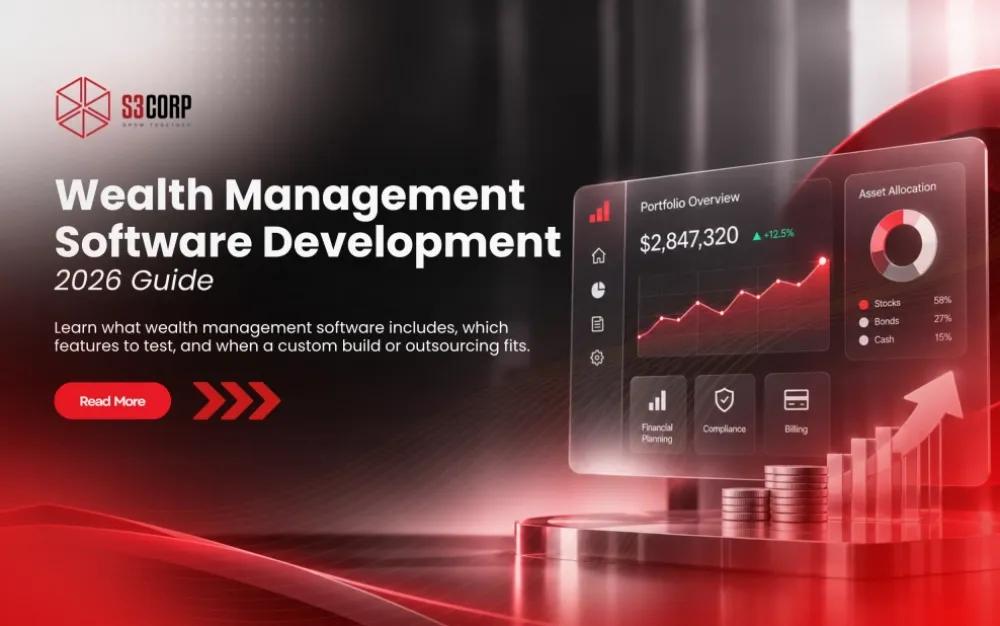
Wealth management software brings client data, portfolios, planning, billing, and compliance records into one system. This guide shows what it includes, which features to test, and when a custom build or outsourcing fits.
02 Nov 2026
- Wealth management software unites client relationships, portfolios, planning, billing, reporting, and compliance records in one system.
- Answer three questions on differentiation, total cost of ownership, and integration friction before you commit to a custom build.
- Run five data test cases on multi-custodian data before you judge any feature.
- Map each regulation to a platform control and to evidence that an examiner can inspect.
- Release artificial intelligence (AI) in three steps: staff assistants first, decision support second, and client-facing automation last.
- Judge an outsourcing partner on regulated-project evidence, intellectual property (IP) terms, and delivery transparency, not on rates alone.
S3Corp holds an ISO/IEC 27001:2022 certification for its information security management system (ISMS). The standard defines requirements for an ISMS, and it does not certify every process or product.
Wealth management software is the system a firm uses to manage client relationships, portfolios, planning, billing, reporting, and compliance records in one place. It matters most when data comes from several custodians, regulators expect documented advice, and clients want digital access.
Cerulli Associates projected in December 2024 that about $124 trillion will change hands in the United States through 2048. Roughly $105 trillion will go to heirs and $18 trillion to charity, according to the Cerulli press release, and the figures are rounded. Your platform must serve those heirs with data you can trust.
Custom wealth management software can give you greater control over the platform, data model, and roadmap, subject to contractual IP rights and third-party dependencies. The price is a larger upfront build and a long-term engineering commitment. It may pay off when measurable business benefits exceed the full cost and risk of building and maintaining the platform.
Most firms buy standard components for everything else. This guide covers what the software includes, which features to test, and which requirements it must meet. You also get a cost model, a data test, a regulation-to-control map, and an AI risk tiering.
Your firm type usually points to the software group you should evaluate first. The software solutions section later in this guide describes each group.
| Firm type | What usually hurts | Software group to start with |
|---|---|---|
| Solo or small registered investment adviser (RIA) | Manual reporting and scattered tools | Portfolio accounting and reporting, with financial planning and customer relationship management (CRM) and workflow tools added as needed |
| Mid-size RIA or multi-family office | Multi-custodian data, custom reports, fee billing | Portfolio accounting and reporting, plus financial planning and CRM and workflow |
| Private or universal bank | Multi-channel advice, core-banking integration, multi-jurisdiction compliance | Enterprise bank wealth platforms |
| Digital wealth or wealthtech startup | Speed to launch and a branded client experience | White-label or embedded wealth core |
Weighing a custom build for your firm?
S3Corp engineers can review your custodian list, advice model, and compliance scope with you. Start with an overview of how S3Corp delivers fintech software.
Wealth management software is a platform that consolidates a firm’s client relationships, portfolio data, planning, reporting, billing, and compliance records. Advisors then work from one version of the truth. Portfolio management software covers investment tracking and performance, while wealth management software adds onboarding, planning, CRM, and compliance around it.
When you shop for software for wealth management, expect eight core modules.
Few firms buy all eight modules from one vendor. They connect two or three products through data feeds. Integration quality therefore matters as much as the feature list.
Off-the-shelf platforms stop fitting in three cases. The vendor cannot change your key workflows, fees outgrow your revenue, or integrations need constant workarounds. Check each condition against your own numbers before you conclude that custom is justified.
Answer three questions with your own numbers.
Custom development is justified only when the value of differentiation exceeds the long-term cost of ownership.
Consider a hypothetical multi-family office with three custodians and a look-through report for trusts. The vendor roadmap never includes that report, so staff rebuild it in spreadsheets every quarter. That pattern signals a differentiation gap, not a training gap.
The cost lines below give you a 3 to 5 year comparison once you enter your own quotes and estimates. Optimizing cost and performance starts with your numbers, not with averages from vendor blogs.
| Cost line | Off-the-shelf: what to count | Custom: what to count |
|---|---|---|
| Licences or seats | Per-user fees, by year | Third-party components you still license |
| Basis-point fees | AUM-based fees at your projected AUM | Third-party platform, custody, data, or aggregation fees, where applicable |
| Implementation | Vendor onboarding and data migration | Discovery, design, build, and migration |
| Integrations | Connector fees and workaround hours | Custodian, pricing, and aggregation connections |
| Internal engineering | Admin and configuration staff | Product owner, engineers, and quality assurance |
| Maintenance | Vendor upgrade work on your side | Fixes, upgrades, and hosting |
| Compliance evidence | Audit requests and vendor reports | Control design, testing, and attestations |
Source-code ownership is a strategic option, not a valuation guarantee. It affects maintenance, vendor switching, handover, and dependency risk. Treat IP ownership as a factor in your TCO, your operations, and your exit strategy.
Check each vendor’s pricing page to confirm whether fees use seats, AUM, or both. Review exit terms and data export rights, because vendor lock-in often hides in the contract. If a legacy system holds your data, plan legacy system modernization as a separate workstream.
Firms upgrade for four reasons. Client data sits in too many systems, clients expect digital access, smaller households must be served economically, and regulators expect better records. Identify your main reason before you compare products, because it decides what you should look for.
If your advisors rebuild one household view from three logins, data fragmentation drives your upgrade. Every copied number adds a chance to break a figure.
Count the hours your team spends on manual reporting each quarter to size the problem. Look for a reconciled household view that shows the source and as-of date for each figure.
Cerulli expects about $85 trillion of the US transfer to reach Gen X and Millennial heirs. High-net-worth (HNW) and ultra-high-net-worth (UHNW) households make up 2% of US households. Cerulli expects them to pass on more than half of the US transfer volume.
In Cerulli’s 2024 U.S. High-Net-Worth and Ultra-High-Net-Worth Markets report, 89% of high-net-worth practices named family meetings and regular family communication a best practice. Look for household-level access for spouses and children, family-level reporting, and a client portal that works on a phone. Include mobile app development in that scope.
Assume a 1% annual fee on a $200,000 account. That is $2,000 in gross fee revenue before costs. Advisor time, software, and compliance all come out of that revenue, so manual work shrinks the margin fast.
Look for automated rebalancing, self-service planning, and hybrid robo-advisory that sends exceptions to a human advisor. Definitions of the mass-affluent tier vary by source, so write down your own threshold.
Regulatory load now sits inside your platform decision. The amended Regulation S-P from the Securities and Exchange Commission (SEC) took effect on August 2, 2024. Larger firms had to comply by December 3, 2025, and smaller firms by June 3, 2026, so both dates have passed.
The rule applies to specified covered institutions, including SEC-registered investment advisers and broker-dealers. Confirm whether your firm falls within scope, since requirements depend on institution type, the data involved, and the incident. Look for access logs, an incident workflow, and a vendor-oversight file in any platform.
Wealth management software solutions fall into five groups. These are portfolio accounting and reporting, financial planning, CRM and workflow, enterprise bank wealth platforms, and white-label or embedded wealth cores. Most firms combine two or three groups, so the practical question is which groups you need and how they will exchange data.
| Group and example vendors | Does best, and typical buyer | Integration effort and what to watch |
|---|---|---|
| Portfolio accounting and reporting (Orion, SS&C Black Diamond, Envestnet Tamarac, Addepar, SS&C Advent) | Multi-custodian accounting and client reports. RIAs and family offices. | Medium to high. Watch for custom report limits and basis-point pricing. |
| Financial planning (eMoney, RightCapital) | Goal modeling and cash-flow projections. Advisors who plan for households. | Medium. Watch for assumptions that clients cannot see or edit. |
| CRM and workflow (Wealthbox, Practifi, Salesforce Financial Services Cloud) | Relationship tracking, tasks, and onboarding steps. Advisory teams of any size. | Medium. Watch for weak links to portfolio data. |
| Enterprise bank wealth platforms (Avaloq, Temenos, FIS, Backbase) | Multi-channel advice and core-banking links. Private and universal banks. | High. Watch for long projects and multi-jurisdiction rules. |
| White-label or embedded wealth core | Fast launch with a branded client experience. Digital wealth startups. | Medium to high. Watch for limits on branding, data ownership, and roadmap control. |
These vendor names are examples, not a ranking. Data moves between the groups through custodian feeds, open banking protocols, and financial data aggregation application programming interfaces (APIs), such as Plaid and Yodlee. The design of your open banking architecture decides how safely and how fast that data flows.
A standard platform stops fitting when one or more of these signals appear.
A custom wealthtech platform can give you control over each of those points, subject to your contract terms. Dedicated FinTech developers can deliver a custom FinTech solution faster, which supports time-to-market acceleration. That speed holds only if your software development life cycle (SDLC) defines scope, testing, and release gates.
S3Corp received a 2026 Sao Khue award for its software outsourcing services and appears on the Vietnam Digital Tech Solutions Map 2026. Turn these signals into scope, acceptance criteria, and a roadmap before you start fintech software development.
At minimum, wealth management software needs accurate holdings and performance data, goal-based planning, a client portal, fee and billing logic, audit-ready reporting, and role-based security. What separates platforms is whether each capability holds up under real data. Test reconciliation to custodians, planning assumptions you can see, and client-ready reports.
In a scalable architecture, the client portal and advisor dashboard sit on top of the platform core. The core connects to custodians, pricing vendors, and aggregation APIs.
Split your wish list into three stages so your first release stays small. The first release should include three features.
The second release adds two differentiators.
Leave one feature for a later release.
Use this eight-step demo script with any vendor or prototype. Each step names the test and the passing result.
These tests also work as a buyer’s guide for wealth management reporting software, because reports only help when the numbers reconcile.
Each segment needs a different feature mix.
Wealth tiers have no single standard definition, and firms and research providers set their own asset cutoffs. The same household can count as HNW at one firm and as mass affluent at another. Decide which cutoffs your firm uses before you write requirements, so each feature maps to a clear client group.
A household that moves up one tier often needs different reporting, entity structures, and service levels.
Want these eight checks run on your own data?
Bring your custodian list and module priorities to an S3Corp engineer. You will learn what a standard platform covers and where custom development fits.
Holdings and valuation data arrive from each custodian on different schedules, in different formats, and with different treatment of corporate actions and cost basis. When a platform merges them without tracking source and valuation date, screens disagree and advisors stop trusting the numbers. Test data handling before you evaluate features.
Consider an advisor who opens a household with accounts at two custodians. One custodian reports at market close, and the other sends a file at 6 a.m. The screen shows a total that matches neither statement.
| Data element and how it arrives | Common failure | What to test |
|---|---|---|
| Positions and cash (daily files or API from each custodian) | Late or partial delivery. End-of-day and intraday values mismatch. | Compare the screen to the custodian statement at a stated time. |
| Transactions (files or API, sometimes with pending items) | Duplicates and missed reversals. | Replay a day that includes reversals. |
| Cost basis and tax lots (custodian-supplied or rebuilt by the platform) | Lots go absent on transferred-in positions. | Use an account with transferred positions. |
| Prices and valuation date (pricing vendors plus custodian values) | Mixed as-of dates across sources. | Confirm that every figure shows source and date. |
| Corporate actions (applied by the custodian, followed by the platform) | Splits, mergers, and spin-offs distort history. | Use an account with a recent spin-off. |
| Held-away accounts (aggregation APIs or client entry) | Broken credentials, expired consent, and stale balances. | Disconnect a link and check that the platform flags it. |
| Private and alternative assets (statements or manual valuation) | The platform shows them as if priced daily. | Confirm that the label reads stated valuation, with a date. |
Held-away data usually flows through aggregation providers such as Plaid, Yodlee, and Finicity, but an API does not guarantee data quality or active client consent. Each custodian also publishes its own advisor-services data-feed documentation. Read it to confirm formats, timing, and API availability.
Run five test cases through any platform or prototype. Each case exposes a different failure, and you can combine cases in shared accounts.
The platform passes when it meets all five conditions across the test cases.
Strong multi-custodian data integration is the foundation of every other feature. If your data layer fails this test, invest in API development or a rebuilt integration layer before you add anything new.
Rules differ by firm type and jurisdiction, but they converge on five system requirements. Systems must keep retrievable records, document advice reasoning, and safeguard client data. They must also oversee third-party vendors and support the identity-verification, customer due-diligence, and anti-money laundering (AML) controls that the law requires.
Map each obligation to a specific platform control and to evidence you can show an examiner. Start with a minimum security baseline of six controls.
Match the standards to your architecture and hosting model, and separate two assurance terms. A System and Organization Controls (SOC) 2 Type II report is an independent auditor’s opinion on controls that operated over a period of time. ISO 27001 certifies an information security management system.
If your platform includes a mobile app, test it against the Open Worldwide Application Security Project (OWASP) Mobile Application Security Verification Standard (MASVS). Give extra weight to its privacy controls when the app handles sensitive financial data.
| Obligation area | What the platform must do | Evidence to ask for |
|---|---|---|
| Books and records (SEC Rule 204-2 for advisers, Rule 17a-4 and Financial Industry Regulatory Authority (FINRA) rules for broker-dealers) | Keep required records retrievable and time-stamped. Preserve versions. | Retention settings, one client’s audit-trail export, and time to retrieve a record set. |
| Advice documentation (adviser fiduciary duty for RIAs, Regulation Best Interest (Reg BI) for broker-dealers serving retail customers, Markets in Financial Instruments Directive II (MiFID II) suitability for EU investment firms) | Capture client facts, risk profile, recommendation, and rationale as a dated, versioned record. | A sample record that shows what the firm knew on the recommendation date. |
| Privacy and safeguards (amended Regulation S-P, General Data Protection Regulation (GDPR) for EU data subjects) | Control access, encrypt data, detect and respond to incidents, notify customers, and oversee service providers. | Incident-response procedure, access logs, vendor-oversight file, and a data map with residency. |
| Identity and AML (broker-dealer customer identification program (CIP) and AML rules, adviser AML rule currently scheduled for January 1, 2028) | Support identity verification, sanctions screening, and politically exposed person screening where your jurisdiction, firm type, and risk assessment require them. Retain the results. | Screening logs and a workflow that staff can change by configuration. |
| Performance advertising (SEC Marketing Rule, Rule 206(4)-1) | Document methodology, run an approval workflow, and reproduce figures. | Methodology document and proof that you can regenerate a past report. |
| Third-party resilience (Reg S-P service-provider oversight, EU Digital Operational Resilience Act (DORA)) | Hold vendor due-diligence records, subprocessor lists, and data portability. | SOC 2 Type II report or ISO 27001 certificate, subprocessor list, and a test export. |
| Other markets (EU, UK, Singapore, Australia) | Meet data-residency, local suitability, and outsourcing rules, which differ by market. | Written confirmation of each rule from local counsel, and a data map by market. |
Two dates need care. The Financial Crimes Enforcement Network (FinCEN) issued a final rule that moves the investment adviser AML rule from January 1, 2026 to January 1, 2028. The postponement is final, and FinCEN has separately said it intends to revisit the rule’s scope.
SEC staff updated its Marketing Rule FAQs on March 19, 2025 and January 15, 2026. The FAQs are staff guidance and create no new legal obligations, so confirm the current guidance with your compliance reviewer before you finalize reporting workflows. Build identity checks with KYC and AML solutions, and automate evidence collection with RegTech compliance automation.
This table is a mapping aid, so have your compliance officer review it for your firm. It is not legal advice. Which obligations apply depends on firm type, market, and risk assessment.
Start with AI that assists staff on documents, notes, and reports, where a human reviews every output. Add AI that influences investment advice only when the platform can log inputs, outputs, and approvals for audit. Keep client-facing automation for last, because this order limits data exposure and supervisory risk while it still saves advisor time.
FINRA Regulatory Notice 24-09 reminds member firms that current rules apply to generative AI and that the notice creates no new requirements. The AI Risk Management Framework from the National Institute of Standards and Technology (NIST) is voluntary. It groups AI risk work into four functions: govern, map, measure, and manage.
Expect more examiner questions about AI records in 2026 and 2027, because current rules already apply. The three tiers below classify AI by risk and suggest a release order. They are separate from the roadmap stages earlier in this guide.
The same tiering logic applies across other AI in fintech use cases.
Outsourcing works when the partner brings fintech domain knowledge, clear IP and security terms, and a delivery model that keeps you close to the work. It is a poor fit when requirements are undefined or no one on your side owns the product. Judge a partner on evidence from regulated projects, not on rates alone.
A strategic approach to FinTech software development outsourcing starts with three checks. Each check below names what goes wrong and the safeguard.
A team that only writes code will miss the reconciliation, tax, and custodian rules that break wealth platforms. The safeguard is a team that has built these components before.
If you plan to hire fintech developers, ask whether they built portfolio accounting, tax-loss harvesting, custodian integrations, or open banking connectors. Ask the team to describe each project, its data sources, and its test approach.
Weak contracts leave ownership of the code unclear. The safeguard is a non-disclosure agreement (NDA), an explicit IP-assignment clause, role-based access to client data, and ISO 27001 evidence. Ask your counsel to review the wording, and verify each certificate with its issuer.
S3Corp has delivered security-focused work such as client volume encryption, and more projects appear across the S3Corp case studies.
Opaque delivery hides problems until late in the project. The safeguard is two-week sprints with demos of software that runs, advisor-led user acceptance testing, and a visible backlog.
Attend the first three sprint demos before you sign a long-term contract. Pair that cadence with fintech testing and quality assurance (QA) so each release carries test evidence.
Compare four factors: time-zone overlap, regulatory familiarity, talent depth, and engagement model. Vietnam offers a young engineering talent pool and a strong cost-to-quality ratio, which is why many firms evaluate outsourcing to Vietnam.
Time zones matter in practice. Singapore is one hour ahead of Vietnam, and Sydney is three to four hours ahead, depending on daylight saving. US teams usually agree on an early-morning or evening overlap window.
S3Corp works as a long-term delivery partner. One engagement covers application development, quality assurance, maintenance support, and DevOps, under flexible collaboration models. Headquarters sit in Ho Chi Minh City, where more than 250 engineers serve clients in Australia, Singapore, and the United States.
Bring your custodian list, compliance scope, and module priorities to a first call. An S3Corp engineer can review them with you when you contact the team. The build side of this decision, from scope to release, is covered in wealth management software development.
Wealth management software is a platform of connected tools that helps advisors run onboarding, planning, portfolio monitoring, reporting, CRM, and compliance in one workflow. It replaces spreadsheets and disconnected tools with a single, reconciled view of each client’s assets and activity.
Cost depends on scope: integrations, compliance requirements, AI features, and the share of the platform you build new. This guide gives no price, because assumptions change the result. Request a scoped estimate that lists assumptions, integration count, and compliance evidence.
Timeline depends on scope, integration count, and compliance evidence. A focused first release takes less time than an enterprise platform. Plan in phases, start with core portfolio data and reporting, and ask any partner to estimate against your own custodian list.
Outsourcing can be safe if contracts assign IP to you, the partner holds a certification such as ISO 27001, and role-based access limits client data. Regular demos and reviews keep delivery transparent. Have counsel review the IP and data-protection terms, and verify certifications with the issuer.
Firms typically use a portfolio accounting and reporting platform such as Orion, SS&C Black Diamond, Envestnet Tamarac, Addepar, or SS&C Advent. Client complexity, asset mix, and custodians drive the choice. Platforms for alternative assets and complex ownership structures differ from platforms for high-volume advisory billing.
A sound evaluation maps each obligation to a specific control: books and records, privacy safeguards, performance advertising, and vendor oversight. Then ask the vendor for evidence, such as retention settings, audit-trail exports, access logs, and security attestations. Simulate an examiner request, such as every record tied to one client recommendation.
Begin with the data foundation: reconciled holdings and cash flows. Then define goals (target amount, date, and priority) and agree on planning assumptions with your investment committee, and show results as probability ranges. Log which assumption set produced each client projection so you can reproduce results during reviews.
Portfolio management software tracks, analyzes, and rebalances investments, and it reports performance. Wealth management software wraps that in the wider client lifecycle: onboarding, planning, CRM, billing, and compliance, so portfolio management is usually one module. Firms often assemble the full set from several tools that share data feeds.
A financial advisor CRM manages relationships, tasks, and onboarding workflows. Wealth management software is broader because it adds portfolio accounting, performance reporting, planning, billing, and compliance records. Many firms run a CRM beside portfolio software, and some platforms bundle both, so check how the two systems share client and account data.
You now know what wealth management software includes, which features to verify, and where data and compliance risks sit. Use these checks on any platform you evaluate. If a standard platform will not fit your data, advice model, or compliance scope, the next step is to understand what custom development involves.
S3Corp has delivered software for global clients for more than 19 years. Engineers in Ho Chi Minh City build scalable architecture and customized solutions for firms in Australia, Singapore, and the United States.
Ready to scope your wealth management platform?
If a standard platform will not fit your data, advice model, or compliance scope, start with what custom development involves.