Whether you have any questions, or wish to get a quote for your project, or require further information about what we can offer you, please do not hesitate to contact us.
Contact us Need a reliable software development partner?
S3Corp. offers comprehensive software development outsourcing services ranging from software development to software verification and maintenance for a wide variety of industries and technologies





Software Development Center






Insights
Table Of Content
Key Takeaways
Which Four Decisions Shape Digital Banking App Development Before You Write Code?
What Is the Difference Between Core Banking and BaaS for a Digital Banking App?
Where Should the Authoritative Ledger Live in a BaaS-Based Banking App?
What Features Must a Digital Banking App Have at Launch?
Which Architecture Pattern Fits a Digital Banking Platform: API Layer, Composable Core or Microservices?
How Do You Secure a Digital Banking App: Authentication, Data, Fraud and Operations?
Which Regulations Apply to a Digital Banking App in the US and EU in 2026?
What Should a Digital Banking App Launch Checklist Include?
Frequently Asked Questions About Digital Banking App Development
Recap and Next Step
A decision guide to digital banking app development. Learn how license model, ledger ownership and core connection shape architecture, compliance, features and launch readiness in US and EU markets.
09 Nov 2026
A digital banking app is the visible layer of three decisions made underneath it. You decide which entity holds the license, which system owns the authoritative ledger, and how the app connects to a core. Because these choices cost a lot to reverse, make them first, map them to your market’s rules, then scope features.
A customer opens your banking app and trusts the balance on the screen. That trust holds only when the number matches a ledger that your sponsor bank, your auditor and your regulator can prove.
Digital banking app development therefore begins with three structural decisions, not with screen design. You choose who holds the license, which system owns the ledger, and how the app reaches a core. Each choice shapes speed, audit scope and exit options for years.
The rulebook also moved in 2026. The Council of the EU agreed PSD3 and PSR compromise texts in April and adopted its first-reading position in October. The US open banking rule stays enjoined while the CFPB reconsiders it.
This guide gives you a decision sequence. You will learn how to choose between core banking and BaaS, where the ledger should live, which features come first and which architecture pattern fits. You will also learn how to map security controls to audit standards and how to release through evidence gates.
You can read it before a vendor conversation. It contains no prices and focuses on decisions, not on vendors.
Planning a banking build?
If you want a second view on your decision map before you commit to a license model, contact the S3Corp team.
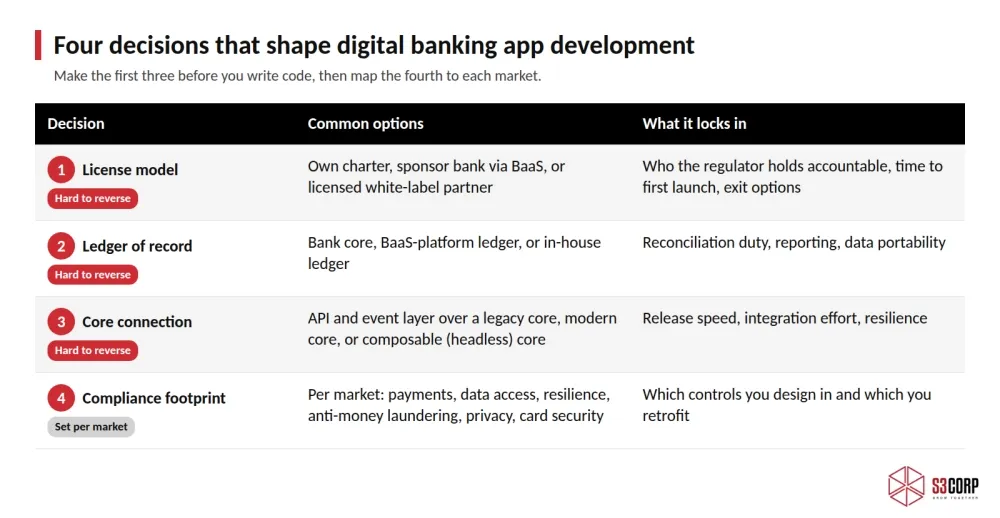
Four decisions shape the build, and the first three are hard to reverse. Table 1 lists the common options and what each one locks in.
| Decision | Common options | What it locks in |
|---|---|---|
| License model | Own charter, sponsor bank via BaaS, or licensed white-label partner | Who the regulator holds accountable, time to first launch, exit options |
| Ledger of record | Bank core, BaaS-platform ledger, or in-house ledger | Reconciliation duty, reporting, data portability |
| Core connection | An application programming interface (API) and event layer over a legacy core, a modern core, or a composable (“headless”) core | Release speed, integration effort, resilience |
| Compliance footprint | Per market: payments, data access, resilience, anti-money laundering, privacy, card security | Which controls you design in and which you retrofit |
This guide uses six terms with one fixed meaning each.
A core banking system (CBS) is the system of record for accounts, balances, posting rules and product logic. Banking-as-a-Service (BaaS) exposes the capabilities of a licensed bank through APIs, usually via middleware. A digital front end can then open accounts and issue cards without holding a charter.
Incumbents usually extend a core, while fintechs often partner with a sponsor bank for a license. Each path leaves different duties with you, as Tables 2 and 3 show.
| Model | License and ledger of record | Speed and control |
|---|---|---|
| Extend your current core | Your bank holds the license. The core holds the ledger of record. | Moderate speed. High control, limited by core change windows. |
| Sponsor bank plus BaaS middleware | The sponsor bank typically holds the license and may designate its core ledger as the authoritative record. Middleware may keep a customer-level sub-ledger. | Fastest first launch. Lower control over product and data. |
| Modern core under your own license | You hold the license and the ledger of record. | Slower first launch. Highest control. |
The sponsor bank row carries the biggest trade-off: you launch sooner, but you give up control over product and data. The modern core row carries the opposite trade-off. Table 3 shows what breaks first in each model.
| Model | Main failure mode | Best fit |
|---|---|---|
| Extend your current core | Slow change windows and a brittle integration layer slow every release. | Incumbent with a core in production |
| Sponsor bank plus BaaS middleware | Weak reconciliation access or a middleware failure freezes customer funds. | Fintech without a charter |
| Modern core under your own license | License delays and a heavy build load push launch back. | Funded team that holds or seeks a license |
The sponsor bank path adds regulatory oversight of your controls. In June 2023, the Federal Reserve, the Federal Deposit Insurance Corporation (FDIC) and the Office of the Comptroller of the Currency issued joint guidance.
It covers third-party risk, including bank relationships with fintechs. Read the interagency guidance on third-party relationships before you sign a program agreement.
Consider an illustrative case. A regional bank runs a core with weekly change windows. An API and event layer lets its mobile team ship every day without touching the core.
The bank can then retire core functions one at a time, which is the usual route in legacy system modernization. If you plan a neobank, the licensing angle matters most, and neobank app development covers it. Incumbents who build on their own core can scope the work through custom banking software development.
The authoritative ledger should be one that the sponsor bank can read directly and reconcile daily, down to each end customer. Middleware may run the sub-ledger. The bank, not the platform, should be able to prove who owns which dollar.
This is a recommended architecture control, not a rule that applies to every program. If you call it a duty in your own documents, cite the rule, guidance or contract clause that applies to your market and model.
The collapse of Synapse in 2024 shows the cost of skipping this control. Synapse was a middleware provider that linked fintech apps to partner banks. Customer funds sat in pooled custodial accounts at those banks, while Synapse kept the detailed records.
After Synapse filed for bankruptcy in April 2024, banks and fintechs could not agree on who owned which balance. The FDIC then issued a proposed recordkeeping rule for custodial deposit accounts.
Picture a fintech whose middleware shows one balance while the bank ledger shows another. Customers see the first number, and the bank cannot prove the second.
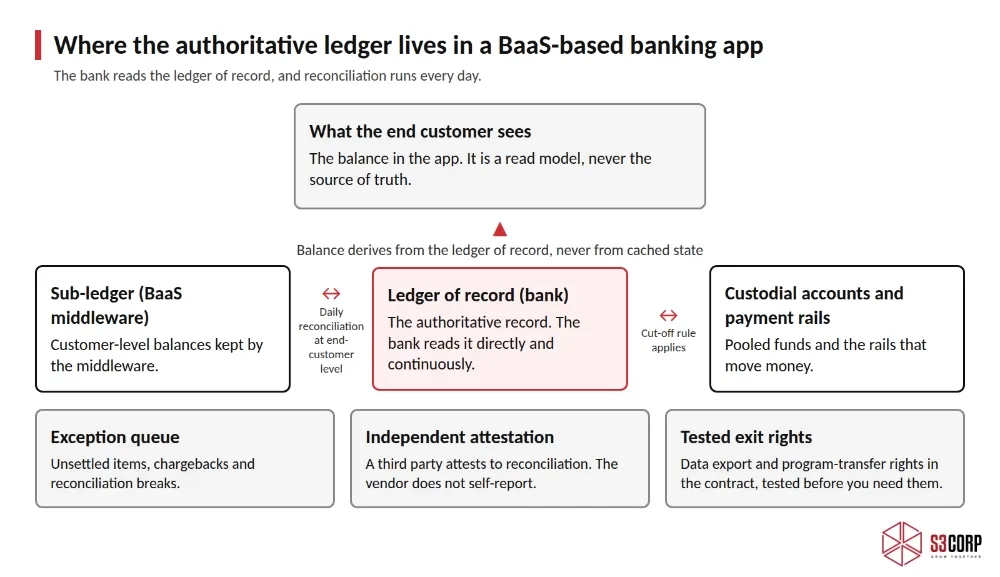
Put these six requirements in every architecture review and in every contract with a sponsor bank or BaaS vendor.
The same principle applies to incumbents, because the balance in the app must derive from core postings.
The FDIC proposal remains a proposal, and the FDIC has not finalized the rule as of November 2026. The Fall 2025 regulatory agenda lists the final custodial-account rule as a long-term action with no final date.
Partner banks already ask for end-customer reconciliation, so design for it now.
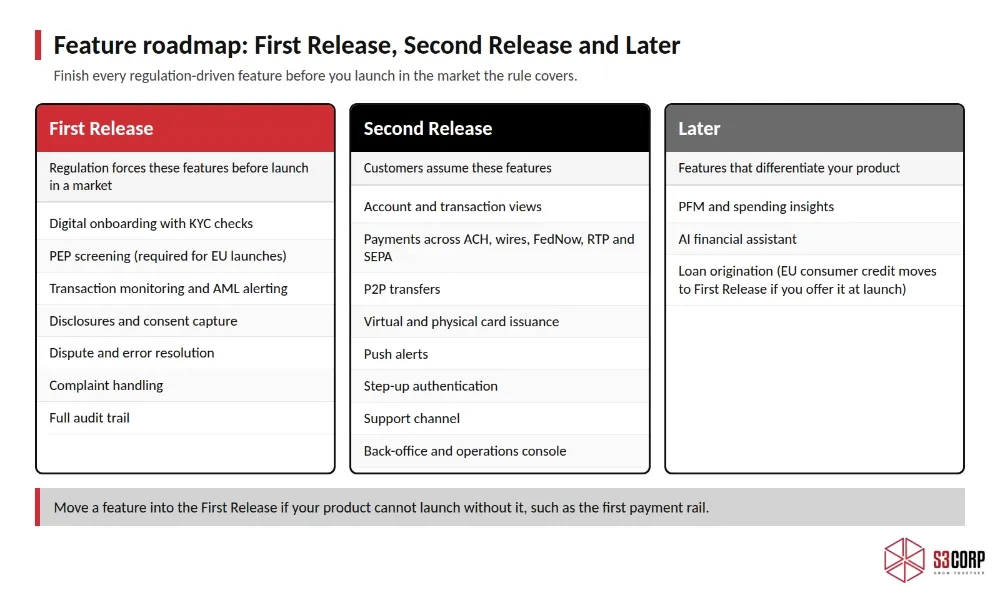
Plan launch features as three releases: First Release, Second Release and Later. Regulation forces the First Release, customers assume the Second Release, and differentiators come Later. Each feature carries a backend and compliance dependency.
Depending on your product, some customer-assumed features move into the First Release. Finish every regulation-driven feature before you launch in the market that the rule covers.
The bullets below name each feature, the backend it needs and the rule it touches.
Teams that design onboarding as a decision workflow often start from KYC and AML solutions for fintech.
Move a feature into the First Release if your product cannot launch without it, such as the first payment rail.
Teams routinely under-scope the console, because customers never see it. Compliance staff and support agents use it every day, so plan it as a product.
User experience (UX) patterns and mobile-specific features belong to the channel layer, and mobile banking app development covers them.
Match the pattern to the constraint you cannot change. If a legacy core binds you, put an API and event layer in front of it. If you run on BaaS, keep a thin domain layer and own the customer experience.
If you hold your own license, consider a composable core. Microservices are a means, not the pattern, and a modular monolith often fits a small team better.
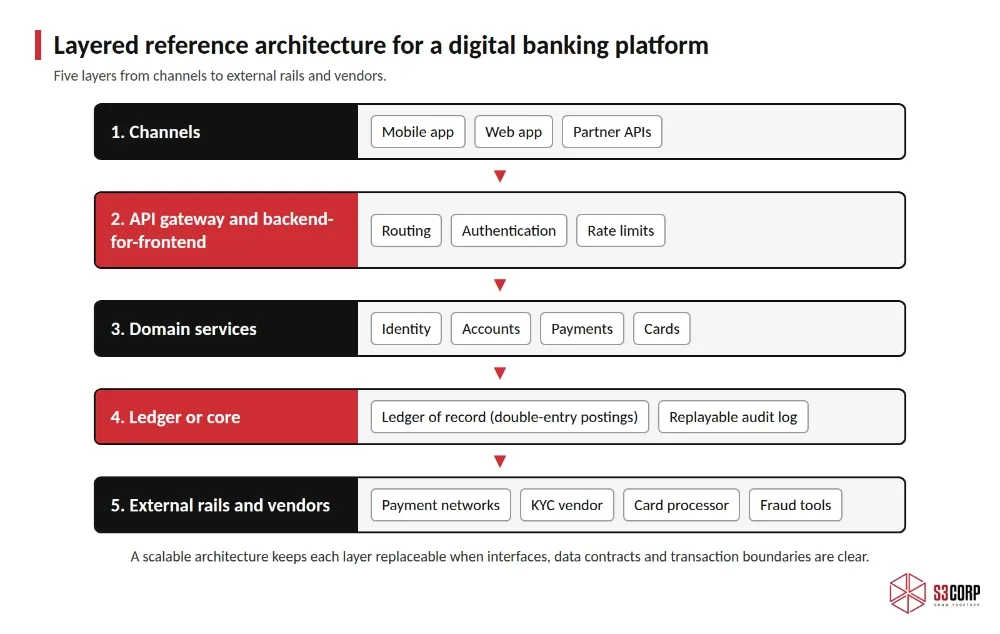
Read the layers from top to bottom.
A scalable architecture can keep each layer replaceable when interfaces, data contracts and transaction boundaries are clear. For example, you can swap a KYC vendor without touching the ledger.
| Pattern | Fits when | What breaks first, and what drives cost |
|---|---|---|
| API and event layer over a legacy core | You must keep the current core and release faster | Core change windows and brittle integrations break first. Cost drivers: core-vendor API access, change windows, test environments. |
| BaaS plus a thin domain layer | You lack a charter and want speed | Middleware outages and weak reconciliation access break first. Cost drivers: middleware licensing, test environments. |
| Composable or modern core with domain services | You hold or seek a license and want control | Data migration and integration effort break first. Cost drivers: data migration, test environments. |
These cost drivers are qualitative on purpose. For numbers, use the fintech app development cost guide.
If you replace a legacy core, use the strangler pattern. Route one capability at a time to new services, and retire the old path after each move.
Rail-level design adds more detail, and real-time payments architecture covers it.
Use standards-based, consent-driven interfaces. In the US, the Financial Data Exchange (FDX) standard is widely used. In the EU, interface specifications such as those from the Berlin Group apply.
The CFPB rule that would mandate US data sharing is enjoined, so treat FDX as market practice, not as a legal duty. Open banking architecture explains the design choices.
Swift and Kotlin, or Flutter and React Native, is a channel-layer choice. It is cheap to reverse compared with the ledger. The native vs hybrid vs cross-platform mobile app development comparison helps you decide.
Amazon Web Services (AWS) and Google Cloud both offer programs for financial services, and Docker and Kubernetes help you move workloads. Data still limits how easily you can leave a cloud.
In the EU, the Digital Operational Resilience Act (DORA) requires financial entities to manage information and communication technology (ICT) third-party risk. For ICT services that support critical or important functions, it also requires exit strategies.
The regulation has applied since 17 January 2025, as the official text of Regulation (EU) 2022/2554 shows. Document your cloud concentration risk, and test the exit path before an auditor asks.
Choosing between these patterns for a real core and license model? Talk to the S3Corp team about your constraints, and read banking software development for the build side.
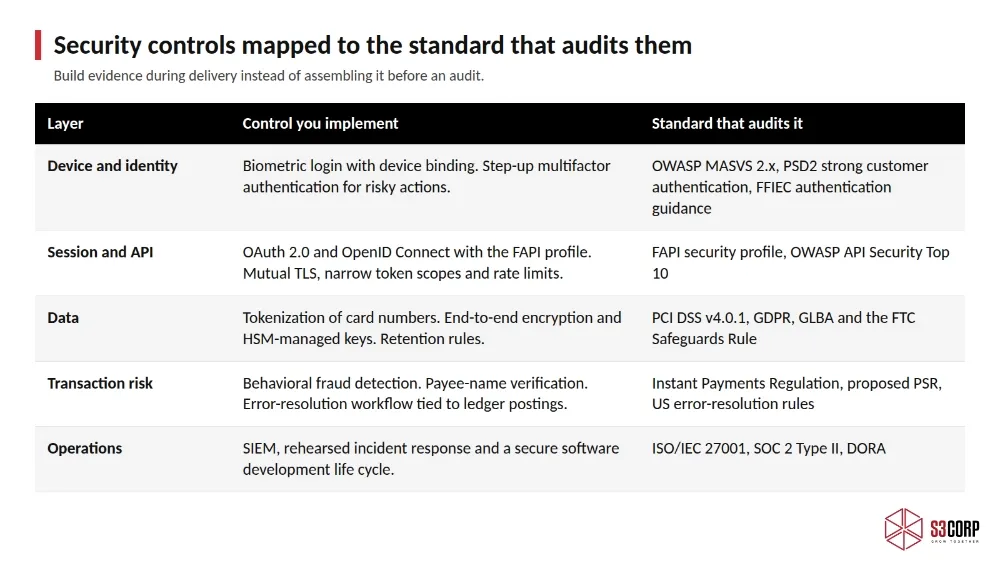
Security controls belong at each layer, not on top of the product. The layers are device and identity, session and API, data, transaction risk, and operations. Map each control to the audit standard that tests it, so you generate evidence during delivery instead of assembling it before an audit.
The PCI Security Standards Council confirms that the 51 future-dated PCI DSS version 4.x requirements became mandatory on 31 March 2025. Teams that need help with scope can start from PCI DSS compliance.
S3Corp has delivered data security work in other domains, such as client volume encryption and data loss prevention. These projects are not banking engagements.
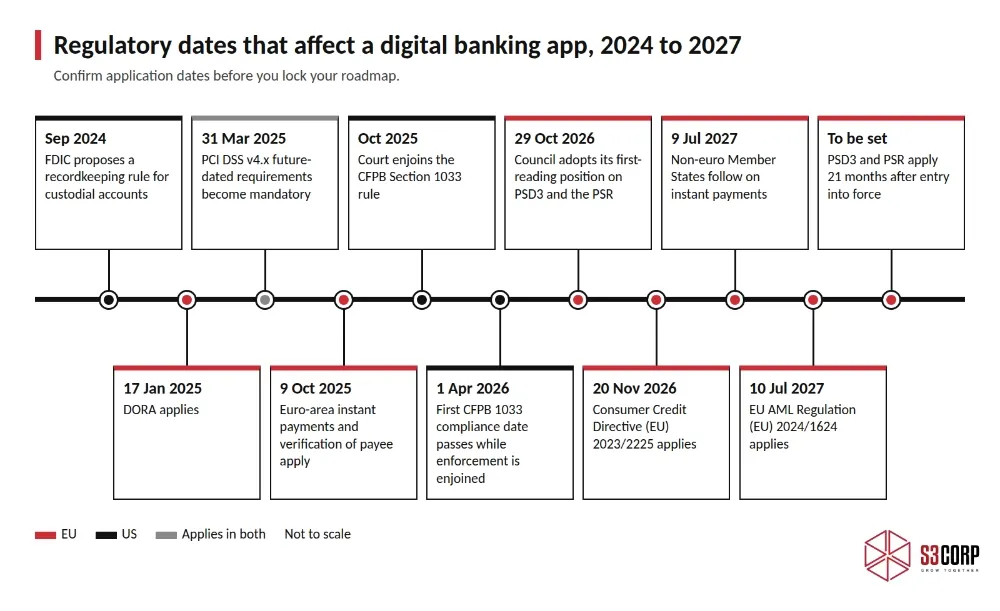
The rules that apply depend on where your customers and your license sit. The same six domains recur: payments conduct, data access, operational resilience, anti-money laundering and know-your-customer checks, privacy and card security.
Two domains moved in 2026. The EU moved closer to adopting PSD3 and the PSR, while the US open banking rule stays enjoined and under reconsideration.
The Council endorsed the PSD3 and PSR compromise texts in April 2026. On 29 October 2026, it adopted its first-reading position on both acts, as Regulation Tomorrow reports.
Only two steps remain: the European Parliament must approve the position at second reading, and the acts must appear in the Official Journal. Entry into force follows 20 days after publication, and a legal summary of the PSD3 and PSR timeline expects general application 21 months after that. No application date exists yet, and PSD2 remains the law until then.
In October 2025, a federal court enjoined the CFPB from enforcing its Dodd-Frank Section 1033 rule on personal financial data rights. The first compliance date, 1 April 2026, passed while the injunction blocked enforcement. The rule has not been withdrawn, and the CFPB is reconsidering it, according to Cozen O’Connor.
| Domain | US | EU |
|---|---|---|
| Payments conduct and authentication | Regulation E error-resolution rules and FFIEC authentication guidance | PSD2 today, with PSD3 and the PSR next |
| Instant payments | FedNow and RTP rail rules | SEPA Instant and the Instant Payments Regulation |
| Data access and open banking | CFPB Section 1033 rule (enjoined) and the FDX standard | PSD2 interfaces, then PSR interface rules |
| Operational resilience and third-party risk | 2023 interagency third-party guidance | DORA |
| Anti-money laundering and know your customer | BSA, CIP and OFAC rules | EU AML directive today, AML Regulation (EU) 2024/1624 from 10 July 2027 |
| Privacy | GLBA | GDPR |
| Card data security | PCI DSS version 4.0.1 | PCI DSS version 4.0.1 |
| Pooled-deposit recordkeeping (BaaS only) | FDIC custodial-account proposal | Safeguarding rules for client funds |
Table 5 shows which rule applies in each market, and Table 6 shows where each rule stands today. Check three rows first.
| Domain | Legal status on 5 November 2026 | Watch-point |
|---|---|---|
| Payments conduct | PSD2 is the law in force. The Council adopted its first-reading position on PSD3 and the PSR on 29 October 2026. Parliament approval and Official Journal publication remain. | No application date exists yet. Plan for proposed fraud-liability rules and for re-authorization of payment and e-money institutions. |
| Instant payments | Euro-area sending and payee verification apply since 9 October 2025. | Non-euro Member States follow on 9 July 2027. |
| Data access | The CFPB rule is enjoined and under reconsideration. | Build to FDX, confirm the latest court orders and rulemaking status, and track the reconsideration. |
| Resilience | DORA applies since 17 January 2025. | Keep the ICT register and the exit strategies for critical services current. |
| AML and KYC | Current EU and US duties apply. | Log every onboarding decision, and check the application date of each AML instrument for your entity type. |
| Privacy | GDPR and GLBA apply according to scope. | Map data flows for any AI assistant, and confirm whether your fintech is a GLBA financial institution. |
| Card security | All future-dated PCI DSS requirements are mandatory since 31 March 2025. | Confirm scope with your assessor. |
| Pooled deposits | Proposed in September 2024. The final rule has no date. | Design for end-customer reconciliation now. |
The EU AML Regulation, (EU) 2024/1624, applies from 10 July 2027, as this law-firm timeline of the EU AML package explains. Until then, the current AML directive stays in place.
Teams that serve other markets should add rows after local counsel reviews them. Candidates include the United Kingdom, Singapore and Australia.
For Singapore, check the technology risk guidelines of the Monetary Authority. For Australia, check standard CPS 234 and the Consumer Data Right.
Teams that automate evidence collection and reporting often use RegTech compliance automation for this work.
Sponsor banks, card networks and enterprise partners ask for third-party proof of your controls. Table 7 shows the three most common ones.
| Attestation | What it proves | Who typically asks |
|---|---|---|
| PCI DSS | Your card-data controls pass an assessment against the standard | Card networks, acquirers, processors and sponsor banks |
| SOC 2 Type II | Your controls operated effectively over a review period | Sponsor banks, US enterprise partners and auditors |
| ISO/IEC 27001 | An audited information security management system is in place | Regulated buyers and partners in the EU and Asia |
PCI DSS is a card data security standard. SOC 2 Type II is an audit report on controls over a period. ISO/IEC 27001 is a standard for an information security management system, and an auditor certifies it.
Treat launch as five evidence gates, not as a date. The gates cover regulatory approvals, ledger and money-movement testing, security validation, operational resilience and customer-risk operations. Each gate names an owner and the artifact that proves it, such as a reconciliation report, a penetration-test summary or a tested exit plan.
| Gate | Must be true | Evidence and owner |
|---|---|---|
| Regulatory approvals | License, sponsor-bank sign-off and program approvals are complete. | Approval letters. Owner: compliance lead. |
| Ledger and money-movement testing | Reconciliation ties out at end-customer level, and every rail passes testing. | Reconciliation report. Owner: finance operations lead. |
| Security validation | Penetration-test findings are closed, and key and access reviews are done. | Penetration-test summary. Owner: security lead. |
| Operational resilience | The recovery time objective (RTO) and recovery point objective (RPO) are tested, incident response is rehearsed, and the ICT register is current. | Disaster-recovery report and tested exit plan. Owner: engineering lead. |
| Customer-risk operations | Fraud rules, transaction limits and case queues are live, and staff are trained. | Runbooks and staffing plan. Owner: operations lead. |
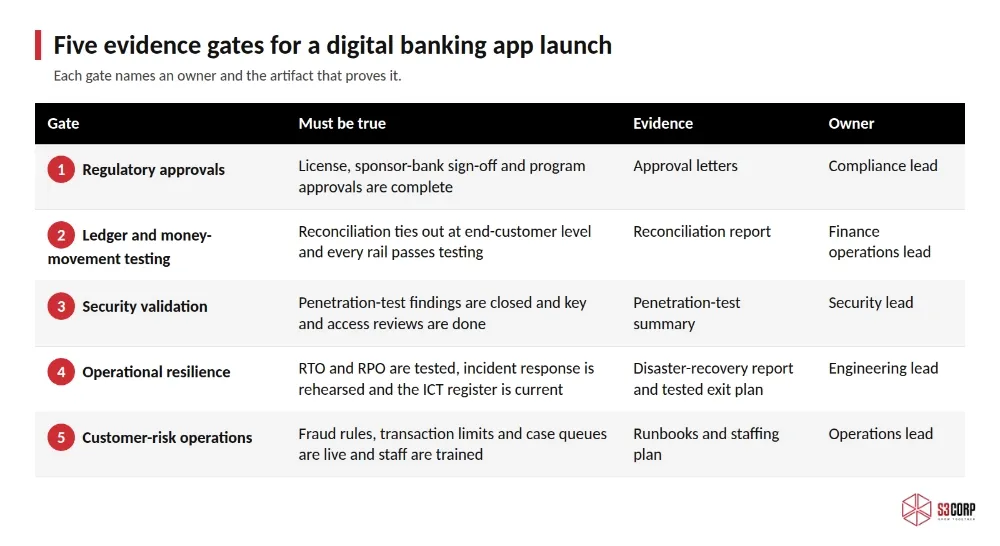
Add these six tests to your go-live readiness review.
Services by S3Corp cover quality assurance (QA) and testing, automation test tool development, DevOps and maintenance support. Launch gates and post-launch monitoring can then sit under one delivery team. Fintech testing and QA goes deeper on test design for this domain.
Four factors drive the timeline: the number of payment rails, the number of KYC vendors, the difficulty of the core integration, and sponsor-bank approvals. For numbers, use the fintech app development cost guide.
If EU customers are in scope, DORA expects tested exit strategies for ICT services that support critical or important functions. Check your contracts, the materiality of each service and the DORA duties that apply to your entity.
Digital banking app development is the work of building the app that customers use and the backend services behind it. Those services cover identity checks, accounts and ledger, payments, cards, fraud controls and back-office tools. The work also covers the core banking system or BaaS connection and the license, security and data rules of each market.
Digital banking is the full capability: accounts, ledger, payments, cards and servicing delivered through digital channels. A mobile banking app is one channel into that capability, while a neobank is a digital-only model built on it. All three share a stack but involve different decisions.
Not always, because many fintechs launch through a sponsor bank or licensed partner that holds the license and the deposits. The fintech owns the app and the customer relationship, but the partner’s regulators expect oversight of your controls. Contract terms, reconciliation access and exit rights therefore matter as much as features.
Yes, until its replacement applies. PSD2 stays in force while PSD3 and the PSR move through formal adoption, and the Council adopted its first-reading position on 29 October 2026. Confirm application dates before you lock your roadmap, and plan for changes to authentication, fraud liability, payee-name checks and open banking interfaces.
Use standards-based, consent-driven interfaces, and log every consent and data release. Apply OAuth 2.0 with a FAPI profile, mutual TLS between services, narrow token scopes and gateway rate limits. Follow PSD2 interface rules in the EU, then PSR rules later, and use FDX in the US while the CFPB rule stays enjoined.
Choose a stack by layer, because no single stack is best. The channel layer, such as Swift and Kotlin or Flutter and React Native, is the easiest to change. Give the backend and ledger the most care: favor mature, auditable languages and datastores, and design for idempotent, double-entry postings.
Treat onboarding as a decision workflow, not as a form. Run identity verification, document and liveness checks, sanctions and PEP screening, and risk scoring as separate services behind an orchestration layer, and log each decision. That lets compliance swap vendors, re-screen current customers and show a regulator why an applicant was approved or declined.
Decide the license model, ledger ownership and core connection first. Then map them to the rules of each market, sequence features across three releases, and release through evidence gates.
That order keeps the expensive decisions deliberate and the cheap ones, such as the front-end framework, flexible. It also supports optimizing cost and performance, because you avoid rework on the layers that are hardest to change.
A strategic approach matters most when you add innovative solutions such as instant payments or an AI assistant. Those features only work on top of a ledger that balances.
S3Corp has 19+ years of software delivery experience with global clients. On 28 May 2026, the Viet Nam Software and IT Services Association (VINASA) awarded S3Corp the Sao Khue Recognition of Excellence 2026. The award covers Software Outsourcing Services.
S3Corp also appears on the Vietnam Digital Tech Solutions Map 2026, as the S3Corp award announcement explains. The case studies show delivery work in other domains.
Ready to turn your decision map into a build plan?
See how S3Corp approaches banking and fintech software development. To discuss your own license model, ledger and core connection, contact the S3Corp team.